
Jonathan Wright (1)
Author of Heretics: The Creation of Christianity from the Gnostics to the Modern Church
For other authors named Jonathan Wright, see the disambiguation page.
Works by Jonathan Wright
Heretics: The Creation of Christianity from the Gnostics to the Modern Church (2011) 117 copies, 2 reviews
The Ambassadors: From Ancient Greece to Renaissance Europe, the Men Who Introduced the World to Itself (2006) 87 copies
I Gesuiti (1-4-2) 1 copy
Associated Works
Tagged
Common Knowledge
Members
Reviews
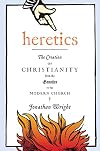
It is not easy to compress 2000 years of Christian heresy in a 300-page book. Jonathan Wright somehow manages to do so. His survey is a necessarily general but reasonably comprehensive one which takes in its stride the various brands of heresy, from the abstruse theological polemics of the Early Church to the groundbreaking spiritual movements which developed amongst the American pioneers - new spiritualities for a New World.
Wright, who describes himself as an agnostic, tries to keep an show more objective stance throughout the book. Whilst not squeamish in describing the punishments meted out to perceived heretics throughout the ages, he also consistently reminds us not to judge history through contemporary eyes. Contrary to popular belief, for instance, torture and executions were considered a "last resort" and were not particularly widespread. Nor were heretics necessarily the "liberal heroes" we tend to make them out to be. Indeed, a consistent theme throughout the book is that, given the opportunity (and the authority) heretics could be as tough on those *they* considered unorthodox.
Whether you enjoy this book or not will likely depend on your particular points of view. Conservative believers may well be irritated by Wright's chummy, Wodehousean humour applied to matters of faith. On the contrary, critics of the established religion might be put off by what they might consider an "apologetic" approach. As a non-academic reader with a general interest in history and theology and a practising Catholic with an open mind (or so I like to think), I found Wright's book very interesting if somewhat repetitive. It is certainly a fine, well-balanced introduction to a thorny subject. show less
Wright, who describes himself as an agnostic, tries to keep an show more objective stance throughout the book. Whilst not squeamish in describing the punishments meted out to perceived heretics throughout the ages, he also consistently reminds us not to judge history through contemporary eyes. Contrary to popular belief, for instance, torture and executions were considered a "last resort" and were not particularly widespread. Nor were heretics necessarily the "liberal heroes" we tend to make them out to be. Indeed, a consistent theme throughout the book is that, given the opportunity (and the authority) heretics could be as tough on those *they* considered unorthodox.
Whether you enjoy this book or not will likely depend on your particular points of view. Conservative believers may well be irritated by Wright's chummy, Wodehousean humour applied to matters of faith. On the contrary, critics of the established religion might be put off by what they might consider an "apologetic" approach. As a non-academic reader with a general interest in history and theology and a practising Catholic with an open mind (or so I like to think), I found Wright's book very interesting if somewhat repetitive. It is certainly a fine, well-balanced introduction to a thorny subject. show less
A history of heresy since the beginning of the Christian church. Not particularly detailed; the author picks a few prominent heresies and discusses them in some detail, leaving out others. His choices make sense; they are a good starting point for anyone wanting to study heresy. The writing is accessible and not larded down with jargon; ok, occasionally he does mention hermeneutics, but come on, you can look up one word, right? The biggest problem I had with this book was the author' s show more insistence on repeatedly telling us that we can't condemn these early people for their treatment of heretics, because after all, it was a different time than. The amount of moral relativism in this book is revolting. Are we to assume that no one in that time thought these behaviors were wrong? And was it really so true that, until the modern era, no one had considered the possibility that murdering people over what they believe might be a bit...excessive? I find this hard to believe, and even if I do believe it, that doesn't mean I have to regard it as all right because of the context of the time. This lost the book a star it might have gotten for subject matter and ease of reading. show less
You May Also Like


Associated Authors
Statistics
- Works
- 4
- Also by
- 1
- Members
- 210
- Popularity
- #105,677
- Rating
- 3.5
- Reviews
- 2
- ISBNs
- 44
- Languages
- 3