
Rosemarie Garland Thomson
Author of Freakery: Cultural Spectacles of the Extraordinary Body
About the Author
Rosemarie Garland Thomson is professor of English at Emory University, author of Staring: How We Look (2009), and editor of Freakery: Cultural Speciacles of the Extraordinary Body (1996).
Works by Rosemarie Garland Thomson
Extraordinary Bodies: Figuring Physical Disability in American Culture and Literature (1997) 118 copies, 1 review
About Us: Essays from the Disability Series of the New York Times (2019) — Editor & introduction — 91 copies, 1 review
Associated Works
The Body and Physical Difference: Discourses of Disability (The Body, In Theory: Histories of Cultural Materialism) (1997) — Contributor — 27 copies
Tagged
Common Knowledge
- Birthdate
- 1946-10-18
- Gender
- female
- Nationality
- USA
- Associated Place (for map)
- USA
Members
Reviews
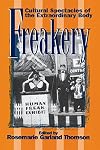
"Freakery" is a scholarly and cerebral -- and anything but dry -- series of essays on freaks shows and the culture, literature, and social attitudes that developed surrounding "freaks."
From P.T. Barnum's display of the "What Is It?" to Herman Melville's tattooed "Typee," and from Circus side-show theatrics to Michael Jackson's self-invention, the chapters of "Freakery" look at how society has exhibited, categorized, and conceptualized individuals that are "different from the rest of us." show more Fascinating, painful, repellent, illuminating, and well worth reading. show less
From P.T. Barnum's display of the "What Is It?" to Herman Melville's tattooed "Typee," and from Circus side-show theatrics to Michael Jackson's self-invention, the chapters of "Freakery" look at how society has exhibited, categorized, and conceptualized individuals that are "different from the rest of us." show more Fascinating, painful, repellent, illuminating, and well worth reading. show less
Extraordinary Bodies: Figuring Physical Disability in American Culture and Literature by Rosemarie Garland Thomson
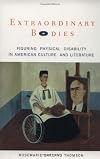
In Extraordinary Bodies: Figuring Physical Disability in American Culture and Literature, Rosemarie Garland Thomson works to “alter the terms and expand our understanding of the cultural construction of bodies and identity by reframing ‘disability’ as another culture-bound, physically justified difference to consider along with race, gender, class, ethnicity, and sexuality” (pg. 5). Her work therefore builds upon the ideas of Michel Foucault and demonstrates in practice the show more materiality about which Judith Butler hypothesized in Bodies That Matter. For a working definition of disability, Thomson writes, “Disability, then, is the attribution of corporeal deviance – not so much a property of bodies as a product of cultural rules about what bodies should be or do” (pg. 6). Thomson applies her analysis to three subjects: the freak show, romantic fiction of the nineteenth century, and the work of black women writers in the twentieth century.
Focusing on the freak show, Thomson writes, “The freak show is a spectacle, a cultural performance that gives primacy to visual apprehension in creating symbolic codes and institutionalizes the relationship between the spectacle and the spectators. In freak shows, the exhibited body became a text written in boldface to be deciphered according to the needs and desires of the onlookers” (pg. 60). The people on display reaffirmed “normal” by demonstrating its opposite. Thomson writes of Joice Heth, a performer in P.T. Barnum’s act, “She becomes a freak not by virtue of her body’s uniqueness, but rather by displaying the stigmata of social devaluation. Indeed, Joice Heth is the direct antithesis of the able-bodied, white, male figure upon which the developing notion of the American normate was predicated” (pg. 59). Similarly, romantic fiction demonstrated the intersectional nature of gender and disability. Thomson argues, “Benevolent maternalism not only restates the terms of liberal individualism, but also, by moving from sympathetic identification with the disabled figures to a distancing repudiation of them, ultimately dramatizes individualism’s most vexing internal contradictions” (pg. 82). Accordingly, “despite the desire to construct a rhetorical model of socially valued feminine selfhood, these novels could only modify the available, dominant script of the masculine liberal self, bending it toward the other-directedness and self-denial mandated by the female domestic role” (pg. 101). The novels confirmed the very beliefs they attempted to alter. Finally, Thomson writes, “If the cultural work of nineteenth-century benevolent maternalism is introducing the body into politicized literary discourse, that work is continued by several twentieth-century African-American women writers who also used disabled figures in strategies of empowerment that recast benevolent maternalism’s positive version of womanhood” (pg. 103). According to Thomson, the extraordinary bodies in the authors’ work “demand accommodation, resist assimilation, and challenge the dominant norms that would efface distinctions such as racial, gender, and sexual differences and the marks of experience” (pg. 130). These novels fully demonstrate the analytical model of Thomson’s work. Thomson concludes, “The rhetorical thrust of this book, then, is to critique the politics of appearance that governs our interpretation of physical difference, to suggest that disability requires accommodation rather than compensation, and to shift our conception of disability from pathology to identity” (pg. 137). In that respect, she more than succeeds. show less
Focusing on the freak show, Thomson writes, “The freak show is a spectacle, a cultural performance that gives primacy to visual apprehension in creating symbolic codes and institutionalizes the relationship between the spectacle and the spectators. In freak shows, the exhibited body became a text written in boldface to be deciphered according to the needs and desires of the onlookers” (pg. 60). The people on display reaffirmed “normal” by demonstrating its opposite. Thomson writes of Joice Heth, a performer in P.T. Barnum’s act, “She becomes a freak not by virtue of her body’s uniqueness, but rather by displaying the stigmata of social devaluation. Indeed, Joice Heth is the direct antithesis of the able-bodied, white, male figure upon which the developing notion of the American normate was predicated” (pg. 59). Similarly, romantic fiction demonstrated the intersectional nature of gender and disability. Thomson argues, “Benevolent maternalism not only restates the terms of liberal individualism, but also, by moving from sympathetic identification with the disabled figures to a distancing repudiation of them, ultimately dramatizes individualism’s most vexing internal contradictions” (pg. 82). Accordingly, “despite the desire to construct a rhetorical model of socially valued feminine selfhood, these novels could only modify the available, dominant script of the masculine liberal self, bending it toward the other-directedness and self-denial mandated by the female domestic role” (pg. 101). The novels confirmed the very beliefs they attempted to alter. Finally, Thomson writes, “If the cultural work of nineteenth-century benevolent maternalism is introducing the body into politicized literary discourse, that work is continued by several twentieth-century African-American women writers who also used disabled figures in strategies of empowerment that recast benevolent maternalism’s positive version of womanhood” (pg. 103). According to Thomson, the extraordinary bodies in the authors’ work “demand accommodation, resist assimilation, and challenge the dominant norms that would efface distinctions such as racial, gender, and sexual differences and the marks of experience” (pg. 130). These novels fully demonstrate the analytical model of Thomson’s work. Thomson concludes, “The rhetorical thrust of this book, then, is to critique the politics of appearance that governs our interpretation of physical difference, to suggest that disability requires accommodation rather than compensation, and to shift our conception of disability from pathology to identity” (pg. 137). In that respect, she more than succeeds. show less

This is a monograph by a disability theorist about vision. The subtitle made me think it was going to be about looking in a broad sense, but it's actually specifically about staring as the main title indicates. For Garland-Thomas, staring is distinct from the gaze, which she calls "an oppressive act of disciplinary looking that subordinates its victim" (9). By contrast, staring is a physiological response we can't control (13, 17), focused on seeking and attempting to subordinate novelty show more (18-19). While attention confers mastery on spectator, the starer is a befuddled spectator (21-2). Paying attention is good, staring is bad (23). She particularly highlights the concept of baroque staring, which is "unconcerned with rationality, mastery, or coherence" and "overrides reason" (49).
Having laid out what staring is, the book then examines how we attempt to regulate staring and what the relationship between starers and starees is. The second half of the book then highlights different things one might stare at: faces, hands, breasts, bodies. The book is an easy read, broken down into six parts and twelve chapters with lots of sections that chunk out topics and ideas very clearly.
The test of any theory, though, is in its explanatory power—and this is of course contextual. What I need explained is probably quite different from what someone else needs explained. For my own work on scientific vision, I found there was a lot of good material in the first half of the book, in how Garland-Thomason highlights the distinction between staring and the scientific/medical gaze, but also how she points out ways in which these often slip into one another. For example, the relationship between base curiosity and elite curiosity (48), which we might think of as gossip versus science. She distinguishes baroque staring from the scientific gaze (57-9), but I see a lot of connections between the issues raised by baroque staring and those raised by scientific vision. There are a lots of bits and bobs I can imagine working into my book, especially into my introduction where I try to lay out what scientific vision is, and I think it will also be useful for my discussion of dilettantism.
Less useful to me was the book's second half; there is some good stuff in the face chapter that I can use in my explorations of physiognomy and eugenics: "physiognomic thought universalized people by offering a generalizable taxonomy by which all could intuitively judge the value of our fellow human beings" and "reading human bodies as a means of evaluating them logically extended into using that evaluation to produce the kinds of bodies that the social order values" (99). But I did not get much out of the discussions of hands, breasts, and bodies. (Perhaps, as a heterosexual man, there is nothing about staring at women's breasts that I need to be told!) I don't think this is a failure of the book, just an indication of what it's doing is not what I am looking for. Like I said earlier, Garland-Thomson is a disability theorist, and I imagine these parts would be very useful for someone working in that field, that's just not me! show less
Having laid out what staring is, the book then examines how we attempt to regulate staring and what the relationship between starers and starees is. The second half of the book then highlights different things one might stare at: faces, hands, breasts, bodies. The book is an easy read, broken down into six parts and twelve chapters with lots of sections that chunk out topics and ideas very clearly.
The test of any theory, though, is in its explanatory power—and this is of course contextual. What I need explained is probably quite different from what someone else needs explained. For my own work on scientific vision, I found there was a lot of good material in the first half of the book, in how Garland-Thomason highlights the distinction between staring and the scientific/medical gaze, but also how she points out ways in which these often slip into one another. For example, the relationship between base curiosity and elite curiosity (48), which we might think of as gossip versus science. She distinguishes baroque staring from the scientific gaze (57-9), but I see a lot of connections between the issues raised by baroque staring and those raised by scientific vision. There are a lots of bits and bobs I can imagine working into my book, especially into my introduction where I try to lay out what scientific vision is, and I think it will also be useful for my discussion of dilettantism.
Less useful to me was the book's second half; there is some good stuff in the face chapter that I can use in my explorations of physiognomy and eugenics: "physiognomic thought universalized people by offering a generalizable taxonomy by which all could intuitively judge the value of our fellow human beings" and "reading human bodies as a means of evaluating them logically extended into using that evaluation to produce the kinds of bodies that the social order values" (99). But I did not get much out of the discussions of hands, breasts, and bodies. (Perhaps, as a heterosexual man, there is nothing about staring at women's breasts that I need to be told!) I don't think this is a failure of the book, just an indication of what it's doing is not what I am looking for. Like I said earlier, Garland-Thomson is a disability theorist, and I imagine these parts would be very useful for someone working in that field, that's just not me! show less
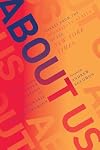
A wonderful always edifying, often moving, collection of articles originally published by the New York Times in its Disability Series. Each piece covers some aspect of being disabled. What does a morning look like for a person with paraplegia? After you have been hospitalized for severe mental illness, how does that change your worklife and the way you are perceived by colleagues? How do you sustain a marriage and parenting when your spouse becomes your caretaker after diagnosis of a show more progressive degenerative illness? What is it like to have an invisible disability that is easy for people to disregard or scoff at? When you have a genetic disability how does that impact your decision to procreate (and what does it say about your life if tests show that a child will have that disability and parents chose to terminate for that reason?) Why does everyone seem to think people with disabilities are (or should be) inspirational when they are just living their lives? Those issues and many more are covered here. I learned so much from the opportunity to listen to these honest eye-opening articles, and the writing is uniformly excellent. As with any collection some of these pieces work better than others, but it's the New York Times so you can bet on a certain standard of quality. Recommended to all. show less
Lists
You May Also Like


Associated Authors
Statistics
- Works
- 5
- Also by
- 2
- Members
- 379
- Popularity
- #63,708
- Rating
- 4.1
- Reviews
- 4
- ISBNs
- 23
- Languages
- 1
- Favorited
- 1