
Ved Mehta (1934–2021)
Author of Mahatma Gandhi and His Apostles
About the Author
Ved Parkash Mehta was an America writer and journalist. He was born in Lahore, India on March 21, 1934. He went blind at the age of three. At 15, he came to the United States to attend a school for the blind in Arkansas. He later attended Pomona College in Southern California, graduating in 1956. show more He earned a second bachelor's degree in modern history from Balliol College, Oxford. He received his master's degree from Harvard in 1961. He became a U. S. citizen in the 1975. He wrote numerous articles on life in 20th-century India. His first book was Face to Face (1957). But he was best-known work was a 12-volume memoir that also illuminated the history of India. They were collectively known as, Continents of Exile. The first volume was Daddyji (1972). The last book in the series, The Red Letters, was published in 2004. His other books included Walking the Indian Streets; The Fly and the Fly-Bottle: Encounters with British Intellectuals (1963); The New Theologian (1966); John is Easy to Please (1971); Delinquent Chacha (1967); and Remembering Mr. Shawn's New York: The Invisible Art of Editing (1998). He worked for more than thirty years at The New Yorker magazine. He was hired as a staff writer in 1961 and remained there until 1994. After leaving The New Yorker, he taught at Yale, Vassar, New York University, and elsewhere. He also continued to write. His work was critically acclaimed. He received a Guggenheim Fellowship in 1971 and 1977. In 1982, he received the MacArthur Foundation "genius grant." In 2009, he was elected a fellow of the Royal Society of Literature. He was given an honorary degree from Pomona College, Bard College, Williams College, The University of Stirling, and Bowdoin College. Ved Mehta died at his home in Manhattan on January 9, 2021 at the age of 86. (Bowker Author Biography) show less
Series
Works by Ved Mehta
Associated Works
For the Love of Books: 115 Celebrated Writers on the Books They Love Most (1999) — Contributor — 479 copies, 4 reviews
Tagged
Common Knowledge
- Canonical name
- Mehta, Ved
- Legal name
- Mehta, Ved Parkash
- Birthdate
- 1934-03-21
- Date of death
- 2021-01-09
- Gender
- male
- Education
- Dadar School for the Blind, Bombay
Arkansas School for the Blind, Little Rock, Arkansas
Pomona College (BA|1956)
Balliol College, University of Oxford (BA|1959)
Harvard University (MA|1961) - Occupations
- writer
- Organizations
- The New Yorker
- Awards and honors
- Royal Society of Literature (Fellow, 2009)
MacArthur Fellow (1982) - Cause of death
- Parkinson's disease
- Nationality
- India
USA (naturalized 1975) - Birthplace
- Lahore, British India [now Pakistan]
- Places of residence
- New York, New York, USA
- Place of death
- Manhattan, New York, USA
- Associated Place (for map)
- New York, USA
Members
Reviews
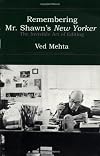
The taxi whizzed up Fifth Avenue, which was then a two-way. I was so exhausted that I could barely find my tongue, but after a while I said stupidly, "I hope someone will read the piece."
"I'll be happy if twelve people in the country read it," he said.
"You can't mean that," I said. "How could the magazine keep going if people didn't read it?"
"I want any piece to be read by its natural readers--people who will understand and enjoy it."
He went on to say that he edited the magazine as if we show more were the ideal readers, and assumed that if we liked a piece the readers would. It seemed such a utopian notion that I could scarcely believe he could hold it. But in subsequent years I learned that that was just one of a number of utopian ideas that he held and was somehow able to indulge while still turning out an extremely financially successful magazine.
Fantastic memoir by writer Ved Mehta of his relationship with William Shawn the editor of the New Yorker from 1952 to 1987. show less
"I'll be happy if twelve people in the country read it," he said.
"You can't mean that," I said. "How could the magazine keep going if people didn't read it?"
"I want any piece to be read by its natural readers--people who will understand and enjoy it."
He went on to say that he edited the magazine as if we show more were the ideal readers, and assumed that if we liked a piece the readers would. It seemed such a utopian notion that I could scarcely believe he could hold it. But in subsequent years I learned that that was just one of a number of utopian ideas that he held and was somehow able to indulge while still turning out an extremely financially successful magazine.
Fantastic memoir by writer Ved Mehta of his relationship with William Shawn the editor of the New Yorker from 1952 to 1987. show less

05 Jun 2009 - Hay-on-Wye Bookshop
Another volume of Mehta's memoirs and again one of the fuller ones. In this one we see him trying to get a place at College in America, having got through High School. His Dad tries to help him financially and emotionally, and we find out how Dr Mehta got involved with the elderly woman as whose companion doctor he travelled for years, as well as Ved's feelings about College life. One interesting facet is that he tries to act as if he isn't blind, even on show more occasion riding a bike and driving a car...! His feelings about and first experiences with women are explored, as well as his complex feelings about his nationality, blindness and intelligence. Very interestingly, we also find him writing his first book, "Face To Face", which explains why that one skips through a large amount of his history which is retold later in more detail.
Engaging, interesting and at times heart-rending. show less
Another volume of Mehta's memoirs and again one of the fuller ones. In this one we see him trying to get a place at College in America, having got through High School. His Dad tries to help him financially and emotionally, and we find out how Dr Mehta got involved with the elderly woman as whose companion doctor he travelled for years, as well as Ved's feelings about College life. One interesting facet is that he tries to act as if he isn't blind, even on show more occasion riding a bike and driving a car...! His feelings about and first experiences with women are explored, as well as his complex feelings about his nationality, blindness and intelligence. Very interestingly, we also find him writing his first book, "Face To Face", which explains why that one skips through a large amount of his history which is retold later in more detail.
Engaging, interesting and at times heart-rending. show less

05 Jun 2009 - Hay-on-Wye Bookshop (Bookends), Hay-on-Wye
This particular Bookends had a big section of second-hand books, and I stumbled across a rich seam of these volumes of Mehta's autobiography, enabling me to fill in nearly all the gaps. I also now understand that he did a couple of summary-type volumes, which explains the strange overlaps I've found.
This volume covers Ved's younger years, up to the time when he went to America in his teens to study at a blind school in Arkansas. show more Notably, it covers the years of Indian Partition, vividly and movingly without being inappropriately gruesome. He is honest about his feelings about Hindu behaviour during the time, and gives such a vivid picture of the time - I've read a lot of memoirs and novels about this period and this really takes a detailed approach to what it was actually like for a normal family, all the more exceptional as Ved went blind at the age of four. There's light relief too - he learns to ride a bicycle and forms friendships and allegiances among the families and servants. A great read - I love this series and am looking forward to the next few, although I fear I'll be compelled to read them all in strict order at some stage, since I have nearly all of them now! show less
This particular Bookends had a big section of second-hand books, and I stumbled across a rich seam of these volumes of Mehta's autobiography, enabling me to fill in nearly all the gaps. I also now understand that he did a couple of summary-type volumes, which explains the strange overlaps I've found.
This volume covers Ved's younger years, up to the time when he went to America in his teens to study at a blind school in Arkansas. show more Notably, it covers the years of Indian Partition, vividly and movingly without being inappropriately gruesome. He is honest about his feelings about Hindu behaviour during the time, and gives such a vivid picture of the time - I've read a lot of memoirs and novels about this period and this really takes a detailed approach to what it was actually like for a normal family, all the more exceptional as Ved went blind at the age of four. There's light relief too - he learns to ride a bicycle and forms friendships and allegiances among the families and servants. A great read - I love this series and am looking forward to the next few, although I fear I'll be compelled to read them all in strict order at some stage, since I have nearly all of them now! show less
05 Jun 2009 - Hay-on-Wye Bookshop, Hay-on-Wye
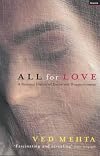
Part of the Continents of Exile series of autobiographical writings by Mehta, here we find an unflinching memoir of his disastrous love affairs with four women, in almost excruciating detail. It's not something you find often in a memoir, but the long series allows him the room for this. We also get a large section about his subsequent psychoanalysis - frustratingly, I have yet to fill in the gap between this and his eventual happy marriage and show more family life.
I think this was in many respects one for the completist - it was a touch harrowing at times and the women's letters were reproduced (presumably with permission) which made it a very intimate read. Interesting though, as we very rarely get into the nuts and bolts of someone else's relationship. show less
Part of the Continents of Exile series of autobiographical writings by Mehta, here we find an unflinching memoir of his disastrous love affairs with four women, in almost excruciating detail. It's not something you find often in a memoir, but the long series allows him the room for this. We also get a large section about his subsequent psychoanalysis - frustratingly, I have yet to fill in the gap between this and his eventual happy marriage and show more family life.
I think this was in many respects one for the completist - it was a touch harrowing at times and the women's letters were reproduced (presumably with permission) which made it a very intimate read. Interesting though, as we very rarely get into the nuts and bolts of someone else's relationship. show less
Awards


You May Also Like


Associated Authors
Statistics
- Works
- 35
- Also by
- 6
- Members
- 1,072
- Popularity
- #23,986
- Rating
- 3.7
- Reviews
- 12
- ISBNs
- 98
- Languages
- 5
- Favorited
- 6