
Charles P. Pierce
Author of Idiot America
About the Author
Works by Charles P. Pierce
Sports Guy: In Search of Corkball, Warroad Hockey, Hooters Golf, Tiger Woods, and the Big, Big Game (2000) 22 copies, 1 review
Associated Works
Wait Wait...Don't Tell Me! The Oddly Informative News Quiz (2002) — Contributor — 78 copies, 2 reviews
Tagged
Common Knowledge
- Birthdate
- 1953-12-28
- Gender
- male
- Education
- Marquette University
- Occupations
- author
journalist - Organizations
- Boston Herald
The National
Esquire
The Boston Globe - Awards and honors
- National Headliners Award (2004)
Sigma Delta Chi Award for Excellence in Journalism (2010) - Short biography
- Charles P. Pierce
He has been a writer-at-large for a men's fashion magazine, and his work has appeared in the New York Times Magazine, the LA Times Magazine, the Nation, the Atlantic, Sports Illustrated and The Chicago Tribune, among others. Although he is no longer a contributor to Eric Alterman’s Altercation, he remains a devoted reader. Pierce is a not infrequent contributor to the American Prospect and Slate. He appears weekly on National Public Radio's sports program Only A Game and on the Stephanie Miller Show and is a regular panelist on NPR's game show, Wait, Wait Don't Tell Me. Since July 1997 he has been a writer at large at Esquire, covering everything from John McCain to the Hubble telescope, with more than a few shooting stars thrown in between. In the fall of 2011 Pierce left the Boston Globe Sunday Magazine, where he had been since 2002, to become a staff writer for Grantland as well as the lead writer for esquire.com's politics blog.
Charles Pierce is the recipient of numerous professional awards and honors. On several occasions, he was named a finalist for the Associated Press Sports Editor's award for best column writing, and it has been suggested that if only he would wear a tie, they might have let him win. He was a 1996 National Magazine Award finalist for his piece on Alzheimer's disease "In the Country of My Disease," and has expanded the piece into a book Hard to Forget: An Alzheimer's Story for Random House. In 2004, he won a National Headliners Award for his Globe Magazine piece, "Deconstructing Ted", and in 2010 another of this Globe Magazine pieces, The Long, Strange, Twisting Case of Frances Carriere's Murder, won a Sigma Delta Chi Award for Excellence in Journalism. Depending on which year this is, Pierce has appeared in Best American Sportswriting more times than any other writer, or has tied with Roger Angell for most appearances in Best American Sportswriting, or is sulking in second place and plotting to regain the top spot soon, or is throwing himself into a stein of despair and refusing to talk about it ever again (the fact that David Halberstam didn't live to see just exactly how wrong he was about Pierce's Tiger Woods profile, "The Man. Amen." doesn't help very much, either. Mark 6:4). Nonetheless,Pierce's sportswriting has been anthologized in Sports Guy: In Search of Corkball, Warroad Hockey, Hooters Golf, Tiger Woods, and the Big, Big Game. Pierce is justly proud of the many awards and accolades he has received from the Media Research Center, and the reassurance they provide that he won't be running out of things to write about anytime soon (but what's with giving his dinner invite to Sam Donaldson?) He was awarded third place in the PBWAA Dan S. Blumenthal Memorial Writing Contest. When he won Phone Jeopardy, Alex Trebek sent him a plaque.
Charles Pierce lives in metro Boston with at least some of his three children all of the time, a malfunctioning Toro lawnmower, a somewhat more reliable snowblower, and his extremely long-suffering wife, who stockpiles shear pins like Mitt Romney stockpiles dried corn.
The above biographical notes are the product of the webmaster and not Mr. Pierce, who regularly evinces surprise that he even has a website.
http://www.charlespierce.net/aboutPag... - Nationality
- USA
- Places of residence
- Shrewsbury, Massachusetts, USA
- Associated Place (for map)
- Massachusetts, USA
Members
Reviews
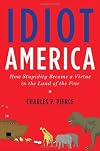
Loved this book, perhaps because it plays to all my prejudices, but trying to be objective, I think Pierce does hit upon trends in modern society that are very worrisome. He posits three basic maxims: (1) Any theory is valid if it sells books, soaks up ratings, or otherwise moves units; (2) Anything can be true if someone says it loudly enough; (3) Fact is that which enough people believe; truth is determined by how fervently they believe it. Try applying these maxims against any number of show more modern trends or events and see how accurately they apply.
Pierce is a journalist and he has been writing along these lines for some time, but the tipping point for him was a visit to the creationist “museum” (the mere concept boggles the mind), where he saw a dinosaur with a saddle on it, because if humans and dinosaurs co-existed, well we could assume that the former had domesticated the latter….this is ignorance on such a scale that it would require a backhoe to shovel it. Of course, that’s my opinion and isn’t anyone entitled to a contrary one? Well, no. Some questions can be legitimately debated, e.g. is there a God, is there life after death, are we here for some divine purpose or did we simply win the biological sweepstakes? But other questions, e.g. evolution, gravity, electromagnetism, quantum mechanics, relativity…all of these has been shown to be correct time and time again through rigorous scientific testing, and to deny them is not exercising some right to differ, it is demonstrating appalling ignorance. And, I’m sorry, but believing deeply does not overturn the scientific applecart. As Pierce puts it, the modern trend has come to this:
“If something feels right, it must be treated with the same respect given something that actually is right. If something is felt deeply, it must carry the same weight as something that is true. If there are two sides to every argument---or, more to the point, if there are people willing to take up two sides to every argument---they both must be right, or, at least, equally valid.” Um….no. This way lies madness, or at least considerable stupidity.
Pierce notes that “the founders wanted a nation of educated people: this, they believed, was essential to self-government,”, but he despairs with the directions he sees, for instance with talk radio: “….that was the driving force in changing American debate into American argument. It moved discussions southward from the brain to the Gut. Debate no longer consists of thesis and antithesis, moving forward to synthesis; it is now a matter of choosing up sides, finding someone on your team to sally forth, and the laying the wood to each other in between commercials for male-enhancement products.”
Pierce pulls no punches and refers to “three intermingled schools of idiocy” that have come to characterize modern society: political idiocy, “best represented on the AM radio dial and on those evening cable television news programs”, commercial idiocy as “the mechanism through which political idiocy (among other things) thrives”, and religious idiocy, “formidable on its own, also functions as a baptismal font for political and commercial idiocy. Gussy up your extremist politics, or your bunco museum in which dinosaurs wear saddles, with the Gospels, and you can paint anyone who suggests that your goods are ridiculous a member of the intelligent, educated segment of the population, come to discomfit the faith-based folks”.
Pierce will offend people who buy into these nostrums, who are taken in by the three maxims and who think this is right, this is the way things should be, but he has a serious argument and serious observations that deserve the sort of scrutiny and debate that is, alas, now all too infrequent.
The last word: “If the country took its obligations to self-government at all seriously, the presence of Sarah Palin on a national ticket would have been an insult on a par with the elevation of Caligula’s horse.”
Great stuff. show less
Pierce is a journalist and he has been writing along these lines for some time, but the tipping point for him was a visit to the creationist “museum” (the mere concept boggles the mind), where he saw a dinosaur with a saddle on it, because if humans and dinosaurs co-existed, well we could assume that the former had domesticated the latter….this is ignorance on such a scale that it would require a backhoe to shovel it. Of course, that’s my opinion and isn’t anyone entitled to a contrary one? Well, no. Some questions can be legitimately debated, e.g. is there a God, is there life after death, are we here for some divine purpose or did we simply win the biological sweepstakes? But other questions, e.g. evolution, gravity, electromagnetism, quantum mechanics, relativity…all of these has been shown to be correct time and time again through rigorous scientific testing, and to deny them is not exercising some right to differ, it is demonstrating appalling ignorance. And, I’m sorry, but believing deeply does not overturn the scientific applecart. As Pierce puts it, the modern trend has come to this:
“If something feels right, it must be treated with the same respect given something that actually is right. If something is felt deeply, it must carry the same weight as something that is true. If there are two sides to every argument---or, more to the point, if there are people willing to take up two sides to every argument---they both must be right, or, at least, equally valid.” Um….no. This way lies madness, or at least considerable stupidity.
Pierce notes that “the founders wanted a nation of educated people: this, they believed, was essential to self-government,”, but he despairs with the directions he sees, for instance with talk radio: “….that was the driving force in changing American debate into American argument. It moved discussions southward from the brain to the Gut. Debate no longer consists of thesis and antithesis, moving forward to synthesis; it is now a matter of choosing up sides, finding someone on your team to sally forth, and the laying the wood to each other in between commercials for male-enhancement products.”
Pierce pulls no punches and refers to “three intermingled schools of idiocy” that have come to characterize modern society: political idiocy, “best represented on the AM radio dial and on those evening cable television news programs”, commercial idiocy as “the mechanism through which political idiocy (among other things) thrives”, and religious idiocy, “formidable on its own, also functions as a baptismal font for political and commercial idiocy. Gussy up your extremist politics, or your bunco museum in which dinosaurs wear saddles, with the Gospels, and you can paint anyone who suggests that your goods are ridiculous a member of the intelligent, educated segment of the population, come to discomfit the faith-based folks”.
Pierce will offend people who buy into these nostrums, who are taken in by the three maxims and who think this is right, this is the way things should be, but he has a serious argument and serious observations that deserve the sort of scrutiny and debate that is, alas, now all too infrequent.
The last word: “If the country took its obligations to self-government at all seriously, the presence of Sarah Palin on a national ticket would have been an insult on a par with the elevation of Caligula’s horse.”
Great stuff. show less

Pierce is concerned with the growing contempt for knowledge in our culture, which he feels has wide relevance for our political, economic and social future. The material he covers will seem fairly self-evident to many i.e., the equating of religious belief with scientific theory, the growth in influence of talk radio hucksters as opposed to the informed experts, the mainstreaming of "crank" conspiracy theories. What makes this book refreshing is Pierce's wit and bravery. He makes the show more obvious, but frequently derided assertion, that not all assertions of fact or opinion are equally valid. Many people may vehemently believe something, but it may still be false. I have to give an example or two from the book. About the "Creation Museum" sponsored by Answers in Genesis: "It was impolite to wonder why our parents had sent us all to college, and why generations of immigrants had sweated and bled so that their children could be educated, if not so that one day we would feel confident enough to look at a museum full of dinosaurs rigged to run six furlongs at Aqueduct and make the not unreasonable assertion that it was batshit crazy, and that anyone who believed this righteous hooey should be kept away from sharp objects and their own money." Or this about the national "hangover" concerning our national level of thought. "Things are in the wrong place. Religion is in the box where science used to be. Politics in on the shelf where you thought you left science the previous afternoon. Entertainment seems to have been knocked over and spilled on everything." Gems like these kept me laughing and wincing. This book also made me more determined to speak out about abuses of language and sloppy or malicious abuses of logic in the public sphere. It's a refreshing, if sobering, book. People with a brain, you are not alone. show less
When acerbic opinion-monger Charles Pierce wrote this book in the years leading up to 2009, he considered titling it Blinking from the Ruins, but discarded that label since he thought it tacitly exonerated the Idiot Americans whom he indicts in the text. He does make allowances for the rest of us who have been "hijacked" into Idiot America, but he calls out the political and cultural leadership of the twenty-first century US for their war on expertise and rejection of rational categories. show more The book is a criticism of its moment and also a history and vernacular theory of American anti-intellectualism.
The history uses as a touchstone and point of contrast the character and ideals of "founding father" James Madison--who was "childless" according to the rubric set forth by today's vice-presidential aspirant J. D. Vance. Pierce's gallery of American cranks includes Atlantean para-geologist Ignatius Donnelly, anti-Masonic conspiracy theorists, UFO enthusiasts, and amateur investigators of the JFK assassination. He distinguishes the virtuous cranks as incubators of imagination from the vicious Idiot Americans who exploit ideas without regard for reality.
The theory of Idiot America is trained on the supremacy of the Gut which deprecates expertise, along with what Pierce calls the "Three Great Premises." These latter are, First: "Any theory is valid if it sells books, soaks up ratings, or otherwise moves units" (35); Second: "Anything can be true if someone says it loudly enough" (41); and Third: "respect for the effort required to develop and promulgate nonsense ... validates the nonsense itself" (47).
I particularly appreciated Pierce's excoriation of the term "faith-based" (133-5), and it is notable how much of Idiot America is driven by religion. The book is bracketed by visits to the Creation Museum of Ken Ham in Hebron, Kentucky, and a culminating point of the historical narrative is the 2005 Scopes redux case Kitzmiller v. Dover. The misogynistic worship of blastocysts was still simmering in 2009 (well before the worm-turning Burwell v. Hobby Lobby Stores, Inc.), but in this account it takes a back seat to bonkers Islamophobia and the durable creed of trickle-down economics.
In the section on "Consequences," Pierce discusses three fruits of Idiot America: the Terry Schiavo controversy, catastrophic climate change, and the US invasion of Iraq. Alas, the sort of idiocy he anatomizes here has only further entrenched itself in the institutions of government, and there was never any comeuppance for the malefactors in those incidents. And there has never been a conscious public correction for the torture porn propagandizing of the "War on Terra," let alone the torture itself that the propaganda helped to inspire and legitimate.
Pierce muses about "reality television" in order to discuss public epistemology in Idiot America, which comes off as borderline-prophetic with respect to the Idiot President chosen by the Electoral College in 2016, a failed real estate mogul who had most conspicuously found his niche in a game show that lionized him in the imaginary character of a business executive. The book shows how Idiot America has corrupted US civic life, and it is a good corrective for anyone who might imagine that this sort of cultural and political decay began with the ascendancy of Trumpism. At the same time, it seems to hold out a hope that the trend might have bottomed out and be susceptible to a reversal. Instead, the subsequent decade and a half has only shown its progression to the point that it imperils the inherited constitutional order and the lives of increasing numbers of citizens as well as the business of the day. show less
The history uses as a touchstone and point of contrast the character and ideals of "founding father" James Madison--who was "childless" according to the rubric set forth by today's vice-presidential aspirant J. D. Vance. Pierce's gallery of American cranks includes Atlantean para-geologist Ignatius Donnelly, anti-Masonic conspiracy theorists, UFO enthusiasts, and amateur investigators of the JFK assassination. He distinguishes the virtuous cranks as incubators of imagination from the vicious Idiot Americans who exploit ideas without regard for reality.
The theory of Idiot America is trained on the supremacy of the Gut which deprecates expertise, along with what Pierce calls the "Three Great Premises." These latter are, First: "Any theory is valid if it sells books, soaks up ratings, or otherwise moves units" (35); Second: "Anything can be true if someone says it loudly enough" (41); and Third: "respect for the effort required to develop and promulgate nonsense ... validates the nonsense itself" (47).
I particularly appreciated Pierce's excoriation of the term "faith-based" (133-5), and it is notable how much of Idiot America is driven by religion. The book is bracketed by visits to the Creation Museum of Ken Ham in Hebron, Kentucky, and a culminating point of the historical narrative is the 2005 Scopes redux case Kitzmiller v. Dover. The misogynistic worship of blastocysts was still simmering in 2009 (well before the worm-turning Burwell v. Hobby Lobby Stores, Inc.), but in this account it takes a back seat to bonkers Islamophobia and the durable creed of trickle-down economics.
In the section on "Consequences," Pierce discusses three fruits of Idiot America: the Terry Schiavo controversy, catastrophic climate change, and the US invasion of Iraq. Alas, the sort of idiocy he anatomizes here has only further entrenched itself in the institutions of government, and there was never any comeuppance for the malefactors in those incidents. And there has never been a conscious public correction for the torture porn propagandizing of the "War on Terra," let alone the torture itself that the propaganda helped to inspire and legitimate.
Pierce muses about "reality television" in order to discuss public epistemology in Idiot America, which comes off as borderline-prophetic with respect to the Idiot President chosen by the Electoral College in 2016, a failed real estate mogul who had most conspicuously found his niche in a game show that lionized him in the imaginary character of a business executive. The book shows how Idiot America has corrupted US civic life, and it is a good corrective for anyone who might imagine that this sort of cultural and political decay began with the ascendancy of Trumpism. At the same time, it seems to hold out a hope that the trend might have bottomed out and be susceptible to a reversal. Instead, the subsequent decade and a half has only shown its progression to the point that it imperils the inherited constitutional order and the lives of increasing numbers of citizens as well as the business of the day. show less
This was published in 2009, seven years before Idiocy reached a new high, to be followed be a mind-boggling four more years of steady climb. It's not done yet, I'm afraid, and I wonder what Mr. Pierce would have to say now (I'm sure I could find out, but I'm behind on other reading...)
Draped in James Madison anecdotes, observations, quotes and opinions, Madison is a hero to Pierce, who uses him and his writings as a foil. Pierce says, "Madison was never a superstar, not even among his show more contemporaries. His home never became a shrine, not the way Washington’s Mount Vernon did, or Jefferson’s Monticello.",
Pierce says in his Introduction
The First Great Premise: Any theory is valid if it sells books, soaks up ratings, or otherwise moves units.
The Second Great Premise: Anything can be true if someone says it loudly enough.
The Third Great Premise: Fact is that which enough people believe. Truth is determined by how fervently they believe it.
There it is, folks. The whole basis of FoxNews, Rush Limbaugh, Alex Jones, talk radio... Oh...and antisocial media. Shouting is harder there, but they do try hard to. Note: Pierce offers no solutions. To be fair, he couldn't. The anti-intellectual inertia and the momentum of their crank-loving propensity (witness the popularity of "reality" TV) are too much.
Some selected flagged observations:
A wrongwing writer named Jonah Goldberg wrote a book titled Liberal Fascism: The Secret History of the American Left from Mussolini to the Politics of Meaning and Pierce, pierces it with
Pierce spends more than a little time with one Ignatius Donnelly, an erudite crank in the 19th century who wrote a few books, one being Ragnarok, of which Pierce said, "Ragnarok is such almost perfect pseudoscience that Donnelly can be said to have helped invent the form. ... It so gleams with the author’s erudition that you don’t notice at first that none of it makes any sense." That's a big problem with cranks - they can baffle even real experts with their stupidity. And by baffle, I mean "where do we even start?" Donnelly had a way with words, saying this of a US Representative colleague (yes, he served there, too):
On Reagan's staff's traitorous selling of arms to Iran and the subsequent diversion of the proceeds (my embellishment):
On political parties, Pierce quotes his muse, Madison, who wrote to James Monroe,
On the ubiquitous, pervasive, wrongwing underbelly that is talk radio:
Hannity gets more than a little page time. On insisting long after they were debunked that Iraq had WMDs: "In any other job in the communications industry, such (and let us be kind) bungling would end a career. In his chosen field, it has made Hannity a multimedia force." Poor Alan Colmes, gets sympathy: "Colmes’s attempt to graft an intellectual conscience onto an industry based on profitable ignorance was exhausting. It was like watching someone try to explain that his hippo could conjugate verbs."
On religion (wrapped into a section on "faith-based" BS), Pierce says Madison knew "To invite religion into government is to invite discord and to establish the tyranny of the righteous." Further,
Global warming:
On the W Bush presidency
More soundbite quotables:
"Of course, if everyone is an expert, then nobody is." (Lots of YouTube financial and epidemiological experts now.)
"The founders wanted a nation of educated people: this, they believed, was essential to self-government." ... Oh well.
"Commercial idiocy is the mechanism through which political idiocy (among other things) thrives."
"Love of God and compassion and empathy leads you to a truly glorious place and science leads you to killing people.” Yes, Ben Stein, Ferris Bueller Idiot, said science leads you to killing people.
"In the months and years after September 11, the worst possible thing was to know what you were talking about."
We've lost. It's so much worse now than in 2009. I'll use this to close this review. Richard Hofstadter gets quoted a lot (but unfortunately, the sources aren't clear; I think this came from Anti-Intellectualism in American Life, which I'm going to read):
Embarrassing, that adjective in front of America. But unfortunately...accurate. show less
Draped in James Madison anecdotes, observations, quotes and opinions, Madison is a hero to Pierce, who uses him and his writings as a foil. Pierce says, "Madison was never a superstar, not even among his show more contemporaries. His home never became a shrine, not the way Washington’s Mount Vernon did, or Jefferson’s Monticello.",
But he felt something in his heart in this place. (And he did have a heart, the shy little fellow. He never would have won Dolley without it.) He studied and he thought, and he ground away at his books, but it wasn’t all intellect with him. Not all the time. He knew the Gut, as well. He knew it well enough to keep it where it belonged."Gut"? Pierce says, "Once you're on television, you become an expert, with or without expertise, because once you're on television, you are speaking to the Gut, and the Gut is a moron, as anyone who's ever tossed a golf club, punbched a wall, or kicked a lawnmower knows. The Gut is the roiling repository of dark and ancient fears. It knows what it knows because it knows how it feels." The Gut is what's behind "facts don't matter".
Pierce says in his Introduction
Idiot America is not the place where people say silly things. It is not the place where people believe in silly things. It is not the place where people go to profit from the fact that people believe in silly things. That America has been with us always—the America of the medicine wagon and the tent revival, the America of the juke joint and the gambling den, the America of lunatic possibility that in its own mad way kept the original revolutionary spirit alive while an establishment began to calcify atop the place.The book is about distrust, with derision ... experts and expertise. And it's worse than ever. When the lieutenant governor of Texas says Dr. Fauci, an incredibly educated, accomplished, knowledgeable epidemiologist "doesn't know what he's talking about."... yeah, it's worse. United States of America, where Pierce says, "This is a great country, in no small part because it is the best country ever devised in which to be a public crank." And how? It's part of our national DNA. "Let us be clear. This is still the best country ever in which to peddle complete public lunacy." So Pierce outlines the Three Great Premises of Idiot America:
[...]
The rise of Idiot America, though, is essentially a war on expertise.
The First Great Premise: Any theory is valid if it sells books, soaks up ratings, or otherwise moves units.
The Second Great Premise: Anything can be true if someone says it loudly enough.
The Third Great Premise: Fact is that which enough people believe. Truth is determined by how fervently they believe it.
There it is, folks. The whole basis of FoxNews, Rush Limbaugh, Alex Jones, talk radio... Oh...and antisocial media. Shouting is harder there, but they do try hard to. Note: Pierce offers no solutions. To be fair, he couldn't. The anti-intellectual inertia and the momentum of their crank-loving propensity (witness the popularity of "reality" TV) are too much.
Some selected flagged observations:
A wrongwing writer named Jonah Goldberg wrote a book titled Liberal Fascism: The Secret History of the American Left from Mussolini to the Politics of Meaning and Pierce, pierces it with
Apparently written with a paint roller, Goldberg’s book is a lugubrious slog through a history without reliable maps, a pre-Columbian wilderness of the mind where, occasionally, events have to have their hearts ripped out of all context and waved on high to the pagan god of the unblinking sun.Love it! And it happens that Goldberg's and my opinion (and Pierce's) align on one point: Goldberg targets Woodrow Wilson for his own deluded reasons,and Pierce labels Wilson "admittedly, a hopelessly overrated president".
The book is little more than a richly footnoted loogie hawked by Goldberg at every liberal who ever loosely called him a fascist. In that capacity, if not as history, it is completely successful.
Pierce spends more than a little time with one Ignatius Donnelly, an erudite crank in the 19th century who wrote a few books, one being Ragnarok, of which Pierce said, "Ragnarok is such almost perfect pseudoscience that Donnelly can be said to have helped invent the form. ... It so gleams with the author’s erudition that you don’t notice at first that none of it makes any sense." That's a big problem with cranks - they can baffle even real experts with their stupidity. And by baffle, I mean "where do we even start?" Donnelly had a way with words, saying this of a US Representative colleague (yes, he served there, too):
“If there be in our midst one low, sordid, vulgar soul … one tongue leprous with slander; one mouth which is like unto a den of foul beasts giving forth deadly odors; if there be one character which, while blotched and spotted all over, yet raves and rants and blackguards like a prostitute; if there be one bold, bad, empty, bellowing demagogue, it is the gentleman from Illinois.”History repeats! Donnelly could have said that today of a certain narcissist.
On Reagan's staff's traitorous selling of arms to Iran and the subsequent diversion of the proceeds (my embellishment):
In fact, Iran-Contra was a remarkable piece of extraconstitutional theater, far beyond anything the Watergate burglars could’ve dreamed up. Arming terrorist states? Using the money to fund a vicious war of dubious legality elsewhere in the world? Government officials flying off to Teheran with a Bible and a cake in the shape of a key? A president whose main defenses against the charge of complicity were neglect and incipient Alzheimer’s disease? Who could make this up? Iran-Contra was a great criminal saga, even up to the fact that it was first revealed not by the lions of the elite American press, but by a tiny newspaper in Beirut.And the people swallowed it all, hook, line, and sinker.
On political parties, Pierce quotes his muse, Madison, who wrote to James Monroe,
"there seems to be a propensity in free governments which will always find or make subjects on which human opinions and passions may be thrown into conflict. The most perhaps that can be counted on is that … party conflicts in such a country or government as ours will be either so light or so transient as not to threaten any permanent or dangerous consequences to the character or prosperity of the republic.”Oops. Pierce says he "calamitously misjudged his fellow Americans." Yep.
On the ubiquitous, pervasive, wrongwing underbelly that is talk radio:
According to a 2007 joint study by the Free Press and the Center for American Progress, on the 257 stations owned by the five largest owners of commercial stations, 91 percent of weekday talk programming is conservative. On an average weekday, the study found, 2,570 hours and 15 minutes of conservative talk is broadcast, but just 254 hours of what the study called “progressive” talk.I know I don’t listen to “progressive” talk - I'm the individualist sort, rather than the flock of sheep type that the "conservatives" attract. And Pierce says Washington University (St. Louis) Professor Andrew Cline studied talk radio and television argument shows: "Television is an emotional medium,” Cline explains. “It doesn’t do reason well. This is entertainment, not analysis or reasoned discourse. Never employ a tightly reasoned argument where a flaming sound bite will do." And Pierce says "You can learn a great deal about how to talk on the radio, but very little about anything you might be talking about." Yep, again.
Hannity gets more than a little page time. On insisting long after they were debunked that Iraq had WMDs: "In any other job in the communications industry, such (and let us be kind) bungling would end a career. In his chosen field, it has made Hannity a multimedia force." Poor Alan Colmes, gets sympathy: "Colmes’s attempt to graft an intellectual conscience onto an industry based on profitable ignorance was exhausting. It was like watching someone try to explain that his hippo could conjugate verbs."
On religion (wrapped into a section on "faith-based" BS), Pierce says Madison knew "To invite religion into government is to invite discord and to establish the tyranny of the righteous." Further,
Mr. Madison went out of his way to wave red flags, most vigorously in Federalist 10, in which he cautions that “the latent causes of faction are [thus] sown in every man, and we see them everywhere brought into different degrees of activity, according to the different circumstances of civil society. A zeal for different opinions concerning religion, concerning government, and many other points … have in turn divided mankind into parties, inflamed them with mutual animosity, and rendered them much more disposed to vex and oppress each other than to co-operate for the common good.”Note which factious entity he listed first. He did know his stuff.
Global warming:
The echoes of Clarence Little are quite clear when Chris Mooney describes how, in 2002, a Republican consultant named Frank Luntz sent out a memo describing how Luntz believed the crisis of global warming should be handled within a political context. “The most important principle in any discussion of global warming is sound science,” wrote Luntz. “The scientific debate is closing [against the skeptics] but not yet closed. There is still a window of opportunity to challenge the science.” In short, it doesn’t matter what the facts actually are, all that matters is how you can make people feel about them.
On the W Bush presidency
Expertise, always, was beside the point, and the consequence had been both hilarious and dire: a disordered nation that applied the rules of successful fiction to the reality around it, and that no longer could distinguish very well the truth of something from its popularity. This election, which was said to be one that could reorder the country in many important ways, did not begin promisingly.Oh, how expert by contrast that was to what came in 2017.
More soundbite quotables:
"Of course, if everyone is an expert, then nobody is." (Lots of YouTube financial and epidemiological experts now.)
"The founders wanted a nation of educated people: this, they believed, was essential to self-government." ... Oh well.
"Commercial idiocy is the mechanism through which political idiocy (among other things) thrives."
"Love of God and compassion and empathy leads you to a truly glorious place and science leads you to killing people.” Yes, Ben Stein, Ferris Bueller Idiot, said science leads you to killing people.
"In the months and years after September 11, the worst possible thing was to know what you were talking about."
We've lost. It's so much worse now than in 2009. I'll use this to close this review. Richard Hofstadter gets quoted a lot (but unfortunately, the sources aren't clear; I think this came from Anti-Intellectualism in American Life, which I'm going to read):
The case against intellect is founded on a set of fictional and wholly abstract antagonisms. Intellect is pitted against feeling, on the ground that it is somehow inconsistent with warm emotion.
It is pitted against character, because it is widely believed that intellect stands for mere cleverness, which transmutes easily into the sly and diabolical. It is pitted against practicality, since theory is held to be opposed to practice. It is pitted against democracy, since intellect is felt to be a form of distinction that defies egalitarianism…. Once the validity of these antagonisms is accepted, then the case for intellect … is lost.
Embarrassing, that adjective in front of America. But unfortunately...accurate. show less
Lists
You May Also Like


Associated Authors
Statistics
- Works
- 6
- Also by
- 4
- Members
- 1,038
- Popularity
- #24,806
- Rating
- 3.7
- Reviews
- 38
- ISBNs
- 21


