
Aldous Huxley (1894–1963)
Author of Brave New World
About the Author
Aldous Huxley was born on July 26, 1894, in Surrey, England, into a distinguished scientific and literary family; his grandfather was the noted scientist and writer, T.H. Huxley. Following an eye illness at age 16 that resulted in near-blindness, Huxley abandoned hope of a career in medicine and show more turned instead to literature, attending Oxford University and graduating with honors. While at Oxford, he published two volumes of poetry. Crome Yellow, his first novel, was published in 1927 followed by Antic Hay, Those Barren Leaves, and Point Counter Point. His most famous novel, Brave New World, published in 1932, is a science fiction classic about a futuristic society controlled by technology. In all, Huxley produced 47 works during his long career, In 1947, Huxley moved with his family to southern California. During the 1950s, he experimented with mescaline and LSD. Doors of Perception and Heaven and Hell, both works of nonfiction, were based on his experiences while taking mescaline under supervision. In 1959, Aldous Huxley received the Award of Merit for the Novel from the American Academy of Arts and Letters. He died on November 22, 1963. (Bowker Author Biography) show less
Image credit: Aldous Huxley, on 1927
Series
Works by Aldous Huxley
Ends and Means: An Inquiry into the Nature of Ideals and into the Methods Employed for Their Realization (1937) 209 copies, 2 reviews
Fahrenheit 451,Brave New World and 1984 Nineteen Eighty-Four 3 Books Bundle Collection (2016) 55 copies
The Cicadas and Other Poems 9 copies
Essays 8 copies
A Teacher's Guide to Brave New World: Common-Core Aligned Teacher Materials and a Sample Chapter (2014) 5 copies
Das Lächeln der Gioconda. Der kleine Archimedes. Zwei Novellen. Übertr. v. Herbert E. Herlitschka. (1979) 5 copies
Och sen levde de lyckliga ... 4 copies
Obras completas 4 copies
О дивный новый мир 4 copies
The Complete Works of Aldous Huxley 3 copies
Fard (Modern English Short Stories) 3 copies
Un mundo feliz. Las puertas de la percepción. Cielo e infierno (Spanish Edition) (2010) — Author — 3 copies
Novelas II 2 copies
Short Science Fiction Collection 059 2 copies
Ronda grotesca 2 copies
Due o tre grazie e tutti i racconti 2 copies
Esas hojas estériles 2 copies
MË E MIRA E BOTËVE 2 copies
Holy Face, and other essays 2 copies
Thế giới mới tươi đẹp 2 copies
Selections from Brave New World 2 copies
Klett Lektürehilfen Brave New World: für Oberstufe und Abitur - Interpretationshilfe für die Schule (2007) 2 copies
The Claxtons 2 copies
The Devils 1 copy
El Petit Arquímedes 1 copy
Contrapunto II 1 copy
Deux ou trois grâces 1 copy
Harper's modern classics 1 copy
Loudun Seytanlari 1 copy
Maimuţă şi esenţă 1 copy
The French of Paris 1 copy
Louise de la Valliere 1 copy
A vak Sm̀son 1 copy
Domenico Gnoli 1 copy
Uncle Spencer 1 copy
A Day in Windsor 1 copy
Frederick Catherwood Archt — Introduction — 1 copy
The Dwarfs 1 copy
Literatura y ciencia 1 copy
The Encyclopedia of Pacifism — Editor — 1 copy
Variaciones de un alma 1 copy
Huxley on Travel 1 copy
Essays of Aldous Huxley 1 copy
Unser Glaube 1 copy
Aldous Huxley Cartas 1 copy
Frunze Uscate 1 copy
Poslije mnogih ljeta 1 copy
Aldous Huxley zum Gedächtnis 1 copy
New preface to an old book 1 copy
Half-Holiday 1 copy
Verhalen 1 copy
Pripovjetke 1 copy
el camino al infierno 1 copy
Fairy Godmother 1 copy
Dans grotesc 1 copy
Hubert and Minnie [short story] — Author — 1 copy
The Portrait [short story] 1 copy
Raněný slepotou 1 copy
Po řadě let... : román 1 copy
Obra Selecta 1 copy
Si restul e tacere 1 copy
L'Arte di vivere 1 copy
Aldous Huxley - Il sorriso della Gioconda | August W. Derleth - La signora Lannisfree | - Lettera noiosa — Author — 1 copy
Markmid og Leidir 1 copy
Uncollected Stories 1 copy
Associated Works
75 Short Masterpieces: Stories from the World's Literature (1961) — Contributor — 316 copies, 2 reviews
The Gospel of Sri Ramakrishna: Abridged Edition (1942) — Foreword, some editions — 307 copies, 5 reviews
Zen and the Psychology of Transformation: The Supreme Doctrine (1951) — Foreword, some editions — 203 copies, 6 reviews
The Moral Life: An Introductory Reader in Ethics and Literature (1999) — Contributor — 202 copies, 2 reviews
The Graphic Canon, Vol. 3: From Heart of Darkness to Hemingway to Infinite Jest (2013) — Contributor — 162 copies, 1 review
The Awakening of Faith: The Classic Exposition of Mahayana Buddhism (1998) — Foreword, some editions — 78 copies, 1 review
Gentlemen, Scholars and Scoundrels: A Treasury of the Best of Harper's Magazine from 1850 to the Present (1972) — Contributor — 62 copies
Parabola: Myth and the Quest for Meaning, Vol. 7, No. 3: Ceremonies (1982) — Contributor — 14 copies
Oogst Der Tijden. keur uit de werken van schrijvers en dichters aller volken en eeuwen (1940) — Contributor — 12 copies
Tableau des mœurs dans les différents âges de la vie (1750) — Introduction, some editions — 12 copies, 1 review
These Simple Things: Some Appreciations of the Small Joys in Daily Life (1965) — Contributor — 7 copies
Sylvia Plath's Tomato Soup Cake: A Compendium of Classic Authors' Favourite Recipes (2024) — Contributor — 6 copies
The Best from Cosmopolitan — Contributor — 4 copies
Die englische Literatur 09 in Text und Darstellung. 20. Jahrhundert. (2001) — Contributor — 3 copies
Georgian Stories 1924 — Contributor — 2 copies
Selections from Huxley: Embracing the Autobiography; on the Advisableness of Improving Natural Knowledge; a Liberal Educ (1911) 2 copies
American Aphrodite: A Quarterly for the Fancy-Free (Volume 3, Number 9) (2013) — Contributor — 2 copies
Meesters der vertelkunst : zevenendertig verhalen uit de moderne wereldliteratuur (1975) — Contributor — 2 copies
Dystopia Boxed Set: 18 Dystopian Classics in One Edition — Contributor — 1 copy
7 Novel Dystopian Collection — Contributor — 1 copy
Antologia do conto moderno — Author — 1 copy
Tagged
Common Knowledge
- Legal name
- Huxley, Aldous Leonard
- Birthdate
- 1894-07-26
- Date of death
- 1963-11-22
- Gender
- male
- Education
- Eton College
Balliol College, Oxford (BA|1916) - Occupations
- novelist
journalist
critic
screenwriter
civil servant
editor (show all 7)
poet - Awards and honors
- Royal Society of Literature (Companion of Literature, 1962)
American Academy of Arts and Letters (Foreign Honorary ∙ Literature ∙ 1960)
American Academy of Arts and Letters Award of Merit (1959) - Relationships
- Huxley, Leonard (father)
Huxley, Matthew (son)
Huxley, Julian (brother)
Huxley, Laura Archera (wife)
Huxley, Thomas Henry (grandfather)
Ward, Mary Augusta (aunt) (show all 11)
Arnold, Matthew (great-uncle)
Ward, Thomas Humphry (uncle)
Arnold, Thomas (great-grandfather)
Huxley, Anthony (nephew)
Huxley, Francis (nephew) - Cause of death
- laryngeal cancer
- Nationality
- UK
- Birthplace
- Godalming, Surrey, England, UK
- Places of residence
- Hollywood, California, USA
Taos, New Mexico, USA
Llano, California, USA
Italy
Sanary-sur-Mer, France - Place of death
- Los Angeles, California, USA
- Burial location
- Watts Memorial Chapel Cemetery, Compton, Guildford, Surrey, England, UK
- Map Location
- England, UK
Members
Discussions
Folio Archives 381: Brave New World by Aldous Huxley 2013 in Folio Society Devotees (June 2024)
March 2013: Aldous Huxley in Monthly Author Reads (March 2013)
Fiction 'midget' parents of growing boy in Name that Book (March 2013)
Reviews

Huxley's first novel is a pleasant little confection. "Chrome yellow" is, of course, an artist's pigment, and the book's fictional country manor Crome features visits from artists. The "yellow" qualifier alludes to aestheticism and decadence (cf. The Yellow Book and the "Yellow Nineties"). This aspect of the title may have contributed as much to the book's alleged notoriety as any of its contents did. The plot eventuates in little of anything, while the short chapters serve as amusing show more exercises in drawing characters and playing with ideas.
Crome Yellow satirizes the Bloomsbury-set scene at Garsington Manor, framed by the visit of the callow poet Denis Stone. He is preoccupied with mooning over young Anne Wimbush, who is slightly his senior. The high point of Stone's deployment is his disquisition on the magic power of words and literature (106-107). I wonder if this character might be a critical self-portrait of the book's author.
New Thought and Theosophical notions are in the air of Crome, entertained especially by Anne's mother Priscilla Wimbush, the lady of the house. Some of the most engaging passages are monologues from Mr. Scogan, an old school friend of Henry Wimbush. Scogan provides a sardonic counterweight to the naive Stone, and some of his prophecies about a rationally-organized future society (22, 114-116) anticipate the content and themes of Huxley's Brave New World. show less
Crome Yellow satirizes the Bloomsbury-set scene at Garsington Manor, framed by the visit of the callow poet Denis Stone. He is preoccupied with mooning over young Anne Wimbush, who is slightly his senior. The high point of Stone's deployment is his disquisition on the magic power of words and literature (106-107). I wonder if this character might be a critical self-portrait of the book's author.
New Thought and Theosophical notions are in the air of Crome, entertained especially by Anne's mother Priscilla Wimbush, the lady of the house. Some of the most engaging passages are monologues from Mr. Scogan, an old school friend of Henry Wimbush. Scogan provides a sardonic counterweight to the naive Stone, and some of his prophecies about a rationally-organized future society (22, 114-116) anticipate the content and themes of Huxley's Brave New World. show less
The Doors of Perception & Heaven and Hell: Two Complete Nonfiction Works (Perennial Classics) by Aldous Huxley
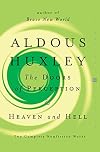
Although much-lauded, especially by those looking for a literary advocate for the re-integration of altered states of consciousness into our society and culture (a cause I tend to support on principle), this book has not stood the test of time very well.
This edition contains, in fact, two works – ‘The Doors of Perception’, an account of Huxley’s experience taking mescalin and ‘Heaven and Hell’, a somewhat rambling view of art from a somewhat self-appointed cultural Pontifex show more Maximus.
‘Heaven and Hell’ betrays itself as something to be expected from a famous European belles-lettrist with a bee in his bonnet, most of which is opinionated nonsense.
It is, nevertheless worth ploughing through (it is only forty pages) in order to reach and appreciate a curious set of ‘appendices’ on a variety of subjects that are genuinely informative and stimulating – albeit not really consciousness-changing.
‘The Doors of Perception’ itself is only fifty pages long and it stands as an excellent and well written account of how an elite member of the British literary class responded to an experience otherwise undertaken by Amerindian shamans and peasants and academics.
From that point of view, it is well worth reading although the responses are so embedded in the habits of Huxley’s class and expectations as to offer little insight other than that:-
- a) the experience is enormously interesting and
- b) there is cause to question the fear of it amongst our authoritarian bureaucrats (albeit with the caveat of caution as to its effects on the truly vulnerable).
Where the account breaks down is in the lack of detachment. This is a man desperate to believe in something and it shows.
The account in both texts is by a patrician who has already decided how he wishes to understand the plebeian and who is subliminally looking for a magical means of reasserting his cultural authority in a mosern age with which he self-evidently has little sympathy.
His snobbery about the modern world and about ordinary folk is palpable. But let us step back because there are insights in the text even if the account demonstrates little of the validity of Huxley’s subsequent philosophical and spiritual claims about his experience.
He also does rather go on a bit about art. Art is a 'thing' with the European intelligentsia but his comments, though interesting, do rather seem to appear like a set of non sequitors.
If he wants to imply that European artists were as high as kites when they produced their great works, then the implication is daft.
He experiences mescalin and then relates it to art but in a way that tells us a great deal about him (perhaps a taste for the magpie gaudy) but very little about art.
He also tends to try and suggest that all meaningful experiences are ‘as one’. This is pure ideology, perhaps a forced assumption resulting from his naive ‘perennialism’.
He asserts but does not demonstrate his points and thus by scattering his shot, he fails to make well the better single valid point that the common experience of taking drugs that alter mental states taps into very similar mental effects in all persons.
He and others take this as meaning that there is some greater reality ‘out there’ but this is not logically necessary. It could (and probably does) equally mean that chemical processes trigger very similar perceptual and ordering processes and imageries in all or most persons.
There is also a determined self-centredness in the account (which is reasonable enough as an account of the experience of taking mescalin) but not of its wider implications.
There is a curious passage on dreaming in colour where you get the sense (I may be being unfair) that he rather resents not dreaming in colour (I do dream in colour and got bullied by a teacher for stating that fact once) and so must diminish it as having meaning.
In this and in his comments on visualisation, you get the sense of his feeling disadvantaged, as if he was disabled, by being an intellectual. But Huxley is an intellectual even if he perhaps wants to be other than intellectual.
Mescalin enables him to leap across to the category of spiritual on one bound. He wants to be a Platonist at a level that is more than intellectual – not merely to accept the existence of a world of forms as rational argument but to perceive them as ‘real’.
Of course, the Platonic always was absurd except as belief but over two thousand years of Western cultural history have been in deep denial about this. Squaring Platonic reason and Platonic faith has been no less a task than squaring Christian revelation and reason itself.
What Huxley, in his experience of mescalin, gets absolutely right is that the majority of the population, in their need to survive through maintaining social bonds, live in a constructed world of perception that is not necessarily ‘real’.
Unfortunately, he assumes that the break-down of our tightly controlled perception of reality, that is required in order to survive in nature let alone in society, can, under the influence of drugs, result in access to a ‘true’ reality.
The greater likelihood is that all we are seeing is the collapse of the controlling socialised and historically constructed reality in favour of contemplative stasis, not Reality but a new version of a reality because Reality is simply not available to us simply because of how we have evolved.
The unreality of everyday reality does not require drugs or altered states of consciousness to expose it as such.
Existentialist reasoning will take you to the same conclusion without needing you to adopt the illusion of seeing the universe in a grain of sand, lovely though such an experience might be.
What Huxley is experiencing is as illusory as socialised or constructed habitual reality but he is grasping at it as ‘true reality’ (like so many before him) because he cannot live without meaning. Indeed, his elite status and education requires that the world have meaning.
In this Huxley is in the same state of torment as his grandfather Thomas Huxley, ‘Darwin’s Bulldog’, in observing a world where the traditional Judaeo-Christian God has no credible role.
Once you start questioning social and personal-historical reality, it is hard to stop and you are left with only three alternatives.
You can accept the social and one’s own history pragmatically and make the best of it (or become grumpy and depressed), create a new self and so contribute to creating a new social reality (the way of the existentialist) or deny one reality and replace it with another (the way of religion).
The ‘normal’ path has both self and meaning (though both are false in the sense of being constructed by others). The existentialist path retains self but contains no meaning other than the meaning inherent in the self he or she constructs – which is a tough path to follow for most people.
The religious mentality in rejecting the forms of society or in seeking to change society (and, in this, communists are religious) in a collective way must retain meaning but can only do so by rejecting self. ‘Selflessness’ is a virtue to the social but not to the individual.
In the 1930s, many elite middle class Englishmen who rejected the social ‘given’ might have chosen the new religion of Marxism-Leninism or discovered obedience to Rome or even (at a pinch) fascism but Huxley found his salvation in the perennial philosophy, loss of self and oneness in ‘nature’.
Experience of mescalin, of religious ecstasy and of many other altered states that break down the conventional ordering of perception in the brain (and Huxley is no fool in his understanding that whatever is happening has a brain chemistry aspect) lead to the grand illusion of all illusions.
A process which should be understood as permitting the illusion of universal consciousness is so powerful in its effects that the person who is not detached and who is sub-consciously searching for meaning must impose non-dualism on the experience, absolute and not contingent.
From a sense of personal salvation (legitimate enough) through the insights given in altered states of consciousness, the mind slips into an assumption that the world out there is actually ‘like that’, imbued with consciousness or some meaning that exists outside the experiencing brain.
Huxley gets into knots here because he does not want to depart too far from the social. He worries about detachment from society and lack of compassion and he argues (probably rightly) that use of altered states must in stable societies (he is a true conservative) enhances social virtues.
In other words, context is all. He clearly fears that he might be confused with some radical anarchy of drug-taking that is not bound by conventions and belief systems. The book was written in 1954 and he died in 1963 so he was spared the worst of the hallucinogenic chaos of the later 1960s.
In fact, existentialist thought also tends oddly to an engaged realignment with the social despite the equally dangerous misuse of the philosophy by the sort of libertarian who has not read or certainly not understood Kierkegaard, Nietzsche, Heidegger or Sartre.
If anyone is misaligned with the social – and there is every reason to be misaligned with the social since the social is always marginally misaligned with functional reality itself as its pragmatism catches up with itself ...
... then an illusory non-dualistic search for meaning in the world and the phenomenological creation of meaning in oneself against the world are going to be eternally with us.
In such responses to social reality, the illusory essentialism of taking the ‘reality’ of personal experiences of altered states as a greater reality will always compete with the colder, harder detached pragmatic observation of social reality as intrinsically absurd if pragmatically necessary.
Perhaps Huxley most gives himself away at the very end of ‘Heaven and Hell’ where he pictures mental hell as a paranoid picture of human robots in a ‘system’. This is the madness he fears and it significantly make up the last paragraphs of the last Appendix. Believe or fear!
Huxley’s short text still represents an entry point for those who are determined on ‘meaning’ no matter what –and no matter that, as he notes himself, the loss of self in this universal consciousness will almost certainly create a passive observing conservatism towards the world.
But, then, an aging Englishman whose world was dying and who feared the philistinism of the masses, might naturally have been drawn to loss of self in a fantasy world induced by drugs.
Yet this is not an argument against permitting those who are disconnected from the world, who are unable to take courage and be critics of the world and of themselves, to take substances that alter consciousness and create the illusion of spirituality.
On the contrary, vast numbers of people are very uncomfortable in any given 'social reality’ (they may be in serious mental or physical pain) and most will not be in such a position that they can afford to revolt with any effect from their condition.
Rather than live in misery, the solaces of religion and of ‘altered states’, with experienced guides concerned for the safety of their subjects, may be vital to the survival of society, pacifying a depressed and anxious population and allowing the energetic to move forward.
So long as spiritual types are not significant as a class in the allocation of power and resources, and their guides, the shamanic and priestly class, do not become bureaucratised into agents of power as in Constantinian Rome, then the more spiritual paths that are permitted the better.
Huxley is merely asking for the freedom to withdraw from society into ecstatic contemplation in order to cope with it … and that freedom should probably have been granted to all in the West a long time ago. show less
This edition contains, in fact, two works – ‘The Doors of Perception’, an account of Huxley’s experience taking mescalin and ‘Heaven and Hell’, a somewhat rambling view of art from a somewhat self-appointed cultural Pontifex show more Maximus.
‘Heaven and Hell’ betrays itself as something to be expected from a famous European belles-lettrist with a bee in his bonnet, most of which is opinionated nonsense.
It is, nevertheless worth ploughing through (it is only forty pages) in order to reach and appreciate a curious set of ‘appendices’ on a variety of subjects that are genuinely informative and stimulating – albeit not really consciousness-changing.
‘The Doors of Perception’ itself is only fifty pages long and it stands as an excellent and well written account of how an elite member of the British literary class responded to an experience otherwise undertaken by Amerindian shamans and peasants and academics.
From that point of view, it is well worth reading although the responses are so embedded in the habits of Huxley’s class and expectations as to offer little insight other than that:-
- a) the experience is enormously interesting and
- b) there is cause to question the fear of it amongst our authoritarian bureaucrats (albeit with the caveat of caution as to its effects on the truly vulnerable).
Where the account breaks down is in the lack of detachment. This is a man desperate to believe in something and it shows.
The account in both texts is by a patrician who has already decided how he wishes to understand the plebeian and who is subliminally looking for a magical means of reasserting his cultural authority in a mosern age with which he self-evidently has little sympathy.
His snobbery about the modern world and about ordinary folk is palpable. But let us step back because there are insights in the text even if the account demonstrates little of the validity of Huxley’s subsequent philosophical and spiritual claims about his experience.
He also does rather go on a bit about art. Art is a 'thing' with the European intelligentsia but his comments, though interesting, do rather seem to appear like a set of non sequitors.
If he wants to imply that European artists were as high as kites when they produced their great works, then the implication is daft.
He experiences mescalin and then relates it to art but in a way that tells us a great deal about him (perhaps a taste for the magpie gaudy) but very little about art.
He also tends to try and suggest that all meaningful experiences are ‘as one’. This is pure ideology, perhaps a forced assumption resulting from his naive ‘perennialism’.
He asserts but does not demonstrate his points and thus by scattering his shot, he fails to make well the better single valid point that the common experience of taking drugs that alter mental states taps into very similar mental effects in all persons.
He and others take this as meaning that there is some greater reality ‘out there’ but this is not logically necessary. It could (and probably does) equally mean that chemical processes trigger very similar perceptual and ordering processes and imageries in all or most persons.
There is also a determined self-centredness in the account (which is reasonable enough as an account of the experience of taking mescalin) but not of its wider implications.
There is a curious passage on dreaming in colour where you get the sense (I may be being unfair) that he rather resents not dreaming in colour (I do dream in colour and got bullied by a teacher for stating that fact once) and so must diminish it as having meaning.
In this and in his comments on visualisation, you get the sense of his feeling disadvantaged, as if he was disabled, by being an intellectual. But Huxley is an intellectual even if he perhaps wants to be other than intellectual.
Mescalin enables him to leap across to the category of spiritual on one bound. He wants to be a Platonist at a level that is more than intellectual – not merely to accept the existence of a world of forms as rational argument but to perceive them as ‘real’.
Of course, the Platonic always was absurd except as belief but over two thousand years of Western cultural history have been in deep denial about this. Squaring Platonic reason and Platonic faith has been no less a task than squaring Christian revelation and reason itself.
What Huxley, in his experience of mescalin, gets absolutely right is that the majority of the population, in their need to survive through maintaining social bonds, live in a constructed world of perception that is not necessarily ‘real’.
Unfortunately, he assumes that the break-down of our tightly controlled perception of reality, that is required in order to survive in nature let alone in society, can, under the influence of drugs, result in access to a ‘true’ reality.
The greater likelihood is that all we are seeing is the collapse of the controlling socialised and historically constructed reality in favour of contemplative stasis, not Reality but a new version of a reality because Reality is simply not available to us simply because of how we have evolved.
The unreality of everyday reality does not require drugs or altered states of consciousness to expose it as such.
Existentialist reasoning will take you to the same conclusion without needing you to adopt the illusion of seeing the universe in a grain of sand, lovely though such an experience might be.
What Huxley is experiencing is as illusory as socialised or constructed habitual reality but he is grasping at it as ‘true reality’ (like so many before him) because he cannot live without meaning. Indeed, his elite status and education requires that the world have meaning.
In this Huxley is in the same state of torment as his grandfather Thomas Huxley, ‘Darwin’s Bulldog’, in observing a world where the traditional Judaeo-Christian God has no credible role.
Once you start questioning social and personal-historical reality, it is hard to stop and you are left with only three alternatives.
You can accept the social and one’s own history pragmatically and make the best of it (or become grumpy and depressed), create a new self and so contribute to creating a new social reality (the way of the existentialist) or deny one reality and replace it with another (the way of religion).
The ‘normal’ path has both self and meaning (though both are false in the sense of being constructed by others). The existentialist path retains self but contains no meaning other than the meaning inherent in the self he or she constructs – which is a tough path to follow for most people.
The religious mentality in rejecting the forms of society or in seeking to change society (and, in this, communists are religious) in a collective way must retain meaning but can only do so by rejecting self. ‘Selflessness’ is a virtue to the social but not to the individual.
In the 1930s, many elite middle class Englishmen who rejected the social ‘given’ might have chosen the new religion of Marxism-Leninism or discovered obedience to Rome or even (at a pinch) fascism but Huxley found his salvation in the perennial philosophy, loss of self and oneness in ‘nature’.
Experience of mescalin, of religious ecstasy and of many other altered states that break down the conventional ordering of perception in the brain (and Huxley is no fool in his understanding that whatever is happening has a brain chemistry aspect) lead to the grand illusion of all illusions.
A process which should be understood as permitting the illusion of universal consciousness is so powerful in its effects that the person who is not detached and who is sub-consciously searching for meaning must impose non-dualism on the experience, absolute and not contingent.
From a sense of personal salvation (legitimate enough) through the insights given in altered states of consciousness, the mind slips into an assumption that the world out there is actually ‘like that’, imbued with consciousness or some meaning that exists outside the experiencing brain.
Huxley gets into knots here because he does not want to depart too far from the social. He worries about detachment from society and lack of compassion and he argues (probably rightly) that use of altered states must in stable societies (he is a true conservative) enhances social virtues.
In other words, context is all. He clearly fears that he might be confused with some radical anarchy of drug-taking that is not bound by conventions and belief systems. The book was written in 1954 and he died in 1963 so he was spared the worst of the hallucinogenic chaos of the later 1960s.
In fact, existentialist thought also tends oddly to an engaged realignment with the social despite the equally dangerous misuse of the philosophy by the sort of libertarian who has not read or certainly not understood Kierkegaard, Nietzsche, Heidegger or Sartre.
If anyone is misaligned with the social – and there is every reason to be misaligned with the social since the social is always marginally misaligned with functional reality itself as its pragmatism catches up with itself ...
... then an illusory non-dualistic search for meaning in the world and the phenomenological creation of meaning in oneself against the world are going to be eternally with us.
In such responses to social reality, the illusory essentialism of taking the ‘reality’ of personal experiences of altered states as a greater reality will always compete with the colder, harder detached pragmatic observation of social reality as intrinsically absurd if pragmatically necessary.
Perhaps Huxley most gives himself away at the very end of ‘Heaven and Hell’ where he pictures mental hell as a paranoid picture of human robots in a ‘system’. This is the madness he fears and it significantly make up the last paragraphs of the last Appendix. Believe or fear!
Huxley’s short text still represents an entry point for those who are determined on ‘meaning’ no matter what –and no matter that, as he notes himself, the loss of self in this universal consciousness will almost certainly create a passive observing conservatism towards the world.
But, then, an aging Englishman whose world was dying and who feared the philistinism of the masses, might naturally have been drawn to loss of self in a fantasy world induced by drugs.
Yet this is not an argument against permitting those who are disconnected from the world, who are unable to take courage and be critics of the world and of themselves, to take substances that alter consciousness and create the illusion of spirituality.
On the contrary, vast numbers of people are very uncomfortable in any given 'social reality’ (they may be in serious mental or physical pain) and most will not be in such a position that they can afford to revolt with any effect from their condition.
Rather than live in misery, the solaces of religion and of ‘altered states’, with experienced guides concerned for the safety of their subjects, may be vital to the survival of society, pacifying a depressed and anxious population and allowing the energetic to move forward.
So long as spiritual types are not significant as a class in the allocation of power and resources, and their guides, the shamanic and priestly class, do not become bureaucratised into agents of power as in Constantinian Rome, then the more spiritual paths that are permitted the better.
Huxley is merely asking for the freedom to withdraw from society into ecstatic contemplation in order to cope with it … and that freedom should probably have been granted to all in the West a long time ago. show less
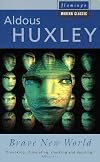
One of the few books I’ve returned to repeatedly over the years is Brave New World, Aldous Huxley’s audacious dystopian classic. When I was young I read it for pleasure. In college, I read it as part of an independent study project on utopia and dystopia in fiction. A few weeks ago, spurred by a sale at Audible, I decided to read . . . er, listen . . . to it again. Fortuitously, I finished it up just as Banned Book Week began. Given that Brave New World is still one of the most show more controversial books of all time (in the top 10 books challenged in the United States last year), it seemed like a perfect choice for this week’s Friday Review.
For the unfamiliar, Huxley’s dystopia is developed in a completely different way from the nightmarish authoritarian worlds of, say, 1984 or Anthem. Orwell famously wrote that “[i]f you want a picture of the future, imagine a boot stamping on a human face — forever.” The world of 1984 is grey, depressing, brutal, and no place than any sane person would want to live. Huxley’s world, on the other hand, is at least superficially enticing. Everybody’s happy. Family strife and trauma have been eliminated, since families themselves are obsolete. There’s loads of things to buy and do to keep people occupied outside of work where, by the way, everybody does what they’re designed to do, so nobody gets fed up with their job. Sex as recreation is encouraged, if not mandated. And, if nothing else, there’s soma, a wonder drug that squelches any lingering worries.
Of course, it doesn’t really work out as well as advertised. If it did there’s be no conflict right? Thus no drama, thus no book. We meet characters who are outsiders, even in a world where everyone is so carefully crafted to be one of the horde. Things go completely haywire when a “savage,” that is a man raised outside the carefully crafted world in which most people live, shows up and begins to ask uncomfortable questions. Usually, at this point, I’d say “wackiness ensues,” but any book that ends with a major character killing himself really isn’t all that wacky.
That said, here are a few observations I picked up reading through Brave New World this time.
First, a writerly observation. Huxley starts the book off in a way that just about every “how to” book on writing says you shouldn’t. He doesn’t introduce any of the main characters. He doesn’t kick off the plot to get you hooked. Instead, he spends several chapters data dumping about how the people who live in this world are created and conditioned. It transitions nicely into the introduction of most of the major characters, but I can’t think a modern editor would be pleased with it. Which just goes to show that you follow the rules, unless you’re good enough to break them and get away with it.
A big part of Brave New World is about conditioning. As I said, Huxley spends several chapters at the outset explaining how children are bred, “decanted,” and conditioned via various means into the caste-bound happy adults they will become. What I never really picked up on before was how that conditioning bumps up against a more traditional form of conditioning, in the character of John “the Savage.” Raised on a reservation by a woman from the wider world left behind during vacation, he grows up as hard wired as the two main bottle-raised characters, Lenina and Bernard. That’s particularly evidence in his reaction to Lenina’s sexual advances, his revulsion driven by what he learned about sexuality in the reservation (namely that his mother, who shared Lenina’s conditioning, was outcast and beaten for having sex with several men in the area). Similarly, his drive to seek refuge in Shakespeare seems to come about in the same unthinking way. It all speaks to me as a commentary on how we are all conditioned by our environments, whether intentionally or not.
Which leads to an altogether less comfortable observation. The philosophical climax of the book is a long discussion between John and Mustapha Mond, the Resident World Controller of Western Europe, who basically runs that part of the world, in which they go back and forth about issues of free will, liberty, and the like. Particularly, John asks about the lower caste workers, who do the truly shit jobs. “Don’t they want better out of life?” he asks (I’m paraphrasing). It’s a question that would come to most us, raised as we are on the importance of “life, liberty, and the pursuit of happiness.” Mond’s answer, of course, is “no,” for the simple reason that they are doing the jobs they are conditioned to do, not just physically by psychologically. They don’t know what they’re missing, in other words.
That conversation resonated to me in that it reminds me of the problem of cultural imperialism and human rights. Like I said, most “Western” nations place a high priority on individual liberty, even at the expense of social order or tranquility. But other cultures – I’m thinking of some Asian ones – don’t place the same emphasis on individuals, instead focusing on group dynamics and social functionality. Does Mond’s explanation of why the lower castes aren’t unhappy with their lot apply equally to people who grow up in other cultures who don’t know they’re being denied the individual liberty others take for granted? Of course, the difference between us and them in the real world is much much less than the difference between the Alphas and Deltas of Brave New World. But I’m not sure that doesn’t just dodge the question.
I always viewed John as “our” representative in the book. After all, he’s the character whose upbringing most closely resembles our own. This time through, I came to the conclusion that I don’t want John representing me. He’s a closed minded fundamentalist asshole, only he quotes Shakespeare instead of the Bible. Not that he doesn’t make some potentially valid criticisms of the world he confronts. He’s just written in such a way that he’s not all that sympathetic. Of course, neither are the representatives of the modern world, either. In that sense, Huxley pushes everyone to the extremes of their positions, for whatever reason. It makes the conflicts ring a bit hollow, in the end, and presents an either/or choice, where something more subtle is possible.
John does have one thing going for him, although it ultimately hastens his demise – empathy. When John and his mother return to society with Lenina and Bernard, she quickly slips into a soma-induced coma and dies. In fact, her convalescence causes quite a spectacle, as people aren’t familiar with aging and are conditioned not to be afraid of death. John behaves in quite recognizable ways when his mother dies – he’s grief stricken, angry at those around him who aren’t, and generally miserable.
By contrast, at the end of the book John leaves the city and tries to live a hermit’s existence in the English countryside. That all goes to hell when a small group of workers catch sight of him flogging himself outside (more problems with sex, of course). Word quickly leaks out about the ritual, which a first brings the press to the area and then a collection of gawkers and curiosity seekers. Looking on from helicopters, they don’t see in John what most of us would – a troubled soul in pain trying to deal with something difficult. They see entertainment, because they’ve been conditioned to treat everything outside of work as entertainment, even other people. As a result, there’s no empathy there and they cheer on John’s flogging for the sake of spectacle. It’s quite nauseating, really. Normally we think of dehumanization as something we do to others, but Huxley turns it around.
Ultimately, what I think struck me most on this go round with Brave New World was my willingness to look critically at whether Huxley’s world is really a dystopia. Yes, the idea of a happy, if shallow, existence free from fear and doubt strikes me as inherently wrong in the gut. In fact, my gut reaction to it is similar to my feelings about transhumanism I wrote about a while back. But as in that piece, I have a hard time making a cogent rational argument as to why a world without pain would be a bad thing. Yes, if we were all eternally healthy we’d take it for granted, but is it necessary to be occasionally ill or injured (perhaps seriously) just to appreciate it? Is my reaction to Huxley’s world mere a result of my own conditioning?
Don’t get me wrong – I’m not going to run for president under a “soma for all!” platform anytime soon. In the real world, transitioning to the type of world Huxley proposed would involve so much coercion and violence that, even if the end product would be desirable, the horrors of getting there would be too much. For a fictional world in which to brainstorm ideas, however, I’m much more skeptical of the dystopian label than I’ve been before.
Which just goes to show you why Brave New World endures, both as a work of literature in its own right and as a target for censors. It makes people think, which can lead to all sorts of wackiness.
www.jdbyrne.net show less
For the unfamiliar, Huxley’s dystopia is developed in a completely different way from the nightmarish authoritarian worlds of, say, 1984 or Anthem. Orwell famously wrote that “[i]f you want a picture of the future, imagine a boot stamping on a human face — forever.” The world of 1984 is grey, depressing, brutal, and no place than any sane person would want to live. Huxley’s world, on the other hand, is at least superficially enticing. Everybody’s happy. Family strife and trauma have been eliminated, since families themselves are obsolete. There’s loads of things to buy and do to keep people occupied outside of work where, by the way, everybody does what they’re designed to do, so nobody gets fed up with their job. Sex as recreation is encouraged, if not mandated. And, if nothing else, there’s soma, a wonder drug that squelches any lingering worries.
Of course, it doesn’t really work out as well as advertised. If it did there’s be no conflict right? Thus no drama, thus no book. We meet characters who are outsiders, even in a world where everyone is so carefully crafted to be one of the horde. Things go completely haywire when a “savage,” that is a man raised outside the carefully crafted world in which most people live, shows up and begins to ask uncomfortable questions. Usually, at this point, I’d say “wackiness ensues,” but any book that ends with a major character killing himself really isn’t all that wacky.
That said, here are a few observations I picked up reading through Brave New World this time.
First, a writerly observation. Huxley starts the book off in a way that just about every “how to” book on writing says you shouldn’t. He doesn’t introduce any of the main characters. He doesn’t kick off the plot to get you hooked. Instead, he spends several chapters data dumping about how the people who live in this world are created and conditioned. It transitions nicely into the introduction of most of the major characters, but I can’t think a modern editor would be pleased with it. Which just goes to show that you follow the rules, unless you’re good enough to break them and get away with it.
A big part of Brave New World is about conditioning. As I said, Huxley spends several chapters at the outset explaining how children are bred, “decanted,” and conditioned via various means into the caste-bound happy adults they will become. What I never really picked up on before was how that conditioning bumps up against a more traditional form of conditioning, in the character of John “the Savage.” Raised on a reservation by a woman from the wider world left behind during vacation, he grows up as hard wired as the two main bottle-raised characters, Lenina and Bernard. That’s particularly evidence in his reaction to Lenina’s sexual advances, his revulsion driven by what he learned about sexuality in the reservation (namely that his mother, who shared Lenina’s conditioning, was outcast and beaten for having sex with several men in the area). Similarly, his drive to seek refuge in Shakespeare seems to come about in the same unthinking way. It all speaks to me as a commentary on how we are all conditioned by our environments, whether intentionally or not.
Which leads to an altogether less comfortable observation. The philosophical climax of the book is a long discussion between John and Mustapha Mond, the Resident World Controller of Western Europe, who basically runs that part of the world, in which they go back and forth about issues of free will, liberty, and the like. Particularly, John asks about the lower caste workers, who do the truly shit jobs. “Don’t they want better out of life?” he asks (I’m paraphrasing). It’s a question that would come to most us, raised as we are on the importance of “life, liberty, and the pursuit of happiness.” Mond’s answer, of course, is “no,” for the simple reason that they are doing the jobs they are conditioned to do, not just physically by psychologically. They don’t know what they’re missing, in other words.
That conversation resonated to me in that it reminds me of the problem of cultural imperialism and human rights. Like I said, most “Western” nations place a high priority on individual liberty, even at the expense of social order or tranquility. But other cultures – I’m thinking of some Asian ones – don’t place the same emphasis on individuals, instead focusing on group dynamics and social functionality. Does Mond’s explanation of why the lower castes aren’t unhappy with their lot apply equally to people who grow up in other cultures who don’t know they’re being denied the individual liberty others take for granted? Of course, the difference between us and them in the real world is much much less than the difference between the Alphas and Deltas of Brave New World. But I’m not sure that doesn’t just dodge the question.
I always viewed John as “our” representative in the book. After all, he’s the character whose upbringing most closely resembles our own. This time through, I came to the conclusion that I don’t want John representing me. He’s a closed minded fundamentalist asshole, only he quotes Shakespeare instead of the Bible. Not that he doesn’t make some potentially valid criticisms of the world he confronts. He’s just written in such a way that he’s not all that sympathetic. Of course, neither are the representatives of the modern world, either. In that sense, Huxley pushes everyone to the extremes of their positions, for whatever reason. It makes the conflicts ring a bit hollow, in the end, and presents an either/or choice, where something more subtle is possible.
John does have one thing going for him, although it ultimately hastens his demise – empathy. When John and his mother return to society with Lenina and Bernard, she quickly slips into a soma-induced coma and dies. In fact, her convalescence causes quite a spectacle, as people aren’t familiar with aging and are conditioned not to be afraid of death. John behaves in quite recognizable ways when his mother dies – he’s grief stricken, angry at those around him who aren’t, and generally miserable.
By contrast, at the end of the book John leaves the city and tries to live a hermit’s existence in the English countryside. That all goes to hell when a small group of workers catch sight of him flogging himself outside (more problems with sex, of course). Word quickly leaks out about the ritual, which a first brings the press to the area and then a collection of gawkers and curiosity seekers. Looking on from helicopters, they don’t see in John what most of us would – a troubled soul in pain trying to deal with something difficult. They see entertainment, because they’ve been conditioned to treat everything outside of work as entertainment, even other people. As a result, there’s no empathy there and they cheer on John’s flogging for the sake of spectacle. It’s quite nauseating, really. Normally we think of dehumanization as something we do to others, but Huxley turns it around.
Ultimately, what I think struck me most on this go round with Brave New World was my willingness to look critically at whether Huxley’s world is really a dystopia. Yes, the idea of a happy, if shallow, existence free from fear and doubt strikes me as inherently wrong in the gut. In fact, my gut reaction to it is similar to my feelings about transhumanism I wrote about a while back. But as in that piece, I have a hard time making a cogent rational argument as to why a world without pain would be a bad thing. Yes, if we were all eternally healthy we’d take it for granted, but is it necessary to be occasionally ill or injured (perhaps seriously) just to appreciate it? Is my reaction to Huxley’s world mere a result of my own conditioning?
Don’t get me wrong – I’m not going to run for president under a “soma for all!” platform anytime soon. In the real world, transitioning to the type of world Huxley proposed would involve so much coercion and violence that, even if the end product would be desirable, the horrors of getting there would be too much. For a fictional world in which to brainstorm ideas, however, I’m much more skeptical of the dystopian label than I’ve been before.
Which just goes to show you why Brave New World endures, both as a work of literature in its own right and as a target for censors. It makes people think, which can lead to all sorts of wackiness.
www.jdbyrne.net show less
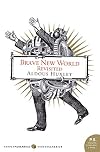
Due to the events from last and this year I got hooked on books on sociology and in general mass control. Reason is very simple - when one gets rather disappointed in the people one tries to find out what and when went wrong.
And unfortunately I have to say course of this planet's society was set way way back. Unfortunately.....
What makes this book bleak and truly dystopian is that author writes almost of events not almost 60 years back but like he is listening and following current news. As show more he says himself he was surprised that future he foreseen with his novel started to realize in only couple of decades.
Let's see....
Crisis and way it can be misused for obtaining power? Check.
Media effect and polarizing effect of it on the masses? Check.
Danger of succumbing to emotions instead of reason (aka activism)? Check.
Rise of bureaucrats - gray man with power - and technocrats grabbing ever more power into their hands? Check.
Inability to use technology outside of what the author calls Big Technology and Big Government? Oh yes, check.
Bureaucratic tendency not to let power slip from their hands once it is obtained (aka mini-despots)? Check.
Rise of scientific zealots that aim to make people uniform (divergence cannot be allowed) and expect them to behave as automatons? Gas-lighting, contradicting statements that mess up people? Use of fear and general wearing down and exhausting of populace using constant crisis as a control factor? Check, check .... and check.
Indifference of general populace to keep their freedoms and ensure elites are not absolute rulers but executives given limited power for limited time - what you might call prevalence of immediate satisfaction of ones needs instead of going for long term solutions? Check.
Forcing migrations and "herding" people (aforementioned masses) and in general dehumanization of society - again through that uniformity and seeking optimal instead of human society? Check.
Dangers of personality-cults and the way propaganda works to push public opinion into desired direction? Check.
Dangers of distractions and off-tracking in order to busy people with things that do not have any value or long term effect when it comes to changing the society for the better? Oh, man, big check.
Dumbing down of general populace (zombies constantly staring into bloody phones 24/7) and failure of education that becomes more of an activist playground than actual learning tool (again, distractions)? Oh, yes, check.
I was surprised that even at time when author was writing the book theories that basically annulled the human being's biological individuality and considered it as a result of only strict forms of social influence were accepted by good deal of social scientists. Considering this, it is no wonder we are where we are.
I was truly intrigued by Institute for Propaganda Analysis and its demise after only 4 years. If there was ever an indicator that the world people live in is not what they believe it is. I mean who would dismantle organization that aims to make people think - not activist way of thinking so popular today (all of the radical movements (from left to right) this organization considered completely undemocratic because radicalism breeds authoritarianism and suffocates freedom of speech) but actual thinking?
You are right - not people who have best for humanity in their heart.
This is a highly recommended book for everyone to read. Might be overly romanticized view of the world but as long people try to keep their individuality, freedom of speech and in general freedom there is still hope. And becoming aware of things taking place around us is always the first step in the right direction.
Highly recommended. show less
And unfortunately I have to say course of this planet's society was set way way back. Unfortunately.....
What makes this book bleak and truly dystopian is that author writes almost of events not almost 60 years back but like he is listening and following current news. As show more he says himself he was surprised that future he foreseen with his novel started to realize in only couple of decades.
Let's see....
Crisis and way it can be misused for obtaining power? Check.
Media effect and polarizing effect of it on the masses? Check.
Danger of succumbing to emotions instead of reason (aka activism)? Check.
Rise of bureaucrats - gray man with power - and technocrats grabbing ever more power into their hands? Check.
Inability to use technology outside of what the author calls Big Technology and Big Government? Oh yes, check.
Bureaucratic tendency not to let power slip from their hands once it is obtained (aka mini-despots)? Check.
Rise of scientific zealots that aim to make people uniform (divergence cannot be allowed) and expect them to behave as automatons? Gas-lighting, contradicting statements that mess up people? Use of fear and general wearing down and exhausting of populace using constant crisis as a control factor? Check, check .... and check.
Indifference of general populace to keep their freedoms and ensure elites are not absolute rulers but executives given limited power for limited time - what you might call prevalence of immediate satisfaction of ones needs instead of going for long term solutions? Check.
Forcing migrations and "herding" people (aforementioned masses) and in general dehumanization of society - again through that uniformity and seeking optimal instead of human society? Check.
Dangers of personality-cults and the way propaganda works to push public opinion into desired direction? Check.
Dangers of distractions and off-tracking in order to busy people with things that do not have any value or long term effect when it comes to changing the society for the better? Oh, man, big check.
Dumbing down of general populace (zombies constantly staring into bloody phones 24/7) and failure of education that becomes more of an activist playground than actual learning tool (again, distractions)? Oh, yes, check.
I was surprised that even at time when author was writing the book theories that basically annulled the human being's biological individuality and considered it as a result of only strict forms of social influence were accepted by good deal of social scientists. Considering this, it is no wonder we are where we are.
I was truly intrigued by Institute for Propaganda Analysis and its demise after only 4 years. If there was ever an indicator that the world people live in is not what they believe it is. I mean who would dismantle organization that aims to make people think - not activist way of thinking so popular today (all of the radical movements (from left to right) this organization considered completely undemocratic because radicalism breeds authoritarianism and suffocates freedom of speech) but actual thinking?
You are right - not people who have best for humanity in their heart.
This is a highly recommended book for everyone to read. Might be overly romanticized view of the world but as long people try to keep their individuality, freedom of speech and in general freedom there is still hope. And becoming aware of things taking place around us is always the first step in the right direction.
Highly recommended. show less
Lists
Fiction For Men (1)
Five star books (1)
Very Very Bad (1)
Ambleside Books (1)
Folio Society (1)
SF - To Read (1)
Witch Hunts (1)
Modernism (1)
bound (1)
to read list (1)
psychology (1)
Favourite Books (1)
recommended (1)
1950s (1)
BBC Big Read (1)
science fiction (1)
. (1)
um actually (1)
Favourite Books (1)
A Novel Cure (1)
Overdue Podcast (1)
AP Lit (1)
Midwest (1)
100 (1)
BitLife (1)
Read in 2007 (1)
substances (1)
Best Satire (1)
To Read (1)
Sonlight Books (1)
1930s (1)
. (1)
Best Dystopias (1)
Science Fiction (1)
Books I've Read (5)
Movies/Shows (2)
Books (1)
2023 Reads (2)
Futurism Works (2)
Unread books (2)
Seeking the Soul (2)
essays (1)
DELETE (1)
Check Library (1)
Blindpill (1)
Book wishlist (1)
Page Turners (1)
BBC Big Read (1)
Florida (1)
BBC Top Books (1)
Classic Sci-Fi (1)
el (1)
Read (1)
Must read (1)
Banned Books (1)
Short and Sweet (1)
1920s (1)
Awards


You May Also Like


Associated Authors
Statistics
- Works
- 280
- Also by
- 113
- Members
- 104,574
- Popularity
- #87
- Rating
- 3.9
- Reviews
- 1,396
- ISBNs
- 1,753
- Languages
- 38
- Favorited
- 287


