
Anthony Doerr
Author of All the Light We Cannot See
About the Author
Anthony Doerr was born on October 27, 1973 in Cleveland, Ohio. He is the author of The Shell Collector, About Grace, Four Seasons in Rome, Memory Wall, and All the Light We Cannot See. His fiction has won four O. Henry Prizes and has been anthologized in several anthologies. He has won the Barnes show more and Noble Discover Prize, the Rome Prize, the New York Public Library's Young Lions Award, the National Magazine Award for Fiction, three Pushcart Prizes, two Pacific Northwest Book Award, three Ohioana Book Awards, the 2010 Story Prize, which is considered the most prestigious prize in the U.S. for a collection of short stories, and the Sunday Times EFG Short Story Award, which is the largest prize in the world for a single short story. His novel, All the Light We Cannot See, won the Adult Fiction Award for the Indies Choice Book Awards in 2015, the International Book of the Year at the ABIA Awards and the Pulitzer Prizes for Fiction in 2015. Anthony Doerr also won the 2015 Andrew Carnegie Medal for Excellence in Fiction for this same title. (Bowker Author Biography) show less
Works by Anthony Doerr
Four Seasons in Rome: On Twins, Insomnia, and the Biggest Funeral in the History of the World (2007) 849 copies, 34 reviews
The Deep 2 copies
All the Light We Cannot See, About Grace and The Shell Collector: The Anthony Doerr Collection (2017) 2 copies
Afterworld [short story] 1 copy
The Caretaker 1 copy
Associated Works
The Year's Best Fantasy and Horror: Fifteenth Annual Collection (2002) — Contributor — 275 copies, 4 reviews
Fight of the Century: Writers Reflect on 100 Years of Landmark ACLU Cases (2020) — Contributor — 260 copies, 5 reviews
Tales of Two Americas: Stories of Inequality in a Divided Nation (2017) — Contributor — 227 copies, 7 reviews
The Best Short Stories 2021: The O. Henry Prize Winners (2021) — Contributor — 101 copies, 5 reviews
Eat Joy: Stories and Comfort Food from 31 Celebrated Writers (2019) — Contributor — 84 copies, 3 reviews
The Artists' and Writers' Cookbook: A Collection of Stories with Recipes (2016) — Contributor — 19 copies
All The Light We Cannot See: A Novel by Anthony Doerr - Summarized (2015) — Author, some editions — 2 copies
Gefährliche Ferien - Bretagne und Atlantikküste: mit Martin Walker und vielen anderen (detebe) (2019) — Contributor — 1 copy
Tagged
Common Knowledge
- Canonical name
- Doerr, Anthony
- Birthdate
- 1973-10-27
- Gender
- male
- Education
- Bowdoin College
Bowling Green State University
University School - Occupations
- novelist
short story writer - Awards and honors
- Rome Prize
Guggenheim Fellowship (2010) - Short biography
- Anthony Doerr has won numerous prizes for his fiction, including the 2015 Pulitzer Prize. His most recent novel, All the Light We Cannot See, was named a best book of 2014 by a number of publications, and was a #1 New York Times Bestseller. Visit him at www.anthonydoerr.com.
- Nationality
- USA
- Birthplace
- Cleveland, Ohio, USA
- Places of residence
- Boise, Idaho, USA
Novelty, Ohio, USA
New Zealand
Rome, Italy - Map Location
- USA
Members
Reviews
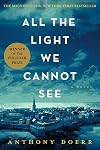
In the darkest places, at the darkest times, there is light, if we can but believe.
This is a story of contrasts, parallels, and coming together.
It is about light, and so, inevitably, also about the dark.
The descriptions are very visual, but what cannot be seen is key. One of the two main characters is blind, so it’s about touch and smell and sound as well. And it’s radio that drives many lives and events. “Radio: it ties a million ears to a single mouth.” It is also “a war waged show more through the air, invisibly”.
It’s about the power (radio) and beauty (biology) of science, but it has a magical-realist plot concerning a diamond, The Sea of Flames, that’s thought to bear a blessing and a curse. There’s also mystery as to where it, and the three decoy copies, are.
It’s overtly, repeatedly rationalist: “Walk through paths of logic. Every outcome has its cause, and every predicament has its solution. Every lock has its key.” But it is also fervently about faith, not in a higher power, but belief in oneself and others.
From those ingredients, in a background of blindness, war, fear, suffering, loss, Doerr tells a tale of hope, overcoming fear, courage, altruism, and beauty, through children whose lives are simultaneously opened up and narrowed.
In the darkest places, at the darkest times, there is light, if we can but believe.
YA Label
I’m wary of labels, but sometimes they help. I was struggling to appreciate this as much as many of my friends have – until I started thinking of it as a US/French YA film, a little like Hugo. It is mostly set in France, with teenage protagonists, very short chapters, straightforward language, cinematic descriptions (20th Century Fox has the film rights), and the immediacy of the present tense.
It’s a little sentimental, avoids graphic details of war and the Holocaust (passing mention of stealing from gas chamber victims, a vague rape scene, and some messy wounds), and explains the shock of “a Jewess” maid in a Berlin apartment block more than would otherwise be necessary. Most aspects of the magical diamond mystery felt out of place in an adult novel, as did the over-plotted final few chapters. The saving grace was that it avoided the temptation to give everyone a happy or even definite ending.
However, as a YA novel, I can enjoy the beautiful writing, without fretting about other aspects. Hence, this review is mostly quotes.
Like the detailed city models the locksmith makes so his blind daughter can learn her way around, it is more than the sum of its parts. It tackles big and sometimes unexpected themes in a gentle way, and the relationships between Marie-Laure and her father, Uncle Etienne, and the housekeeper are particularly poignant.
A 4* book that was a 3* experience for me.
Plot and Structure
The story is told in short chapters that mostly alternate between Werner and Marie-Laure; later on, there’s a third character. It is set between 1934 and 1944 (plus a postscript), but it jumps back and forward between those years, so you gradually realise how the threads will come together.
Werner is a German orphan with a passion for and incredible understanding of electronics and radio, gleaned in part from listening to children’s science broadcasts – on the radio. His talent is spotted, required, and honed. At an elite school, he encounters brutality (physical and mental) and luxury that astound him. He questions in his own mind, but does as he is told. The true Nazis are portrayed as evil (though even von Rumpel has a soft side when he thinks of his daughters), but those like Werner are fodder for the war machine; victims of a kind.
Marie-Laure, blind since age six, is the otherwise perfect daughter of a locksmith at a Parisian museum. As the Germans approach Paris, she and her father seek safety in her uncle’s house in Saint-Malo which, as a quote in the preface points out, will be almost totally destroyed by allied bombing.
Birds and Shells
Marie-Laure has a passion for shells, snails, sea-creatures, and the sea itself, as does her shell-shocked, reclusive uncle. She treasures a Braille copy of Twenty Thousand Leagues Under the Sea, which becomes a metaphor for many aspects of her story. She and her uncle bond over these things (his leaving a trail of seashells is how she first meets him), which eventually enables him to learn courage from her and to emerge from his own “shell”.
But it’s birds that fill the pages - as incidental creatures, as symbols, and because they are the passion of Frederik, a friend of Werner’s, who has a copy of Audubon’s famous book of birds, and for whom the appearance of an owl is briefly transformative.
• “As the birds rush overhead, she imagines she can feel the light settling over their wings, striking each individual feather.”
• In a fire, “swifts, flushed from chimneys, catch fire and swoop like blown sparks out over the ramparts and extinguishing themselves in the sea.”
• “Marie-Laure is glad to hear the smile enter his voice. But beneath it she can sense his thoughts fluttering like trapped birds.”
• “A flock of blackbirds explode out of a tree.” – and another time, when boys fire shots into trees.
• “That bird can fly to Africa and back. Powered by bugs and worms and desire.”
• Even a Nazi inquisitor “sent forth his queries like birds”.
Quotes - Recurring
• “You have to believe the story.”
• “Open your eyes and see what you can with them before they close forever.”
• “Don’t you want to be alive before you die?”
• “The brain, which lives without a spark of light, builds for us a world full of light.”
• “There is only chance… chance and physics.”
• “Mathematically, all of light is invisible.”
Quotes - Light
• “The daylight unwinds from the trees.”
• “December sucks the light from the castle.”
• “The moon sets and the eastern sky lightens, the hem of night pulling away, taking starts with it.”
• “Faint twilight angles through smoke and shutter slats in hazy red stripes.”
• “The leaden dusk drains away.”
• “Watching shadows disentangle themselves from night, watching miners limp past at dawn.”
• “The very first pale light of predawn leaking through… The slow sandy light of dawn permeates the room. Everything transient and aching; everything tentative.”
• “His handgun is black; it seems to draw all the light in the room toward it.”
Quotes - Senses
• “Her hands move ceaselessly, gathering, probing, testing… To really touch something… is to love it.”
• “She can smell gasoline under the wind. As if a great river of machinery is streaming slowly, irrevocably, towards her.”
• “She can sense a shiver beneath the air, in the pauses between the chirring of the insects, like the spider cracks of ice when too much weight is set upon it.”
• “His voice is low and soft, a piece of silk you might keep in a drawer and pull out only on rare occasions.”
• “She never knew salt to have a smell.”
• After deprivation, “The eggs tasted like clouds, like spun gold” and peaches were “wedges of wet sunlight”.
• “The apartment is sleek and shiny, full of deep carpets that swallow noise.”
• “A thick red carpet sucks at the soles of Werner’s brogues.”
• “To shut your eyes is to guess nothing of blindness. Beneath your world of skies and faces and buildings exists a rawer and older world, a place where surface planes disintegrate and sounds ribbon in shoals through the air. Marie-Laure can sit in an attic high above the street and hear lilies rustling in marshes two miles away. She hears Americans scurry across farm fields, directing their huge cannons at the smoke of Saint-Malo… she hears the bones of dead whales stir five leagues below, their marrow offering a century of food for cities of creatures who will live their whole lives and never once see a photon sent from the sun. She hears her snails in the grotto drag their bodies over the rocks.”
Quotes – The Sea
• “The sea murmuring in a language that traveled through stones, air, sky.”
• “It sucks and booms and splashes and rumbles; it shifts and dilates and falls over itself.”
• “Like cold silk, cold, sumptuous silk onto which the sea has laid her offerings… The sand pulls the heat from her fingertips, from the soles of her feet”
• “On the beaches, her privations and fear are rinsed away by wind and color and light.”
Quotes - General
• “I believe in you. I think you will do something great.”
• Trunks at the orphanage hold “the last possessions of deceased parents… fathers swallowed by the mines”.
• “Rumors circulate through the Paris museum, moving fast, as quick and brightly colored as scarves.” They also “rustle along the paths of the Jardins des Plantes”.
• “Flames scamper up walls… The fires pool and strut… Smoke chases dust; ash chokes smoke.”
• “The trees seethe and the house smoulders.”
• “The house seems the material equivalent of her uncle’s inner being: apprehensive, isolated, but full of cobwebby wonders.”
• “Almost a child, monastic in the modesty of his needs and wholly independent of any sort of temporal obligations.”
• “intoxicated… forever drunk on rigor and exercise and gleaming boot leather.”
• “Emptiness and fullness, in the end, somehow the same.”
• Miners: “To men like that, time was a surfeit, a barrel they watched slowly drain. When really, he thinks, it’s a glowing puddle you carry in your hands… working so hard not to spill one single drop.”
Quibbles
I don’t mind the American spelling or vocabulary: it’s written by a US author, not in the language of the characters, so “color” is fine, as is “pants” where a Brit would say “trousers”. But occasionally anachronistic phrases or assumptions really grated: the locksmith mentions air-conditioned trains to Marie-Laure (in 1940), as if she'd know what they were; another time, she says “But we are the good guys. Aren’t we, Uncle?”; and she imagines her uncle “working out some cost-benefit-analysis”.
Image source: https://cultureuob.files.wordpress.com/2012/11/rc-key.jpg show less
This is a story of contrasts, parallels, and coming together.
It is about light, and so, inevitably, also about the dark.
The descriptions are very visual, but what cannot be seen is key. One of the two main characters is blind, so it’s about touch and smell and sound as well. And it’s radio that drives many lives and events. “Radio: it ties a million ears to a single mouth.” It is also “a war waged show more through the air, invisibly”.
It’s about the power (radio) and beauty (biology) of science, but it has a magical-realist plot concerning a diamond, The Sea of Flames, that’s thought to bear a blessing and a curse. There’s also mystery as to where it, and the three decoy copies, are.
It’s overtly, repeatedly rationalist: “Walk through paths of logic. Every outcome has its cause, and every predicament has its solution. Every lock has its key.” But it is also fervently about faith, not in a higher power, but belief in oneself and others.
From those ingredients, in a background of blindness, war, fear, suffering, loss, Doerr tells a tale of hope, overcoming fear, courage, altruism, and beauty, through children whose lives are simultaneously opened up and narrowed.
In the darkest places, at the darkest times, there is light, if we can but believe.
YA Label
I’m wary of labels, but sometimes they help. I was struggling to appreciate this as much as many of my friends have – until I started thinking of it as a US/French YA film, a little like Hugo. It is mostly set in France, with teenage protagonists, very short chapters, straightforward language, cinematic descriptions (20th Century Fox has the film rights), and the immediacy of the present tense.
It’s a little sentimental, avoids graphic details of war and the Holocaust (passing mention of stealing from gas chamber victims, a vague rape scene, and some messy wounds), and explains the shock of “a Jewess” maid in a Berlin apartment block more than would otherwise be necessary. Most aspects of the magical diamond mystery felt out of place in an adult novel, as did the over-plotted final few chapters. The saving grace was that it avoided the temptation to give everyone a happy or even definite ending.
However, as a YA novel, I can enjoy the beautiful writing, without fretting about other aspects. Hence, this review is mostly quotes.
Like the detailed city models the locksmith makes so his blind daughter can learn her way around, it is more than the sum of its parts. It tackles big and sometimes unexpected themes in a gentle way, and the relationships between Marie-Laure and her father, Uncle Etienne, and the housekeeper are particularly poignant.
A 4* book that was a 3* experience for me.
Plot and Structure
The story is told in short chapters that mostly alternate between Werner and Marie-Laure; later on, there’s a third character. It is set between 1934 and 1944 (plus a postscript), but it jumps back and forward between those years, so you gradually realise how the threads will come together.
Werner is a German orphan with a passion for and incredible understanding of electronics and radio, gleaned in part from listening to children’s science broadcasts – on the radio. His talent is spotted, required, and honed. At an elite school, he encounters brutality (physical and mental) and luxury that astound him. He questions in his own mind, but does as he is told. The true Nazis are portrayed as evil (though even von Rumpel has a soft side when he thinks of his daughters), but those like Werner are fodder for the war machine; victims of a kind.
Marie-Laure, blind since age six, is the otherwise perfect daughter of a locksmith at a Parisian museum. As the Germans approach Paris, she and her father seek safety in her uncle’s house in Saint-Malo which, as a quote in the preface points out, will be almost totally destroyed by allied bombing.
Birds and Shells
Marie-Laure has a passion for shells, snails, sea-creatures, and the sea itself, as does her shell-shocked, reclusive uncle. She treasures a Braille copy of Twenty Thousand Leagues Under the Sea, which becomes a metaphor for many aspects of her story. She and her uncle bond over these things (his leaving a trail of seashells is how she first meets him), which eventually enables him to learn courage from her and to emerge from his own “shell”.
But it’s birds that fill the pages - as incidental creatures, as symbols, and because they are the passion of Frederik, a friend of Werner’s, who has a copy of Audubon’s famous book of birds, and for whom the appearance of an owl is briefly transformative.
• “As the birds rush overhead, she imagines she can feel the light settling over their wings, striking each individual feather.”
• In a fire, “swifts, flushed from chimneys, catch fire and swoop like blown sparks out over the ramparts and extinguishing themselves in the sea.”
• “Marie-Laure is glad to hear the smile enter his voice. But beneath it she can sense his thoughts fluttering like trapped birds.”
• “A flock of blackbirds explode out of a tree.” – and another time, when boys fire shots into trees.
• “That bird can fly to Africa and back. Powered by bugs and worms and desire.”
• Even a Nazi inquisitor “sent forth his queries like birds”.
Quotes - Recurring
• “You have to believe the story.”
• “Open your eyes and see what you can with them before they close forever.”
• “Don’t you want to be alive before you die?”
• “The brain, which lives without a spark of light, builds for us a world full of light.”
• “There is only chance… chance and physics.”
• “Mathematically, all of light is invisible.”
Quotes - Light
• “The daylight unwinds from the trees.”
• “December sucks the light from the castle.”
• “The moon sets and the eastern sky lightens, the hem of night pulling away, taking starts with it.”
• “Faint twilight angles through smoke and shutter slats in hazy red stripes.”
• “The leaden dusk drains away.”
• “Watching shadows disentangle themselves from night, watching miners limp past at dawn.”
• “The very first pale light of predawn leaking through… The slow sandy light of dawn permeates the room. Everything transient and aching; everything tentative.”
• “His handgun is black; it seems to draw all the light in the room toward it.”
Quotes - Senses
• “Her hands move ceaselessly, gathering, probing, testing… To really touch something… is to love it.”
• “She can smell gasoline under the wind. As if a great river of machinery is streaming slowly, irrevocably, towards her.”
• “She can sense a shiver beneath the air, in the pauses between the chirring of the insects, like the spider cracks of ice when too much weight is set upon it.”
• “His voice is low and soft, a piece of silk you might keep in a drawer and pull out only on rare occasions.”
• “She never knew salt to have a smell.”
• After deprivation, “The eggs tasted like clouds, like spun gold” and peaches were “wedges of wet sunlight”.
• “The apartment is sleek and shiny, full of deep carpets that swallow noise.”
• “A thick red carpet sucks at the soles of Werner’s brogues.”
• “To shut your eyes is to guess nothing of blindness. Beneath your world of skies and faces and buildings exists a rawer and older world, a place where surface planes disintegrate and sounds ribbon in shoals through the air. Marie-Laure can sit in an attic high above the street and hear lilies rustling in marshes two miles away. She hears Americans scurry across farm fields, directing their huge cannons at the smoke of Saint-Malo… she hears the bones of dead whales stir five leagues below, their marrow offering a century of food for cities of creatures who will live their whole lives and never once see a photon sent from the sun. She hears her snails in the grotto drag their bodies over the rocks.”
Quotes – The Sea
• “The sea murmuring in a language that traveled through stones, air, sky.”
• “It sucks and booms and splashes and rumbles; it shifts and dilates and falls over itself.”
• “Like cold silk, cold, sumptuous silk onto which the sea has laid her offerings… The sand pulls the heat from her fingertips, from the soles of her feet”
• “On the beaches, her privations and fear are rinsed away by wind and color and light.”
Quotes - General
• “I believe in you. I think you will do something great.”
• Trunks at the orphanage hold “the last possessions of deceased parents… fathers swallowed by the mines”.
• “Rumors circulate through the Paris museum, moving fast, as quick and brightly colored as scarves.” They also “rustle along the paths of the Jardins des Plantes”.
• “Flames scamper up walls… The fires pool and strut… Smoke chases dust; ash chokes smoke.”
• “The trees seethe and the house smoulders.”
• “The house seems the material equivalent of her uncle’s inner being: apprehensive, isolated, but full of cobwebby wonders.”
• “Almost a child, monastic in the modesty of his needs and wholly independent of any sort of temporal obligations.”
• “intoxicated… forever drunk on rigor and exercise and gleaming boot leather.”
• “Emptiness and fullness, in the end, somehow the same.”
• Miners: “To men like that, time was a surfeit, a barrel they watched slowly drain. When really, he thinks, it’s a glowing puddle you carry in your hands… working so hard not to spill one single drop.”
Quibbles
I don’t mind the American spelling or vocabulary: it’s written by a US author, not in the language of the characters, so “color” is fine, as is “pants” where a Brit would say “trousers”. But occasionally anachronistic phrases or assumptions really grated: the locksmith mentions air-conditioned trains to Marie-Laure (in 1940), as if she'd know what they were; another time, she says “But we are the good guys. Aren’t we, Uncle?”; and she imagines her uncle “working out some cost-benefit-analysis”.
Image source: https://cultureuob.files.wordpress.com/2012/11/rc-key.jpg show less

This is a brilliant book. At 530 pages it is not quite a doorstopper and yet I didn't want to let go. I lingered in the latter part of the novel, not wanting to finish. Finding my eyes almost welling up with tears at times. The writing is 5 star beautiful. It is told in an unconventional manner, moving back and forth in time and filling in pieces along the way to let the reader see how we got to where we are. The beginning is the end, although not quite. It is the story of a young boy in show more Germany before World War II and a younger girl in Paris, and what the war does to them and how these two people are linked by events vastly out of their control. There are a number of other characters who are very important to the story and well fleshed out as partners to the journey of our two primaries.
I doubt I will read a better book this year. I hope a few come close. I feel like reading this brilliant book again right now but I think I will let it rest for a year or two and do it again. I don't want to spoil this story with details in this short review. show less
I doubt I will read a better book this year. I hope a few come close. I feel like reading this brilliant book again right now but I think I will let it rest for a year or two and do it again. I don't want to spoil this story with details in this short review. show less
Luminous, intensely personal intersecting stories of a blind French girl who contributes in a small way to the Resistance with a secret radio, and a talented German orphan who has been trained to seek out just such transmissions. So many lovely passages in a book about the horrors and deprivations of WWII... Doerr put me in the moment brilliantly over and over again with descriptions of air, sound and light as well as more solid things like water, rock and metal. This is not about the "big show more picture", but rather about the thousands of small moments that make up life, even in the midst of earth-shattering events.
Review written in September, 2015 show less
Review written in September, 2015 show less
You know the kind of book: you get to the end of it, and you want to go back to the beginning and start over again? Uh-huh, that’s what I’m talking about. Anthony Doerr may have written the best book I will read this year. And the thing is, I finished it a few days ago and I can’t stop thinking about it and as time passes I can’t get over how wonderful, rich and satisfying this story is.
"So how, children, does the brain, which lives without a spark of light, build for us a world full show more of light?"
Marie Laure LeBlanc is a blind twelve-year-old girl living in Paris with her father, the master of the locks at the Museum of Natural History, when the Germans seize control and begin their occupation of the country in 1940. They are forced to evacuate and make their way to her great uncle’s home in the sea side village of Saint-Malo. Her father carries with him the museum’s most prized and dangerous gem. He tries to make the world smaller for Marie Laure by building her a model, an exact replica of the town and by creating wooden puzzles for her to twist, turn and eventually crack open to reveal the surprise inside. (More about that in a bit.) Her natural curiosity and intelligence are fueled by her love for her father. And little by little she makes her way through Jules Vern’s 20,000 Leagues Under the Sea.
At the same time, in a German mining town three hundred miles northeast of Paris, seven-year-old orphan Werner Pfennig and his younger sister Jutta, are raised at Children’s House by the indomitable Frau Elena. In the land of ‘make-do’ she performs tiny miracles every day to keep her young charges healthy and productive. But Werner is an extremely bright and inquisitive child, and his interest in short wave radios and their transmissions allow him and Jutta to hear a Frenchman, talking about science. They are enthralled. At the same time Werner comes to the attention of authorities and that leads to his acceptance in the exclusive and brutal Hitler Youth Academy and eventually to the tracing of illegal radio transmissions for the Wehrmacht.
Doerr constructs his narrative in such a user friendly way that the pages flip effortlessly, each chapter only a page or two long, so that the 530 page book seems much, much shorter. As I read I was overcome by the beauty of the language and the intricate way Doerr allowed me to twist the puzzle that was the story’s plot, time and again, to reveal the surprise. Back and forth in time he led me until finally Marie Laure’s thread and Werner’s thread meet in August, 1944. Saint-Malo is fully occupied by the Germans but the allies are bombing the town and she can hear a German sergeant-major in the bottom floor of her great uncle’s house, hunting for the precious thing she has kept safe for several years. Gradually the tension that has been building for hundreds of pages comes to a brutal climax. But it’s the denouement that had me holding my breath because this author brilliantly continues the story through 2014.
Clear the boards and make room for a wonderful addition to the WWII literature because this is a keeper and very highly recommended. show less
"So how, children, does the brain, which lives without a spark of light, build for us a world full show more of light?"
Marie Laure LeBlanc is a blind twelve-year-old girl living in Paris with her father, the master of the locks at the Museum of Natural History, when the Germans seize control and begin their occupation of the country in 1940. They are forced to evacuate and make their way to her great uncle’s home in the sea side village of Saint-Malo. Her father carries with him the museum’s most prized and dangerous gem. He tries to make the world smaller for Marie Laure by building her a model, an exact replica of the town and by creating wooden puzzles for her to twist, turn and eventually crack open to reveal the surprise inside. (More about that in a bit.) Her natural curiosity and intelligence are fueled by her love for her father. And little by little she makes her way through Jules Vern’s 20,000 Leagues Under the Sea.
At the same time, in a German mining town three hundred miles northeast of Paris, seven-year-old orphan Werner Pfennig and his younger sister Jutta, are raised at Children’s House by the indomitable Frau Elena. In the land of ‘make-do’ she performs tiny miracles every day to keep her young charges healthy and productive. But Werner is an extremely bright and inquisitive child, and his interest in short wave radios and their transmissions allow him and Jutta to hear a Frenchman, talking about science. They are enthralled. At the same time Werner comes to the attention of authorities and that leads to his acceptance in the exclusive and brutal Hitler Youth Academy and eventually to the tracing of illegal radio transmissions for the Wehrmacht.
Doerr constructs his narrative in such a user friendly way that the pages flip effortlessly, each chapter only a page or two long, so that the 530 page book seems much, much shorter. As I read I was overcome by the beauty of the language and the intricate way Doerr allowed me to twist the puzzle that was the story’s plot, time and again, to reveal the surprise. Back and forth in time he led me until finally Marie Laure’s thread and Werner’s thread meet in August, 1944. Saint-Malo is fully occupied by the Germans but the allies are bombing the town and she can hear a German sergeant-major in the bottom floor of her great uncle’s house, hunting for the precious thing she has kept safe for several years. Gradually the tension that has been building for hundreds of pages comes to a brutal climax. But it’s the denouement that had me holding my breath because this author brilliantly continues the story through 2014.
Clear the boards and make room for a wonderful addition to the WWII literature because this is a keeper and very highly recommended. show less
Lists
Read in 2016 (1)
Five star books (1)
THE WAR ROOM (1)
New Arrivals (1)
Obama Reads (1)
READ IN 2022 (1)
Europe (1)
Favourite Books (1)
Coming of Age (1)
AP Lit (1)
History (1)
el (1)
FAB 2022 (1)
. (1)
World Books (1)
Indie Next Picks (2)
READ IN 2021 (1)
FAB 2021 (1)
French Books (1)
2023 Reads (1)
Awards


You May Also Like


Associated Authors
Statistics
- Works
- 17
- Also by
- 27
- Members
- 34,393
- Popularity
- #551
- Rating
- 4.2
- Reviews
- 1,321
- ISBNs
- 309
- Languages
- 24
- Favorited
- 23
