
James Randi (1928–2020)
Author of Flim-Flam! Psychics, ESP, Unicorns and other Delusions
About the Author
Randall James Hamilton Zwinge was born on August 7, 1928 in Toronto, Ontario, Canada. He began his career in the late 40's as an illusionist and escape artist. He became known as the Amazing Randi and was an international success. In 1986, he received the McArthur "genius" grant. He retired from show more stage magic at the age of 60 and began a career of investigating claims of the paranormal. He devoted his life to debunking paranormal claims. Preferring to be called a skeptic or an investigator, he aimed to show that "something was not likely." He was considered a father of the modern skeptical movement. He wrote numerous books which included, Houdini, His Life and Art (1976) co-authored with Bert Randolp Sugar; Flim Flam! The Truth About Unicorns, Parapsychology, and Other Delusions (1980); The Faith Healers (1987); and An Encyclopedia of Claims, Frauds, and Hoaxes of the Occult and Supernatural (1995). In 1976, Mr. Randi, along with Carl Sagan, Isaac Asimov, and others, founded the Committee for Skeptical Inquiry. It published the magazine Skeptical Inquirer. James Randi, also known as the Amazing Randi, died at his home in Florida at the age of 92. (Bowker Author Biography) show less
Image credit: Credit: Steve Jurvetson, 2007
Works by James Randi
An Encyclopedia of Claims, Frauds, and Hoaxes of the Occult and Supernatural (1995) 311 copies, 1 review
The Mask of Nostradamus: The Prophecies of the World's Most Famous Seer (1990) 160 copies, 4 reviews
Conjuring: Being a Definitive History of the Venerable Arts of Sorcery, Prestidigitation, Wizardry, Deception, & Chicanery and of the Mountebanks & Scoundrels Who have Perpetrated… (1992) 125 copies, 1 review
Skeptoid 2 copies
Associated Works
Undiluted Hocus-Pocus: The Autobiography of Martin Gardner (2014) — Afterword — 100 copies, 7 reviews
Tagged
Common Knowledge
- Canonical name
- Randi, James
- Legal name
- Randi, James
- Other names
- Randi, the Amazing (stage name)
Zwinge, Randall James Hamilton (birth name) - Birthdate
- 1928-08-07
- Date of death
- 2020-10-20
- Gender
- male
- Occupations
- stage magician
fraud investigator - Organizations
- CSI: Committee for Skeptical Inquiry (formerly CSICOP)
Society of American Magicians
International Brotherhood of Magicians
The Magic Circle
James Randi Educational Foundation - Awards and honors
- MacArthur Fellowship (1986)
Joseph A. Burton Forum Award (1989)
Richard Dawkins Award (2003)
Philip J. Klass Award (2007)
Heinz Oberhummer Award (2016) - Relationships
- Alvarez, José (husband)
- Short biography
- James Randi has an international reputation as a magician and escape artist, but today he is best known as the world's most tireless investigator and demystifier of paranormal and pseudoscientific claims. Randi has pursued "psychic" spoonbenders, exposed the dirty tricks of faith healers, investigated homeopathic water "with a memory," and generally been a thorn in the sides of those who try to pull the wool over the public's eyes in the name of the supernatural. In 1993, the PBS-TV "NOVA" series broadcast a one-hour special dealing with Randi's life work, particularly with his investigations of Uri Geller and various occult and healing claims being made by scientists in Russia.
In 1996, the James Randi Education Foundation was established to further Randi's work. Randi's long-standing challenge to psychics now stands as a $1,000,000 prize administered by the Foundation. It remains unclaimed. - Nationality
- Canada (birth)
USA (naturalized 1987) - Birthplace
- Toronto, Ontario, Canada
- Places of residence
- Rumson, New Jersey, USA
Plantation, Florida, USA - Place of death
- Plantation, Florida, USA
- Map Location
- USA
Members
Reviews
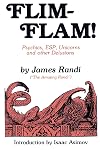
If Martin Gardner is the Godfather of skepticism, James Randi is the crude, but effective enforcer. He prefers to debunk by empirical means (as opposed to Gardner's thorough intellectual dismantling) and Randi hides no disdain, calling the "psychics" and other frauds charlatans and more while explaining how he handled the would be para-whatevers. And, he has yet to be proven wrong. Who best to out a trickster than a professional magician?
Magician and skeptic extraordinaire James "the Amazing" Randi examines and debunks all kinds of way-out-there stuff, from people who claim they can levitate by means of meditation, to "psychic surgery," to the Bermuda Triangle. He also details a number of experiments he conducted to test whether people with claimed paranormal powers could demonstrate them under controlled conditions. (Spoiler alert: They couldn't.)
Parts of this book, mostly chapters that focus closely on one particular show more topic, are in-depth, fascinating, and entertaining to read. (Although I suspect that whether one finds the tone of humor-laced curmudgeonliness Randi takes throughout charming or irritating is likely to depend upon one's predisposition.) Other parts are rather disjointed, choose odd details to focus on, and display, perhaps, more passion than polish in the writing. It's also kind of dated, as it was first published in the 80s and features a number of subjects that were big topics then, but have been replaced with new pseudoscientific fads since. (When was the last time you heard anybody talking about biorhythms?)
Still, uneven or not, I deeply appreciate the fact that this book, and other books like it, exist, and that Randi is and has been out there doing the things he does. His book about Uri Geller, in which he devastatingly exposed all the famous spoonbender's tricks, was a real eye-opener for me as a youngster. I started reading it as someone who'd always simply accepted psychic claims (as well as any number of other dubious phenomena) at face value, and finished it as a more mature and significantly less gullible thinker. I say we need more books that can do that sort of thing. Many, many more. show less
Parts of this book, mostly chapters that focus closely on one particular show more topic, are in-depth, fascinating, and entertaining to read. (Although I suspect that whether one finds the tone of humor-laced curmudgeonliness Randi takes throughout charming or irritating is likely to depend upon one's predisposition.) Other parts are rather disjointed, choose odd details to focus on, and display, perhaps, more passion than polish in the writing. It's also kind of dated, as it was first published in the 80s and features a number of subjects that were big topics then, but have been replaced with new pseudoscientific fads since. (When was the last time you heard anybody talking about biorhythms?)
Still, uneven or not, I deeply appreciate the fact that this book, and other books like it, exist, and that Randi is and has been out there doing the things he does. His book about Uri Geller, in which he devastatingly exposed all the famous spoonbender's tricks, was a real eye-opener for me as a youngster. I started reading it as someone who'd always simply accepted psychic claims (as well as any number of other dubious phenomena) at face value, and finished it as a more mature and significantly less gullible thinker. I say we need more books that can do that sort of thing. Many, many more. show less
This book systematically takes psuedoscience from the 60s and 70s and smashes it with the hammer of science. It can seem a little outdated, talking about pyramids, the Bermuda triangle, etc, until you start to see the patterns that are still around today. No one may be trying to pass off photoshopped pictures of fairies as real anymore, but there are plenty of people who believe in "power hologram" rubber bracelets, homeopathy, astrology, numerology, fung shui, tarot cards, palm reading, show more acupuncture, and any number of other hoaxes. This book teaches you to see these things like a magician sees them, to look for the trick, and to see them like a scientist sees them, as a phenomenon that, if genuine, is testable. show less

My reactions to reading this book in 1992.
An interesting book which reveals the many sides to Michael Nostradamus: quite, competent doctor, composer of recipes, and, of course, would-be prophet. Randi has done the unenviable task of wading through Nostradamus’ turgid, muddled poetry to debunk the 10 best cases Nostradamians put forth to bolster his credibility. Randi shows many of these are disguised retroactive prophecies or complete non-matches for the allegedly prophesied events. Randi show more also shows that Nostradamus did, on occasion, make quite clear prophecies -- which didn’t come true. Randi also delves into the interesting possibility Nostradamus was a Protestant sympahtizer. Randi also does some nice summarizing on other contemporary prophets to Nostradamus (like John Dee and Paracelsus), end of the world prophecies, 16th century medicine, and the history and types of astrology. show less
An interesting book which reveals the many sides to Michael Nostradamus: quite, competent doctor, composer of recipes, and, of course, would-be prophet. Randi has done the unenviable task of wading through Nostradamus’ turgid, muddled poetry to debunk the 10 best cases Nostradamians put forth to bolster his credibility. Randi shows many of these are disguised retroactive prophecies or complete non-matches for the allegedly prophesied events. Randi show more also shows that Nostradamus did, on occasion, make quite clear prophecies -- which didn’t come true. Randi also delves into the interesting possibility Nostradamus was a Protestant sympahtizer. Randi also does some nice summarizing on other contemporary prophets to Nostradamus (like John Dee and Paracelsus), end of the world prophecies, 16th century medicine, and the history and types of astrology. show less
Lists
Awards

You May Also Like


Associated Authors
Statistics
- Works
- 17
- Also by
- 4
- Members
- 2,056
- Popularity
- #12,506
- Rating
- 3.9
- Reviews
- 24
- ISBNs
- 37
- Languages
- 6
- Favorited
- 5