

Patrick Tilley (1928–2020)
Author of Cloud Warrior
About the Author
Series
Works by Patrick Tilley
Associated Works
Tagged
Common Knowledge
- Birthdate
- 1928-07-04
- Date of death
- 2020-05-25
- Gender
- male
- Education
- University of Durham (King's College)
- Occupations
- graphic designer
scriptwriter
author - Nationality
- UK
- Birthplace
- Southend, Essex, England, UK
- Associated Place (for map)
- England, UK
Members
Reviews
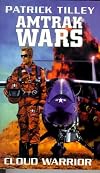
A quite decent post-apocalypic tale with western overtones. It does however slow quite a bit around the half-way mark.
Its also a very particular westernie. Dances with Wolves, which has been done in sci-fi fashion on other occasions most notably Avatar, although Enemy Mine is similar .
I was one of the few who quite disliked the big film mentioned above, and was actually rooting for the bad guys frankly :P . This however is a better rendition of the story with multiple pretty decent show more characters.
Ultimately though its still a Chosen One narrative with a lot more ‘magic’ than i was expecting in a sci-fi dystopia and goes very heavy on the predestination which, as usual with prophecy, robs events of a lot of their urgency.
There’s also some minor problems such as some stupid future-speak, although not as bad as the like of the kids from Beyond Thunder Dome.
Finally this one is very much a Book One which comes with its own issues.
Edit: It just occurred to me that this makes an interesting juxtaposition with the Time Machine, where the surface dwellers here are physically repulsive rather than the underground ones but the underground dwellers are still the monstrous ones.... show less
Its also a very particular western
I was one of the few who quite disliked the big film mentioned above, and was actually rooting for the bad guys frankly :P . This however is a better rendition of the story with multiple pretty decent show more characters.
Ultimately though its still a Chosen One narrative with a lot more ‘magic’ than i was expecting in a sci-fi dystopia and goes very heavy on the predestination which, as usual with prophecy, robs events of a lot of their urgency.
There’s also some minor problems such as some stupid future-speak, although not as bad as the like of the kids from Beyond Thunder Dome.
Finally this one is very much a Book One which comes with its own issues.
Edit: It just occurred to me that this makes an interesting juxtaposition with the Time Machine, where the surface dwellers here are physically repulsive rather than the underground ones but the underground dwellers are still the monstrous ones.... show less

This is hardly 'LITERATURE', but the central premise is so strong, and it's implications played out with such panache that some 20 years after first reading it, it's still a favourite. A body is found in a Manhattan hospital, with puncture marks in hands, feet and sides. It is, of course, Christ - time-travelling between Biblical times and the present day. It's a real page turner, with terrific backstory, and a final few pages that had the hairs on the back of my neck at full attention.

My reactions to reading this novel in 2002.
This is another book I read that allegedly was influenced by Charles Fort. I couldn't see it myself. There is a sort of vague "We're property." flavor about it with talk that man be the result of genetic engineering or visited, a la Erich von Daniken (specifically mentioned), by aliens in the past. However, nothing definite is stated. At novel's end, the purpose of the six alien artifacts (perhaps not even extraterrestrial but always there) is not show more clear.
Now, there is nothing wrong with an sf story that shows the unknowableness of the alien. But I didn't get the impression that Tilley was seriously trying to do such a story.
This book is a definite creature of the seventies, specifically of the blockbuster thriller variety. The chapters are short, and there is a wealth of characters almost none of them developed to the extent of even the archetypal sort found in sf short stories and certainly not as much as you would expect in a 416 page book. (To be fair, Tilley is capable of some humor now and then.)
The setting is an America concerned about an energy shortage and unemployment and inflation. The President's Cabinet is concerned with the Cold War and, rather stereotypically, the Secretary of Defense is a hawkish sort who seems to irrationally distrust Russia and will brook no trade with China. (To be fair, his suspiciousness of the Russians is partly justified.) Air Force General Mitch Allbright (something of a pun) is apocalyptically fascinated with the nukes under his charge. However, he keeps his apocalyptic desires reined in and heroically is ready to sacrifice himself.
The "scientific concerns" are very much of the seventies. Not only do we have talk of human-dolphin communication and "machine intelligence" and the genetic memory inherent in RNA (discredited as far as I know, at least in humans, but it shows up in seventies sf a fair amount) but also more dubious items like pyramid power, ancient astronauts, and, surprisingly, the medieval notion of the psychological states of women affecting the fetuses they carry. Tilley's ultimate plot is muddled though. It seems that the alien has helped man develop latent psychic powers, put him in touch with a cosmic consciousness which gives him an immortality of sorts (there is a lot here about myths being true) by immersion in it, but it's not explained why the alien has to end technological civilization by eliminating technologically generated electricity. (This reminded me of Frederic Brown's "The Waveries" and the fondly remembered The Day the Machines Stopped by Christopher Anvil, the first sf disaster novel I ever read.)
There is a disturbing notion at novel's end, an end which would be where most sf writers would start the story: that man will be better off having to start over (though it is acknowledged that millions will probably die). Tilley seems to imply that such a reset of civilization will enable us to get things right this time, that we'll play our own music rather than listen to recordings and our scientists won't be so upset by findings that contradict their theories (which is a hackneyed and untrue view of science).
On the other hand, this was in the exploring-the-alien-artifact subgenre that I like, and there are also very few sf novels set in eastern Montana, specifically the fictional locale of Crow Ridge, slightly northwest of Miles City (in which scenes are set). Tilley did a pretty good job briefly describing the area, and it was fun to read a novel set around places I know. But, if it wasn't for those last two items, this novel would have been very disappointing. show less
This is another book I read that allegedly was influenced by Charles Fort. I couldn't see it myself. There is a sort of vague "We're property." flavor about it with talk that man be the result of genetic engineering or visited, a la Erich von Daniken (specifically mentioned), by aliens in the past. However, nothing definite is stated. At novel's end, the purpose of the six alien artifacts (perhaps not even extraterrestrial but always there) is not show more clear.
Now, there is nothing wrong with an sf story that shows the unknowableness of the alien. But I didn't get the impression that Tilley was seriously trying to do such a story.
This book is a definite creature of the seventies, specifically of the blockbuster thriller variety. The chapters are short, and there is a wealth of characters almost none of them developed to the extent of even the archetypal sort found in sf short stories and certainly not as much as you would expect in a 416 page book. (To be fair, Tilley is capable of some humor now and then.)
The setting is an America concerned about an energy shortage and unemployment and inflation. The President's Cabinet is concerned with the Cold War and, rather stereotypically, the Secretary of Defense is a hawkish sort who seems to irrationally distrust Russia and will brook no trade with China. (To be fair, his suspiciousness of the Russians is partly justified.) Air Force General Mitch Allbright (something of a pun) is apocalyptically fascinated with the nukes under his charge. However, he keeps his apocalyptic desires reined in and heroically is ready to sacrifice himself.
The "scientific concerns" are very much of the seventies. Not only do we have talk of human-dolphin communication and "machine intelligence" and the genetic memory inherent in RNA (discredited as far as I know, at least in humans, but it shows up in seventies sf a fair amount) but also more dubious items like pyramid power, ancient astronauts, and, surprisingly, the medieval notion of the psychological states of women affecting the fetuses they carry. Tilley's ultimate plot is muddled though. It seems that the alien has helped man develop latent psychic powers, put him in touch with a cosmic consciousness which gives him an immortality of sorts (there is a lot here about myths being true) by immersion in it, but it's not explained why the alien has to end technological civilization by eliminating technologically generated electricity. (This reminded me of Frederic Brown's "The Waveries" and the fondly remembered The Day the Machines Stopped by Christopher Anvil, the first sf disaster novel I ever read.)
On the other hand, this was in the exploring-the-alien-artifact subgenre that I like, and there are also very few sf novels set in eastern Montana, specifically the fictional locale of Crow Ridge, slightly northwest of Miles City (in which scenes are set). Tilley did a pretty good job briefly describing the area, and it was fun to read a novel set around places I know. But, if it wasn't for those last two items, this novel would have been very disappointing. show less
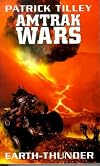
This is the last book of the Amtrak Wars series. I'm much less comfortable with Steven's character in this book -- he's always been a bit mixed up, and I don't blame him for that given his background, but in this book he's actively disloyal to those he loves, which is something new. That made the first 50 or so pages of this book quite hard to read, because I find it hard to read books where I hate the main protagonist.
A lot of people complain about the ending of this book, especially as its show more the last Amtrak Wars book written, but doesn't resolve the main plot line. I didn't think it was that bad though, although perhaps that's because the coda didn't appear in earlier versions? The coda resolves a lot for me, and although the ending is sad, I thought it was fair.
I liked this book overall.
http://www.stillhq.com/book/Patrick_Tilley/Earth_Thunder.html show less
A lot of people complain about the ending of this book, especially as its show more the last Amtrak Wars book written, but doesn't resolve the main plot line. I didn't think it was that bad though, although perhaps that's because the coda didn't appear in earlier versions? The coda resolves a lot for me, and although the ending is sad, I thought it was fair.
I liked this book overall.
http://www.stillhq.com/book/Patrick_Tilley/Earth_Thunder.html show less
Lists
You May Also Like


Associated Authors
Statistics
- Works
- 14
- Also by
- 3
- Members
- 2,842
- Popularity
- #9,028
- Rating
- 3.3
- Reviews
- 18
- ISBNs
- 94
- Languages
- 2
- Favorited
- 2