
Janny Wurts
Author of Daughter of the Empire
About the Author
Janny Wurts Janny Wurst began her writing career while still in high school, when she wrote several novels which she never published. After graduation and a self-financed trip to Europe, Wurts knew that she wanted to create something spectacular but needed life experiences to add a flavor of show more reality to it. While still in college, she conceived the idea for "The Wars of Light and Shadow." But she was also drawn to painting, and first achieved success as a commercial illustrator for major New York publishing houses, with the intention of using her skill to create covers for her own books. After years of working as an illustrator, Wurts sold her first novel, "Sorcerer's Legacy," in 1982. It was followed by the "Cycle of Fire" coming of age trilogy: "Stormwarden" in 1984, "Keeper of the Keys" in 1986 and "Shadowfane" in 1988. Raymond E. Feist, a fellow fantasy author, asked Wurts to co-author a series set on the Tsurani world that he had created. The resulting Empire trilogy of "Daughter of the Empire," published in 1987, "Servant of the Empire" in 1990 and "Mistress of the Empire" in 1992, was an international bestseller which placed Wurts in the spotlight and named her a true fantasy writer. The project for which she is best known is the "Wars of Light and Shadow" series, of which new stories are still being written. (Bowker Author Biography) show less
Series
Works by Janny Wurts
Empire Trilogy: Daughter of the Empire • Servant of the Empire • Mistress of the Empire (2012) 54 copies
Cat Call 911 1 copy
Triad 1 copy
Moebius Trip 1 copy
Grimdark Magazine Issue #46 1 copy
Finder's Keeper 1 copy
Associated Works
Evil Is a Matter of Perspective: An Anthology of Antagonists (2017) — Contributor — 94 copies, 3 reviews
The Best Science Fiction of the Year #13 (1984) — Cover artist, some editions — 68 copies, 2 reviews
Tagged
Common Knowledge
- Legal name
- Wurts, Janny
- Birthdate
- 1953-12-10
- Gender
- female
- Occupations
- fantasy novelist
illustrator - Organizations
- Science Fiction and Fantasy Writers of America (SFWA)
- Awards and honors
- British Fantasy Award Nominee (Anthology / Collection, 1995)
Best Cover Illustration/Hardcover (A.S.F. A. 1994) - Agent
- Jonathan Matson (Harold Matson Agency)
- Relationships
- Maitz, Don (husband)
- Nationality
- USA
- Birthplace
- Bryn Mawr, Pennsylvania, USA
- Places of residence
- Florida, USA
- Associated Place (for map)
- USA
Members
Discussions
Oct Fantasy Thread - SPOILERS - Curse of the Mistwraith - Wurts Joining Us! in The Green Dragon (November 2017)
Oct Fantasy Thread - NO SPOILERS - Curse of the Mist Wraith - Wurts Joining Us! in The Green Dragon (March 2015)
Fantasy, Sorcerer's wife in Name that Book (May 2011)
Book Discussion: To Ride Hell's Chasm - SPOILER FREE thread in The Green Dragon (December 2009)
Reviews

Wow. This is truly epic fantasy at it's most epic. 50 years in the writing, yes the stunning conclusion to is totally worth the wait. Like the entire 10 book preceding series, it is not 'easy' reading, it is not light fantasy, you have to remember a lot of details and understand the implications of (sometimes very short) scenes which will impact much later. Even at 900 pages, not all the details are given to you, events skip forward in long gaps of time, but prophecies may come true - if show more everyone has the courage to make bold choices. Needless to say, you do really have to have read the whole series (or at least re-read from Initiate's trial), and be prepared to commit to chunks of intense reading to savour the intricacy.
Song picks up fairly shortly after Destiny's Conflict, Arithon sees the Fellowship's choice of allowing his sanctioned heir to die on the Temple's pyre, as a betrayal - it circumvented the Korinthian plots and saved other complications, but he would have found another course. Once recovered he devotes his considerable abilities to shearing all ties, debts and coercions so that he can pursue his own course according to his Own free will. This causes consternation among his allies and all the powers who would support him, but he will not be swayed. But Arithorn is not the only force in the world, and the dragons (some of the best fantasy dragons ever written, truly unconstrained power) are enticed to consider the concept of not-dragon! and where this might place their Compact. the Fellowship sorcerers are over-stretched again, but the faint hopes of restoration to full power and return of the Pavarians' they are sworn to safeguard, are not yet extinguished, even though more dire choices are left - sometime humanity will have to stand on it's own merits, against the risk of being banished from the world forever.
The final stakes are indeed world-shaping, and didn't go in the direct I was expecting. There is quite a protracted period of time, much of the last quarter or so, when you genuinely don't know how it's all going to play out, which after 10 books is incredible writing. It does all wrap up, the ending is absolutely perfect, there are no loose strands, every character meets their destiny one way or the other. That said, I haven't given it 5* which the earliest books did achieve. Even at 900 pages it sometimes feels, well not rushed, but significant events skipped through. I would have liked more details in some places, and perhaps less focus elsewhere. I never really did buy into the harmonic frequency uplifts which is the premise behind much of the 'magic' in the world.
It's an amazing series, one of the best epic fantasy I've ever read, it does genuinely have depth, history and backstory to be compared to Tolkein, which is not something I've ever said before. It is very long, very committing reading, but utterly engrossing with amazing characters performing amazing deeds against an amazing world. show less
Song picks up fairly shortly after Destiny's Conflict, Arithon sees the Fellowship's choice of allowing his sanctioned heir to die on the Temple's pyre, as a betrayal - it circumvented the Korinthian plots and saved other complications, but he would have found another course. Once recovered he devotes his considerable abilities to shearing all ties, debts and coercions so that he can pursue his own course according to his Own free will. This causes consternation among his allies and all the powers who would support him, but he will not be swayed. But Arithorn is not the only force in the world, and the dragons (some of the best fantasy dragons ever written, truly unconstrained power) are enticed to consider the concept of not-dragon! and where this might place their Compact. the Fellowship sorcerers are over-stretched again, but the faint hopes of restoration to full power and return of the Pavarians' they are sworn to safeguard, are not yet extinguished, even though more dire choices are left - sometime humanity will have to stand on it's own merits, against the risk of being banished from the world forever.
The final stakes are indeed world-shaping, and didn't go in the direct I was expecting. There is quite a protracted period of time, much of the last quarter or so, when you genuinely don't know how it's all going to play out, which after 10 books is incredible writing. It does all wrap up, the ending is absolutely perfect, there are no loose strands, every character meets their destiny one way or the other. That said, I haven't given it 5* which the earliest books did achieve. Even at 900 pages it sometimes feels, well not rushed, but significant events skipped through. I would have liked more details in some places, and perhaps less focus elsewhere. I never really did buy into the harmonic frequency uplifts which is the premise behind much of the 'magic' in the world.
It's an amazing series, one of the best epic fantasy I've ever read, it does genuinely have depth, history and backstory to be compared to Tolkein, which is not something I've ever said before. It is very long, very committing reading, but utterly engrossing with amazing characters performing amazing deeds against an amazing world. show less
Daughter of the Empire: An Epic Saga of the World on the Other Side of the Riftwar (Riftwar Cycle: The Empire Trilogy) by Raymond E. Feist
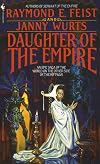
Surprisingly good, given how boring and cardboard Feist's Midkemia characters tend to be. The protagonist is not really a nice person--she is a slaver after all-but she is interesting, and I was caught up in her courtly intrigues. It is tempting to attribute the uptick in quality to departing the generic Tolkien-esque Midkemia setting for the vaguely Asian/Mesoamerican Kelewan. In reality, I suspect Feist's coauthor Jenny Wurts deserves the credit. My main complaint is that the novel focuses show more on how the protagonist navigates the aristocratic circles of the Tsuranuanni Empire, governed by byzantine rules of honor and gentility, and often the narrative progresses by the authors introducing a new rule that works in favor of the protagonist. It is a common trope in science fiction but oh well. show less
Unfortunately, this book unambiguously disappointed me compared to the first book, primarily due to 1) Mara's incompetence, 2) the Midkemian slave plot device, and 3) the boring pace. In the first book, Mara makes mistakes, since she is a callow player of the Game, after all, recently torn from a convent of all places, but at the same time she shows flashes of brilliance, and executes a plot from end-to-end all on her own. In the second book, Mara loses all her competence - she receives show more accolades from enemies and allies alike, but never does she actually show, through her plans and actions, that she knows what she is doing, that she is a master strategist, that she's achieving her goals through her ability rather than luck or the ability of her subordinates.
I knew about and dreaded going in the Midkemian slave - he was every bit as annoying as I feared, and then some. Just as in the first Riftwar trilogy, I found the declared cultural superiority of Midkema over Kelewan to be racist and repellent. His relationship with Mara just exacerbated the annoying place he had in the plot and her character's development.
Finally, I had trouble staying awake through this book. It suffered from the uneven pacing of Feist's first Riftwar trilogy, and even worse, on multiple occasions it built up suspense only to switch perspectives at the climax so you didn't even know what happened much less get to experience the visceral payoff. I couldn't understand the decision to make the book so much less compelling than it could've been.
I had hopes that the trilogy would live up to the promise of the first book, but I'm going to have to pass on the third book. Servant of the Empire felt like a huge waste of time, and I have no reason to believe that the third book won't be even worse. show less
I knew about and dreaded going in the Midkemian slave - he was every bit as annoying as I feared, and then some. Just as in the first Riftwar trilogy, I found the declared cultural superiority of Midkema over Kelewan to be racist and repellent. His relationship with Mara just exacerbated the annoying place he had in the plot and her character's development.
Finally, I had trouble staying awake through this book. It suffered from the uneven pacing of Feist's first Riftwar trilogy, and even worse, on multiple occasions it built up suspense only to switch perspectives at the climax so you didn't even know what happened much less get to experience the visceral payoff. I couldn't understand the decision to make the book so much less compelling than it could've been.
I had hopes that the trilogy would live up to the promise of the first book, but I'm going to have to pass on the third book. Servant of the Empire felt like a huge waste of time, and I have no reason to believe that the third book won't be even worse. show less
Very intense and emotional epic fantasy of mature scope and depth, a book that can be experienced as a self-contained story yet it's the stage setter of a longer series, which I'm currently reading and enjoying immensely.
I loved the richly detailed and researched descriptions and the harmonic world-building, full of lore and history. Athera is a world of ancient mysteries, guarded by sorcerers and enchantresses, sundered by internal strife and molded by the fears and hopes of his show more inhabitants. Both the plot and the relationships between characters are deep and layered, granting unexpected twists and unpredictable turns of events, all presented with the striking vibrancy of Janny Wurts' boundless imagination and lyric style.
The story opens with a grave prologue and shows the long-lasting all-consuming hate between two kingdoms in the world of Dascen Elur, and the dictates of a five-century-old prophecy which promises restoration and disruption in another world. Two princes, apparently the embodiment of good and evil, unwittingly are entangled by the coils of fate and thrown (literally) into an epic journey of unknown consequences.
Arithon, a small, lithe man who struggles between an emphatic core that craves harmony and the expectations of others that want him to be a hero.
Lysaer, a stalwart, handsome and charming man born and breed to the crown, driven by an innate hunger for justice and looking for a purpose to cope with the loss of his birthright.
They are the only hope to free the world of Athera from the vices of the unnatural mist which covers the sun and corrupts the life on the land, but nurtured in misunderstandings and mutual hurt, the elusive balance between them is soon to tip the scale against all auguries.
My first foray into the series was with Child of Prophecy, a short story set on the world of Athera centuries earlier than Mistwraith's opening, and some names and facts sounded familiar, it was more immediate to gain reading momentum and go past the first pages where the massive context-shaping leaves the reader a little disoriented, but soon follows the first unveiling of Arithon's demeanor and Lysaer's resolve as the Sorcerers give insight of the princes duty to Athera's plight.
I'm very glad I've discovered this fantasy gem of deepest complexity and stylistic brilliance, featuring unforgettable adult protagonists, a well-rounded cast of characters and a compelling, thought-provoking tale that engaged me at every level, and had me run for the following book, The Ships of Merior. show less
I loved the richly detailed and researched descriptions and the harmonic world-building, full of lore and history. Athera is a world of ancient mysteries, guarded by sorcerers and enchantresses, sundered by internal strife and molded by the fears and hopes of his show more inhabitants. Both the plot and the relationships between characters are deep and layered, granting unexpected twists and unpredictable turns of events, all presented with the striking vibrancy of Janny Wurts' boundless imagination and lyric style.
The story opens with a grave prologue and shows the long-lasting all-consuming hate between two kingdoms in the world of Dascen Elur, and the dictates of a five-century-old prophecy which promises restoration and disruption in another world. Two princes, apparently the embodiment of good and evil, unwittingly are entangled by the coils of fate and thrown (literally) into an epic journey of unknown consequences.
Arithon, a small, lithe man who struggles between an emphatic core that craves harmony and the expectations of others that want him to be a hero.
Lysaer, a stalwart, handsome and charming man born and breed to the crown, driven by an innate hunger for justice and looking for a purpose to cope with the loss of his birthright.
They are the only hope to free the world of Athera from the vices of the unnatural mist which covers the sun and corrupts the life on the land, but nurtured in misunderstandings and mutual hurt, the elusive balance between them is soon to tip the scale against all auguries.
My first foray into the series was with Child of Prophecy, a short story set on the world of Athera centuries earlier than Mistwraith's opening, and some names and facts sounded familiar, it was more immediate to gain reading momentum and go past the first pages where the massive context-shaping leaves the reader a little disoriented, but soon follows the first unveiling of Arithon's demeanor and Lysaer's resolve as the Sorcerers give insight of the princes duty to Athera's plight.
I'm very glad I've discovered this fantasy gem of deepest complexity and stylistic brilliance, featuring unforgettable adult protagonists, a well-rounded cast of characters and a compelling, thought-provoking tale that engaged me at every level, and had me run for the following book, The Ships of Merior. show less
Lists
Awards


You May Also Like


Associated Authors
Statistics
- Works
- 62
- Also by
- 34
- Members
- 21,929
- Popularity
- #981
- Rating
- 4.0
- Reviews
- 360
- ISBNs
- 244
- Languages
- 8
- Favorited
- 73


