This topic is currently marked as "dormant"—the last message is more than 90 days old. You can revive it by posting a reply.
2QuentinTom
bloody hell, what happened there?
shit.
apologies everyone. It's supposed to say Tomcatmurr's reading part 2. now there's no way of changing it.
dontcha love technology?
shit.
apologies everyone. It's supposed to say Tomcatmurr's reading part 2. now there's no way of changing it.
dontcha love technology?
3QuentinTom
Tomcatmurr's reading Part 2
5RickHarsch
so, superious, are you suggesting the title should be 'Eating Tomcatmurr's Biscuits'? I like it.
6A_musing
No more is needed. We understand.
I brought a snack to your housewarming:

Also, a little bauble:

I brought a snack to your housewarming:
Also, a little bauble:
7LolaWalser
Yes, Hugo is short for HUge eGO--but sometimes that's a trip. He was a megastar, after all, and if he fancied himself as the Improver of Mankind, it serves to remember the masses who saw him as one (and the governments who persecuted him as one!) Besides, a certain earnestness, didacticism, "principles" (all the things that make him so suitable for children, btw) were in evidence in most 19th century literature (in England no less--I agree completely with whoever said George Eliot was the first Victorian to write for adults). One can almost see a reaction in it to the previous centuries, the ironic and sophisticated eighteenth especially, when culture was still reserved for the noble. The first (and not the last) demotion of taste, in a way, with the rise of the mass man.
8QuentinTom
oh how delicious! Yum yum.
Interesting stuff on Korzybski, Por, thanks for the link.
Interesting stuff on Korzybski, Por, thanks for the link.
10Macumbeira
If I was sitting in a sailors bar on Guernesey with Hugo....
I would say, Victor, mon ami, tell me again the story of Gilliat and the octopus...imitate the whistling and the barking noises of that dreadfull monster, tell me how the grotto looked inside and the rushing of the water between the stones... tell me tentacle by tentacle how the pieuvre would try to pull the sailor towards his beak and the unspeakable horror of it all...
I would say, Victor, mon ami, tell me again the story of Gilliat and the octopus...imitate the whistling and the barking noises of that dreadfull monster, tell me how the grotto looked inside and the rushing of the water between the stones... tell me tentacle by tentacle how the pieuvre would try to pull the sailor towards his beak and the unspeakable horror of it all...
11LolaWalser
If I was sittin' in a sailors' bar on Guernsey with Victor Hugo, I'd say, I'd say, Victor, cheri, Victor, mon chou, tell me again, what would you do, if you were an octopus young and vigorous; tentacle by tentacle retell the horrid spectacle- with sound effects!--the whistling, the barking, the snorting, the sucking, the ripping and hollowing, the water rushing between the stones, the cracking of bones, the tweak of your mighty beak, the unspeakable joy of it all...
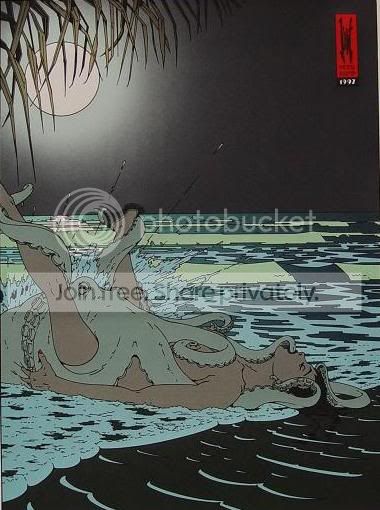
12QuentinTom
OMG!
HHAAHAH.
(Can someone please empty my litter tray. I think I may have wet myself.)
HHAAHAH.
(Can someone please empty my litter tray. I think I may have wet myself.)
13QuentinTom
If I was sitting in a sailors bar on Guernesey with Hugo....
I would say, Victor, mon pot, mon petit crapeau, mon fleur, tell me again about the battle of Waterloo, le mot du Combray, the charge of the lancers, the lion mound. Tell me about the slang of Paris, the assassins and hookers, and the cemeteries of the poor.
And then, talk to me of Baudelaire, poor penniless Baudelaire, who died of the pox, wordless and spleenfilled.
I would say, Victor, mon pot, mon petit crapeau, mon fleur, tell me again about the battle of Waterloo, le mot du Combray, the charge of the lancers, the lion mound. Tell me about the slang of Paris, the assassins and hookers, and the cemeteries of the poor.
And then, talk to me of Baudelaire, poor penniless Baudelaire, who died of the pox, wordless and spleenfilled.
14Macumbeira
LOLOLOLOLOLAAAAAAAAAAAAAAAAAAAAAAAAAAAAAAAAAAAAAAAAAAAAAAAAAAAAAAAAAAAAAAAAAAAAAAAAAAAAAAAAAAAAAAAAAAAAAAAAAAAAAAAAAAAAAAAAAAAAAAAAAAA

16Macumbeira
Wohahahahaha she keeps doing it !!!!!
17QuentinTom
oooooo lala!
18Macumbeira
Can we put the squitty picture as the new logo of " la salope erotique du poulpe pour le poulpe" ?
19beelzebubba
11: Lola, just when I thought I'd seen everything...
20LolaWalser
#18
Vere ees zis salope? And how much does shee charge?
#19
Googling "octopus hentai" will reveal many unusual NOT-SAFE-FOR-WORK sights. So I'm told.
Vere ees zis salope? And how much does shee charge?
#19
Googling "octopus hentai" will reveal many unusual NOT-SAFE-FOR-WORK sights. So I'm told.
21Macumbeira
Guys and Gals, I am leaving you now, have some henta... euh work to do
22Macumbeira
zee charges whatzever zee wants. A Freulein like tees has no prees
23QuentinTom
all right then, moving on.
in other news today, the last two speakers of Ayapaneco refuse to talk to each other, hastening the extinction of this centuries old language. Sounds like a parable.
http://www.guardian.co.uk/world/2011/apr/13/mexico-language-ayapaneco-dying-out
in other news today, the last two speakers of Ayapaneco refuse to talk to each other, hastening the extinction of this centuries old language. Sounds like a parable.
http://www.guardian.co.uk/world/2011/apr/13/mexico-language-ayapaneco-dying-out
24Macumbeira
Funny but sad too.
25QuentinTom
It's been a busy week here at the Casa Murr, but my reading of Les Mis continues apace. I am now about three quarters of the way through. I have decided to devote probably the rest of the year to reading French lit. (Hopefully it won't take me that long to finish Les Mis.) Looking in my library, I think I have enough french material I have not yet read to last me at least six months. Also, I plan to buy more in Paris in May. I am dying to read more Baudelaire, all his prose, and his letters, if I can find them in English.
I found an online link to Baudelaire's review of Les Mis (in French) and have been slowly reading my way through that. I am at the point with my french where I can get all of the words, but not always coalesce them together to create a meaning I am certain of. B was publicly very positive about Hugo's book, but in private he told his mother he thought it 'vile and inept'. Hugo's didacticism he called a 'heresy'. In the debate on the purpose of art, I am on Baudelaire's side.
Les Mis continues to astound me. The ambuscade section, and the prison escapes are brilliantly well done, and Gavroche sleeping in the elephant is an unforgettable image. The historical sections were very interesting and informative, the chapter on Louis Philippe is one of the best character descriptions of a real person I have ever read. The shade of LP should count himself lucky to be immortalised so faithfully and so sensitively, and so fairly. The sections on argot are also fascinating.
And then last night, I read this love scene between Marius and Cosette which was so baaaaaaaad it had me howling with laughter.
He threw himself against a tree which was close at hand, erect, his brow pressed close to the bark, feeling neither the wood which flayed his skin, nor the fever which was throbbing in his temples, and there he stood motionless, on the point of falling, like the statue of despair.
He remained a long time thus. One could remain for eternity in such abysses. At last he turned round. He heard behind him a faint stifled noise, which was sweet yet sad.
It was Cosette sobbing.
She had been weeping for more than two hours beside Marius as he meditated.
He came to her, fell at her knees, and slowly prostrating himself, he took the tip of her foot which peeped out from beneath her robe, and kissed it.
She let him have his way in silence. There are moments when a woman accepts, like a sombre and resigned goddess, the religion of love.
"Do not weep," he said.
She murmured:--
"Not when I may be going away, and you cannot come!"
He went on:--
"Do you love me?"
She replied, sobbing, by that word from paradise which is never more charming than amid tears:--
"I adore you!"
He continued in a tone which was an indescribable caress:--
"Do not weep. Tell me, will you do this for me, and cease to weep?"
"Do you love me?" said she.
He took her hand.
"Cosette, I have never given my word of honor to any one, because my word of honor terrifies me. I feel that my father is by my side. Well, I give you my most sacred word of honor, that if you go away I shall die."
wait, it gets better:
"Then I will pray to God and I will think of you here, so that you may be successful. I will question you no further, since you do not wish it. You are my master. I shall pass the evening to-morrow in singing that music from Euryanthe that you love, and that you came one evening to listen to, outside my shutters. But day after to-morrow you will come early. I shall expect you at dusk, at nine o'clock precisely, I warn you. Mon Dieu! how sad it is that the days are so long! On the stroke of nine, do you understand, I shall be in the garden."
"And I also."
And without having uttered it, moved by the same thought, impelled by those electric currents which place lovers in continual communication, both being intoxicated with delight even in their sorrow, they fell into each other's arms, without perceiving that their lips met while their uplifted eyes, overflowing with rapture and full of tears, gazed upon the stars.
Oh lala. I mean, I know the gap between the 19th century and the 21st century sensibility and all that, but that really is inept!
Here is an illustration from the original edition of LM, 1862, by Gustave Brion:

The Thenardeires
I found an online link to Baudelaire's review of Les Mis (in French) and have been slowly reading my way through that. I am at the point with my french where I can get all of the words, but not always coalesce them together to create a meaning I am certain of. B was publicly very positive about Hugo's book, but in private he told his mother he thought it 'vile and inept'. Hugo's didacticism he called a 'heresy'. In the debate on the purpose of art, I am on Baudelaire's side.
Les Mis continues to astound me. The ambuscade section, and the prison escapes are brilliantly well done, and Gavroche sleeping in the elephant is an unforgettable image. The historical sections were very interesting and informative, the chapter on Louis Philippe is one of the best character descriptions of a real person I have ever read. The shade of LP should count himself lucky to be immortalised so faithfully and so sensitively, and so fairly. The sections on argot are also fascinating.
And then last night, I read this love scene between Marius and Cosette which was so baaaaaaaad it had me howling with laughter.
He threw himself against a tree which was close at hand, erect, his brow pressed close to the bark, feeling neither the wood which flayed his skin, nor the fever which was throbbing in his temples, and there he stood motionless, on the point of falling, like the statue of despair.
He remained a long time thus. One could remain for eternity in such abysses. At last he turned round. He heard behind him a faint stifled noise, which was sweet yet sad.
It was Cosette sobbing.
She had been weeping for more than two hours beside Marius as he meditated.
He came to her, fell at her knees, and slowly prostrating himself, he took the tip of her foot which peeped out from beneath her robe, and kissed it.
She let him have his way in silence. There are moments when a woman accepts, like a sombre and resigned goddess, the religion of love.
"Do not weep," he said.
She murmured:--
"Not when I may be going away, and you cannot come!"
He went on:--
"Do you love me?"
She replied, sobbing, by that word from paradise which is never more charming than amid tears:--
"I adore you!"
He continued in a tone which was an indescribable caress:--
"Do not weep. Tell me, will you do this for me, and cease to weep?"
"Do you love me?" said she.
He took her hand.
"Cosette, I have never given my word of honor to any one, because my word of honor terrifies me. I feel that my father is by my side. Well, I give you my most sacred word of honor, that if you go away I shall die."
wait, it gets better:
"Then I will pray to God and I will think of you here, so that you may be successful. I will question you no further, since you do not wish it. You are my master. I shall pass the evening to-morrow in singing that music from Euryanthe that you love, and that you came one evening to listen to, outside my shutters. But day after to-morrow you will come early. I shall expect you at dusk, at nine o'clock precisely, I warn you. Mon Dieu! how sad it is that the days are so long! On the stroke of nine, do you understand, I shall be in the garden."
"And I also."
And without having uttered it, moved by the same thought, impelled by those electric currents which place lovers in continual communication, both being intoxicated with delight even in their sorrow, they fell into each other's arms, without perceiving that their lips met while their uplifted eyes, overflowing with rapture and full of tears, gazed upon the stars.
Oh lala. I mean, I know the gap between the 19th century and the 21st century sensibility and all that, but that really is inept!
Here is an illustration from the original edition of LM, 1862, by Gustave Brion:

The Thenardeires
26Macumbeira
Ah comon Tomcat, where is you romantic soul ? Do you never stare at the stars when kissing a loved one?
27theaelizabet
You are not a sombre and resigned goddess so you cannot understand the religion of love.
28Makifat
25
Selected Letters of Charles Baudelaire: The Conquest of Solitude, translated/edited by Rosemary Lloyd, is good, but let me know if you find a more recent collection of his letters. (I also have a volume of letters from his youth, but haven't looked at it in ages.). And don't forget to look into the The Intimate Journals, translated by Isherwood with an introduction by Auden.
Selected Letters of Charles Baudelaire: The Conquest of Solitude, translated/edited by Rosemary Lloyd, is good, but let me know if you find a more recent collection of his letters. (I also have a volume of letters from his youth, but haven't looked at it in ages.). And don't forget to look into the The Intimate Journals, translated by Isherwood with an introduction by Auden.
29QuentinTom
>26 Macumbeira:, 27 HA!
I tried it last night with my partner, but we both looked really silly. try it with yours. you'll see what I mean.
>28 Makifat: Oh Maki, excellent for the letters link, thanks. I already have the journals on my list, along with the Modern Painter and the artificial paradises.
There's also the novel Les derniers jours de Charles Baudelaire by Levy, which I am itching to read, but I don't think it's translated into English. I"ll check it out when I'm in Paris and see whether I can tackle it in French. Gulp.
One of the places I'm planning on dragging my long suffering partner to is Shakespeare and Company.
http://www.shakespeareandcompany.com/
I tried it last night with my partner, but we both looked really silly. try it with yours. you'll see what I mean.
>28 Makifat: Oh Maki, excellent for the letters link, thanks. I already have the journals on my list, along with the Modern Painter and the artificial paradises.
There's also the novel Les derniers jours de Charles Baudelaire by Levy, which I am itching to read, but I don't think it's translated into English. I"ll check it out when I'm in Paris and see whether I can tackle it in French. Gulp.
One of the places I'm planning on dragging my long suffering partner to is Shakespeare and Company.
http://www.shakespeareandcompany.com/
30QuentinTom
Auden on Baudelaire. I am moist at the very thought.
31QuentinTom
I mean, I don't mean literally Auden on Baudelaire. I mean Auden writing on Baudelaire.
Just wanted to remove any ambiguity there.
Just wanted to remove any ambiguity there.
33Porius
The breeze - the breath of God - is still,
And the mist upon the hill,
Shadowy - shadowy - yet unbroken,
Is a symbol and a token -
How it hangs upon the trees,
A mystery of mysteries!
And the mist upon the hill,
Shadowy - shadowy - yet unbroken,
Is a symbol and a token -
How it hangs upon the trees,
A mystery of mysteries!
34Porius
THE DOG AND THE SCENT-BOTTLE
Come here, my dear, good, beautiful doggie, and nose this delicious scent which comes from the bestest perfumer in Paris.
And the dog, tail swinging, which, I believe, is that poor creature's way of laughing and smiling (smirking), came up and stuck his curious snout on the uncorked bottle. Then, in a flash, it backed away in a snit, barking at me all the while.
'Ah miserable cur, if I had tendered you a sack of shit you would have sniffed at it for all you were worth and devoured it into the bargain. In this you resemble the voters, they should never be offered exquisite scents, which they cannot begin to appreciate, but only painstakingly selected piffle - right up their alley, no?'
Come here, my dear, good, beautiful doggie, and nose this delicious scent which comes from the bestest perfumer in Paris.
And the dog, tail swinging, which, I believe, is that poor creature's way of laughing and smiling (smirking), came up and stuck his curious snout on the uncorked bottle. Then, in a flash, it backed away in a snit, barking at me all the while.
'Ah miserable cur, if I had tendered you a sack of shit you would have sniffed at it for all you were worth and devoured it into the bargain. In this you resemble the voters, they should never be offered exquisite scents, which they cannot begin to appreciate, but only painstakingly selected piffle - right up their alley, no?'
35QuentinTom
Great stuff Por.
I see that I have become iconic.
I see that I have become iconic.
36QuentinTom
I'm going to put a list here of the books I will be hunting down in my trip to Europe. Please comment freely, make additions, alert me as to other stuff you know along these lines, editions/translations to look out for/avoid, etc. I'm going to be looking for stuff I know I cannot get here.
The Arcades Project
Artificial Paradises
The Modern Painter
Intimate Journals
The Conquest of Solitude
Porius
A Glastonbury Romance
Weymouth Sands
Maiden Castle
The Invention of Love
The Venice Letters
Bel Ami
The Arcades Project
Artificial Paradises
The Modern Painter
Intimate Journals
The Conquest of Solitude
Porius
A Glastonbury Romance
Weymouth Sands
Maiden Castle
The Invention of Love
The Venice Letters
Bel Ami
37theaelizabet
Ha! I had just placed an order with the local interlibrary loan system for The Invention of Love after reading the posts by you and Por on the nature thread. By the way, I'm seeing Arcadia this Wednesday.
My copy of Porius arrived last week, also thanks to the aforementioned library system.
Lymond, by the way, rules! He was perfect company for gloomy weather.
My copy of Porius arrived last week, also thanks to the aforementioned library system.
Lymond, by the way, rules! He was perfect company for gloomy weather.
39zenomax
36 - Murr, Walter Benjamin's essays on CB were republished a few years back as The writer of modern life - a play on B's own The Painter of Modern Life.
I don't have them, but would like to. I see them as probably a polished, fleshed out version of the Baudelaire section in The Arcades Project.
I don't have them, but would like to. I see them as probably a polished, fleshed out version of the Baudelaire section in The Arcades Project.
40lilisin
If you're going to be looking for French lit and want to attempt reading in French, then you must *MUST* read the author Romain Gary. Find his Les Racines du Ciel. Gorgeous book! One of my favorites.
41Porius
Inspired by TCM's intended foray into French literature I will be spending an hour a day in Baudelaire, etc. study. I hold no brief for the Frenchman & co., but I enjoy reading misc. items on the subject of C.B. and his countrymen and women. Maupassant happens to be my favorite of the French. Here's an example of the items I will be looking into.
THE SANCTITY OF BAUDELAIRE
A TRANSLATION BY Ch: Isherwood of B's INTIMATE JOURNALS was published in Eng. in 1930, with an intro. by T.S. Eliot. It has now been brought out here for the first time, in a somewhat revised text and with an intro. by W.H.Auden instead of one by TSE, which in the meantime hadbeen included in the vol. of the latters SELECTED ESSAYS and become one of the principal stimuli for the recent vogue of B.
When I speak of B's 'recent vogue,' I do not, of course, mean to imply that his reputation has at any time seriously declined. B. was one of the greatest of French poets, and has been recognized as such by writers of all periods and many schools. But during the last 15 years or so, he has been pressed into service by certain elements in the literary world who want to claim him for their own cause, and his career has been shown in a light which falsifies the meaning of his work. Messers. Eliot, Auden, and Isherwood are all, in their several ways, active champions of Christian doctrine. In times of disillusion with politics, it is usual to find a retreat in the direction of traditional religion, and that is what we have been getting lately. Now, B, after his exploit of 1848, when he leapt on the barricades and shouted 'Down with General Aupick!' (his stepfather), became cynical enough about politics. But this is not enough for Eliot and Auden and Isherwood: they want to have him a good Catholic, too. E. and A. both have attached tremendous importance to the last disjointed entries in his journals, written 4 or 5 yrs. before B. died, in which he alternates programs of diet with desperate expressions of piety. These were dictated, A. believes, by a 'real change of heart.' B. was suffering at the time from the penultimate stage of syphilis. 'I have,' he wrote at this time, 'cultivated my hysteria with delight and terror . . . and today I have received a singular warning . I have felt the wind of the wing of madness pass over me.' 'To the eye of nature,' says Auden, his repentance 'was too late. As he spoke, the bird swooped and struck. But, to the eye of the spirit, we are entitled to believe he was in time - for, though the spirit needs time, an instant of it is enough.'
But B's great book LES FLEURS du MAL, the work by which he is known, had been published years before, and, though its poems in praise of Satan and of Peter's denial of Christ are occasionally set off by the brusque descent of disciplinary angels and by favorable references to Jesus, it is hardly a work of piety. I agree with Anatole France (whose critical point of view has become so unfashionable in the present ay, with the dogmatisms of unsure people) that 'B. is a very bad Christian. He loves sin and deliciously savors the feeling that he is lost to God. He knows that he is being damned, and thereby he renders to the divine wisdom a tribute which will be counted to him for righteousness, but he is intoxicated by the idea of damnation and his appetite for women goes no further than what is necessary to guarantee tht he has definitely forfeited his soul.' (So B. writes in these journals: 'For my part, I say: the sole and supreme pleasure in love lies in the absolute knowledge of doing EVIL. And men and women know, from birth, that in Evil is to found all voluptuousness.') His references to God, says France, were stimulated by egoism. 'In his arrogance he wished to believe that everything he did was important, even his little impurities ; so he wanted them all to be sins that would interest heaven and hell. But at bottom he had only a half-faith. His spirit alone was Christian. His heart and his mind remained empty.'
The puritanical side of the Catholic Church had evidently combined with an Oedipus complex to produce in B. his curious view of love. It is possible to show that religion contributed much else to his work? He had some sympathy of fellow-feeling for the poor and the ignored and the ill. Yet it is characteristic of him that when he writes his memorable poem about the 'big hearted servant' of whom he had been jealous in childhood, he imagines her returning from the grave to weep over his fallen state. This is moving; but so is his satanic pride, and there is a good deal more pride in him than pity. B. is one of the great modern poets, as Eliot and Auden themselves are poets of at least the first rank. Eliot, in ASH WEDNESDAY, can move us when his weakness and chagrin tremble into the accents of prayer; Auden, in his CHRISTMAS ORATORIO, can move us with the spectacle of Joseph and Mary staggered by an Annunciation which seems to be breaking the news of the arrival of a difficult and topflight poet. But are such things as these religion? Are B's angels religion? Aren't they rather literary devices of uncomfortable rationalists who, disgusted by the dullness of democracy, the vulgarity of revolution, have resorted for protection against them to the mythology and animism of childhood? When B. prayed to Poe (not remarkable for his Christian feeling and rather perfunctory about his faith), as he did in the last entry of his journal; when Eliot and Auden and Isherwood invoke the example of B., they are appealing to a passion for literature which has managed to burn pure and intense through suffering and degradation. But what has this to do with the Christian cults for whose rites the churches are built and the parsons and priests ordained?
Edmund Wilson
November 1, 1947
Same year as Varese's translation of PARIS SPLEEN
THE SANCTITY OF BAUDELAIRE
A TRANSLATION BY Ch: Isherwood of B's INTIMATE JOURNALS was published in Eng. in 1930, with an intro. by T.S. Eliot. It has now been brought out here for the first time, in a somewhat revised text and with an intro. by W.H.Auden instead of one by TSE, which in the meantime hadbeen included in the vol. of the latters SELECTED ESSAYS and become one of the principal stimuli for the recent vogue of B.
When I speak of B's 'recent vogue,' I do not, of course, mean to imply that his reputation has at any time seriously declined. B. was one of the greatest of French poets, and has been recognized as such by writers of all periods and many schools. But during the last 15 years or so, he has been pressed into service by certain elements in the literary world who want to claim him for their own cause, and his career has been shown in a light which falsifies the meaning of his work. Messers. Eliot, Auden, and Isherwood are all, in their several ways, active champions of Christian doctrine. In times of disillusion with politics, it is usual to find a retreat in the direction of traditional religion, and that is what we have been getting lately. Now, B, after his exploit of 1848, when he leapt on the barricades and shouted 'Down with General Aupick!' (his stepfather), became cynical enough about politics. But this is not enough for Eliot and Auden and Isherwood: they want to have him a good Catholic, too. E. and A. both have attached tremendous importance to the last disjointed entries in his journals, written 4 or 5 yrs. before B. died, in which he alternates programs of diet with desperate expressions of piety. These were dictated, A. believes, by a 'real change of heart.' B. was suffering at the time from the penultimate stage of syphilis. 'I have,' he wrote at this time, 'cultivated my hysteria with delight and terror . . . and today I have received a singular warning . I have felt the wind of the wing of madness pass over me.' 'To the eye of nature,' says Auden, his repentance 'was too late. As he spoke, the bird swooped and struck. But, to the eye of the spirit, we are entitled to believe he was in time - for, though the spirit needs time, an instant of it is enough.'
But B's great book LES FLEURS du MAL, the work by which he is known, had been published years before, and, though its poems in praise of Satan and of Peter's denial of Christ are occasionally set off by the brusque descent of disciplinary angels and by favorable references to Jesus, it is hardly a work of piety. I agree with Anatole France (whose critical point of view has become so unfashionable in the present ay, with the dogmatisms of unsure people) that 'B. is a very bad Christian. He loves sin and deliciously savors the feeling that he is lost to God. He knows that he is being damned, and thereby he renders to the divine wisdom a tribute which will be counted to him for righteousness, but he is intoxicated by the idea of damnation and his appetite for women goes no further than what is necessary to guarantee tht he has definitely forfeited his soul.' (So B. writes in these journals: 'For my part, I say: the sole and supreme pleasure in love lies in the absolute knowledge of doing EVIL. And men and women know, from birth, that in Evil is to found all voluptuousness.') His references to God, says France, were stimulated by egoism. 'In his arrogance he wished to believe that everything he did was important, even his little impurities ; so he wanted them all to be sins that would interest heaven and hell. But at bottom he had only a half-faith. His spirit alone was Christian. His heart and his mind remained empty.'
The puritanical side of the Catholic Church had evidently combined with an Oedipus complex to produce in B. his curious view of love. It is possible to show that religion contributed much else to his work? He had some sympathy of fellow-feeling for the poor and the ignored and the ill. Yet it is characteristic of him that when he writes his memorable poem about the 'big hearted servant' of whom he had been jealous in childhood, he imagines her returning from the grave to weep over his fallen state. This is moving; but so is his satanic pride, and there is a good deal more pride in him than pity. B. is one of the great modern poets, as Eliot and Auden themselves are poets of at least the first rank. Eliot, in ASH WEDNESDAY, can move us when his weakness and chagrin tremble into the accents of prayer; Auden, in his CHRISTMAS ORATORIO, can move us with the spectacle of Joseph and Mary staggered by an Annunciation which seems to be breaking the news of the arrival of a difficult and topflight poet. But are such things as these religion? Are B's angels religion? Aren't they rather literary devices of uncomfortable rationalists who, disgusted by the dullness of democracy, the vulgarity of revolution, have resorted for protection against them to the mythology and animism of childhood? When B. prayed to Poe (not remarkable for his Christian feeling and rather perfunctory about his faith), as he did in the last entry of his journal; when Eliot and Auden and Isherwood invoke the example of B., they are appealing to a passion for literature which has managed to burn pure and intense through suffering and degradation. But what has this to do with the Christian cults for whose rites the churches are built and the parsons and priests ordained?
Edmund Wilson
November 1, 1947
Same year as Varese's translation of PARIS SPLEEN
42Macumbeira
Wow
43Macumbeira
Any newspaper, from the first line to the last, is nothing but a web of horrors, I cannot understand how an innocent hand can touch a newspaper without convulsing in disgust.
Charles Baudelaire
I am glad I am not alone in this feeling
Charles Baudelaire
I am glad I am not alone in this feeling
44Makifat
Any newspaper, from the first line to the last, is nothing but a web of horrors...
Felix Feneon took lemons and made lemonade...
http://www.librarything.com/work/2596895
Felix Feneon took lemons and made lemonade...
http://www.librarything.com/work/2596895
46QuentinTom
Great stuff, Por. I'm curious now about A's introduction. I would say Baudelaire's work is Catholic only in the sense that Alistair Crowley's was: a reaction to Catholicism couched within the Catholic framework itself.
45, 44, I agree Colette and Feneon are great, but I can find them easily here, so I won't be looking for them in Europe. It's going to be a delicate balancing act between my lust for acquiring books, my budget, and my baggage allowance.
39, Zeno, you read my mind again! I saw that in the bookstore here yesterday, and was almost tempted, but not quite. Now I think I should dash back to get it, like I did with the Barthes. LOl
oh lilisin, thank you! Romain de Gary looks fabulous. Mac, have you come across him? he looks like someone you might enjoy as well. I will definitely look out for him! Looks like the kind of writer NYRB classics should do in English.
45, 44, I agree Colette and Feneon are great, but I can find them easily here, so I won't be looking for them in Europe. It's going to be a delicate balancing act between my lust for acquiring books, my budget, and my baggage allowance.
39, Zeno, you read my mind again! I saw that in the bookstore here yesterday, and was almost tempted, but not quite. Now I think I should dash back to get it, like I did with the Barthes. LOl
oh lilisin, thank you! Romain de Gary looks fabulous. Mac, have you come across him? he looks like someone you might enjoy as well. I will definitely look out for him! Looks like the kind of writer NYRB classics should do in English.
47Macumbeira
Read some excerpts during school days. I think it was "white dog"
48QuentinTom
my current question:
Is there life after Les Miserables? What is it like? Will I ever finish it?
Is there life after Les Miserables? What is it like? Will I ever finish it?
49Porius
So I don't cause a clutter here at TCM's station I will take my Baudelairing over to my reader's diary. With the way things are going in the Republic it looks as though we will be needing the Baudelaire's and the Daumier's to see the wolves through the sheep's clothing. I can barely stomach our 'politicians' from our tap-dancer-in-chief down to our dumbpfuck congressmen & women. Oh well off to Baudelaire.
50QuentinTom
AT LAST!!!!!!!!!
I finished Les Mis at 1.30 in the morning. What a labour!
Here is my review, which will probably give lots of fuel to those who think I am a Hugo hater. I have tried to put my finger on what it is about Hugo's style that bugs me so much.
Here is the short version for LT
http://www.librarything.com/work/6755972/details/37442513
I also have been reduced to tears by the terrible formatting of blogspot. CURSE THOSE F******G TECHIES!
and here is the long version from The Lectern.
http://thelectern.blogspot.com/2011/04/les-miserables-victor-hugo.html
viola..c' est fini.
I finished Les Mis at 1.30 in the morning. What a labour!
Here is my review, which will probably give lots of fuel to those who think I am a Hugo hater. I have tried to put my finger on what it is about Hugo's style that bugs me so much.
Here is the short version for LT
http://www.librarything.com/work/6755972/details/37442513
I also have been reduced to tears by the terrible formatting of blogspot. CURSE THOSE F******G TECHIES!
and here is the long version from The Lectern.
http://thelectern.blogspot.com/2011/04/les-miserables-victor-hugo.html
viola..c' est fini.
51slickdpdx
Thumbable link here: http://www.librarything.com/review/37442513
Wonderful review! And the formatting at The Lectern looks fine to me except for the long gap at the synonym strings. Mmm, synonym strings.
I liked the strong presence of Hugo the narrator. I felt like I was at the table with Hugo the whole time I read the book and I enjoyed the company. He is not subtle though. Sometimes (okay, often!) gets carried away. That second is part of the charm, for me.
Wonderful review! And the formatting at The Lectern looks fine to me except for the long gap at the synonym strings. Mmm, synonym strings.
I liked the strong presence of Hugo the narrator. I felt like I was at the table with Hugo the whole time I read the book and I enjoyed the company. He is not subtle though. Sometimes (okay, often!) gets carried away. That second is part of the charm, for me.
52Porius
Great job on Hugo. I can see why I always choose Trollope when faced with the choice of Hugo or old Anthony. It's not length, Trollope churned out his share of three deckers.
A.T. is not interested in explaining EVERYTHING, every goddamned thing. And he doesn't bother overmuch with thunderstorms, tempests at sea, tempests in a tea pot, and such like things. But for all of that, TCM is right, you have to admire old Hugo for his big brass pair of balls, if for nothing else.
A.T. is not interested in explaining EVERYTHING, every goddamned thing. And he doesn't bother overmuch with thunderstorms, tempests at sea, tempests in a tea pot, and such like things. But for all of that, TCM is right, you have to admire old Hugo for his big brass pair of balls, if for nothing else.
53LolaWalser
Congrats on shaking off the ol' albatross, Murr! Thumbelicious reviews!
But now what.
But now what.
54absurdeist
Ditto everybody here. I was posting, following Por-Man's lead on the pimp it thread, and didn't realize you'd all gathered here.
Goes to show you can really be put off by a lot in a book, and yet still laud it's grandeur. Takes a rare cat to communicate that complexity, in my book.
Goes to show you can really be put off by a lot in a book, and yet still laud it's grandeur. Takes a rare cat to communicate that complexity, in my book.
55Macumbeira
I'll thumb it right now, but will read it later. Une dissertation du chat se savoure...
56baswood
Really enjoyed you review on Hugo and your link to the Lectern. Interesting what you say about western civilization in its twilight phase my views as well. I just hope its a long twilight - Apres moi le deluge.
57QuentinTom
indeed, Bas. I'm glad you're enjoying The Lectern.
Thanks everyone for all your kind words on my Hugo essai. I'm going to try to fix the formatting later today. Can't abide ugliness.
>53 LolaWalser: But now what?
I read Pierre and Jean over the weekend, my first Maupassant. How did I miss this writer all these years? Amazing! Like a Pissaro or Renoir painting in words. My copy also includes M's essay on the novel, which I am going to read later today. More on that later. Maupasant is now on my list of books to look out for in Europe (see amended post 36)
I am now reading George Sand, also for the first time. The Devil's Pool, nicely produced by Hesperus. The novel starts as a meditation on the relationship between art and society prompted by this Holbein woodcut:

Are the blind man, the beggar, the madman and the poor peasant compensated for their prolonged wretchedness by the mere reflection that death is not a misfortune for them? No! An implacable sadness, a terrible sense of doom hangs heavy over the artist's work. It is like a bitter curse hurled at the fate of humanity. ...the tomb must not be a refuge to which we can send those whom we are unwilling to make happy.
George Sand
THE DEVIL's POOL
Dostoevsky wrote of George Sand:
She was not a thinker, but she had the gift of most clearly intuiting a happier future awaiting humanity. All her life she believed strongly and magnanimously in the realisation of those ideals precisely because she had the capacity to raise up the ideal in her own soul. The preservation of this faith to the end is usually the lot of all elevated souls, all lovers of humanity.
A WRITER'S DIARY
JUNE 1876
Thanks everyone for all your kind words on my Hugo essai. I'm going to try to fix the formatting later today. Can't abide ugliness.
>53 LolaWalser: But now what?
I read Pierre and Jean over the weekend, my first Maupassant. How did I miss this writer all these years? Amazing! Like a Pissaro or Renoir painting in words. My copy also includes M's essay on the novel, which I am going to read later today. More on that later. Maupasant is now on my list of books to look out for in Europe (see amended post 36)
I am now reading George Sand, also for the first time. The Devil's Pool, nicely produced by Hesperus. The novel starts as a meditation on the relationship between art and society prompted by this Holbein woodcut:

Are the blind man, the beggar, the madman and the poor peasant compensated for their prolonged wretchedness by the mere reflection that death is not a misfortune for them? No! An implacable sadness, a terrible sense of doom hangs heavy over the artist's work. It is like a bitter curse hurled at the fate of humanity. ...the tomb must not be a refuge to which we can send those whom we are unwilling to make happy.
George Sand
THE DEVIL's POOL
Dostoevsky wrote of George Sand:
She was not a thinker, but she had the gift of most clearly intuiting a happier future awaiting humanity. All her life she believed strongly and magnanimously in the realisation of those ideals precisely because she had the capacity to raise up the ideal in her own soul. The preservation of this faith to the end is usually the lot of all elevated souls, all lovers of humanity.
A WRITER'S DIARY
JUNE 1876
58Porius
Usually but not always. I always thought I would get smarter about all these things as I got older and gained in wisdom but the truth is I am still very much in the dark. Fyodor's first sentence it seems to me damns Sand with faint praise. She's not a THINKER but she intuits a happier future for the nitwits she found underfoot all the days of her life. Hearing this about myself would be enough to cause me to bury my books 5 fathoms deep. Take up crochet or something like that.
59QuentinTom
yes, it does rather, I know what you mean. However, D was writing about GS on the occasion of her death, so no danger that she would hear him. He revered GS as an example of a Christian writer. Yawn.
60theaelizabet
Margaret Fuller on Sands, after reading some of Sands' early works, but prior to meeting her:
"I am astonished at her insight in the life of thought. She must know it through some man. Women, under any circumstances, can scarce do more than dip their foot in this broad and deep river; they have not the strength to contend with the current... It is very easy for women to be heroic in action, but when it comes to interrogating God, the universe, the soul, and above all, trying to live above their own hearts, they dart down to their nests like so many larks, and, if they cannot find them, fret like the French Corrine."
And later, after reading Sands Lettres d'un Voyageur:
"What do I see? An unfortunate woman wailing her loneliness, wailing her mistakes, writing for money? O she has genius, and a manly grasp of mind, but not a manly heart! Will there never be a being to combine a man's mind and a woman's heart, and who yet finds life too rich to weep over? Never?"
"I am astonished at her insight in the life of thought. She must know it through some man. Women, under any circumstances, can scarce do more than dip their foot in this broad and deep river; they have not the strength to contend with the current... It is very easy for women to be heroic in action, but when it comes to interrogating God, the universe, the soul, and above all, trying to live above their own hearts, they dart down to their nests like so many larks, and, if they cannot find them, fret like the French Corrine."
And later, after reading Sands Lettres d'un Voyageur:
"What do I see? An unfortunate woman wailing her loneliness, wailing her mistakes, writing for money? O she has genius, and a manly grasp of mind, but not a manly heart! Will there never be a being to combine a man's mind and a woman's heart, and who yet finds life too rich to weep over? Never?"
61Macumbeira
LOL can't believe what I am reading !
62anna_in_pdx
sometimes it seems that women were worse obstacles to feminism than men. The second quote is particularly silly. Men are never lonely, never sorry for mistakes, never in need of money?
63LolaWalser
Maupassant is beautiful. I recently reread Une vie and it made me so very very happy (of course it's tragic).
64theaelizabet
>61 Macumbeira:, 62 And this was the woman who went on to write Woman in the Nineteenth Century, considered the first feminist writing in the U.S.
65anna_in_pdx
It is amazing how much thought about gender changed in a century. I had trouble reading the Second Sex because it already seemed so far removed from the attitudes and values I'd grown up with. The Feminine Mystique was a much easier read - I think because she didn't get all Freudian and talked about real people instead of literary characters. Sorry for hijacking your thread Murr, I will shut up now.
66geneg
Obviously Margaret Fuller never read any Flannery O'Connor (I know, a hundred years apart), but Flannery puts the lie to women never having male sensibilities AND a male heart. Her short stories will wring you out and break you on the rack. Her novels are three-hundred page beat downs.
68absurdeist
Seems to me, Gene, you're going to have to lay down the law and force us to read some Flannery in 2012. I love her stories too. She kicks you in the gut and stomps on your biases with tenderness and compassion. DFW introduced me to her, in his famous Salon interview. Love her.
70beelzebubba
Flannery O'Connor, definitely! I've only read The Violent Bear it Away, but what a book.
71QuentinTom
>65 anna_in_pdx:
First of all, Anna, and others, I don't regard it as hijacking at all. Please feel free to take the conversation in whatever direction you want. :)
I went through a Simon de Beauvoir phase about 20 years ago and read nearly everything by her (I have her four volume autobiography beckoning me from the shelves mmmmm tempting, tempting). The Second Sex was an eye opener for me because it showed me how what we think are natural phenomena are actually ideological constructs. The criticism levelled at TSS - that it only focusses on literary characters, not real people - is not valid in my view. SDB was trying to show how cultural notions of femininity (and by extension, masculinity- although that wasn't her idea, but that's what I got from it) are transmitted. Through most of the 19th century the dominant mode of cultural transmission was literature, so of course it made sense to use literary characters, rather than case studies of ordinary people. She was writing about cultural transmission thirty years before Foucault and Barthes.
I have not read Betty Friedan, but all feminism owes everything to SDB, no matter how much the current third wave (or is it the fourth wave we are on now?) disparage her.
The recent new translation of The Second Sex ran into a storm of controversy, launched by Tori Moi in this essay in the LRB:
http://www.lrb.co.uk/v32/n03/toril-moi/the-adulteress-wife
SDB let herself down in my eyes with her ridiculous book about Mao and China, a classic example of Westerners (wrongly) interpreting Chinese phenomena through their own ideological constructs.
And I agree with Anna, Margaret Fuller is particularly silly, at least based on the quote from Thea, and the precis of Woman in the Nineteenth Century from wikipedia.
But back to George Sand. I can only conclude that her status and life was more important than her actual literary production, which, based in this book at least, is pretty bloody lousy. Perhaps she was an early example of celebrity. Has anyone read her correspondence with Flaubert?
First of all, Anna, and others, I don't regard it as hijacking at all. Please feel free to take the conversation in whatever direction you want. :)
I went through a Simon de Beauvoir phase about 20 years ago and read nearly everything by her (I have her four volume autobiography beckoning me from the shelves mmmmm tempting, tempting). The Second Sex was an eye opener for me because it showed me how what we think are natural phenomena are actually ideological constructs. The criticism levelled at TSS - that it only focusses on literary characters, not real people - is not valid in my view. SDB was trying to show how cultural notions of femininity (and by extension, masculinity- although that wasn't her idea, but that's what I got from it) are transmitted. Through most of the 19th century the dominant mode of cultural transmission was literature, so of course it made sense to use literary characters, rather than case studies of ordinary people. She was writing about cultural transmission thirty years before Foucault and Barthes.
I have not read Betty Friedan, but all feminism owes everything to SDB, no matter how much the current third wave (or is it the fourth wave we are on now?) disparage her.
The recent new translation of The Second Sex ran into a storm of controversy, launched by Tori Moi in this essay in the LRB:
http://www.lrb.co.uk/v32/n03/toril-moi/the-adulteress-wife
SDB let herself down in my eyes with her ridiculous book about Mao and China, a classic example of Westerners (wrongly) interpreting Chinese phenomena through their own ideological constructs.
And I agree with Anna, Margaret Fuller is particularly silly, at least based on the quote from Thea, and the precis of Woman in the Nineteenth Century from wikipedia.
But back to George Sand. I can only conclude that her status and life was more important than her actual literary production, which, based in this book at least, is pretty bloody lousy. Perhaps she was an early example of celebrity. Has anyone read her correspondence with Flaubert?
72theaelizabet
>71 QuentinTom: I downloaded the Sands/Flaubert correspondence last night, but have yet to dip into it. Perhaps I will a bit tonight.
73Porius
Sand/Flaubert correspondence:
http://www.mirrorservice.org/sites/ftp.ibiblio.org/pub/docs/books/gutenberg/etex...
http://www.mirrorservice.org/sites/ftp.ibiblio.org/pub/docs/books/gutenberg/etex...
74QuentinTom
oh thank you!
69> lilisin, did you want to say something? LOL
69> lilisin, did you want to say something? LOL
76QuentinTom
And in other news today, check out the Changhua county government website FAQ for some useful advice:
http://www.chcg.gov.tw/english/08faq/01main_detail.asp?eid=2284
You have been warned!
http://www.chcg.gov.tw/english/08faq/01main_detail.asp?eid=2284
You have been warned!
77beelzebubba
Thanks, Murr. I won't be having breakfast now.
78Macumbeira
LOL, A dog a day keeps the doctor away !
79absurdeist
I've never tasted dog meat before. You know how "bacon" comes from pork? I wonder if you can get "barkon" from canines?
Might be tasty!
Might be tasty!
80geneg
I'm intrigued by the possibility of getting a disease while being eaten. What makes me think at a time like that, that getting a disease would rise to the level of serious.
81beelzebubba
I think I had cat once. Not by choice, mind you. I ordered cabrito (sorry Urania) in Mexico once. It was very stringy and greasy. Quite awful. A friend afterwards told me it was probably a cat.
82RickHarsch
Gene,
I am very interested in your brain, more now than ever.
rick
I am very interested in your brain, more now than ever.
rick
84RickHarsch
Slip: what would the terms of service say if it could speak?
85slickdpdx
No, zombies - while eating you - give you the disease of becoming a zombie. That might distress. What do zombies most like to eat? Brains!
87QuentinTom
So, pursuing my project of trying to get through some of my Still Unread tagged books with a French theme, and reading Voltaire's Candide, in the excellent Norton Critical Edition.
I adore Voltaire (in fact, I think I am probably Voltaire reincarnated in a cat). This edition contains extracts from Auerbach, Cassirer and Weightman, as well as lots of excerpts from French writers on Voltaire. Here is old Victor hugo at it again:
"I have pronounced the word 'smile'. Let me pause over it." * Murr rolls his eyes*
I already have Nancy Mitford's Voltaire in Love earmarked to find in Europe. Can anyone recommend any other good bio's of Voltaire?
I am also currently reading a few pages of Bakhtin's Problems of Dostoevsky's Poetics which I started a long time ago during my Dostoevsky days and didn't finish. I aim to finish this before I leave. It's a slow dense read, but utterly utterly brilliant. Easily making it into my top 5 books of criticism ever. Here's a sample:
"The major emotional thrust of all of Dostoevsky's work, in its form as well as its content, is the struggle against a reification of man, of human relations, of all human values under the conditions of capitalism." Hear hear.
I adore Voltaire (in fact, I think I am probably Voltaire reincarnated in a cat). This edition contains extracts from Auerbach, Cassirer and Weightman, as well as lots of excerpts from French writers on Voltaire. Here is old Victor hugo at it again:
"I have pronounced the word 'smile'. Let me pause over it." * Murr rolls his eyes*
I already have Nancy Mitford's Voltaire in Love earmarked to find in Europe. Can anyone recommend any other good bio's of Voltaire?
I am also currently reading a few pages of Bakhtin's Problems of Dostoevsky's Poetics which I started a long time ago during my Dostoevsky days and didn't finish. I aim to finish this before I leave. It's a slow dense read, but utterly utterly brilliant. Easily making it into my top 5 books of criticism ever. Here's a sample:
"The major emotional thrust of all of Dostoevsky's work, in its form as well as its content, is the struggle against a reification of man, of human relations, of all human values under the conditions of capitalism." Hear hear.
88QuentinTom
Revised list of books to look for in Europe: please add, comment etc.
The Arcades Project
Artificial Paradises
The Modern Painter
Intimate Journals
The Conquest of Solitude
Porius
A Glastonbury Romance
Weymouth Sands
Maiden Castle
The Invention of Love
The Venice Letters
Bel Ami
The Boundaries of Genre
Voltaire's Philosophical Dictionary
Voltaire in Love
A wicked Company
Les Racines du Ciel
The Arcades Project
Artificial Paradises
The Modern Painter
Intimate Journals
The Conquest of Solitude
Porius
A Glastonbury Romance
Weymouth Sands
Maiden Castle
The Invention of Love
The Venice Letters
Bel Ami
The Boundaries of Genre
Voltaire's Philosophical Dictionary
Voltaire in Love
A wicked Company
Les Racines du Ciel
89LolaWalser
"I have pronounced the word 'smile'. Let me pause over it." * Murr rolls his eyes*
And I totally burst out laughing, as they say in books.
Yaaaaaaaaaaaaaay for Bakhtin love! I remember that very well!
And I totally burst out laughing, as they say in books.
Yaaaaaaaaaaaaaay for Bakhtin love! I remember that very well!
90LolaWalser
#88
All I can tell you is that The Venice letters are damn difficult to find (admittedly I haven't looked in years...) I had to get them through an interlibrary loan.
As for other ideas, I'd simply check the wishlist--surely you have a wishlist?-- and get whatever is cheaper to buy in Europe than have shipped home. Will you have time for antiquarian shopping and discoveries serendipitous?
All I can tell you is that The Venice letters are damn difficult to find (admittedly I haven't looked in years...) I had to get them through an interlibrary loan.
As for other ideas, I'd simply check the wishlist--surely you have a wishlist?-- and get whatever is cheaper to buy in Europe than have shipped home. Will you have time for antiquarian shopping and discoveries serendipitous?
91QuentinTom
yes, that's what I'm doing. I'm hoping to go mad in the bookshops in Hay.
93QuentinTom
ooooo thanks for reminding me!
94absurdeist
A quick perusal of this thread might help jog your memory of novels you've been meaning to get to. I think there were a few listed there you'd mentioned wanting to get to at some point, though most you're already familiar with.
Raymond Federman is much easier to find in Europe. He was especially popular in France. Postmodern concrete novelist. Entire novels structured as collections of concrete poems: Double or Nothing & Take it or Leave It are good places to start. I'd grab anything I could find by him.
Raymond Federman is much easier to find in Europe. He was especially popular in France. Postmodern concrete novelist. Entire novels structured as collections of concrete poems: Double or Nothing & Take it or Leave It are good places to start. I'd grab anything I could find by him.
95PimPhilipse
You should consider Voltaire in Exile by Ian Davidson.
96RickHarsch
tc: have you read Bakhtin on Rabelais?
97Porius
TC, do you have this?
http://www.questia.com/read/14509369?title=Voltaire%3a%20Historian
You must have this list but here they are anyway:
Marvin Carlson, V. and the 18th C, Theatre, Greenwood, 1998
Hadyn Mason, V. A Biography, Johns Hopkins, 1981
Jack McLean, Hopeless But Not Serious: Autobiog. of the Urban V. 1996
Theodore Besterman, V., 1969
J.H. Brumfitt, V: Historian, 1958
Ian Davidson, V. A Life, 2010
Peter Gay, V. Politics, Yale 1988
Bettina Knapp, V. Revisited, 2000
Roger Pearson, V. Almighty, 2005
Ricardo J. Quinones, Erasmus and V.,2010
http://www.questia.com/read/14509369?title=Voltaire%3a%20Historian
You must have this list but here they are anyway:
Marvin Carlson, V. and the 18th C, Theatre, Greenwood, 1998
Hadyn Mason, V. A Biography, Johns Hopkins, 1981
Jack McLean, Hopeless But Not Serious: Autobiog. of the Urban V. 1996
Theodore Besterman, V., 1969
J.H. Brumfitt, V: Historian, 1958
Ian Davidson, V. A Life, 2010
Peter Gay, V. Politics, Yale 1988
Bettina Knapp, V. Revisited, 2000
Roger Pearson, V. Almighty, 2005
Ricardo J. Quinones, Erasmus and V.,2010
98QuentinTom
>94 absurdeist:,95, 97
Thanks guys for your suggestions. Duly noted and added.
>96 RickHarsch: no, rick, have you?
Thanks guys for your suggestions. Duly noted and added.
>96 RickHarsch: no, rick, have you?
99RickHarsch
NOOOOO. I have to get it one day and give myself over to it. But it seems the ideal combination for me, personally.
100QuentinTom
Bakhtin in chapter 4 of Problems of Dostoevsky's Poetics outlines the genre of the menippea, a satirical genre invented by Menippus of Gadara in the first half of the third century BC. According to B the genre consists of the following 14 characteristics:
1. Comedy, especially carnivalised comedy
2. Characterised by an extraordinary freedom of plot and invention even though the heros may be mythological or historical
3. The plot consists of fantastic, adventurous situations designed to test the truth of a philosophical idea
4. Combination of mystical philosophical elements with slum naturalism. The wise man collides with earthly realism.
5. Philosophical universalism, rather than academically philosophic; naked ultimate questions only remain.
6. Three planed construction, with action happening on Olympus, Earth, and Hades, or other manifestations of these three planes.
7. Inclusion of experimental fantasticality of view point: from on high, or from underneath (think Gulliver in Lilliput)
8. Moral -psychological experimentation, description of psychotic, double or altered states, and dreams
9. Scandal scenes, eccentric behaviour and embarrassment, the presence of the inappropriate word.
10.Sharp contrasts, oxymoronic combinations, sudden juxtapositions and misalliances: the virtuous whore, the emperor who becomes a slave.
11. Frequent inclusion of social utopias, El Dorado, and dreams or journeys thereto. The Quest for such.
12. Wide use of inserted genres: poems, letters, documents, spurious and or real.
13. Multi styled, multi-toned.
14. Concerned with current and topical issues, journalistic, feuilletonistic.
According to B, the menippea, combined with the Socratic dialogue, is the chief root of the novel form. I can see how Dostoevsky makes use of both these genres. Perhaps other readers of Brothers Karamazov would care to comment on how they see the menippea working itself out in that novel.
However, my main question is this: what current works of literature would you describe as a menippea, according to this checklist. I am especially interested to hear from people with a better knowledge than mine of contemporary literature, in any language, to see whether this genre is still alive and well.
To start with, I kept thinking of Gravity's Rainbow.
1. Comedy, especially carnivalised comedy
2. Characterised by an extraordinary freedom of plot and invention even though the heros may be mythological or historical
3. The plot consists of fantastic, adventurous situations designed to test the truth of a philosophical idea
4. Combination of mystical philosophical elements with slum naturalism. The wise man collides with earthly realism.
5. Philosophical universalism, rather than academically philosophic; naked ultimate questions only remain.
6. Three planed construction, with action happening on Olympus, Earth, and Hades, or other manifestations of these three planes.
7. Inclusion of experimental fantasticality of view point: from on high, or from underneath (think Gulliver in Lilliput)
8. Moral -psychological experimentation, description of psychotic, double or altered states, and dreams
9. Scandal scenes, eccentric behaviour and embarrassment, the presence of the inappropriate word.
10.Sharp contrasts, oxymoronic combinations, sudden juxtapositions and misalliances: the virtuous whore, the emperor who becomes a slave.
11. Frequent inclusion of social utopias, El Dorado, and dreams or journeys thereto. The Quest for such.
12. Wide use of inserted genres: poems, letters, documents, spurious and or real.
13. Multi styled, multi-toned.
14. Concerned with current and topical issues, journalistic, feuilletonistic.
According to B, the menippea, combined with the Socratic dialogue, is the chief root of the novel form. I can see how Dostoevsky makes use of both these genres. Perhaps other readers of Brothers Karamazov would care to comment on how they see the menippea working itself out in that novel.
However, my main question is this: what current works of literature would you describe as a menippea, according to this checklist. I am especially interested to hear from people with a better knowledge than mine of contemporary literature, in any language, to see whether this genre is still alive and well.
To start with, I kept thinking of Gravity's Rainbow.
101RickHarsch
First TC, thanks. I've saved it for a personal file.
Maybe the whole of Onetti's works fit, for one.
Henry Miller.
#6 is especially difficult...insert criticism here, etc.
Maybe the whole of Onetti's works fit, for one.
Henry Miller.
#6 is especially difficult...insert criticism here, etc.
102RickHarsch
I mean, for instance, one reader believes 2666 may refer to two hells, while not believing that Archimboldi is any more than a name the author liked. I think Archie was quite deliberate, obviously deliberate, while the 2666 business is just fine to go along with but less important.
103LolaWalser
#102
Are you alluding to me? Because the interpretation of the title I liked was the one signalling "going to hell". Without any commitment to the idea whatsoever on the part of the writer, of course, or on mine about its "importance". As for the name, yes, I imagine it was deliberate, complete with confusion/resonance with Arcimboldo, in the sense that every name choice is deliberate. But, no, for my part, I don't believe there's a special "message" to be divined in it. If you do, go ahead and describe it--in the appropriate thread, maybe.
#100
The Magic mountain! I'm afraid that's all the "modern" I can get. :)
Are you alluding to me? Because the interpretation of the title I liked was the one signalling "going to hell". Without any commitment to the idea whatsoever on the part of the writer, of course, or on mine about its "importance". As for the name, yes, I imagine it was deliberate, complete with confusion/resonance with Arcimboldo, in the sense that every name choice is deliberate. But, no, for my part, I don't believe there's a special "message" to be divined in it. If you do, go ahead and describe it--in the appropriate thread, maybe.
#100
The Magic mountain! I'm afraid that's all the "modern" I can get. :)
104slickdpdx
I think he's referring to me and I was just offering further speculation along the same lines. I don't doubt there is more to Archimboldi than a name but I don't think he signifies a particular artist.
105QuentinTom
ok, so back to the menippea.....
Lola, can you expand? (I mean tell us more, not eat more herring gellato, dear)
Lola, can you expand? (I mean tell us more, not eat more herring gellato, dear)
106absurdeist
100> It's been a good long while since I've read it, but I'm pretty positive The Illuminatus! Trilogy fits the majority of points listed in the menippea definition. Seems the best of your paranoid, conspiratorial tomes might naturally be menippean?
107LolaWalser
The magic mountain, on first brush, looks realistic and historical, yet clearly harks to myth, even fairy tale, although the trappings are naturalistic, prosaic (decadence, illness); there are comic situations, carnivalesque even, and eccentric characters (to say more would be to introduce spoilers!); the entire book is a fantastic tale of intellectual adventure designed to test the truth of several philosophical ideas, expounded at length in Socratic dialogues, and revealing universal naked questions; the setting is multiplaned, with the external Earth (the outer world cooking up a global war) and a local Olympus (the sanatorium in the mountains); the hero reaches all-important insights through altered state/ dreams/ near-death experience, completes his spiritual Quest, and descends (back) into outer world, which has become Hades in the meantime, according to the best journalistic evidence of the time we have.
108Macumbeira
ohLALA quelle éloquence ! ( dreamy ) You speak so well...
110RickHarsch
Just what I meant, though well and not obliquely expressed.
111RickHarsch
> 109: and it's relatively short.
112geneg
Once again, allow me to put forward Flannery O'Connor's ouvre, especially her two novels. It's harder to find a more grotesque person in American Lit than Hazel Motes. Going back over the list, she doesn't miss much. I'm getting a real jones for some Flannery. Maybe the one about the traveling Bible salesman who steals the farmer's daughter's wooden leg. Or the baptismal story about the river. That might be the name of that story, The River. If you want the comically American grotesque with a dollop of Heaven and Hell, you can't go wrong with Flannery O'Connor.
114QuentinTom
113, never mind. Candide is definitely a menippea, as are most of Voltaire's contes. Bakhtin mentions them several times as examples.
Brilliant summary of the Magic Mountain. I hadn't realised that book was funny: Mann, funny? really looking forward to our group read later.
Robert anton Wilson keeps coming up again and again. Seems like I really should check out this illuminatus trilogy?
mumbo jumbo looks really interesting. I"ll look out for that one.
Flannery O'Çonnor (gene, you really should try her, she's great :P)
I can't really remember. I read only one story 'Revelation', but it left not much of a trace in my mind. Perhaps others can comment on this?
What about Discoworld? oooops. typo there. Discworld. I haven't read any of them, but it seems from reading the reviews that they might also be menippea.
Thanks for the input everyone.
Brilliant summary of the Magic Mountain. I hadn't realised that book was funny: Mann, funny? really looking forward to our group read later.
Robert anton Wilson keeps coming up again and again. Seems like I really should check out this illuminatus trilogy?
mumbo jumbo looks really interesting. I"ll look out for that one.
Flannery O'Çonnor (gene, you really should try her, she's great :P)
I can't really remember. I read only one story 'Revelation', but it left not much of a trace in my mind. Perhaps others can comment on this?
What about Discoworld? oooops. typo there. Discworld. I haven't read any of them, but it seems from reading the reviews that they might also be menippea.
Thanks for the input everyone.
115LolaWalser
Mann, funny?
**treading carefully**
To horribly dull people like moi, yes. Not, like, "ha-ha" funny, ALL the time. But he definitely could smile.
**treading carefully**
To horribly dull people like moi, yes. Not, like, "ha-ha" funny, ALL the time. But he definitely could smile.
116QuentinTom
what Bakhtin calls reduced laughter?
117LolaWalser
HAHA!
Er, haha.
Aha.
Er, haha.
Aha.
118Mr.Durick
I came across the term Menippean Satire when I was looking into what Gravity's Rainbow might be rather than a novel. There's a famous older (possibly now dead) Canadian literary critic, whose name refuses to come to mind, who found four categories for long, prose fiction, the novel being only one of them and being a study of character. He renamed Menippean Satire for the purpose of his discussion. A number of people are ready to put Gravity's Rainbow and at least some other Pynchon into that category.
Robert
Robert
119MeditationesMartini
>118 Mr.Durick: Northrop Frye! Northrop Frye! Borthrop Frye! I mean Northrop Frye!
120Mr.Durick
Of course! Thank you.
I ought to read the book that that was in. I have it, but I read this material as an excerpt in an anthology, probably about the theory of the novel or some such.
Robert
I ought to read the book that that was in. I have it, but I read this material as an excerpt in an anthology, probably about the theory of the novel or some such.
Robert
121RickHarsch
Gravity's rainbow may be many things, but I find Pynchon untalented with characters--i went for it with high expectations and found about seventeen pages in that it would not exceed V. which I thought was mediocre.
122tonikat
So they say, but I find that a bit harsh Mr Harsch. Did you continue to the end?
It's a stupendous book and the journey of Slothrop important, at least to me, and interesting as a study in character and change. In the works I have read Pynchon's characters don't give me any trouble at all, they do what they have to from the angles he writes from. I wouldn't want him to write them any other way, that would then not be Pynchon.
I'm not one to try and fit it into categories though -- this category does seem interesting -- but I cannot picture TP writing Gravity's Rainbow with any rules for it to follow in mind at all.
It's a stupendous book and the journey of Slothrop important, at least to me, and interesting as a study in character and change. In the works I have read Pynchon's characters don't give me any trouble at all, they do what they have to from the angles he writes from. I wouldn't want him to write them any other way, that would then not be Pynchon.
I'm not one to try and fit it into categories though -- this category does seem interesting -- but I cannot picture TP writing Gravity's Rainbow with any rules for it to follow in mind at all.
123RickHarsch
Certainly I can pick up a book with expectations too specific and my own zone not in conjunction with the author's--all a matter of timing. I still have the book and will no doubt begin again within a year or two. That may be it. On the other hand many writers get me in a headlock regardless--to me Dostoevsky is one of the great comedic authors--surprise me, keep me down with metaphors across my neck while they dribble on my finest bibs. I hardly think I think definitively in the negative. When I love, though, the author and I stand Olympian, united...
124tonikat
Then I wish you luck in connecting to Pynchon, so the problem becomes a non-problem perhaps.
I loved Crime and Punishment, then the Brothers Karamazov was a matter of endurance (perhaps my translation) - but comedy i did not find a lot -- but by coincidence I have to read A Gentle Creature by tomorrow, now my hopes are higher.
I loved Crime and Punishment, then the Brothers Karamazov was a matter of endurance (perhaps my translation) - but comedy i did not find a lot -- but by coincidence I have to read A Gentle Creature by tomorrow, now my hopes are higher.
125RickHarsch
Maybe I have to get drunk and ask Pynchon outside, easily handled.
127QuentinTom
I can see how the whole of the 18th century would be alien to JCP's sensibility. Thanks for the link Por. Great reading there.
Gravity's Rainbow is a masterpiece. you have to give it time, it's a hard book to get into, but worth it. You gave up too soon, Rick. It's not really about characters but about marvellous riffing language. I would have thought it would be right up your alley.
Tony, nice to see you here. I think it's less a question of Pynchon following rules, than the work falling within the boundaries of a particular domain. I have also read that GR can be viewed as a Jeremiad, so I guess it's all things to everybody. As I said, a brilliant book.
Robert, old bean, can you rack your dusty memory a bit more and tell us more about Frye's categories?
Gravity's Rainbow is a masterpiece. you have to give it time, it's a hard book to get into, but worth it. You gave up too soon, Rick. It's not really about characters but about marvellous riffing language. I would have thought it would be right up your alley.
Tony, nice to see you here. I think it's less a question of Pynchon following rules, than the work falling within the boundaries of a particular domain. I have also read that GR can be viewed as a Jeremiad, so I guess it's all things to everybody. As I said, a brilliant book.
Robert, old bean, can you rack your dusty memory a bit more and tell us more about Frye's categories?
128QuentinTom
Bakhtin on reduced laughter:
Under certain conditions and in certain genres, laughter can be reduced. It continues to determine the structure of the image, but it itself is muffled down to the minimum: we see, as it were, the track left by the laughter in the structure of the represented reality, but the laughter itself we do not hear.
Under certain conditions and in certain genres, laughter can be reduced. It continues to determine the structure of the image, but it itself is muffled down to the minimum: we see, as it were, the track left by the laughter in the structure of the represented reality, but the laughter itself we do not hear.
129Mr.Durick
tomcat, I'm not up to it right now. Essentially I would reread this and report back to you. You can take out the middleman.
Robert
Robert
130QuentinTom
ok robert, great link. Thank you.
131tonikat
#127 - yes tomcat you're quite right -- I am obsessed by seeing things from the writers view at the moment and was seeing things in soem sort of circular argument as to 'well if the creator of the novel did not see things that way then why should we', that such freedom to create is in soem way what i want to reach rather than freedom to taxonomise -- it is of course not that simple and I do not wish to put that other view down, but will be going on with my imitation of the authors for now.
132QuentinTom
10 years ago when I finished (after 7 long years of travail) my degree with the OU it was my intention to go on and do a masters or a phd. However, other things intervened, and now with the destruction of academia in the West, and Asia flooded with unemployed Phds, and my advancing age, it's too late.
The subject I was interested in studying was queer theory, especially in regards to 19th century literature. What especially interested me was the encoding of a gay stance in otherwise innocent literature, the way gay themes signalled themselves secretly to readers 'in the know', the rhetorical devices used, the literary gaydar, the silences that speak volumes, and so on. my intention was to combine linguistics with theory, literature, and history: all the things that get my juices flowing, so to speak. I wanted to study how the great classic novels included homosexual characters and themes. Which might come as something of a shock to those who cannot see them.
I just completed Graham Robb's Strangers: Homosexual Love in the 19th century, an excellent, nay superb study of the topic. I'll be reviewing it in more detail for the lectern later, I think. Robb's book reminds me how any understanding of 19th century culture is fundamentally flawed without a study of the (largely invisible, or at least transparent to our eyes now) role gay culture played in it.
He also makes the point that many of the codes gay - or gay friendly- writers used to signal gay themes and characters to each other are becoming lost, and that our understanding of them is dying, as gay culture becomes more mainstream, and as illiteracy increases.
A fascinating book, highly recommended for anyone with an interest in the 19th century.
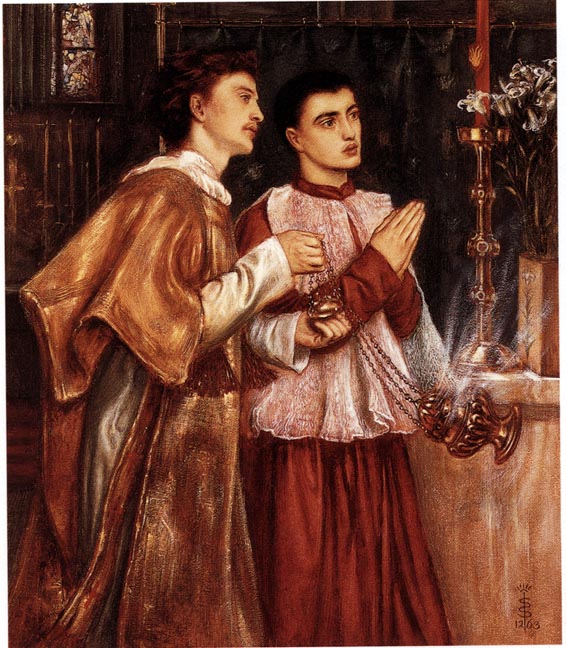
Two Acolytes Censing, Pentecost
Simeon Solomon (1840-1905)
The subject I was interested in studying was queer theory, especially in regards to 19th century literature. What especially interested me was the encoding of a gay stance in otherwise innocent literature, the way gay themes signalled themselves secretly to readers 'in the know', the rhetorical devices used, the literary gaydar, the silences that speak volumes, and so on. my intention was to combine linguistics with theory, literature, and history: all the things that get my juices flowing, so to speak. I wanted to study how the great classic novels included homosexual characters and themes. Which might come as something of a shock to those who cannot see them.
I just completed Graham Robb's Strangers: Homosexual Love in the 19th century, an excellent, nay superb study of the topic. I'll be reviewing it in more detail for the lectern later, I think. Robb's book reminds me how any understanding of 19th century culture is fundamentally flawed without a study of the (largely invisible, or at least transparent to our eyes now) role gay culture played in it.
He also makes the point that many of the codes gay - or gay friendly- writers used to signal gay themes and characters to each other are becoming lost, and that our understanding of them is dying, as gay culture becomes more mainstream, and as illiteracy increases.
A fascinating book, highly recommended for anyone with an interest in the 19th century.
Two Acolytes Censing, Pentecost
Simeon Solomon (1840-1905)
133Macumbeira
you are going to love the Magic Mountain
134absurdeist
Oh Murr, I've much to say on this delicate and "dangerous" subject. Particularly after hearing an interview with the Columbia Univ. history professor just today, who recently co-authored, along with, ahem, Larry Flynt, pardon me, a work of U.S.A. Presidential History titled, One Nation Under Sex: How the Private Lives of Presidents, First Ladies and Their Lovers Changed the Course of American History in which it is revealed that Abraham Lincoln, prior to marriage at the age of thirty-four, and even after marriage, insisted on having certain men sleep in the same bed with him (**gasp**) though, there's no certain documentation that anything besides sleep actually occurred.
If I may digress from the 19th century to the 20th momentarily, I've decided, after hearing your post of 132, to send you also, assuming I can copy the Cantonese components of an address accurately, The Runaway Soul by Harold Brodkey. It's for you.
In Part II of the tome, "Unnatural History," there are three sections comprising 158 pages total on the theme of homosexuality:
1. "HOMOSEXUALITY; or, Two Men on a Train"
2. "HOMOSEXUALITY: After the Train Ride"
3. "HOMOSEXUALITY; or, Second Sight"
I look forward to your review.
Lastly, with deep respect & reverence, I say "bullpucky!" to the idea that you're too old to do anything, impractical as it might be. IMO, just link The Lectern on any grad. application or resume, and that alone should count for enough "life experience" and learning for at least an automatic M.A.
If I may digress from the 19th century to the 20th momentarily, I've decided, after hearing your post of 132, to send you also, assuming I can copy the Cantonese components of an address accurately, The Runaway Soul by Harold Brodkey. It's for you.
In Part II of the tome, "Unnatural History," there are three sections comprising 158 pages total on the theme of homosexuality:
1. "HOMOSEXUALITY; or, Two Men on a Train"
2. "HOMOSEXUALITY: After the Train Ride"
3. "HOMOSEXUALITY; or, Second Sight"
I look forward to your review.
Lastly, with deep respect & reverence, I say "bullpucky!" to the idea that you're too old to do anything, impractical as it might be. IMO, just link The Lectern on any grad. application or resume, and that alone should count for enough "life experience" and learning for at least an automatic M.A.
135geneg
Murr, check out The Bostonians. I didn't notice any gay men, but at least two of the women are "spinsters". One, a well educated doctor, iirc preferred to dress in men's clothing. It might help satisfy the James jones for a while, too.
This sounds like a very interesting project.
This sounds like a very interesting project.
136theaelizabet
The basic thesis of Strangers: Homosexual Love in the 19th Century reminds me a bit of The Celluloid Closet, which I read way back when. Strangers sounds quite interesting. I'll look forward to reading more about it at the Lectern.
137PimPhilipse
http://www.guardian.co.uk/books/2011/apr/27/dorian-gray-oscar-wilde-uncensored
Of course no-one ever doubted Ozzie's orientation, but apparently his meaningful silences were a bit too eloquent for his editors.
Of course no-one ever doubted Ozzie's orientation, but apparently his meaningful silences were a bit too eloquent for his editors.
138LolaWalser
Good god, what took them so long?
*ordering*
*ordering*
139Mr.Durick
Gene, the Boston marriage came to my attention some years back when I was taking a look at Sarah Orne Jewett. It may have been just a little more acceptable than explicit homosexuality so James could have gotten away with an allusion to it.
Robert
Robert
140geneg
The Bostonians is about, among other things, a Boston marriage, but if there is any homosexual activity he does not explicitly refer to it. If there is code, I'm not privy to it. But the character of the Doctor sure seems like a lesbian. As I said, she is a doctor, so she is also a smart woman who knows how to compete with men, a woman who might be called pushy today. I am aware that many men think pushy women must be lesbians, but this doctor, for a minor character has plenty of traits that might be what one would expect to find in a repressed lesbian of the time.
141baswood
#132 Perhaps its not too late. As you know the OU is littered with people who are advancing in years. Hmmm.... perhaps littered is the wrong word but you know what I mean.
Strangers: Homosexual love in the 19th century sounds almost essential, looking forward to your review.
Strangers: Homosexual love in the 19th century sounds almost essential, looking forward to your review.
142QuentinTom
>139 Mr.Durick:, 135
Mistah D you beat me to it. I was just going to point out the Boston Marriage. Gene, The Bostonians is one of my favourite HJs. It has some of his most lyrical, pelucid writing. The novel is obviously about a lesbian relationship - in fact James's whole project was homosexual love - but he never writes about it directly, for obvious reasons. 'The love that dare not speak its name' is especially silent and coy in his writing. No doubt you have read The Beast in the Jungle, which is a classic example of the elliptical, encoded gay presence. In fact, HJ was one of the writers I wanted to study in detail.
http://thelectern.blogspot.com/search?q=the+Bostonians
Interestingly, the wikipedia article which Robert linked to has this to say:
However, there is no documentary proof that any particular "Boston marriage" included sexual relations.
This is also one of the common rejoinders to the Lincoln myth Freeeeeeeeeeeky mentioned in 134. (It's well known that Lincoln had gay relationships) that it is only a 'claim', that there is 'no documentary proof'. This is part of the general suppression of gay history on the part of straight historians and critics who cannot accept the fact that their 'subject' may bat for the other side. The call for 'documentary evidence' is absurd, and may be countered by three arguments which point out the latent homophobia of the demand:
1. There is also no documentary evidence that sexual relations did not take place.
2. What kind of documentary evidence would you like? Stained sheets? A sworn afadavit that on this night, at this location, in the presence of three adult witnesses, a notary public, and a policeman, sexual activity did duly take place, as witnessed hereunto by those present and undersigned? These are private acts, of course there is no documentary evidence!
3. No documentary evidence for sexual activity is ever 'required' in the case of heterosexual relationships, so why the methodological double standard here?
The release of the unexpurgated Wilde is a great event! hurrah! More Oscar!
>134 absurdeist: , 141
You are kind to say so, Freeeky, but nowadays, universities are not in the habit of handing out degrees to the worthy. It's a loss of income for them.
Bas, I still think about the OU, but the courses they offer at masters level are not so interesting to me, and phds are soooo expensive.
Mistah D you beat me to it. I was just going to point out the Boston Marriage. Gene, The Bostonians is one of my favourite HJs. It has some of his most lyrical, pelucid writing. The novel is obviously about a lesbian relationship - in fact James's whole project was homosexual love - but he never writes about it directly, for obvious reasons. 'The love that dare not speak its name' is especially silent and coy in his writing. No doubt you have read The Beast in the Jungle, which is a classic example of the elliptical, encoded gay presence. In fact, HJ was one of the writers I wanted to study in detail.
http://thelectern.blogspot.com/search?q=the+Bostonians
Interestingly, the wikipedia article which Robert linked to has this to say:
However, there is no documentary proof that any particular "Boston marriage" included sexual relations.
This is also one of the common rejoinders to the Lincoln myth Freeeeeeeeeeeky mentioned in 134. (It's well known that Lincoln had gay relationships) that it is only a 'claim', that there is 'no documentary proof'. This is part of the general suppression of gay history on the part of straight historians and critics who cannot accept the fact that their 'subject' may bat for the other side. The call for 'documentary evidence' is absurd, and may be countered by three arguments which point out the latent homophobia of the demand:
1. There is also no documentary evidence that sexual relations did not take place.
2. What kind of documentary evidence would you like? Stained sheets? A sworn afadavit that on this night, at this location, in the presence of three adult witnesses, a notary public, and a policeman, sexual activity did duly take place, as witnessed hereunto by those present and undersigned? These are private acts, of course there is no documentary evidence!
3. No documentary evidence for sexual activity is ever 'required' in the case of heterosexual relationships, so why the methodological double standard here?
The release of the unexpurgated Wilde is a great event! hurrah! More Oscar!
>134 absurdeist: , 141
You are kind to say so, Freeeky, but nowadays, universities are not in the habit of handing out degrees to the worthy. It's a loss of income for them.
Bas, I still think about the OU, but the courses they offer at masters level are not so interesting to me, and phds are soooo expensive.
143Macumbeira
way too expensive !
144RickHarsch
The Bern Book by Vincent Carter is an amazing oddity written by THE ONLY BLACK MAN IN BERN (there must have been an African or two)...There must be something of similar fascination, uniqueness, and whatall, if gay literature. A gay friend of mine, unfortunately not a writer, who works for the US government in a benign capacity (if that's possible) was posted to Tirana for three years. Imagine.
145RickHarsch
The story of the 'discovery' and publication by my old press of Carter's large Such Sweet Thunder makes for a pathetic little parable about how a writer such as meself can suffer the least of slights to the greatest extent of betrayal-pain...or something like that.
Available on demand. Maybe Dr. W, write me if you want to hear it.
Available on demand. Maybe Dr. W, write me if you want to hear it.
146dchaikin
Murr, I've caught up!...with this thread anyway. Wonderful stuff on Hugo, and you nailed my problem with Les Mis - the suffocating aspect.
No clue what discworld is doing being mentioned in this thread, it's not for you, I suspect. But, so you know, there is trend in discworld. There are the early Rincewind books which are complete insane, with miscellaneous stuff of all sorts. If there in Menippus in there, it's probably in these book. In the middle books the insanity is toned down a bit and the books actually hover around a consistent plot . Then, as the series "progresses", they become more plot driven, and more murder mystery like...that gets you to about 2001 or so. So, anyway, now you know.
No clue what discworld is doing being mentioned in this thread, it's not for you, I suspect. But, so you know, there is trend in discworld. There are the early Rincewind books which are complete insane, with miscellaneous stuff of all sorts. If there in Menippus in there, it's probably in these book. In the middle books the insanity is toned down a bit and the books actually hover around a consistent plot . Then, as the series "progresses", they become more plot driven, and more murder mystery like...that gets you to about 2001 or so. So, anyway, now you know.
148QuentinTom
Gosh, I have fallen a bit behind. Rather than writing a review of Strangers, I tried my hand at a bit of gay decoding of a passage from Les Miserables, inspired by some passing remarks Robb made in his book. Here is the link.
http://thelectern.blogspot.com/2011/05/fragment-0510_10.html
Since Strangers, I read Sartre's memoir of the first 10 years of his childhood: Les Mots, a fantastic book, which goes straight to my list of Really Great Books. I know it's fashionable now in our Neo Christian, Neo Dark Ages, to poohpooh Sartre and existentialism, but whatever one thinks about his philosophy and his wrong headed support of the Soviet Union, Sartre was an utterly superb writer. His trilogy Les chemins de la liberté remains one of my all time favourite works.
In this slim but dense book he describes a small lonely boy's discovery of books and words and the power of his imagination. I'm just going to quote from it, and let the quotes stand by themselves.
I sometimes got close enough to observe these boxes (the books in his grandfather's library) which opened like oysters, and I discovered the nakedness of their internal organs, pale, dank, slightly blistered pages, covered with small black veins, which drank ink and smelled of mildew.
The Universe lay spread at my feet and each thing was humbly begging for a name, and giving it one was like both creating it and taking it. Without this fundamental illusion, I should never have written.
Since I had discovered the world through language for a long time I mistook language for the world. To exist was to have a registered trade-name on the infinite Tables of the Word: writing meant engraving new beings on them or- this was my most persistent illusion- catching living things in the trap of phrases: if I put words together ingeniously, the object would become entangled in the signs, and I would hold it.
And describing his grandfather, Charles Schweitzer:

He was a nineteenth century man who, like so many others, including Victor Hugo himself, thought he was Victor Hugo.
Ha!
An incredible book, a must read for lovers of books, words, language and literature, which, I would imagine, is everyone here, right?
http://thelectern.blogspot.com/2011/05/fragment-0510_10.html
Since Strangers, I read Sartre's memoir of the first 10 years of his childhood: Les Mots, a fantastic book, which goes straight to my list of Really Great Books. I know it's fashionable now in our Neo Christian, Neo Dark Ages, to poohpooh Sartre and existentialism, but whatever one thinks about his philosophy and his wrong headed support of the Soviet Union, Sartre was an utterly superb writer. His trilogy Les chemins de la liberté remains one of my all time favourite works.
In this slim but dense book he describes a small lonely boy's discovery of books and words and the power of his imagination. I'm just going to quote from it, and let the quotes stand by themselves.
I sometimes got close enough to observe these boxes (the books in his grandfather's library) which opened like oysters, and I discovered the nakedness of their internal organs, pale, dank, slightly blistered pages, covered with small black veins, which drank ink and smelled of mildew.
The Universe lay spread at my feet and each thing was humbly begging for a name, and giving it one was like both creating it and taking it. Without this fundamental illusion, I should never have written.
Since I had discovered the world through language for a long time I mistook language for the world. To exist was to have a registered trade-name on the infinite Tables of the Word: writing meant engraving new beings on them or- this was my most persistent illusion- catching living things in the trap of phrases: if I put words together ingeniously, the object would become entangled in the signs, and I would hold it.
And describing his grandfather, Charles Schweitzer:

He was a nineteenth century man who, like so many others, including Victor Hugo himself, thought he was Victor Hugo.
Ha!
An incredible book, a must read for lovers of books, words, language and literature, which, I would imagine, is everyone here, right?
149LolaWalser
That's my favourite Sartre--and I've read ALL of him except Being and nothingness... and correspondence.
Everything he said about booklove was just so right, and I especially clicked with the early germination of the passion, with adventure stories and comics.
Have you read his plays? For once staging is superfluous, they are so philosophical as to make much better reads.
Everything he said about booklove was just so right, and I especially clicked with the early germination of the passion, with adventure stories and comics.
Have you read his plays? For once staging is superfluous, they are so philosophical as to make much better reads.
150RickHarsch
I'll never forget his opening passages on Flaubert.
But I am so distant from time I didn't know he was out of academic or literary fashion, Sartre.
But I am so distant from time I didn't know he was out of academic or literary fashion, Sartre.
151Makifat
Sartre was an utterly superb writer.
Hear, hear. Superb and perceptive. Another fine writer whose writing has been neglected in favor of anecdotal muckraking regarding his personal life.
Hear, hear. Superb and perceptive. Another fine writer whose writing has been neglected in favor of anecdotal muckraking regarding his personal life.
152RickHarsch
he didn't HAVE to wear those glasses
153QuentinTom
149> yes! I loved that too, his discovery of Jules Verne took me back to my own childhood. Like you, I have read all of Sartre's fiction and drama. I'd like to try Being and Nothingness, in fact, if I have a spare 20 minutes I may toss off a quick phd on its connections with Buddhism...
151, 152>
All part and parcel of the Age of Stupidity in which we live.
151, 152>
All part and parcel of the Age of Stupidity in which we live.
154geneg
But I'll take my existentialism a little less cut and dried. I prefer Camus to Sartre. You know, it wouldn't hurt my feelings if someone mentioned Camus or Sartre in the 2012 reads thread. That is if the interest is there. Sartre wrote some plays that might pop up in the stage right thread, also.
156QuentinTom
I think out of Camus and Sartre, Sartre was the better writer. But that's just taste, I daresay.
I have just finished reading The Infernal Machine, and NDP edition of some of Cocteau's plays, including Orpheus, The Eiffel Tower Wedding Party, The Knights of the Round Table (translated by Auden), Bacchus, and The speaker's text of Oedipus Rex, Stravinsky's opera.
I seem to have been revisiting many of the authors who had an impact on my youth this month. When I was 20 I toured America with a one woman show based on the writings of Cocteau. Now, before you hasten to remark that I am not a woman, let me tell you that I was providing musical accompaniment to my friend, a woman. She had discovered some radio monologues by Cocteau, and was bringing them to life on the stage. I played French chanson on the piano. I went through a Cocteau phase, read everything, wore a duffle coat with a hood etc etc, fell in love with a boxer etc etc, fell in love with his movies. At one point in the '40s and '50s Cocteau was a big influence, especially on the look of the era, but now, I guess he is mostly forgotten (?)
Cocteau is interesting. On the one had it's possible to see him as a late Symbolist, the last of the Decadents, with his reworking of Greek Myths, his thinly veiled homoeroticism, his l'art pour l'art. On the other, it's possible to see him as a kind of proto Barthesian - Eco structuralist, especially in his criticism and writings about art.
The most interesting piece in this collection is The Eiffel Tower Wedding Party, a kind of Dada-meets-the-Sitwells jeux du theatre. In the preface to this piece, JC writes:
The true symbol is never planned: it emerges by itself, as long as the bizarre, the unreal do not enter into the reckoning....The poet ought to disengage objects and ideas from their veiling mists; he ought to display them suddenly, so nakedly and so quickly that they are scarcely recognisable. It is then that they strike us with their youth,... this is the case with commonplaces - old, powerful, generally esteemed after the manner of masterpieces, but whose original beauty, because of long use, no longer surprises us.
Which I guess is the impetus behind his reworking of greek myth. Anyway, this little piece featured music by: Milhaud, Poulenc, Auric, Honegger and Tailleferre (with Cocteau, this group was known as Les Six). Here is a reconstruction of this piece:
http://www.youtube.com/watch?v=ejsAoYzWmt0
And here is Cocteau's drawing of Orpheus. I still find his drawings miraculous in their simplicity and evocativeness.
I have just finished reading The Infernal Machine, and NDP edition of some of Cocteau's plays, including Orpheus, The Eiffel Tower Wedding Party, The Knights of the Round Table (translated by Auden), Bacchus, and The speaker's text of Oedipus Rex, Stravinsky's opera.
I seem to have been revisiting many of the authors who had an impact on my youth this month. When I was 20 I toured America with a one woman show based on the writings of Cocteau. Now, before you hasten to remark that I am not a woman, let me tell you that I was providing musical accompaniment to my friend, a woman. She had discovered some radio monologues by Cocteau, and was bringing them to life on the stage. I played French chanson on the piano. I went through a Cocteau phase, read everything, wore a duffle coat with a hood etc etc, fell in love with a boxer etc etc, fell in love with his movies. At one point in the '40s and '50s Cocteau was a big influence, especially on the look of the era, but now, I guess he is mostly forgotten (?)
Cocteau is interesting. On the one had it's possible to see him as a late Symbolist, the last of the Decadents, with his reworking of Greek Myths, his thinly veiled homoeroticism, his l'art pour l'art. On the other, it's possible to see him as a kind of proto Barthesian - Eco structuralist, especially in his criticism and writings about art.
The most interesting piece in this collection is The Eiffel Tower Wedding Party, a kind of Dada-meets-the-Sitwells jeux du theatre. In the preface to this piece, JC writes:
The true symbol is never planned: it emerges by itself, as long as the bizarre, the unreal do not enter into the reckoning....The poet ought to disengage objects and ideas from their veiling mists; he ought to display them suddenly, so nakedly and so quickly that they are scarcely recognisable. It is then that they strike us with their youth,... this is the case with commonplaces - old, powerful, generally esteemed after the manner of masterpieces, but whose original beauty, because of long use, no longer surprises us.
Which I guess is the impetus behind his reworking of greek myth. Anyway, this little piece featured music by: Milhaud, Poulenc, Auric, Honegger and Tailleferre (with Cocteau, this group was known as Les Six). Here is a reconstruction of this piece:
http://www.youtube.com/watch?v=ejsAoYzWmt0
And here is Cocteau's drawing of Orpheus. I still find his drawings miraculous in their simplicity and evocativeness.
157absurdeist
What an interesting post, Mr. Murr!
I've intended to read Les Enfants Terribles forever. The Erotic Drawings by Jean Cocteau look pretty evocative too!
Where all in the States did you perform?
I've intended to read Les Enfants Terribles forever. The Erotic Drawings by Jean Cocteau look pretty evocative too!
Where all in the States did you perform?
158LolaWalser
When I was 20 I toured America with a one woman show based on the writings of Cocteau.
Now THAT'S the kind of sentence we all should be able to include in our CVs before we quit this vale of tears!!
I don't have the feeling that Cocteau is forgotten--that is, not among the people who may be expected to know who he was. And not in France, where his influence was so intense and varied. But perhaps he is receding into the past (which may be "normal", or at least inevitable--the snows of yesteryear...) If you polled the streets, how many could place the names of, say, Breton, Eluard, Gide, Clair? The best one can hope for is that the oblivion will only set in AFTER death.
Now THAT'S the kind of sentence we all should be able to include in our CVs before we quit this vale of tears!!
I don't have the feeling that Cocteau is forgotten--that is, not among the people who may be expected to know who he was. And not in France, where his influence was so intense and varied. But perhaps he is receding into the past (which may be "normal", or at least inevitable--the snows of yesteryear...) If you polled the streets, how many could place the names of, say, Breton, Eluard, Gide, Clair? The best one can hope for is that the oblivion will only set in AFTER death.
159QuentinTom
well, that's good to know. Stuck here on my island it's hard to know who's in, who's out, and what is remembered in the centres of civilisation. certainly no one here has ever heard of Cocteau.
EF, if my memory serves me well, our itinerary included:
New York City
Albequerque
Houston
Austin
New Orleans
San Jose
San Francisco
LA
And one or two other places which I can't really remember. the tour was organised by the Alliance Francaise, so we performed in cities where there was an active Alliance. It was an experience.
EF, if my memory serves me well, our itinerary included:
New York City
Albequerque
Houston
Austin
New Orleans
San Jose
San Francisco
LA
And one or two other places which I can't really remember. the tour was organised by the Alliance Francaise, so we performed in cities where there was an active Alliance. It was an experience.
160baswood
#156, Interesting post. Brilliant link. I have not read any Cocteau (another huge gap looms) have seen the films and last year went to a local theatre group production of le voix humaine. It was an interesting production as the performance was cut up into sort of bite sized chunks with an exaggerated performance slowed down considerably so that the English speakers in the audience could follow.
I like the music of Les six which I stumbled upon way back when.... I saw a performance in London by Stomu Yamashta who was touring with a mime group and they did a wonderful piece to the music of Le boeuf sur le toit - Milhaud.
You might not be surprised to know that Cocteau has not been forgotten in France.
I like the music of Les six which I stumbled upon way back when.... I saw a performance in London by Stomu Yamashta who was touring with a mime group and they did a wonderful piece to the music of Le boeuf sur le toit - Milhaud.
You might not be surprised to know that Cocteau has not been forgotten in France.
161anna_in_pdx
A propos Sartre, I just bought The Wretched of the Earth, which I think I had read before but I had no memory of. So, I was reading the foreword ("all you bourgeois white readers, this book is not about you, it doesn't even care about you, read it if you dare,") thinking, OK, this has to be by some French philosophical firebrand that I've probably never heard of yet it sounds vaguely familiar somehow - until I flipped to the end of it to see who it was and of course it was Sartre. Correction, it's a French firebrand that I HAVE heard of. And read.
I had to read La Nausee and L'Etre et le Neant when I was a French lit major lo these many years ago. I did not like Sartre when I was in college, though I did love Camus. Probably I'd appreciate S. more now.
I also loved Malraux. Weren't we thinking of maybe reading La Condition Humaine (which is called Man's Fate or some other terrible rendering in English) next year?
I had to read La Nausee and L'Etre et le Neant when I was a French lit major lo these many years ago. I did not like Sartre when I was in college, though I did love Camus. Probably I'd appreciate S. more now.
I also loved Malraux. Weren't we thinking of maybe reading La Condition Humaine (which is called Man's Fate or some other terrible rendering in English) next year?
162QuentinTom
But Anna I'm confused, I thought The Wretched of the Earth was by Fritz (turn the) Fanon? are those actual real quotes you posted there, or a summary of what you got from it? I find it hard to believe that Sartres would write that kind of stuff...
Malraux is also one of my heroes. An intellectual man of action. La Condition Humaine is utterly brilliant. I have a nice little pile of books by M waiting to be read. Have you read his art criticism?
Bas, thanks for reassuring me that at least in France, Cocteau is not forgotten. For those new to Cocteau, I would recommend Les Enfants Terribles as a place to start. It's kind of mythological, really.
Let's have some more Milhaud:
Scaramouche. Totally mad music. I love it.
http://www.youtube.com/watch?v=s75gx9-QOIk
in this version my Milhaud himself,
http://www.youtube.com/watch?v=Wk_sVJZJ9v4&feature=related
and in this version, by Saint Martha and Kissin
(oh dear, listening to that again is hard to believe that I used to play it years ago...)
Malraux is also one of my heroes. An intellectual man of action. La Condition Humaine is utterly brilliant. I have a nice little pile of books by M waiting to be read. Have you read his art criticism?
Bas, thanks for reassuring me that at least in France, Cocteau is not forgotten. For those new to Cocteau, I would recommend Les Enfants Terribles as a place to start. It's kind of mythological, really.
Let's have some more Milhaud:
Scaramouche. Totally mad music. I love it.
http://www.youtube.com/watch?v=s75gx9-QOIk
in this version my Milhaud himself,
http://www.youtube.com/watch?v=Wk_sVJZJ9v4&feature=related
and in this version, by Saint Martha and Kissin
(oh dear, listening to that again is hard to believe that I used to play it years ago...)
163anna_in_pdx
162: It was the foreword. It was written by Sartre. Fanon wrote the actual book.
I paraphrased, but I can quote directly from it if you wish. :) (it's at home and I am at work but maybe later tonight.)
I paraphrased, but I can quote directly from it if you wish. :) (it's at home and I am at work but maybe later tonight.)
164QuentinTom
oh ok, no hurry, thanks.
have a nice day at work there.
:)
have a nice day at work there.
:)
165Porius
THE WEEPING BURGHER
It is with a strange malice
That I distort the world
Ah! that ill humors
Should mask white girls
And ah! that Scaramouche
Should have a black barouche
The sorry verities!
Yet in excess, continual,
There is cure of sorrow.
Permit that if as ghost I come
Among the people burning in me still,
I come as belle design
Of foppish line.
And I, then, tortured for old speech
A white of wildly woven rings;
I, weeping in a calcined heart,
My hands such sharp, imagined things
Wallace Stevens
It is with a strange malice
That I distort the world
Ah! that ill humors
Should mask white girls
And ah! that Scaramouche
Should have a black barouche
The sorry verities!
Yet in excess, continual,
There is cure of sorrow.
Permit that if as ghost I come
Among the people burning in me still,
I come as belle design
Of foppish line.
And I, then, tortured for old speech
A white of wildly woven rings;
I, weeping in a calcined heart,
My hands such sharp, imagined things
Wallace Stevens
166geneg
Ummmm, boy! A Weeping Burgher! Does it weep those delicious juices, or cheese, or, better yet, both? Ah well, no matter, as long as it weeps.
167Macumbeira
mmm... Sartre, Camus et Beauvoir, never my cup of tea. Sartre never was beau à voir...Camus books have a stale taste and Simone...oh Simone ça va encore.
but I will overcome my nausée and try one of Sartres less known books.
But Malraux is rather cool, art thief if ever there was one, I liked his voie royale, it is better than Indiana Jones...
His Musée imaginaire is a must read - must have, but look out for a classy color pic edition
but I will overcome my nausée and try one of Sartres less known books.
But Malraux is rather cool, art thief if ever there was one, I liked his voie royale, it is better than Indiana Jones...
His Musée imaginaire is a must read - must have, but look out for a classy color pic edition
168citygirl
Which one was the book where the guy was suffering horribly in the desert, and describes minutely the sun and the insects and whole bright horribleness? Had to read it for a class.
I hate that book.
I hate that book.
169anna_in_pdx
I think there's a scene like that in La Nausee but could be wrong as it's been 20 years since I read it and I was reading in French.
170RickHarsch
> 168 Maybe the opening chapter of the Stranger was magnified by the circumstances under which you read it. Or an early aversion to libraries transmogrified the serene desert into a book-riddled, pest-ridden maze of book stacks.
171citygirl
No, it wasn't l'Etranger. That one I liked. And, as I recall, anna, the whole book was that scene in the desert.
172anna_in_pdx
La Peste? Perhaps? I have not read that one. (It's in my TBR pile. In English because I am lazy.)
173citygirl
Maybe, but I don't think so. Starting to think I hallucinated the book in a fit of sunstroke brought on by the hot weather surrounding my college campus.
174RickHarsch
That's simply too easy. You must be conflating atmospherics, drunks, and early monster bed-time stories
175geneg
La Peste, if my reliance on cognates serves me, is set in the town of Oran in Algeria. It features lots of rats. But no desert.
176ChocolateMuse
Murr, I really like the Scaramouche. I hadn't heard it before.
177Macumbeira
suffering in the desert in French literature ? Must be Saint Exupery ? Terre des Hommes?
Gene is right, La peste is in a city full of rats.
Gene is right, La peste is in a city full of rats.
178QuentinTom
Oran.
179citygirl
I figured it out (w/ the help of Wikipedia). It was a short story by Camus, Le renegat, in the Exile book.
181anna_in_pdx
As promised, here is a quote from Sartre's Foreword to Frantz Fanon's Wretched of the Earth.
Europeans, you must open this book and enter into it. After a few steps in the darkness you will see strangers gathered around a fire; come close, and listen, for they are talking of the destiny they will mete out to your tradingcenters and to the hired soldiers who defend them. They will see you, perhaps, but they will go on talking among themselves, without even lowering their voices. This indifference strikes home: Their fathers, shadowy creatures, *your* creatures, were but dead souls; you it was who allowed them glimpses of light, to you only did they dare speak, and you did not bother to reply to such zombies. Their sons ignore you; a fire warms them and sheds light around them, and you have not lit it. Now, at a respectful distance, it is you who will feel furtive, nightbound, and perished with cold. Turn and turn about; in these shadows from whence a new dawn will break, it is you who are the zombies.
Europeans, you must open this book and enter into it. After a few steps in the darkness you will see strangers gathered around a fire; come close, and listen, for they are talking of the destiny they will mete out to your tradingcenters and to the hired soldiers who defend them. They will see you, perhaps, but they will go on talking among themselves, without even lowering their voices. This indifference strikes home: Their fathers, shadowy creatures, *your* creatures, were but dead souls; you it was who allowed them glimpses of light, to you only did they dare speak, and you did not bother to reply to such zombies. Their sons ignore you; a fire warms them and sheds light around them, and you have not lit it. Now, at a respectful distance, it is you who will feel furtive, nightbound, and perished with cold. Turn and turn about; in these shadows from whence a new dawn will break, it is you who are the zombies.
182zenomax
181 - nice passage of writing, perhaps even more prescient than JPS knew. Thanks for that Anna.
183LolaWalser
RIGHT ON!1!
184QuentinTom
powerful stuff! Thanks for posting Anna.
185Macumbeira
Yes thanks me for reminding me why I do not like les existentialists !
187RickHarsch
re # 185: What do we do with dissenters here?
188Macumbeira
impale ?
189Macumbeira
impale ? i Love to be prejudiced
191QuentinTom
je suis un exististentialiste!
Seriously, I find Existentialism to be quite sympathetic as a philosophy. Those parts of Dostoevsky where he anticipates the existentialists are the ones that ring truest to me. I'm also interested in the similarities between Buddhism and Existentialism. At any rate, it's certainly more valid than the idiocy of Christianity.
I'm trying to fit in a read of Camus' The myth of Sisyphus before I leave, but I am becoming swept in by the Maelstrom of Wolf Solent and have a few pages of Bakhtin left to finish.
Seriously, I find Existentialism to be quite sympathetic as a philosophy. Those parts of Dostoevsky where he anticipates the existentialists are the ones that ring truest to me. I'm also interested in the similarities between Buddhism and Existentialism. At any rate, it's certainly more valid than the idiocy of Christianity.
I'm trying to fit in a read of Camus' The myth of Sisyphus before I leave, but I am becoming swept in by the Maelstrom of Wolf Solent and have a few pages of Bakhtin left to finish.
192QuentinTom
Meanwhile, pimping my latest review of a little known work from my library:
The Age of Stupidity: Cultural Life in the Immediate Pre Cataclysmic Era
mm, no touchstone: Here's the link:
http://www.librarything.com/work/book/73348447
The Age of Stupidity: Cultural Life in the Immediate Pre Cataclysmic Era
mm, no touchstone: Here's the link:
http://www.librarything.com/work/book/73348447
193Macumbeira
woohooo I say
195RickHarsch
> 191 Similarly, I spent two years studying and writing a novel about the parallels between western nihilism and Tantric philosophy.
196baswood
I C Faraway: is this the same guy who wrote 700 million Salesmen can't be wrong. Great stuff Murr.
198ChocolateMuse
Murr, that's very good. Clever, apt and very funny. But I still wouldn't live in your utopia for anything.
A professor at work was saying recently that studies have shown that the IQ of the population has gone down drastically since WWII.
A professor at work was saying recently that studies have shown that the IQ of the population has gone down drastically since WWII.
199Macumbeira
Is IQ test still valid ?
200ChocolateMuse
This is serendipitous, Murr. After reading your essai, I read some related stuff from Davies, under the heading "Rebellion against Mediocrity".
He mentions the "lumpishness, the dowdy triviality, the shoddy expertise, and the lack of foundation which bedevils so much of North American education."
He talks about Barzun's House of Intellect - Murr, have you read it? Or anyone else?
Interestingly, he goes on to talk about the 'other-directed', an apparently new concept in the 50s, of "the man or woman who is influenced in the important and unimportant things of life by the attitudes of his 'peer group'... more than by any personal sense of morality or responsibility". Apparently this concept was developed by a few sociologists at the University of Chicago, and published in a book called The Lonely Crowd (All this is new to me, but LT knows their touchstones...) :)
I find it hard to believe that the idea of an 'other-directed' person is so new! Is is only since mass media that such people began to exist? Or was it just not recognised? And Davies goes on to say that this kind of person is relatively rare. Really? I think social media must have influenced this pretty drastically.
He mentions the "lumpishness, the dowdy triviality, the shoddy expertise, and the lack of foundation which bedevils so much of North American education."
He talks about Barzun's House of Intellect - Murr, have you read it? Or anyone else?
Interestingly, he goes on to talk about the 'other-directed', an apparently new concept in the 50s, of "the man or woman who is influenced in the important and unimportant things of life by the attitudes of his 'peer group'... more than by any personal sense of morality or responsibility". Apparently this concept was developed by a few sociologists at the University of Chicago, and published in a book called The Lonely Crowd (All this is new to me, but LT knows their touchstones...) :)
I find it hard to believe that the idea of an 'other-directed' person is so new! Is is only since mass media that such people began to exist? Or was it just not recognised? And Davies goes on to say that this kind of person is relatively rare. Really? I think social media must have influenced this pretty drastically.
201ChocolateMuse
Mac, I don't know - I do know it's recognised now that it only measures one version of 'intellect' - but it still acts as some kind of measure of something relating to intellect, so is probably still significant that it's dropped so much.
Murr, here's one for you, Davies again:
But there is a danger in concentrating on what is wrong... let us not wallow in a deliciously frightening sense of intellectual inadequacy and then pass on to some new and more fashionable mortification. That is a dark frivolity, but still frivolity.
Murr, here's one for you, Davies again:
But there is a danger in concentrating on what is wrong... let us not wallow in a deliciously frightening sense of intellectual inadequacy and then pass on to some new and more fashionable mortification. That is a dark frivolity, but still frivolity.
202henkmet
I thought the average IQ of a population is 100 by definition? How then can someone claim it dropped?
203ChocolateMuse
I don't know. But I just asked said professor for more info, and he gave me some sources, for what they're worth.
Lynn, R.; Harvey, J. (2008). "The decline of the world's IQ". Intelligence 36 (2): 112
Abstract:
Dysgenic fertility means that there is a negative correlation between intelligence and number of children. Its presence during the last century has been demonstrated in several countries. We show here that there is dysgenic fertility in the world population quantified by a correlation of − 0.73 between IQ and fertility across nations. It is estimated that the effect of this has been a decline in the world's genotypic IQ of 0.86 IQ points for the years 1950–2000. A further decline of 1.28 IQ points in the world's genotypic IQ is projected for the years 2000–2050. In the period 1950–2000 this decline has been compensated for by a rise in phenotypic intelligence known as the Flynn Effect, but recent studies in four economically developed countries have found that this has now ceased or gone into reverse. It seems probable that this “negative Flynn Effect” will spread to economically developing countries and the whole world will move into a period of declining genotypic and phenotypic intelligence. It is possible that “the new eugenics” of biotechnology may evolve to counteract dysgenic fertility.
Also Teasdale TW & Owen DR (2005). "A long-term rise and recent decline in intelligence test performance: The Flynn Effect in reverse". Personality and Individual Differences 39 (4): 837–843
Abstract:
In the 1980s reviewed evidence indicated that, through the preceding decades of the last century, population performance on intelligence tests had been rising substantially, typically about 3–5 IQ points per decade, in developed countries. The phenomenon, now termed the ‘Flynn Effect’, has been variously attributed to biological and/or to social and educational factors. Although there is some evidence to suggest a slowing of the effect through the 1990s, only little evidence, to our knowledge, has yet been presented to show an arrest or reversal of the trend. Substantially replicating a recent report from Norway, we here report intelligence test results from over 500,000 young Danish men, tested between 1959 and 2004, showing that performance peaked in the late 1990s, and has since declined moderately to pre-1991 levels. A contributing factor in this recent fall could be a simultaneous decline in proportions of students entering 3-year advanced-level school programs for 16–18 year olds.
I haven't seen this movie, but it fits: http://www.youtube.com/watch?v=BBvIweCIgwk
Lynn, R.; Harvey, J. (2008). "The decline of the world's IQ". Intelligence 36 (2): 112
Abstract:
Dysgenic fertility means that there is a negative correlation between intelligence and number of children. Its presence during the last century has been demonstrated in several countries. We show here that there is dysgenic fertility in the world population quantified by a correlation of − 0.73 between IQ and fertility across nations. It is estimated that the effect of this has been a decline in the world's genotypic IQ of 0.86 IQ points for the years 1950–2000. A further decline of 1.28 IQ points in the world's genotypic IQ is projected for the years 2000–2050. In the period 1950–2000 this decline has been compensated for by a rise in phenotypic intelligence known as the Flynn Effect, but recent studies in four economically developed countries have found that this has now ceased or gone into reverse. It seems probable that this “negative Flynn Effect” will spread to economically developing countries and the whole world will move into a period of declining genotypic and phenotypic intelligence. It is possible that “the new eugenics” of biotechnology may evolve to counteract dysgenic fertility.
Also Teasdale TW & Owen DR (2005). "A long-term rise and recent decline in intelligence test performance: The Flynn Effect in reverse". Personality and Individual Differences 39 (4): 837–843
Abstract:
In the 1980s reviewed evidence indicated that, through the preceding decades of the last century, population performance on intelligence tests had been rising substantially, typically about 3–5 IQ points per decade, in developed countries. The phenomenon, now termed the ‘Flynn Effect’, has been variously attributed to biological and/or to social and educational factors. Although there is some evidence to suggest a slowing of the effect through the 1990s, only little evidence, to our knowledge, has yet been presented to show an arrest or reversal of the trend. Substantially replicating a recent report from Norway, we here report intelligence test results from over 500,000 young Danish men, tested between 1959 and 2004, showing that performance peaked in the late 1990s, and has since declined moderately to pre-1991 levels. A contributing factor in this recent fall could be a simultaneous decline in proportions of students entering 3-year advanced-level school programs for 16–18 year olds.
I haven't seen this movie, but it fits: http://www.youtube.com/watch?v=BBvIweCIgwk
204geneg
First, if I understand other directed as two common English words used to describe one's typical relationships with others, I would say the most other directed person who ever lived is Jesus Christ. It's mostly His other directedness that makes people angry with Him. We don't want to turn the other cheek, we want to shoot the shit out of the bastard that attacked us. His definition of who will go to Heaven and who won't is all about being other directed. His entire message is that it's better having 6,000,000,000 people looking out for you in a world where we all look out for one another, rather than have one person looking out for you in a world in which everyone is looking out for themselves. But in that view, someone might get something they don't deserve, so we can't have that. Jesus created socialism as a political idea. He is the greatest humanist that ever lived.
As far as IQ is concerned, it ain't rocket science folks, what else happened in this country right after WWII? As Newt Minnow once described it a vast wasteland opened onto the American psyche, dragging all before it into the maw of its stupidity. I can't think of a more self directed activity than watching teevee.
As far as IQ is concerned, it ain't rocket science folks, what else happened in this country right after WWII? As Newt Minnow once described it a vast wasteland opened onto the American psyche, dragging all before it into the maw of its stupidity. I can't think of a more self directed activity than watching teevee.
205RickHarsch
tcm: I just started reading Bakhtin on the toilet...What did you learn from the book, if you can say it in some form or other?
207Porius
Raw Spring, that time between the last dregs of Winter and the first reports of Spring, is doubtless Rick's favorite time of year.
208ChocolateMuse
Gene, other directedness in the sociological terms I alluded to above means something different from what I think you're saying. It's more about directing what one does out of fear of others' opinions, rather than directing what one does to help others.
209QuentinTom
Thanks for all your friendly comments and thumbs for Faraway. I was trying to do something new: create a review for a book that has not been written, and see how the review 'stands in for' or symbolises the book. I was also attempting a Jeremiad on the state of culture today. The Stuff about language and thought that I wrote is something that lies very close to my heart.
Choco, thanks for the stuff about IQ. IQ has long been discredited as a means of measuring intelligence (the test can be faked and cheated and studied for in all manner of ways) but it still gets credence, partly because nothing better has come along to replace it. Barzun's book looks interesting. I think Slick was reading From Dawn to Decadence recently. It has been on my shelves for ages, unread.
>200 ChocolateMuse:. Great Davies quotes! Like you, I am not convinced about the newness of the 'other directed' person. Part of humanity's nature is to be influenced by the people around us, and peer pressure is nothing new. Perhaps it's just 'new' for the psychologist/academics who removed their heads long enough out of each others arses to notice the phenomenon.
I will pass gracefully over the mention of Jesus Christ in >204 geneg:, and bury my vomit in my litter tray.
On to Bakhtin.
>205 RickHarsch:
Good question, rick. (However, I strenuously warn against reading on the loo. Hemorrhoids will result.)
I learnt:
about the Menippea
that Dostoevsky was even more of a genius than I thought
that Bakhtin was even more of a genius than I thought
about some of the main points of Dostoevsky criticism (chapter 1)
about the representing word and the represented word
that for Dostoevsky, the self, the truth, is dialogic, in other words, that we experience/create the truth/the self through dialogue
This last sentence of the book sums it up nicely for me:
D's works are a word about a word addressed to a word. The represented word comes together with the representing word on one level and on equal terms. They penetrate one another, overlap one another at various dialogic angles.
I"m reading Appendix 2 and then I'm done with it. I'll be interested to hear what you learnt from it.
Choco, thanks for the stuff about IQ. IQ has long been discredited as a means of measuring intelligence (the test can be faked and cheated and studied for in all manner of ways) but it still gets credence, partly because nothing better has come along to replace it. Barzun's book looks interesting. I think Slick was reading From Dawn to Decadence recently. It has been on my shelves for ages, unread.
>200 ChocolateMuse:. Great Davies quotes! Like you, I am not convinced about the newness of the 'other directed' person. Part of humanity's nature is to be influenced by the people around us, and peer pressure is nothing new. Perhaps it's just 'new' for the psychologist/academics who removed their heads long enough out of each others arses to notice the phenomenon.
I will pass gracefully over the mention of Jesus Christ in >204 geneg:, and bury my vomit in my litter tray.
On to Bakhtin.
>205 RickHarsch:
Good question, rick. (However, I strenuously warn against reading on the loo. Hemorrhoids will result.)
I learnt:
about the Menippea
that Dostoevsky was even more of a genius than I thought
that Bakhtin was even more of a genius than I thought
about some of the main points of Dostoevsky criticism (chapter 1)
about the representing word and the represented word
that for Dostoevsky, the self, the truth, is dialogic, in other words, that we experience/create the truth/the self through dialogue
This last sentence of the book sums it up nicely for me:
D's works are a word about a word addressed to a word. The represented word comes together with the representing word on one level and on equal terms. They penetrate one another, overlap one another at various dialogic angles.
I"m reading Appendix 2 and then I'm done with it. I'll be interested to hear what you learnt from it.
210RickHarsch
tcm Thanks for the energy you put into your reply...I look forward to a full understanding of what you wrote
211RickHarsch
So there I found myself a-seat upon the great gormslung of the dolomitis, in the vast constricting suckspace of innards exiling, when I came upon the woodthins encoded, and I thought 'Summer already? Have I been in here too long?'
212geneg
Bakhtin on the Toilet doesn't seem to have a touchstone and a general search doesn't show it either.
214Makifat
But Rabelais and His World? Mmmm, mmmm, good!
215QuentinTom
damn those pesky touchstones!
well, I finally put Bakhtin to rest last night. I'm going to leave three quotes to give a glimpse of why this book has gone straight to the Really Great Book pile. Regular readers of my thread will have heard me going on and on about Barthes and how S/Z is the best book of criticism ever written. Bakhtin's book on Dostoevsky joins Barthes on the pinnacle of greatness. Let them jostle each other yah!
1.
A beginning and an end, a birth and a death are possessed by a person, a life, a fate, but not by consciousness, which by its very nature is infinite, revealing itself only from within, that is, only for consciousness itself. Beginnings and ends lie in the objective (and object like) world for others, but not for the conscious person himself.
2.
The major emotional thrust of all Dostoevsky's work, in its form as well as it's content, is the struggle against a reification of man, of human relations, of all human values under the conditions of capitalism.
3.
When a member of a speaking collective comes upon a word, it is not as a neutral word of language, not as a word free from the aspirations and evaluations of others, uninhabited by others voices. No, he receives the word from another's voice, and filled with that other voice. The word enters his context from another context, permeated with the interpretations of others. His own thought finds the word already inhabited.
Bakhtin continues the 19th century tradition started by Belinsky of writing criticism that is not merely literary criticism, but also philosophy and social criticism, something altogether more meaningful and profound.
well, I finally put Bakhtin to rest last night. I'm going to leave three quotes to give a glimpse of why this book has gone straight to the Really Great Book pile. Regular readers of my thread will have heard me going on and on about Barthes and how S/Z is the best book of criticism ever written. Bakhtin's book on Dostoevsky joins Barthes on the pinnacle of greatness. Let them jostle each other yah!
1.
A beginning and an end, a birth and a death are possessed by a person, a life, a fate, but not by consciousness, which by its very nature is infinite, revealing itself only from within, that is, only for consciousness itself. Beginnings and ends lie in the objective (and object like) world for others, but not for the conscious person himself.
2.
The major emotional thrust of all Dostoevsky's work, in its form as well as it's content, is the struggle against a reification of man, of human relations, of all human values under the conditions of capitalism.
3.
When a member of a speaking collective comes upon a word, it is not as a neutral word of language, not as a word free from the aspirations and evaluations of others, uninhabited by others voices. No, he receives the word from another's voice, and filled with that other voice. The word enters his context from another context, permeated with the interpretations of others. His own thought finds the word already inhabited.
Bakhtin continues the 19th century tradition started by Belinsky of writing criticism that is not merely literary criticism, but also philosophy and social criticism, something altogether more meaningful and profound.
217QuentinTom
oh gosh, I am sooooooo enjoying Wolf Solent.
He became aware that a blackbird, in the dark twilight of hazel stems, was uttering notes of an extraordinary purity and poignance. He listened, fascinated. That particular intonation of the blackbird's note, more full of the spirits of air and of water than any sound upon earth, had always possesed a mysterious attraction for him. It seemed to hold, in the sphere of sound, what amber-paved pools surrounded by hart's tongue ferns contain in the sphere of substance. It seemed to embrace in it all the sadness that it is possible to experience without crossing the subtle line into the region where sadness becomes misery.
I cannot think of any other prose artist in the language who writes so well about nature (and I've been thinking about this all afternoon), except maybe Virginia Woolf, but her nature writing is not so transparent as JCP's. JCP suddenly focuses your attention on a bubble of water running down a frog's back; VW focuses your attention on how this is described with words. I swear I actually see the natural world around me better as a result of reading this. Elsewhere, he writes about the perilous, arrowy scent of a primrose, which is just so perfect.
Can't wait to find and get started on Porius. BLiss.
He became aware that a blackbird, in the dark twilight of hazel stems, was uttering notes of an extraordinary purity and poignance. He listened, fascinated. That particular intonation of the blackbird's note, more full of the spirits of air and of water than any sound upon earth, had always possesed a mysterious attraction for him. It seemed to hold, in the sphere of sound, what amber-paved pools surrounded by hart's tongue ferns contain in the sphere of substance. It seemed to embrace in it all the sadness that it is possible to experience without crossing the subtle line into the region where sadness becomes misery.
I cannot think of any other prose artist in the language who writes so well about nature (and I've been thinking about this all afternoon), except maybe Virginia Woolf, but her nature writing is not so transparent as JCP's. JCP suddenly focuses your attention on a bubble of water running down a frog's back; VW focuses your attention on how this is described with words. I swear I actually see the natural world around me better as a result of reading this. Elsewhere, he writes about the perilous, arrowy scent of a primrose, which is just so perfect.
Can't wait to find and get started on Porius. BLiss.
218Makifat
Tomcat, as you have a particular interest in the homosexual element in literature, could you please one day explain the issue in Wolf Solent regarding Redfern, the young man who died, and over whom most of the male characters seem to be pining?
219QuentinTom
I'll let you know if anything comes to mind. There seem to be a number of homosexual characters in the book: The Rev. Valley, Mr Urquhart, and Jason Otter, who seems to me to be a kind of pastiche of Swinburne, all swwooning over Redfern, as you say. I"m about half way through.
Maki, I just saw your review.you seem to be a bit ambivalent about old JCP, to say the least!
Maki, I just saw your review.you seem to be a bit ambivalent about old JCP, to say the least!
220Makifat
You could probably say that. Undoubtedly brilliant, undoubtedly a creature from some other time and space. He has a remarkable density about him, a real eccentricity. I haven't read widely in him, other than what I mention in the review (I think I may have dabbled in the Autobiography since then). I've often thought of looking into the book by his brother(?), Mr. Weston's Good Wine to see if there are any similarities of style.
There seem to be a number of homosexual characters in the book: The Rev. Valley, Mr Urquhart, and Jason Otter...
Ha! I had my suspicions, but I also considered that they were the way they were because they were British. (joke) I think my favorite part of the book is the unseen photo of the girl straddling the headstone....
But still, what is it with poor Redfern?
There seem to be a number of homosexual characters in the book: The Rev. Valley, Mr Urquhart, and Jason Otter...
Ha! I had my suspicions, but I also considered that they were the way they were because they were British. (joke) I think my favorite part of the book is the unseen photo of the girl straddling the headstone....
But still, what is it with poor Redfern?
221QuentinTom
it's becoming clearer. I shall write more anon. Leaving for the airport in a couple of hours. Europe, brace yourself: Murr is on his way.
only problem now is deciding what poetry to take. I'm taking Wolf Solent with me and one other book, which should be poetry, I think.
mmm.
Probably Baudelaire.
only problem now is deciding what poetry to take. I'm taking Wolf Solent with me and one other book, which should be poetry, I think.
mmm.
Probably Baudelaire.
222RickHarsch
the coast of slovenia will welcome you should you find your way here
223ChocolateMuse
Have a marvellous time, Murr! I hope we hear from you while you're there occasionally, but if not, think of us sometimes :)
224theaelizabet
>221 QuentinTom:, Safe and glorious travels, 'Murr. Find an internet cafe or two and stay in touch.
227QuentinTom
I'm back! woohooo! with a pile of new books! WWWOOOHHHHHOOOOO!
I did not manage to find the edition of Porius everyone is using, so I have ordered it, and it is on its way. I did read Wolf solent, however, and will be reviewing it sometime this week, when I get over my jetlag.
it's great to be back, I have missed everyone.
I did not manage to find the edition of Porius everyone is using, so I have ordered it, and it is on its way. I did read Wolf solent, however, and will be reviewing it sometime this week, when I get over my jetlag.
it's great to be back, I have missed everyone.
229absurdeist
Suh-weet! Glad you're back! Been like an alley without a cat since you've been gone.
Once you're settled in, I would like to see a listing of your European acquisitions please. Welcome back!
Once you're settled in, I would like to see a listing of your European acquisitions please. Welcome back!
230ChocolateMuse
WWWOOOOOHHHHHOOOOOOOO!
The vodka has stayed relatively full since you left, and as for the herrings, they've gone off. We've needed you.
♥
The vodka has stayed relatively full since you left, and as for the herrings, they've gone off. We've needed you.
♥
232anna_in_pdx
Oh Tomcat it is great to have you back!
233QuentinTom
Thanks for the warm welcome everyone! I retuned to a mound of laundry and work, and it's still taking me some time to catch up on the threads.
I just completed The Private Lives of the Impressionists, which I bought in the Musee D'Orsay in Paris. A fascinating look at the friendships and careers and private lives of Manet, Monet, Pissaro, Renoir, Sisley, Degas, Morisot, Cassat, Caillebotte, Bazille and Cezanne, this book fuelled my obsession for 19th century France.
The unsung hero of the Impressionists' story was the dealer Paul Durand Ruel, who throughout their careers supported and financed many of the artists of the group, while facing bankruptcy and ruin himself, at the same time building up the most important collection of Impressionist art in the world.
In Paris I saw a fabulous exhibition of Caillebotte. The exhibition featured paintings by Gustave Caillebotte, like this one, and photographs by his brother Martial Caillebotte side by side. Fascinating, the photographs especially, giving a glimpse of a lost world.
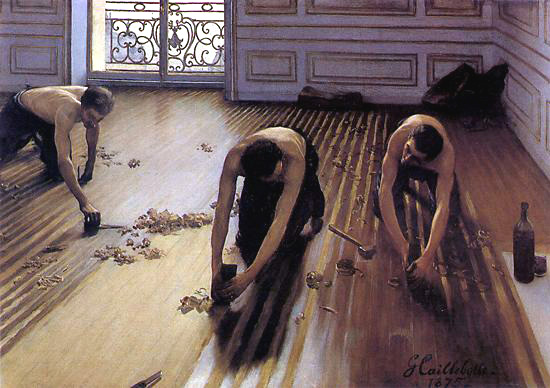
THe FLoor Strippers by Gustave CAillebotte

Gustave Caillebotte and dog on the Place du Carousel by Martial Caillebotte
Still Life with fruit by Cezanne
When I use paint to outline the skin of a beautiful peach or the melancholy of an old apple, I catch a glimpse in their reflections of their love for the sun, their memories of dew and freshness.
Cezanne
A fascinating and important book for understanding 19th century French culture, but it is marred by Sue Roe's incompetence as a writer. The text is full of ghastly cliches, gushing stupidities, and grammatical errors, and the illustration of Cezanne's A Modern Olympia has been reproduced back to front. (!)
I just completed The Private Lives of the Impressionists, which I bought in the Musee D'Orsay in Paris. A fascinating look at the friendships and careers and private lives of Manet, Monet, Pissaro, Renoir, Sisley, Degas, Morisot, Cassat, Caillebotte, Bazille and Cezanne, this book fuelled my obsession for 19th century France.
The unsung hero of the Impressionists' story was the dealer Paul Durand Ruel, who throughout their careers supported and financed many of the artists of the group, while facing bankruptcy and ruin himself, at the same time building up the most important collection of Impressionist art in the world.
In Paris I saw a fabulous exhibition of Caillebotte. The exhibition featured paintings by Gustave Caillebotte, like this one, and photographs by his brother Martial Caillebotte side by side. Fascinating, the photographs especially, giving a glimpse of a lost world.
THe FLoor Strippers by Gustave CAillebotte

Gustave Caillebotte and dog on the Place du Carousel by Martial Caillebotte
Still Life with fruit by Cezanne
When I use paint to outline the skin of a beautiful peach or the melancholy of an old apple, I catch a glimpse in their reflections of their love for the sun, their memories of dew and freshness.
Cezanne
A fascinating and important book for understanding 19th century French culture, but it is marred by Sue Roe's incompetence as a writer. The text is full of ghastly cliches, gushing stupidities, and grammatical errors, and the illustration of Cezanne's A Modern Olympia has been reproduced back to front. (!)
234QuentinTom
>229 absurdeist: Enriiiiiiiiique, you can see my recent acquisitions on my profile page. I'm going to be introducing the best of them over the next few days, but suffice it to say, that I am most pleased about my little John Cowper Powys collection, which I got all in the same shop in Hay, all in the Village Press editions from the 1970s. Orgasmic!
235QuentinTom
I am now reading The Mabinogion, the medieval Welsh epic, to prepare myself for Porius.
236LolaWalser
Welcome back! Where are the travel impressions? Forthcoming?
237QuentinTom
forthcoming, yes.
238absurdeist
234> sounds like you had yourself multiple bookgasms in Hay! Ohhhhhhh!
(it only took me like 28 hours to think up that)
(it only took me like 28 hours to think up that)
239QuentinTom
Paris is to my taste the most beautiful city on earth. I hadn't been for almost 20 years, but I spent a lot of time there when I was young. It was lovely to go back. I was most struck this time by the colour of the city, and the quality of the light, which is something one forgets. ALso, one gets the feeling in Paris that somewhere, some serious artistic, intellectual life is happening. We queued very early for the Caillebotte exhibition, for example, and already early in the morning, there was a large queue, and they were not tourists.
Amsterdam, in contrast, is merely an amusement park for adults. There's something for everyone, boating, drugs, art, sex, gambling, rambling, and it's all safe and legal. Amsterdam is rather more louche, but it must be a great city for the young. I was struck by how much everyone drinks. All the shops shut at 6, a shock to Asian dwellers, to allow people time to drink. There was much more drunkenness in the streets than Paris.
Wales, well, you all know my love affair with the UK. What a fucking shit hole. TRains were late and filthy, everyone was rude and lazy, and the cost of things was obscene. Signs everywhere warning that we are under constant 24 hour cctv surveillance. on the platform at London Bridge station, suddenly an announcement that we are under surveillance. What's with this shit? I love the way they tell us, to hide the fact that they never asked us...
Anyway, the Hay festival was great fun. More impressions on that later.
Amsterdam, in contrast, is merely an amusement park for adults. There's something for everyone, boating, drugs, art, sex, gambling, rambling, and it's all safe and legal. Amsterdam is rather more louche, but it must be a great city for the young. I was struck by how much everyone drinks. All the shops shut at 6, a shock to Asian dwellers, to allow people time to drink. There was much more drunkenness in the streets than Paris.
Wales, well, you all know my love affair with the UK. What a fucking shit hole. TRains were late and filthy, everyone was rude and lazy, and the cost of things was obscene. Signs everywhere warning that we are under constant 24 hour cctv surveillance. on the platform at London Bridge station, suddenly an announcement that we are under surveillance. What's with this shit? I love the way they tell us, to hide the fact that they never asked us...
Anyway, the Hay festival was great fun. More impressions on that later.
240anna_in_pdx
I lived in Paris as a student for a year. That was more than 20 years ago. Now I am planning a trip for next March and am so glad to hear your impressions.
241absurdeist
Murr, anna, anybody who's been to Paris, have you had the opportunity to peruse the Shakespeare & Co.?
242baswood
Hi EF
I was in Shakespeare & Co. last October and I saw it again tonight. Let me explain. We spent a few days in Paris last October and Shakespeare &Co. was on our itinerary, spent a wet morning in there until lunchtime (like most of Paris it doesn't open till 10.30). Tonight we went to our local cinema (Marciac, Gers, France) to see the new Woody Allen Film; Midnight in Paris and the frontage of Shakespeare &Co appears right near the end of the film. A bit syncro ctiyish huh. Lovers of Paris will love the Woody Allen film. Back to the bookshop, wonderful old shop with a history, it's still running those competitions. Books are piled high and reasonably well sorted. Two long legged American girls were at front of house and for me it was a bit like an oasis in the desert to find a good second hand English bookshop in France. Worth a detour.
I was in Shakespeare & Co. last October and I saw it again tonight. Let me explain. We spent a few days in Paris last October and Shakespeare &Co. was on our itinerary, spent a wet morning in there until lunchtime (like most of Paris it doesn't open till 10.30). Tonight we went to our local cinema (Marciac, Gers, France) to see the new Woody Allen Film; Midnight in Paris and the frontage of Shakespeare &Co appears right near the end of the film. A bit syncro ctiyish huh. Lovers of Paris will love the Woody Allen film. Back to the bookshop, wonderful old shop with a history, it's still running those competitions. Books are piled high and reasonably well sorted. Two long legged American girls were at front of house and for me it was a bit like an oasis in the desert to find a good second hand English bookshop in France. Worth a detour.
243anna_in_pdx
Oh gosh, I was just saying today that this is the first Woody Allen film in pretty much ever that I have actually WANTED to go see.
244QuentinTom
I spent the whole morning in Shakespeare and Co. They did not have any John Cowper Powys, and their selection of French literature in translation was woefully inadequate: 236 different editions of The Three Muskateers, but no Zola at all. :(
It had a great atmosphere though, and two lovely reading rooms up stairs, with a piano, which an effete young asian lad was playing all the time I was there. They even provided a typewriter and paper in case you got inspired.
I bought there:
Monsieur Proust
Afloat
Alien Hearts
Hashish, Wine, Opium
The Invention of Love
It had a great atmosphere though, and two lovely reading rooms up stairs, with a piano, which an effete young asian lad was playing all the time I was there. They even provided a typewriter and paper in case you got inspired.
I bought there:
Monsieur Proust
Afloat
Alien Hearts
Hashish, Wine, Opium
The Invention of Love
245Porius
I suppose the ghosts at Shakespeare & Co. are the most interesting things at the place. What one wouldn't give to see the natty Jim Joyce pretending to read Euripides over in a lonely corner. Or Thomas Stearns posing with Tacitus.
http://upload.wikimedia.org/wikipedia/commons/4/4a/Euripides_Pio-Clementino_Inv3...
http://upload.wikimedia.org/wikipedia/commons/4/4a/Euripides_Pio-Clementino_Inv3...
246Macumbeira
I visited S&Co once or twice in my Joyce period. But I seem to remember that what we visit is not the original shop or location. You are more likely to bump into writer's ghosts at the Procope, ( is that Voltaire sitting over there ? ) or eating your "Souflé au caramel" in one of the rooms of " La Perouse"
247QuentinTom
Speaking of ghosts and apparitions, I had a strange encounter in Antwerp when I visited it a few weeks ago. Strolling along the quay, I saw, seated on a pile of rope and fishing baskets, a figure who looked vaguely familiar: gaunt, wild eyed, with terrible hair. He was gazing out to sea with a far away look in his eyes, muttering to himself words, that, as I drew near, I recognised to be from Finnegan's Wake.
It was none other than our very own Captain Mac! We flew into each others arms like lost souls in purgatory. Then followed a wild excursion into the depths of Antwerp. We visited the ships, dingy bars and backstreet brothels, sailors dives and the haunts of longshoremen, with Captain Mac discoursing on the history of Brabant and the Flatlands, his adventures with pirates and whales in the South Atlantic, magical creatures found at the poles. We discussed the plots of books never heard of before, and gossiped about avatars in far off places. we had a fabulous meal of fishheads, feathers and champagne in a lovely place called the Villa Des Roses, and then after that, things become lost in a bit of a blurr as the wine and poetry flowed. Occasionally the Captain would stop, point a bony finger to the horizon and mutter: le Salon faut savoir cést histoire, and his brow would darken and his eyes gleam strangely.
Then, as the shadows lengthened and the sun sank below the yard arm, the Captain graciously poured me and my companion back onto the train to Amsterdam. Was it a Coleridgean dream? I wondered as I dozed in the carriage. but in my pocket I found a small silver hand, sign of the burgers of Antwerp, a memory of a marvellous meeting of minds and friends.
It was none other than our very own Captain Mac! We flew into each others arms like lost souls in purgatory. Then followed a wild excursion into the depths of Antwerp. We visited the ships, dingy bars and backstreet brothels, sailors dives and the haunts of longshoremen, with Captain Mac discoursing on the history of Brabant and the Flatlands, his adventures with pirates and whales in the South Atlantic, magical creatures found at the poles. We discussed the plots of books never heard of before, and gossiped about avatars in far off places. we had a fabulous meal of fishheads, feathers and champagne in a lovely place called the Villa Des Roses, and then after that, things become lost in a bit of a blurr as the wine and poetry flowed. Occasionally the Captain would stop, point a bony finger to the horizon and mutter: le Salon faut savoir cést histoire, and his brow would darken and his eyes gleam strangely.
Then, as the shadows lengthened and the sun sank below the yard arm, the Captain graciously poured me and my companion back onto the train to Amsterdam. Was it a Coleridgean dream? I wondered as I dozed in the carriage. but in my pocket I found a small silver hand, sign of the burgers of Antwerp, a memory of a marvellous meeting of minds and friends.
249Makifat
TC, so nice that you've returned from your wanderings with a crate of books. I happen to note this evening that we have both recently stumbled across a copy of Powys' The Inmates. Inasmuch as the author characterized it as a "philosophy of the demented", it ought to be right up our alley, say what?
250Macumbeira
oh my God, oh my God,
I kept silent because I thought it was a dream, but indeed a week ago or was it a month, a year, ( time flies !), I encountered these two beautiful cats sitting in the newly restored entrance hall of the Antwerp central station. One looked vaguely familiar, a bit like Saul Bellow in that 62 portrait made by Truman Moore, cocky hat and all. He was not alone, there was a beautiful feline with him...
but was it you TC ?
It is true, they followed me and yes we spoke to each other, we spoke about distant lands and fantastic books and great writers and... and...so many things.
It cannot be !
Was it you walking by my side along the Schelde river? Was it you dining with me in the café along the dock? Was it you licking your whiskers after the scallops, and the "Dame Noire"? Did we visit together that big bad red building and stood in awe, together in front of some Flemish Primitive?
It must have been a dream.
The erudition, the intelligence, the wit that I enjoyed in that single afternoon convinced me that it only could have been a dream encounter, until I found these two golden boxes filled with the most delicious tea from the far Island of Formosa.
If indeed it was you, dear friend, then life is more magical than any fiction.
I kept silent because I thought it was a dream, but indeed a week ago or was it a month, a year, ( time flies !), I encountered these two beautiful cats sitting in the newly restored entrance hall of the Antwerp central station. One looked vaguely familiar, a bit like Saul Bellow in that 62 portrait made by Truman Moore, cocky hat and all. He was not alone, there was a beautiful feline with him...
but was it you TC ?
It is true, they followed me and yes we spoke to each other, we spoke about distant lands and fantastic books and great writers and... and...so many things.
It cannot be !
Was it you walking by my side along the Schelde river? Was it you dining with me in the café along the dock? Was it you licking your whiskers after the scallops, and the "Dame Noire"? Did we visit together that big bad red building and stood in awe, together in front of some Flemish Primitive?
It must have been a dream.
The erudition, the intelligence, the wit that I enjoyed in that single afternoon convinced me that it only could have been a dream encounter, until I found these two golden boxes filled with the most delicious tea from the far Island of Formosa.
If indeed it was you, dear friend, then life is more magical than any fiction.
251QuentinTom
oh Captain Mac! Come to my arms! Pass the bottle!
252QuentinTom
>249 Makifat: Makifat HA! That's exactly what prompted me to get the inmates. consider my dilemma. There I was in a second hand bookshop in hay confronted by three shelves of Powys: about 15 JCP novels and essays, a couple of books by brother Lewellyn, and a couple more by brother Theodore; more books about the brothers by other Welsh writers, and a 20 kilo luggage allowance! It was precisely that 'philosophy of the demented' that determined my choice of The Inmates. And then, of course, I read Porius's masterful review! haha!
I'm nearly ready with my own review of Wolf Solent. Oh boy, what a fabulous writer old JCP was.
I'm nearly ready with my own review of Wolf Solent. Oh boy, what a fabulous writer old JCP was.
253absurdeist
247, 250>
i've just turned so green
with envying
I could pass
for Welsh grass
in spring
i've just turned so green
with envying
I could pass
for Welsh grass
in spring
254Macumbeira
TC, could we label our meeting as the first reunion of the European branch of "Le Salon Littéraire"? Could we ? Next year Paris ?
255absurdeist
No, next year ... Le Salon du Chino! We'll tour the local men's and women's penitentiaries, and learn how to leap barbed wire in a single bound!
256Poquette
It thrills me to know that Mac is the real thing! So if Mac is real, Murr must also be real! Here I've been thinking all along yous guys were too good to be true. Delighted to know you are flesh and blood . . .
257Macumbeira
flesh and wodka in some cases
258urania1
Murr and Mac meet. I am so envious. Murr, Mac - the USA (horrible though it may be) longs for a visit from you particularly those of us living in that pastoral Gehenna known as East Tennessee.
259ChocolateMuse
As for Australia, it pines for you.
Murr, they say Australian ballet is more muscular and athletic than European. Will that entice you? And Mac, wodka is all very well, but when it comes to quantity, a lot of Aussies know something about drinking...
Murr, they say Australian ballet is more muscular and athletic than European. Will that entice you? And Mac, wodka is all very well, but when it comes to quantity, a lot of Aussies know something about drinking...
260QuentinTom
it really was a memorable event. In our drunken revelries we did remember to raise a glass to le salon, didn't we mac. Le premier convention du Salon! Vive le salon!
we should do it again, in fact it would be great to have a salon convention, in a spot equidistant to everyone so that no one has to travel further than others. I'm going to avoid Europe next year due to the Olympics. It's gonna be hell.
I have at last completed my essai on Wolf Solent. I have not done justice to this wonderful book. I was trying to complete it in snatches at airport lounges towards the end, not the best way to approach a book of this power and complexity. But nonetheless, there it is.
http://www.librarything.com/work/187655/book/66093820
The Lectern version
http://thelectern.blogspot.com/2011/06/wolf-solent-john-cowper-powys-he-had.html
we should do it again, in fact it would be great to have a salon convention, in a spot equidistant to everyone so that no one has to travel further than others. I'm going to avoid Europe next year due to the Olympics. It's gonna be hell.
I have at last completed my essai on Wolf Solent. I have not done justice to this wonderful book. I was trying to complete it in snatches at airport lounges towards the end, not the best way to approach a book of this power and complexity. But nonetheless, there it is.
http://www.librarything.com/work/187655/book/66093820
The Lectern version
http://thelectern.blogspot.com/2011/06/wolf-solent-john-cowper-powys-he-had.html
261Macumbeira
Vive le Salon ! We toasted you all ! Then over a glass of Meurseault we tried to picture how all of you would really be outside the salon...and how nice it would be to get you all together some time somewhere
262Macumbeira
Nice review TC, as always.
Where did you find that illustration?
Where did you find that illustration?
263baswood
Excellent review and thoughts on Wolf Solent. Some of those thoughts are reflected through Porius, very interesting.
264QuentinTom
Thank you gentlemen. Mac, it's Samuel Palmer, an artist I always associate with Cowper Powys.
http://en.wikipedia.org/wiki/Samuel_Palmer
http://en.wikipedia.org/wiki/Samuel_Palmer
266Macumbeira
Poor Samuel, he fathered an imbecile
"Samuel Palmer was largely forgotten after his death. In 1909, large amounts of his Shoreham work were destroyed by his surviving son Alfred Herbert Palmer, who burnt "a great quantity of father's handiwork ... Knowing that no one would be able to make head or tail of what I burnt; I wished to save it from a more humiliating fate". The destruction "included sketchbooks, notebooks, and original works, and lasted for days".
"Samuel Palmer was largely forgotten after his death. In 1909, large amounts of his Shoreham work were destroyed by his surviving son Alfred Herbert Palmer, who burnt "a great quantity of father's handiwork ... Knowing that no one would be able to make head or tail of what I burnt; I wished to save it from a more humiliating fate". The destruction "included sketchbooks, notebooks, and original works, and lasted for days".
267QuentinTom
Grrrrrrrrr. stupid fucker that Alfred.
268Porius
as the wife of the explorer/traveller/linguist,writer/etc. etc. Richard Burton burned many of his papers. unspeakable.
269QuentinTom
may Alfred and Mrs Burton rot in hell for all eternity. With no herring.
270Porius
3 by WW with art by SP
http://www.youtube.com/watch?v=YswVozzvZ3o&feature=player_embedded#at=99
not read particularly well
I'd like to strangle the idiot who shot this video
http://www.youtube.com/watch?v=gzSlTaOY_ls
As you all know I'm a closet biographical critic'
http://www.artnet.de/artwork/426084027/785/samuel-palmer-the-shearers.html
http://www.youtube.com/watch?v=YswVozzvZ3o&feature=player_embedded#at=99
not read particularly well
I'd like to strangle the idiot who shot this video
http://www.youtube.com/watch?v=gzSlTaOY_ls
As you all know I'm a closet biographical critic'
http://www.artnet.de/artwork/426084027/785/samuel-palmer-the-shearers.html
272QuentinTom
I have fallen a bit behind with my reading and writing. I'm in a summer funk. It's too hot, and I am too busy this month to have much energy left over for anything else. Also, the siren call of the swimming pool is difficult to resist. I was goingt o write about the Mabinogion, but it's too much effort. Instead, let me tell you about my encounter with Alfred Brendel at Hay.
I have always revered Brendel, especially for the way he plays Schubert, my favourite composer. He gave two talks at Hay, and I went to both.
In the first he talked about humour in pure music- by which he means music which is wordless. He focussed on Hayden, Beethoven's Diabelli Variations, some cadenza's by Beethoven. His main point was that humour in music was largely restricted to classical composers, and did not really appear in the Romantics. He saw this as an expression of the Enlightenment, and quoted the German Romantic Jean Paul: 'Humour is the sublime in reverse'. I did take notes, but I cannot decipher them, alas. Brendel illustrated the lecture with musical excerpts played on the piano. It was fascinating, and one came away with the sense of a man steeped in European enlightenment culture. His references ranged from Kant, Jean Paul, Lessing, and of course all the composers.
The next day, he gave a talk connected with his latest book, the Collected Poems: Playing the Human Game. Here he was talking about his life and literary influences. THe host, some radio journalist from the UK did a terrible job of asking the right questions (obviously, someone completely out of her depth with Brendel) and it was a bit frustrating. AB mentioned that reading and literary culture had been just as important to him all his life as music.
During the Q&A I asked him to name some of his key writers and books, and I noted down his response:
Oblomov
Christian Morgenstern
Stendahl
Diderot
Zbigniew Herbert
The Manuscript found in Saragossa
Flaubert, especially L' Education Sentimentale
Tolstoy, especially Childhood, Boyhood, Youth
Robert Musil
Georg Christoph Lichtenberg
Edward Gorey
He also took special care to underline his love for Shakespeare, and his devotion to the Russian nonsense writers: Daniil Kharms and others, and his especial reverence for Haydn's music and ideas.
AB is probably one of the last practitioners of nonsense in his own verse. As he said: "I like the sense in the nonsense, and the nonsense in the sense."
I came away with the impression of a deeply learned man, erudite in all the major European languages, with a deep knowledge of the European Enlightenment, lightly worn, and always spoken about with a twinkle in his eye. I see him in a way as the last representative in our trashy age of the European Enlightenment. I revere him even more.
And he signed my copy and gave me the most charming smile!
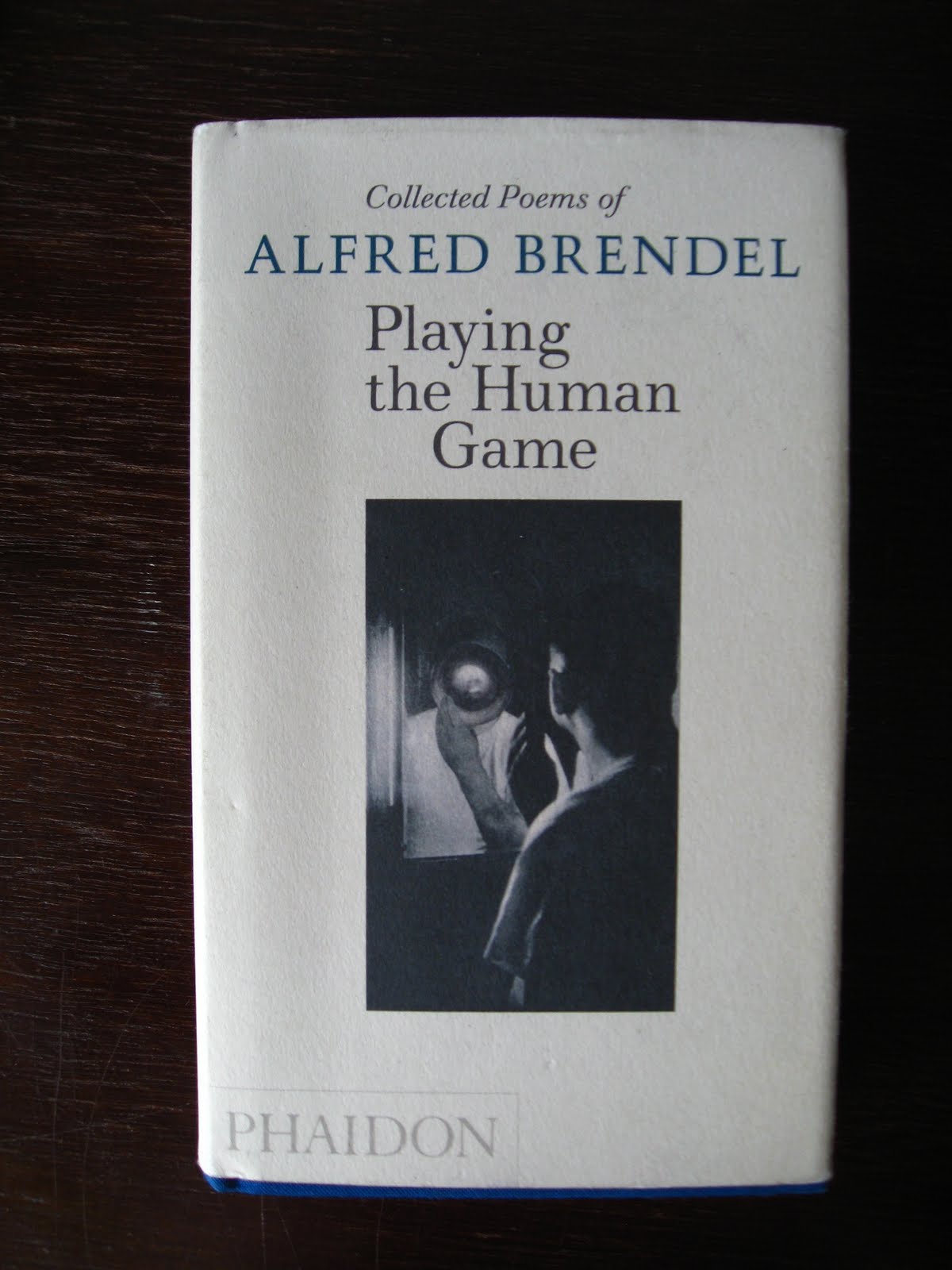
and here he is playing the Haydn sonata he talked about in his first lecture.
http://www.youtube.com/watch?v=-UPTU6GIzhk
I have always revered Brendel, especially for the way he plays Schubert, my favourite composer. He gave two talks at Hay, and I went to both.
In the first he talked about humour in pure music- by which he means music which is wordless. He focussed on Hayden, Beethoven's Diabelli Variations, some cadenza's by Beethoven. His main point was that humour in music was largely restricted to classical composers, and did not really appear in the Romantics. He saw this as an expression of the Enlightenment, and quoted the German Romantic Jean Paul: 'Humour is the sublime in reverse'. I did take notes, but I cannot decipher them, alas. Brendel illustrated the lecture with musical excerpts played on the piano. It was fascinating, and one came away with the sense of a man steeped in European enlightenment culture. His references ranged from Kant, Jean Paul, Lessing, and of course all the composers.
The next day, he gave a talk connected with his latest book, the Collected Poems: Playing the Human Game. Here he was talking about his life and literary influences. THe host, some radio journalist from the UK did a terrible job of asking the right questions (obviously, someone completely out of her depth with Brendel) and it was a bit frustrating. AB mentioned that reading and literary culture had been just as important to him all his life as music.
During the Q&A I asked him to name some of his key writers and books, and I noted down his response:
Oblomov
Christian Morgenstern
Stendahl
Diderot
Zbigniew Herbert
The Manuscript found in Saragossa
Flaubert, especially L' Education Sentimentale
Tolstoy, especially Childhood, Boyhood, Youth
Robert Musil
Georg Christoph Lichtenberg
Edward Gorey
He also took special care to underline his love for Shakespeare, and his devotion to the Russian nonsense writers: Daniil Kharms and others, and his especial reverence for Haydn's music and ideas.
AB is probably one of the last practitioners of nonsense in his own verse. As he said: "I like the sense in the nonsense, and the nonsense in the sense."
I came away with the impression of a deeply learned man, erudite in all the major European languages, with a deep knowledge of the European Enlightenment, lightly worn, and always spoken about with a twinkle in his eye. I see him in a way as the last representative in our trashy age of the European Enlightenment. I revere him even more.
And he signed my copy and gave me the most charming smile!
and here he is playing the Haydn sonata he talked about in his first lecture.
http://www.youtube.com/watch?v=-UPTU6GIzhk
273Makifat
What a fantastic encounter that must have been! I had no idea Brendel was a poet.
The Saragossa Manuscript is one of my all-time favorites, and the rest of his reading list isn't too shabby either! (I was just going through The Waste Books this afternoon, as a matter of fact.) And the Edward Gorey, incongruous at first glance, is a sweet touch.
The Saragossa Manuscript is one of my all-time favorites, and the rest of his reading list isn't too shabby either! (I was just going through The Waste Books this afternoon, as a matter of fact.) And the Edward Gorey, incongruous at first glance, is a sweet touch.
274ChocolateMuse
ohhhhhhh Murr. The most marvellous thing. How I envy you.
I had a musical epiphany a few years ago, and one of the factors that influenced it was a recording of Brendel playing Schubert's 'lesser' sonata in A, D664. When I mentioned to my piano teacher that I wanted to learn it, he said that he (the teacher) would find that boring. Then I listened to others playing the same sonata - I still liked it very much (more than my teacher), but it was Brendel that gave it that extra magic that influenced me so profoundly.
Don't think too badly of my teacher, his taste is impeccable in most things, except that he's not a fan of the keyboard music of Mozart and the classical period (neither am I when it's all said and done) and he suggested that this sonata falls under that general umbrella. In his further defence, he speaks enthusiastically of other Schubert works, just not that particular one - and we do know that Schubert is generally considered to be early Romantic, not Classical. :)
I had a musical epiphany a few years ago, and one of the factors that influenced it was a recording of Brendel playing Schubert's 'lesser' sonata in A, D664. When I mentioned to my piano teacher that I wanted to learn it, he said that he (the teacher) would find that boring. Then I listened to others playing the same sonata - I still liked it very much (more than my teacher), but it was Brendel that gave it that extra magic that influenced me so profoundly.
Don't think too badly of my teacher, his taste is impeccable in most things, except that he's not a fan of the keyboard music of Mozart and the classical period (neither am I when it's all said and done) and he suggested that this sonata falls under that general umbrella. In his further defence, he speaks enthusiastically of other Schubert works, just not that particular one - and we do know that Schubert is generally considered to be early Romantic, not Classical. :)
275zenomax
Murr - how exciting - glad your Hay trip ended so well.
Musil? Russian nonsense writers? This man is obviously someone much detached from the norm.
Musil? Russian nonsense writers? This man is obviously someone much detached from the norm.
276baswood
Ah Oblomov at the top of your list of Brendel's key books. One of my favourite novels - time for a re read I think.
Lovely storey of your meeting with the great man.
Lovely storey of your meeting with the great man.
277QuentinTom
thanks for your comments everyone. I'm going to reply to you all later, I have a three day training ahead of me tomorrow. but I just wanted to reply to Choco, coz I've been thinking about what you said all evening.
Schubert is more classical than people think. listen to his early symphonies, for example, and there is little to distinguish him from Haydn, the quintessential Enlightenment composer. One of the things I love about Schubert is the way he straddles the line, if such a thing may be imagined, between the Enlightenment, and the Romantic. This is a position which is closest to my own intellectual makeup, and the period I feel most at home in, culturally and historically. Another reason why I love Hoffman's Murr so much, which also creates a dialogue between Enlightenment and Romanticism. It seems to me that only Brendel really pulls this off in his playing of schubert, although, Uchida comes close, as does Schiff.
Here is Kempf playing the sonata so others can hear what we are talking about:
http://www.youtube.com/watch?v=5oQlWaAmPQQ&feature=related
not Brendel, but near enough, I guess.
Schubert is more classical than people think. listen to his early symphonies, for example, and there is little to distinguish him from Haydn, the quintessential Enlightenment composer. One of the things I love about Schubert is the way he straddles the line, if such a thing may be imagined, between the Enlightenment, and the Romantic. This is a position which is closest to my own intellectual makeup, and the period I feel most at home in, culturally and historically. Another reason why I love Hoffman's Murr so much, which also creates a dialogue between Enlightenment and Romanticism. It seems to me that only Brendel really pulls this off in his playing of schubert, although, Uchida comes close, as does Schiff.
Here is Kempf playing the sonata so others can hear what we are talking about:
http://www.youtube.com/watch?v=5oQlWaAmPQQ&feature=related
not Brendel, but near enough, I guess.
278Porius
A great man indeed not assigning nonsense a specific location. How can one appreciate great literature without this approach? Ah, that twinkle in the eye. I had a wonderful talk with Francis Huxley after one of his lectures at the DIA, he had a similar twinkle in his all-seeing eye.
279Makifat
Today I Wrote Nothing - a wonderfully absurd collection by Kharms.
For some reason, thinking of Kharms and nonsense, I just picked up a recently acquired collection of stories by Wolfgang Hildesheimer. The first random page I opened to had a reference to, of all people, Schubert:
I cannot get up anymore, for even if I do find my way through the bedroom, I will get lost in the living room. I lie here, dozing, looking at postcards or heliogravures, or else, on the phonograph next to my bed I play a serenade of Schubert's or his "Ave Maria" sung by a Black singer. She has such a lovely, calming voice. I also sometimes read "The Joys of Cactus Growing", from which I have learned, say, that cacti bloom. Perhaps one of mine has bloomed, but I cannot tell, for, as I have said, I no longer go into my living room.
-from the story "I Orient Myself". (The title of which seems also to bear some reference to our dear Murr. Signs and wonders.)
For some reason, thinking of Kharms and nonsense, I just picked up a recently acquired collection of stories by Wolfgang Hildesheimer. The first random page I opened to had a reference to, of all people, Schubert:
I cannot get up anymore, for even if I do find my way through the bedroom, I will get lost in the living room. I lie here, dozing, looking at postcards or heliogravures, or else, on the phonograph next to my bed I play a serenade of Schubert's or his "Ave Maria" sung by a Black singer. She has such a lovely, calming voice. I also sometimes read "The Joys of Cactus Growing", from which I have learned, say, that cacti bloom. Perhaps one of mine has bloomed, but I cannot tell, for, as I have said, I no longer go into my living room.
-from the story "I Orient Myself". (The title of which seems also to bear some reference to our dear Murr. Signs and wonders.)
280absurdeist
Murr,
Wanna trade that Alfred Brendel autograph for a Joseph Brodsky?
Wanna trade that Alfred Brendel autograph for a Joseph Brodsky?
281ChocolateMuse
Maybe my teacher never heard it played by Brendel. The Kempf recording is lovely, but as you say, not Brendel.
It's that crossover that I love about Schubert too - all the clarity of classical, but with the openness to interpretation of romantic.
I'm holding a Schubertiad at my place on 1 August, only it's not only Schubert's music we'll be playing. I'm inviting students from the uni where I work, and some staff. I wish you people could come too.
It's that crossover that I love about Schubert too - all the clarity of classical, but with the openness to interpretation of romantic.
I'm holding a Schubertiad at my place on 1 August, only it's not only Schubert's music we'll be playing. I'm inviting students from the uni where I work, and some staff. I wish you people could come too.
283ChocolateMuse
Welll, zeno, it might take away from the informality of the evening. And we're all just amateurs. But you never know, we might. :)
284QuentinTom
Just had the most exhausting week with very little time for reading. Porius is on hold, but I am reading the essays of JCP in Obstinate Cymric, which is a lot easier to carry around.
>273 Makifat: Makifat dearest
I was not surprised by AB's inclusion of Morgenstern, in that ABs poems have a distinctly Morgensternian feel to them. He writes in German and they are translated by Richard Stokes into English. They have this great puckish humour. I would post one, but I'm worried about copyright issues. (I could always pm one, I suppose, to interested parties...) AB's reading is fascinating.
I love your Kharms excerpt. Very reminiscent of Oblomov.
275>Zeno
I was surprised by Musil as well. I wanted to ask AB about Hoffman, but I was only allowed one question. They should have had me do the interview, not that twit journalist.
Zeno276> Bas
Good old Oblomov, eh?
Por>
Do tell us more about your meeting with FH? What transpired? and what is FH to you that you should weep for him?
Henri>
I shall ignore you, you beastly man. What a dilemma to confront me with! What sleepless nights and anxious hours!
Choco,
your schubertiad sounds wonderful. I shall be there in spirit, lurking behind the sofa, if I may. I think of the Salon as one big schubertiad (although I do feel some guilt at delaying and prevaricating over the classical music thread. What would Dr Urania Newton say?)
Brendel's book of poetry, by the way, is beautifully produced by Phaidon, in blue linen with silver titles and and spining, with German in blue ink on one side, and the English translation on facing in black, and a dust cover on lovely stiff paper. it is lavishly illustrated with prints of work by:
MAx Neumann
GUnter Brus
Ernst Skicka
and others
Here is a sample of the above artists:
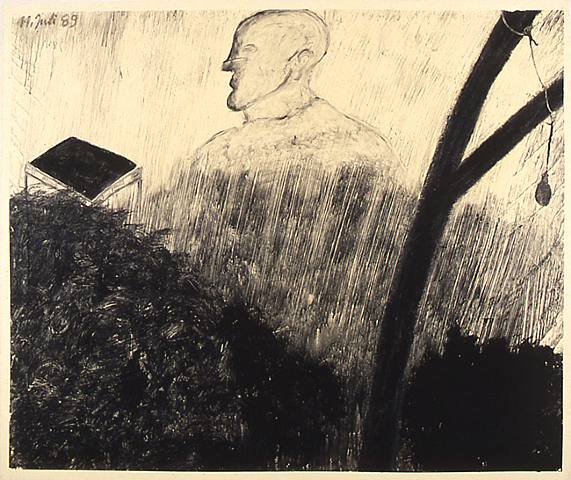
Brus

Neuman

Skricka
>273 Makifat: Makifat dearest
I was not surprised by AB's inclusion of Morgenstern, in that ABs poems have a distinctly Morgensternian feel to them. He writes in German and they are translated by Richard Stokes into English. They have this great puckish humour. I would post one, but I'm worried about copyright issues. (I could always pm one, I suppose, to interested parties...) AB's reading is fascinating.
I love your Kharms excerpt. Very reminiscent of Oblomov.
275>Zeno
I was surprised by Musil as well. I wanted to ask AB about Hoffman, but I was only allowed one question. They should have had me do the interview, not that twit journalist.
Zeno276> Bas
Good old Oblomov, eh?
Por>
Do tell us more about your meeting with FH? What transpired? and what is FH to you that you should weep for him?
Henri>
I shall ignore you, you beastly man. What a dilemma to confront me with! What sleepless nights and anxious hours!
Choco,
your schubertiad sounds wonderful. I shall be there in spirit, lurking behind the sofa, if I may. I think of the Salon as one big schubertiad (although I do feel some guilt at delaying and prevaricating over the classical music thread. What would Dr Urania Newton say?)
Brendel's book of poetry, by the way, is beautifully produced by Phaidon, in blue linen with silver titles and and spining, with German in blue ink on one side, and the English translation on facing in black, and a dust cover on lovely stiff paper. it is lavishly illustrated with prints of work by:
MAx Neumann
GUnter Brus
Ernst Skicka
and others
Here is a sample of the above artists:
Brus

Neuman

Skricka
285Porius
It just so happened that after his lecture FH took questions and they went quickly and I was the last in line and asked my questions and we sat there for quite a long time discussing this and that. He was somewhat impressed that I had read a couple of his books including THE RAVEN AT THE WRITING DESK. It was some time ago so my memory isn't too clear as to just what we talked about but I think we talked about Robert Anton Wilson but I'm not entirely certain. He was generous with his time and didn't make me feel like the shallow nitwit I undoubtedly was at the time.
286Poquette
Catching up on your thread, Tom. I am with you and Rena, Schubert holds a special place in my heart. In fact, I consider him to be one of the essentials. In addition to the piano music, his songs . . . what can I say? Music of the gods? Would love to be a fly on the wall of your Schubertiad, Rena.
287ChocolateMuse
Suz, you wouldn't be a fly on the wall, you'd be an honoured guest.
288QuentinTom
Still deeply immersed in Porius. Its dark, autumnal mood is beginning to get to me. I am taking occasional refuge in a very silly crime novel by Edgar Box, who is none other than Gore Vidal Death Before Bedtime. More on this later. Perfect summer reading.
But, more importantly, inspired by Choco's thread on the books to read before you're 30, I was digging around in the archives, and I found a list of my reading for 1984, my last year of senior high school. I kept lists of everything I read all through my youth, but only the lists for 1984, 1985, 1990, and an incomplete list for 1991 survived the years and the wanderings.
I'm putting up the list for 1984, when I was 18 here, for your interest and comment. I was really surprised by some of these, as I have no recollection of having them read them at all. For example, I was convinced I read A Glastonbury Romance that year, but according to the list, it was Weymouth Sands I read. I have no memory of this book at all, but I do have a clear memory of AGR, which, I suppose I must have read at another point much later. oh dear. My memory is going.
Dubliners James Joyce
Lord Jim Conrad
Under Milkwood Dylan Thomas
Der Kaukasiche Kreiderkreis Bertolt Brecht
Die Gesammelte Schwiegen des Doktor Murkus Heinrich Boll
A Christmas Carol Charles Dickens
Pickwick Papers Charles Dickens
Zanzibar, oder Das Letste Grund Ulrich Muhe
Selected Poems W.H. Auden
Anthony and Cleopatra Shax
Juno and the Paycock Sean O’Casey
Macbeth Shax
The First Circle Solzhenitsyn
Decameron Boccacio
The Idiot Dostoevsky
The Cocktail Party T.S.Eliot
Shakespeare’s Flowering of the Spirit Margaret Bennell
The Doomed Oasis Hammond Innes
Stiller Max Frisch
Andorra Max Frisch
Weymouth Sands John Cowper Powys
Cities of the Red Night William Burroughs
W.H. Auden Humphrey Carpenter
De Profundis Oscar Wilde
The Letters of Oscar Wilde
The Age of Reason Sartre
The Little World of Don Camillo Giovanni Guareschi
Riotous Assembly Tom Sharp
The White Paper Jean Cocteau
Olga Ivinskaya A Captive of Time
The Possessed Dostoevsky
Selected Poems Boris Pasternak
The Last of the Wine Mary Renault
The Unbearable Bassington Saki
Short Stories Saki
Justine Lawrence Durrell
Balthazar Lawrence Durrell
Mountolive Lawrence Durrell
Clea Lawrence Durrell
Selected Poetry T.S. Eliot
Selected Poetry John Dryden
The Seven Pillars of Wisdom T.E. Lawrence
The Mint T.E. Lawrence
Titles in bold are set books: I took English and German lit, and drama that year.
But, more importantly, inspired by Choco's thread on the books to read before you're 30, I was digging around in the archives, and I found a list of my reading for 1984, my last year of senior high school. I kept lists of everything I read all through my youth, but only the lists for 1984, 1985, 1990, and an incomplete list for 1991 survived the years and the wanderings.
I'm putting up the list for 1984, when I was 18 here, for your interest and comment. I was really surprised by some of these, as I have no recollection of having them read them at all. For example, I was convinced I read A Glastonbury Romance that year, but according to the list, it was Weymouth Sands I read. I have no memory of this book at all, but I do have a clear memory of AGR, which, I suppose I must have read at another point much later. oh dear. My memory is going.
Dubliners James Joyce
Lord Jim Conrad
Under Milkwood Dylan Thomas
Der Kaukasiche Kreiderkreis Bertolt Brecht
Die Gesammelte Schwiegen des Doktor Murkus Heinrich Boll
A Christmas Carol Charles Dickens
Pickwick Papers Charles Dickens
Zanzibar, oder Das Letste Grund Ulrich Muhe
Selected Poems W.H. Auden
Anthony and Cleopatra Shax
Juno and the Paycock Sean O’Casey
Macbeth Shax
The First Circle Solzhenitsyn
Decameron Boccacio
The Idiot Dostoevsky
The Cocktail Party T.S.Eliot
Shakespeare’s Flowering of the Spirit Margaret Bennell
The Doomed Oasis Hammond Innes
Stiller Max Frisch
Andorra Max Frisch
Weymouth Sands John Cowper Powys
Cities of the Red Night William Burroughs
W.H. Auden Humphrey Carpenter
De Profundis Oscar Wilde
The Letters of Oscar Wilde
The Age of Reason Sartre
The Little World of Don Camillo Giovanni Guareschi
Riotous Assembly Tom Sharp
The White Paper Jean Cocteau
Olga Ivinskaya A Captive of Time
The Possessed Dostoevsky
Selected Poems Boris Pasternak
The Last of the Wine Mary Renault
The Unbearable Bassington Saki
Short Stories Saki
Justine Lawrence Durrell
Balthazar Lawrence Durrell
Mountolive Lawrence Durrell
Clea Lawrence Durrell
Selected Poetry T.S. Eliot
Selected Poetry John Dryden
The Seven Pillars of Wisdom T.E. Lawrence
The Mint T.E. Lawrence
Titles in bold are set books: I took English and German lit, and drama that year.
290zenomax
Saki is another favourite who seems to be out of fashion at the moment.
Murr - which of these have either risen or fallen in your estimation over time, would you say?
Murr - which of these have either risen or fallen in your estimation over time, would you say?
291Macumbeira
precocious chap
292Porius
At 18 if I could tie my shoes properly the parental roof would be raised high as the moonbeamcarpenters. I've always relished fellows like Saki, Firbank, and Wodehouse, if only for the surfeit of vicious aunties. But I doubt very much that TCM would give my 18 year old self the time of day. At that callow age I always had to be knocking somebody down or picking somebody up as it were.
293absurdeist
Murr, seeing that list, I'm wondering if maybe A_musing was your Dad?
296ChocolateMuse
"At 18 if I could tie my shoes properly the parental roof would be raised high as the moonbeamcarpenters" LOL Por.
I'm glad my 18 year-old self is not the only one put to shame by that list.
I'm glad my 18 year-old self is not the only one put to shame by that list.
297Tuirgin
Tomcat's 18 year old list puts my 37 year old list to shame. I remember being in high school and thinking that a friend of mine who received a book for Christmas got screwed over by the elves. It was a few more years before I really discovered literature.
298QuentinTom
well, now, before you all start getting in a tizzy, a lot of these books were rather over my head.
I remember feeling terribly out of my depth with Solzhenistyn's book. I spent hours in the library poring over the Encycl. Britt. trying to get my head around 'dialectics' and not succeeding terribly well. What's interesting to me now looking back is to see how early my obsession with the Russians started, which I had kind of forgotten went back so far. I had a kind of reading mentor who got me into the Russians. ( incidentally, the only book my father recommended to me on this list was the TOm Sharpe. It was my mother who turned me on to T.E. Lawrence. nuff sed.) I was also rather in at the deep end with Auden's poetry, but then I still am...
Zeno, it's an interesting question. I suppose the biggest change of heart would be Durrell, who was enormously important to me at that time- he changed everything for me, but who now I don't rate terribly highly. I reread the Alexandria Quartet about 5 years ago and was rather embarrassed, both at it, and at my younger self. However, one must remain loyal to the gods of one's youth. I still enjoy his poetry, and think he may be underrated as a poet.
I also reread the Sartre, twice, and it still stands in my estimation as a very great masterpiece. And of course Dostoevsky...
I was a Hammond Innes NUT! I think I read all of them, and Alastair Maclean was another great favourite. I devoured those books. The Wreck of the Mary Deare, remember that one?
and as for Saki, I basically modelled my younger self on the unbearable Bassington.
I remember feeling terribly out of my depth with Solzhenistyn's book. I spent hours in the library poring over the Encycl. Britt. trying to get my head around 'dialectics' and not succeeding terribly well. What's interesting to me now looking back is to see how early my obsession with the Russians started, which I had kind of forgotten went back so far. I had a kind of reading mentor who got me into the Russians. ( incidentally, the only book my father recommended to me on this list was the TOm Sharpe. It was my mother who turned me on to T.E. Lawrence. nuff sed.) I was also rather in at the deep end with Auden's poetry, but then I still am...
Zeno, it's an interesting question. I suppose the biggest change of heart would be Durrell, who was enormously important to me at that time- he changed everything for me, but who now I don't rate terribly highly. I reread the Alexandria Quartet about 5 years ago and was rather embarrassed, both at it, and at my younger self. However, one must remain loyal to the gods of one's youth. I still enjoy his poetry, and think he may be underrated as a poet.
I also reread the Sartre, twice, and it still stands in my estimation as a very great masterpiece. And of course Dostoevsky...
I was a Hammond Innes NUT! I think I read all of them, and Alastair Maclean was another great favourite. I devoured those books. The Wreck of the Mary Deare, remember that one?
and as for Saki, I basically modelled my younger self on the unbearable Bassington.
299Tuirgin
I read Dostoevsky in one of my earliest attempts to "read the classics." Crime and Punishment, and I was no more than 19 or 20. It changed everything for me. It opened a door that has never shut. I wouldn't even know where to find it.
300absurdeist
299> Crime and Punishment was one of the firsts for me as well, when in my early thirties I'd decided to tackle those classics. Unforgettable novel. Raskolnikov still lives inside me.
301QuentinTom
C&P didn't have as much impact on me as the Idiot. I first read C&P when I was Germany in 1992, and most of it went right over me. It was not a good time in my life to be reading it. I didn't really engage with it.
Actually, this would be a good idea for a thread: The book that changed you more than any other.
More reading reminiscenses?
Actually, this would be a good idea for a thread: The book that changed you more than any other.
More reading reminiscenses?
302Tuirgin
I have read The Idiot either two or three times. That was to come later, though. Idiot surprised me for how differently I read it each time. You could almost say that the first time I read Myshkin as a romantic Quixote, and the second as a tragic one. The impact on me, either way, was great, but how I thought about him, and the central meaning of that bit of his life was dramatically different.
I haven't talked to many who are familiar with Idiot. Do you have notes on the book, Murr?
I haven't talked to many who are familiar with Idiot. Do you have notes on the book, Murr?
303QuentinTom
I find The Idiot to be the most difficult to grasp of D's novels, and most difficult to conceptualise as a unity. As you say, it keeps changing in my mind. I have read it 4 or 5 times, three times before I was 25.
Here is my review:
http://thelectern.blogspot.com/2010/06/idiot-dostoevsky.html
Here is my review:
http://thelectern.blogspot.com/2010/06/idiot-dostoevsky.html
304Poquette
>301 QuentinTom: Actually, this would be a good idea for a thread: The book that changed you more than any other.
What a good idea!
What a good idea!
305Porius
Or books. Louis Halle's OUT OF CHAOS was one of those seminal books for me. Another book was THE OUTSIDER by Colin Wilson.
306QuentinTom
Right, where are we, what have I been reading, apart from Porius, that is, which I am loving to bits.
I read a very silly but entertaining crime novel by Gore Vidal, written under the pseudonym Edgar box: Death before Bedtime. The main character, a PR man turned detective is obviously Gore himself fantazising about how he would work as a detective. As it's a crime novel there is the obligatory womanising, but there is a wonderful gay subtext to the whole thing, with catty comments about clothes etc that only a gay man would notice. There are some very funny jokes, including the opening exchange:
"You know, I've never gone to bed with a man on a train before", she said, taking off her blouse.
"Neither have I," I said...
I have a theory that I think best shortly after I wake up in the morning. Since no very remarkable idea has ever come to me at any time, to prove or disprove my theory, I can happily believe that this is so, and my usual plodding seems almost inspired to me in these hours between waking and the clutter and confusion of lunchtime...
I have always regarded it as a stroke of good fortune that I was not born or brought up in a small American town. They may the backbone of the country, but they are also the backbone of ignorance, bigotry and boredom, all in vast quantities...
Vidal wrote three of these Edgar Box thrillers, I have one other which I intend to read when I finish Porius. A must for fans of Gore Vidal.
I also read JCP's collection of essays Obstinate Cymric. One modern critic has called JCP an interminable old bore, and it must be his non-fiction writings that were being referred to. These essays are little more than rants, in which the same themes crop up again and again: how wonderful the Welsh are, the multiverse, his hatred of science etc etc. There are some interesting ideas, to be sure, but they are buried so deeply and have to be teased out. Only for die hard fans of JCP, those who have already given over their loyalty to him, as I have, I suppose. An interesting and illuminating essay on Finnegan's Wake, and an interesting essay called 'My Philosophy' are the highlights of this collection, the latter casting extremely helpful light on Porius. More on that in my forthcoming review. Here are some excerpts:
Reason like logic, is much more likely to drive us insane than cure us of insanity.
If there has ever been a book - I am tempted to say a codex - ravishingly and painfully designed for the Innermost Circle of Cognoscenti and Illuminati, but composed by its author from a collection of the grossest graffiti scrawled by the hoi polloi (sic) in the public conveniences of half the world, it is Finnegan's Wake.
(I knew you would like that EF)
I am now reading JCP's study of Dostoievsky, which is also very idiosyncratic, and more revealing about JCP than about Dostoevsky. JCP revered Dostoevsky, and calls him the greatest novelist in the world, with D's four novels as the greatest novels ever written. Demons is his favourite. Again, some very interesting ideas in a lot of verbiage.
I am also rereading the Great Gatsby with a private student.
I read a very silly but entertaining crime novel by Gore Vidal, written under the pseudonym Edgar box: Death before Bedtime. The main character, a PR man turned detective is obviously Gore himself fantazising about how he would work as a detective. As it's a crime novel there is the obligatory womanising, but there is a wonderful gay subtext to the whole thing, with catty comments about clothes etc that only a gay man would notice. There are some very funny jokes, including the opening exchange:
"You know, I've never gone to bed with a man on a train before", she said, taking off her blouse.
"Neither have I," I said...
I have a theory that I think best shortly after I wake up in the morning. Since no very remarkable idea has ever come to me at any time, to prove or disprove my theory, I can happily believe that this is so, and my usual plodding seems almost inspired to me in these hours between waking and the clutter and confusion of lunchtime...
I have always regarded it as a stroke of good fortune that I was not born or brought up in a small American town. They may the backbone of the country, but they are also the backbone of ignorance, bigotry and boredom, all in vast quantities...
Vidal wrote three of these Edgar Box thrillers, I have one other which I intend to read when I finish Porius. A must for fans of Gore Vidal.
I also read JCP's collection of essays Obstinate Cymric. One modern critic has called JCP an interminable old bore, and it must be his non-fiction writings that were being referred to. These essays are little more than rants, in which the same themes crop up again and again: how wonderful the Welsh are, the multiverse, his hatred of science etc etc. There are some interesting ideas, to be sure, but they are buried so deeply and have to be teased out. Only for die hard fans of JCP, those who have already given over their loyalty to him, as I have, I suppose. An interesting and illuminating essay on Finnegan's Wake, and an interesting essay called 'My Philosophy' are the highlights of this collection, the latter casting extremely helpful light on Porius. More on that in my forthcoming review. Here are some excerpts:
Reason like logic, is much more likely to drive us insane than cure us of insanity.
If there has ever been a book - I am tempted to say a codex - ravishingly and painfully designed for the Innermost Circle of Cognoscenti and Illuminati, but composed by its author from a collection of the grossest graffiti scrawled by the hoi polloi (sic) in the public conveniences of half the world, it is Finnegan's Wake.
(I knew you would like that EF)
I am now reading JCP's study of Dostoievsky, which is also very idiosyncratic, and more revealing about JCP than about Dostoevsky. JCP revered Dostoevsky, and calls him the greatest novelist in the world, with D's four novels as the greatest novels ever written. Demons is his favourite. Again, some very interesting ideas in a lot of verbiage.
I am also rereading the Great Gatsby with a private student.
307baswood
TC you seem to have had more than your fill of JCP recently, having just finished Wolf Solent and moving straight into Porius. Definitely a little light reading is required.
I am enjoying the Porius experience but now I will be pleased to finish so that I can get out from underneath it. I am looking forward to the reviews.
Catching up on your back issues of "The Lectern" fascinating stuff.
I am enjoying the Porius experience but now I will be pleased to finish so that I can get out from underneath it. I am looking forward to the reviews.
Catching up on your back issues of "The Lectern" fascinating stuff.
308absurdeist
Amen to that, about The Lectern. And what a brilliant observation made by JCP about FW!
309QuentinTom
oh but bas, I hope I am not giving the impression that I am fed up with JCP. on the contrary, I admire him more and more. I mean, he was definitely a crackpot, but he could write better than anyone else around him. Porius is a stupendous achievement which ever way you look at it.
thanks for your kind words about The Lectern, both of you.
thanks for your kind words about The Lectern, both of you.
310LolaWalser
"Edgar Box"--reminds me of John Cleese's fondness for silly aliases, e.g. "Kim Bread".
Kim Bread.
Can't explain it.
Kim Bread.
Can't explain it.
311LolaWalser
OMG Cat, you MUST read Ludwig Tieck's dramatisation of the Puss in boots (if you haven't already). I was Laughing Out Loud in crowded subways, and I hate to do that, makes people stare so. Extremely hip for the period, multiple action planes, nested dialogue, self-referential flowing commentary, and funniest comments about the Kater from the appalled audience (why are we watching a play about a cat? Why isn't anyone commenting on the fact that it's A CAT? etc.)
312QuentinTom
Oh Death Before Bedtime was full of silly names! Kim Bread, ha!
did you read the Tieck in English or German, where did you find it, I want to read it! *jumping up and down*
did you read the Tieck in English or German, where did you find it, I want to read it! *jumping up and down*
314LolaWalser
Just supply trampoline!
My parents' cat jumps onto bedsheets when they are making the bed and then they swing it between themselves. (Have I just committed familial high treason...?)
'Twas in German, Murr, Reclam's little editions.
Oh hey, Gutenberg has a translation in English--you must scroll to it, it's within a selection:
http://www.gutenberg.org/cache/epub/12060/pg12060.html
German:
http://gutenberg.spiegel.de/buch/5470/1
My parents' cat jumps onto bedsheets when they are making the bed and then they swing it between themselves. (Have I just committed familial high treason...?)
'Twas in German, Murr, Reclam's little editions.
Oh hey, Gutenberg has a translation in English--you must scroll to it, it's within a selection:
http://www.gutenberg.org/cache/epub/12060/pg12060.html
German:
http://gutenberg.spiegel.de/buch/5470/1
315Poquette
I just realized that I have this very volume on my Kindle, which I downloaded for the Novalis. Also, in fishing around on the Internet, I found it in Google Books where you can page through and look at the illustrations and get a better feel for the "bookness" of the book which always helps me anyway with the Gutenberg transcriptions. So I'm looking forward to reading Tieck's Puss in Boots.
http://books.google.com/books?id=KWB2BcIby1EC&printsec=frontcover#v=twopage&...
http://books.google.com/books?id=KWB2BcIby1EC&printsec=frontcover#v=twopage&...
316LolaWalser
This must be a stupid question, but I must ask it--HOW does one get to the actual book on Google Books??? It's driven me crazy in the past, on the Internet Archive, when they sent you to Google Books and there's no obvious way to get to the text!
I accept humbly in advance that I'm possibly the dumbest or blindest internaut ever. Now please help.
#315
I hope it's enjoyable in English too. A nice trifle. I've been coming across more humourous Germans lately. I think I've fallen in love with Heine, at this late date.
I accept humbly in advance that I'm possibly the dumbest or blindest internaut ever. Now please help.
#315
I hope it's enjoyable in English too. A nice trifle. I've been coming across more humourous Germans lately. I think I've fallen in love with Heine, at this late date.
317Poquette
>316 LolaWalser: I've had the same difficulty at times. In this case, I clicked on "Preview the book" or some thing similar to that, and voila! There it was. I agree that it is not as transparent as it might be. And the infuriating thing is that many of the books listed at Google Books are just that – bibliographic listings. So sometimes when we are having difficulty getting to the actual text, it is because the text is not available!
318PimPhilipse
>316 LolaWalser:: Internet Archive usually (if the book is out of copyright) provides a PDF or DJVU version of the book. If not, and you can still browse through the entire book on Google, there are ways of downloading all the pages and re-assembling them into a PDF or DJVU. I did that with the book on the Faerie Queene and it was quite a hassle.
If you have specific examples I may be able to investigate the easiest way to acquire the book digitally.
If you have specific examples I may be able to investigate the easiest way to acquire the book digitally.
319ChocolateMuse
>316 LolaWalser: Internaut! That is marvellous. You should patent it.
320QuentinTom
oh that is brilliant. 12 volumes of German classics and I WANT THEM ALL! Lots of great stuff there, especially the Jean Paul.
I am in the final stages of Porius (sounds like cancer...) and having revelation after revelation. Some German Romanticism could be just the thing I need after I finish it.
Kindle. was that a free download, Suzanne?
mmmm.
I am in the final stages of Porius (sounds like cancer...) and having revelation after revelation. Some German Romanticism could be just the thing I need after I finish it.
Kindle. was that a free download, Suzanne?
mmmm.
322Poquette
Here it is for vol. 4, with the Puss in Boots:
http://www.gutenberg.org/ebooks/12060
And for the set, scroll down for "German" and you'll see the volumes listed separately:
http://www.gutenberg.org/browse/titles/g
ETA that you don't need a Kindle for this. You can download books from this site to your computer if you want and if you click on a book you will see the various formats available.
http://www.gutenberg.org/ebooks/12060
And for the set, scroll down for "German" and you'll see the volumes listed separately:
http://www.gutenberg.org/browse/titles/g
ETA that you don't need a Kindle for this. You can download books from this site to your computer if you want and if you click on a book you will see the various formats available.
324QuentinTom
LOl. You can show a cat stuff but you can't teach it.
Suzanne, thanks, I got those links, what I was trying to express was an emerging interest in a kindle -DONT TELL URANIA!!!!!!!!!!
Suzanne, thanks, I got those links, what I was trying to express was an emerging interest in a kindle -DONT TELL URANIA!!!!!!!!!!
325DanMat
>317 Poquette:
When Google started to make an "ebook" store (in hopes of pushing out their own ereaders and getting into epublishing), it got more confusing. If you have a gmail account make sure you sign out of it before doing a google book search because it's more difficult to download the pdf's (it wants you to add them to a bookshelf).
Here is a book as it looks when you are searching normally:
(stay away from the "get it now", "view sample" on left; you want the "download" on the upper-right)
http://books.google.com/books?id=fUEOAAAAIAAJ&printsec=frontcover&dq=ham...
And when you are doing your search on the left is a list:
Any Books
Preview available
Google eBooks
Free Google eBooks
"Any books" is the default. If you click on "Free Google eBooks" you will get the ability to download pdf's. "Google eBooks" is a trap.
A fair amount of pdf's will not read on the B&W ereaders. Something like a recent, academic journal article will read (tinier mind you because most ereader displays are smaller). But others can be very problematic taking up enormous amounts of bytes and be too much for the readers to comprehend. I bought a tablet because most of what I want are the scanned pdf's and I needed a similar processing abilty (speedwise, zoomwise) with pdf's as I have on my desk top (it's also all screen, so you are getting much more reading area). I turn the background black and the text white reducing eye-fatigue.
I'd recommend the newer, B&W nook over the Kindle though. It's lighter and has a touch screen swipe to change pages.
When Google started to make an "ebook" store (in hopes of pushing out their own ereaders and getting into epublishing), it got more confusing. If you have a gmail account make sure you sign out of it before doing a google book search because it's more difficult to download the pdf's (it wants you to add them to a bookshelf).
Here is a book as it looks when you are searching normally:
(stay away from the "get it now", "view sample" on left; you want the "download" on the upper-right)
http://books.google.com/books?id=fUEOAAAAIAAJ&printsec=frontcover&dq=ham...
And when you are doing your search on the left is a list:
Any Books
Preview available
Google eBooks
Free Google eBooks
"Any books" is the default. If you click on "Free Google eBooks" you will get the ability to download pdf's. "Google eBooks" is a trap.
A fair amount of pdf's will not read on the B&W ereaders. Something like a recent, academic journal article will read (tinier mind you because most ereader displays are smaller). But others can be very problematic taking up enormous amounts of bytes and be too much for the readers to comprehend. I bought a tablet because most of what I want are the scanned pdf's and I needed a similar processing abilty (speedwise, zoomwise) with pdf's as I have on my desk top (it's also all screen, so you are getting much more reading area). I turn the background black and the text white reducing eye-fatigue.
I'd recommend the newer, B&W nook over the Kindle though. It's lighter and has a touch screen swipe to change pages.
326Makifat
A tablet or netbook is great for pdf's. I received a very nice Sony e-reader last Xmas, but it just had too many problems downloading/displaying the Internet Archive pdf texts that I love, particularly large files and illustrations. (I ended up returning it.) The display on my Acer netbook is adjustable so that there is minimal eye strain, and I can read it outside at night whilst enjoying a pipe. When it dies, I plan on getting a tablet of some sort, but until then, what I have is fine.
327Poquette
Before I bought my Kindle I looked at the Nook and decided the Kindle had more versatility. Maybe the Nook has changed since March, but a finger swipe capability is not enough to convince me that I made the wrong choice at this time. The prices are coming down so fast that eventually people may routinely have more than one ereader for different purposes. Reading books is my main purpose on the Kindle. If I want to read an electronic version of a magazine, I'll read it on my laptop.
Also, DanMat is speaking of more reading area, and what I love about the Kindle is that I can actually narrow the reading "column" and increase the type size so that I can read one line at one glance, and it has actually doubled my reading speed. Of course, if I want to read slower or read poetry line by line, I can make the appropriate adjustments. Also the Kindle screen is designed to minimize glare and is just slightly gray although the type is stark black and sharp as anything.
I absolutely love the ability to increase type size. I have reached (some would say "exceeded") the age where larger type is easier on the eyes.
Tom, you can download the Kindle software at Amazon and try it out on your computer to give you an idea of how all the different capabilities work.
Also, DanMat is speaking of more reading area, and what I love about the Kindle is that I can actually narrow the reading "column" and increase the type size so that I can read one line at one glance, and it has actually doubled my reading speed. Of course, if I want to read slower or read poetry line by line, I can make the appropriate adjustments. Also the Kindle screen is designed to minimize glare and is just slightly gray although the type is stark black and sharp as anything.
I absolutely love the ability to increase type size. I have reached (some would say "exceeded") the age where larger type is easier on the eyes.
Tom, you can download the Kindle software at Amazon and try it out on your computer to give you an idea of how all the different capabilities work.
328anna_in_pdx
I am very happy with my Nook, but I only use about 5% of any given gadget's capabilities. I am having trouble downloading library e-books but that is probably me and not the Nook. A friend of Chris' has reconfigured his Nook to be completely compatible with some kind of fancy mobile software (forgot what it is called, I think it starts with a Z) so apparently you can dink around with them and make them more user friendly IF you are a computer geek.
I read the Puss in Boots play on the computer yesterday and it was hysterical. I wish I could read German though - the translation seemed sort of flat at times.
I read the Puss in Boots play on the computer yesterday and it was hysterical. I wish I could read German though - the translation seemed sort of flat at times.
329QuentinTom
>325 DanMat: DanMat thanks for such detailed help. Unfortunately, I think the screen I get when I press the link you provided must be different from yours. I can see no "get it now", "view sample" on left; or "download" on the upper-right. And I can't see the list on the left either. I am stuck with browsing the covers of the google books. They look nice.
What's wrong with me? Why can't i just click on the book cover and it opens and I can read it? Why can't these techie gits make things easy?
* Murr weeping unconsolably*
How are DanMat's instructions working for you lola?
I am attracted to all the great stuff available for free on the internet, and I am occasionally shaken by a storm of consumer interest in the Kindle and all that stuff. But they soon pass these storms. It has passed now. I will read a book. Much easier. Open. Read. Enjoy.
*sniff*
What's wrong with me? Why can't i just click on the book cover and it opens and I can read it? Why can't these techie gits make things easy?
* Murr weeping unconsolably*
How are DanMat's instructions working for you lola?
I am attracted to all the great stuff available for free on the internet, and I am occasionally shaken by a storm of consumer interest in the Kindle and all that stuff. But they soon pass these storms. It has passed now. I will read a book. Much easier. Open. Read. Enjoy.
*sniff*
331ChocolateMuse
Murr, I just had a look for you. Far as I can see, some books have it and some don't, a bit like people, really.
Here is one that has it: http://books.google.com/books?id=oRGvP1eArggC&source=gbs_similarbooks - at top right, click on 'preview this book'.
On the other hand, here is one that doesn't have it: http://books.google.com/books?id=xSXEswj4D78C&num=10
you see it says 'snippet view' where the other one says preview. So that's a subtle apologetic way of saying that this one's off limits.
Hope that helps. ♥
ETA: DanMat seems to see something quite different. It sounds good, wish I could see it too!
Here is one that has it: http://books.google.com/books?id=oRGvP1eArggC&source=gbs_similarbooks - at top right, click on 'preview this book'.
On the other hand, here is one that doesn't have it: http://books.google.com/books?id=xSXEswj4D78C&num=10
you see it says 'snippet view' where the other one says preview. So that's a subtle apologetic way of saying that this one's off limits.
Hope that helps. ♥
ETA: DanMat seems to see something quite different. It sounds good, wish I could see it too!
332QuentinTom
Thanks choco. I'm glad I'm not alone.
DanMat can we please have some of what you're having?
DanMat can we please have some of what you're having?
333Tuirgin
I am a computer geek by trade. I have the first Nook, and the 3rd Kindle. I gripe whenever I'm stuck with the Nook. You can't change the screen orientation, which becomes really important with PDFs. Also, Barnes and Noble doesn't like giving refunds -- fought with them for a week before they finally refunded me a measly $12. I'd actually given up, then they turned around and gave it to me. Not worth the trouble. Amazon has refunded me 5 or 6 times. They make it easy. I ask for a refund on every book that I buy that has been formatted by an apparent imbecile with no concept of copy editing. Ebooks, even by big publishers, are still formatted with very little attention to detail. I strip the DRM off of every book I buy, convert them to the formats I use, and reformat them to make them look better. I'm anal retentive about layout and design.
If typography is important to you, and you aren't a geek, ebooks aren't ready for you, yet. If you are a geek, it's awfully nice being able to hyperlink all the endnotes in, say, anything from Oxford U Press, which are never linked when you buy them. Footnotes come linked, but not endnotes. My ebook copy of The Mabinigion is easier to read for this reason (my having linked the endnotes) than is my paperback.
If professional quality typography is just a luxury to you, then ebooks are mighty convenient.
I prefer hardcover to ebook, and ebook to mass market paperback. Between ebook and trades it's usually down to convenience, so ebooks usually win.
If typography is important to you, and you aren't a geek, ebooks aren't ready for you, yet. If you are a geek, it's awfully nice being able to hyperlink all the endnotes in, say, anything from Oxford U Press, which are never linked when you buy them. Footnotes come linked, but not endnotes. My ebook copy of The Mabinigion is easier to read for this reason (my having linked the endnotes) than is my paperback.
If professional quality typography is just a luxury to you, then ebooks are mighty convenient.
I prefer hardcover to ebook, and ebook to mass market paperback. Between ebook and trades it's usually down to convenience, so ebooks usually win.
334DanMat
Sorry for the confusion. Google's book search is getting so idiosyncratic! I'll try to figure out a more standard way of searching for the free stuff. I'm on my tablet now, so typing is a chore. I do like books more, but I've saved myself from buying so many reprints, grabbing stuff from gutenberg/IA/google that it's kinda paid for itself. Haven't read anything cover to cover yet, so that aspect is a failure. But I do have a bunch of things stored on here that I've been trying to memorize, poems, French idioms, the Kings and Queens of England, foreign phrases, which is nice it have handy. And I've about 50 unread jstor articles.
335Makifat
If typography is important to you, and you aren't a geek, ebooks aren't ready for you, yet.
Internet Archive is the greatest thing since LibraryThing. The typography of a text is important for me, and there's nothing like the enjoyment of reading some rare tome in the typography of the original edition. Even struggling through the obscure pages of The Hermetick Romance is worth the effort.
I've also had some problems getting through to the Google books texts. I consult them rarely enough that I always forget how to get to them, until I happen to hit the right link and, voila!, there it is.
Internet Archive is the greatest thing since LibraryThing. The typography of a text is important for me, and there's nothing like the enjoyment of reading some rare tome in the typography of the original edition. Even struggling through the obscure pages of The Hermetick Romance is worth the effort.
I've also had some problems getting through to the Google books texts. I consult them rarely enough that I always forget how to get to them, until I happen to hit the right link and, voila!, there it is.
336DanMat
>331 ChocolateMuse:
So both those books are out of copyright and therefore attainable. The ones you are looking at might not necessarily be the ones you can download. However, if you look at the Washington Square example, the preview link is just to the right of the cover, if you click that you'll get the book and the option to download (the link just above the pages to the right). The Moby Dick you've linked to is strictly preview.
FYI: "Get it now", "view sample" is a lead in to the annoying google book shelf and it's makes it difficult to find a download button at that point. Also, don't be signed into gmail or any google account while you are doing book searches in google books.
Here's what I would do (let's use Moby Dick as an example):
Type: "Moby Dick" into google just like you were doing a normal search, hit enter.
Near the top of the google webpage, it reads: Web, Images, Videos, etc. Click on "more". A vertical list will appear with more options. Click on the "books" option, second from top on that list for me. The results will display (these are only books now). Now on the left, halfway down is:
Any Books
Preview available
Google eBooks
Free Google eBooks
"Any book" is the default. But on my results pages it looks like the first one is a "full view". It says it in the brief info just under the link. The second result says "no preview". The fourth, the Norton Critical edition, unfortunately that's another no preview. If you just want to look at full versions of Moby Dick that you can download, click on the left "Free Google eBooks". Anything after that is the total text and downloadable. That first result, when we had it on "Any book", even though it said "full view" had no option to download. Some previews can be quite substantial, especially if you only want to read an introduction or something. But the previews are not downloadable, not even a single page.
But again, I've yet to read a whole book. Maybe if I had an eink reader that would be different, who knows.
I think what Tuirgin's hinting at is getting a plain text version of something, then tweaking it in MSword (maybe increasing font size, changing it even, making it bold, include page numbers, etc., then making a pdf copy of that to read. At least that's what I'm reading on my tablet, pdf's only no MSoffice or plain text stuff (though it's possible for a few extra bucks). I took a plain text copy of Ulysses and made a pdf out of it, still very small megabyte-wise.
I've used this a few times (only good every 30 minutes or so):
http://www.freepdfconvert.com/
*you don't need to put your real email address in there, just wait on that page and it will say it's finished.
**Also, if you do the Moby Dick search and limit it to "Free Google eBooks", then go a little lower on the left:
Any time
21st century
20th century
19th century
Custom range...
Select "19th century", you get some interesting reviews...
***Now, here's an old one, Knight of the Burning Peslte, from 1613:
http://books.google.com/books?id=2d49AAAAIAAJ&dq=the&pg=PT5#v=onepage&am...
This is neat:
http://books.google.com/books?id=mGMXAAAAYAAJ&dq=the&pg=PR1#v=onepage&am...
And this:
http://books.google.com/books?id=MT92hcXWZscC&dq=the&pg=PP7#v=onepage&am...
Here's one, from 1646, French, Salomon de La Broue, about bridles and bits for cavalry horse:
http://books.google.com/books?id=an1DAAAAcAAJ&pg=PA9#v=onepage&q&f=f...
So both those books are out of copyright and therefore attainable. The ones you are looking at might not necessarily be the ones you can download. However, if you look at the Washington Square example, the preview link is just to the right of the cover, if you click that you'll get the book and the option to download (the link just above the pages to the right). The Moby Dick you've linked to is strictly preview.
FYI: "Get it now", "view sample" is a lead in to the annoying google book shelf and it's makes it difficult to find a download button at that point. Also, don't be signed into gmail or any google account while you are doing book searches in google books.
Here's what I would do (let's use Moby Dick as an example):
Type: "Moby Dick" into google just like you were doing a normal search, hit enter.
Near the top of the google webpage, it reads: Web, Images, Videos, etc. Click on "more". A vertical list will appear with more options. Click on the "books" option, second from top on that list for me. The results will display (these are only books now). Now on the left, halfway down is:
Any Books
Preview available
Google eBooks
Free Google eBooks
"Any book" is the default. But on my results pages it looks like the first one is a "full view". It says it in the brief info just under the link. The second result says "no preview". The fourth, the Norton Critical edition, unfortunately that's another no preview. If you just want to look at full versions of Moby Dick that you can download, click on the left "Free Google eBooks". Anything after that is the total text and downloadable. That first result, when we had it on "Any book", even though it said "full view" had no option to download. Some previews can be quite substantial, especially if you only want to read an introduction or something. But the previews are not downloadable, not even a single page.
But again, I've yet to read a whole book. Maybe if I had an eink reader that would be different, who knows.
I think what Tuirgin's hinting at is getting a plain text version of something, then tweaking it in MSword (maybe increasing font size, changing it even, making it bold, include page numbers, etc., then making a pdf copy of that to read. At least that's what I'm reading on my tablet, pdf's only no MSoffice or plain text stuff (though it's possible for a few extra bucks). I took a plain text copy of Ulysses and made a pdf out of it, still very small megabyte-wise.
I've used this a few times (only good every 30 minutes or so):
http://www.freepdfconvert.com/
*you don't need to put your real email address in there, just wait on that page and it will say it's finished.
**Also, if you do the Moby Dick search and limit it to "Free Google eBooks", then go a little lower on the left:
Any time
21st century
20th century
19th century
Custom range...
Select "19th century", you get some interesting reviews...
***Now, here's an old one, Knight of the Burning Peslte, from 1613:
http://books.google.com/books?id=2d49AAAAIAAJ&dq=the&pg=PT5#v=onepage&am...
This is neat:
http://books.google.com/books?id=mGMXAAAAYAAJ&dq=the&pg=PR1#v=onepage&am...
And this:
http://books.google.com/books?id=MT92hcXWZscC&dq=the&pg=PP7#v=onepage&am...
Here's one, from 1646, French, Salomon de La Broue, about bridles and bits for cavalry horse:
http://books.google.com/books?id=an1DAAAAcAAJ&pg=PA9#v=onepage&q&f=f...
338Tuirgin
Sorry for my brevity earlier. I was supposed to be working.
For those with know-how—it really only takes being able to work directly with HTML and CSS—a word processor is undesirable. When I'm fixing books that I've purchased I am editing them directly in the EPUB format. EPUB is really just a collection of files, mostly XML and XHTML, wrapped in a zip archive. You can change a book.epub to book.zip and unzip it like any other zip archive.
To convert from Amazon's format, which is really just MOBI unless you've gotten a miserable TOPAZ format book (I always, always, always return TOPAZ books for a refund). Once the DRM is removed, you can convert it to EPUB and use the tools that are out there for editing EPUB. Given the simplicity of EPUB, it really only requires a text editor of some sort. I use Emacs because it gives me a lot of power, particularly in dealing with Regular Expressions which is a way of matching/replacing strings of text.
An example of my use of it is with Oxford University Press's ebooks. OUP's books will have some footnotes, especially in the introductory material, and these will already have hyperlinks in their ebooks. Most of their notes, however, are end notes. There is an asterisk (*) in the text, and in the back of the book you find the page number and the phrase directly preceding the asterisk and see what the note is. In ebooks these are not linked and there are no freaking page numbers to refer to in trying to find your end note. This is miserable. But using regular expressions in a series of steps, I'm able to create hyperlinks between each asterisk and it's relevant note. It may take me an hour or two per book to fix it up, but it's well worth it. If I didn't know how to do this, I'd be reading far fewer ebooks. Without proper linking of all notes, ebooks are completely inappropriate for anything but simple novels.
Sorry for engeekering this conversation. I think ereaders have a lot of potential, but devoted readers should know what they're getting and not getting. There's quite a few sites discussing the typographical mess provided by ebooks and ereaders, but few of these bring out the fact that the majority of problems are the bloodly lazy publishers that don't bother with creating ebooks that make full use of the technology as it exists today.
I'll go back to my corner now.
Tuirgin, the wish-I-weren't-a Geek.
For those with know-how—it really only takes being able to work directly with HTML and CSS—a word processor is undesirable. When I'm fixing books that I've purchased I am editing them directly in the EPUB format. EPUB is really just a collection of files, mostly XML and XHTML, wrapped in a zip archive. You can change a book.epub to book.zip and unzip it like any other zip archive.
To convert from Amazon's format, which is really just MOBI unless you've gotten a miserable TOPAZ format book (I always, always, always return TOPAZ books for a refund). Once the DRM is removed, you can convert it to EPUB and use the tools that are out there for editing EPUB. Given the simplicity of EPUB, it really only requires a text editor of some sort. I use Emacs because it gives me a lot of power, particularly in dealing with Regular Expressions which is a way of matching/replacing strings of text.
An example of my use of it is with Oxford University Press's ebooks. OUP's books will have some footnotes, especially in the introductory material, and these will already have hyperlinks in their ebooks. Most of their notes, however, are end notes. There is an asterisk (*) in the text, and in the back of the book you find the page number and the phrase directly preceding the asterisk and see what the note is. In ebooks these are not linked and there are no freaking page numbers to refer to in trying to find your end note. This is miserable. But using regular expressions in a series of steps, I'm able to create hyperlinks between each asterisk and it's relevant note. It may take me an hour or two per book to fix it up, but it's well worth it. If I didn't know how to do this, I'd be reading far fewer ebooks. Without proper linking of all notes, ebooks are completely inappropriate for anything but simple novels.
Sorry for engeekering this conversation. I think ereaders have a lot of potential, but devoted readers should know what they're getting and not getting. There's quite a few sites discussing the typographical mess provided by ebooks and ereaders, but few of these bring out the fact that the majority of problems are the bloodly lazy publishers that don't bother with creating ebooks that make full use of the technology as it exists today.
I'll go back to my corner now.
Tuirgin, the wish-I-weren't-a Geek.
339DanMat
That sounds like great stuff. It's a shame that publishers aren't even creating internal links for their own e-documents, especially the OUP. I had to do a much lower key fix for a complete works of Shakespeare text file (which I had turned into a pdf) from project gutenberg. I found the notes tool for the RepliGo reader could scan the entire document (1000+ pages) for any notes and list them all in about two seconds (when you click on a note, it'll bring you to the page). This provided a makeshift table of contents and a way to readily jump to a particular play.
I really hope we haven't scared Murr off with all this though!
I really hope we haven't scared Murr off with all this though!
340absurdeist
Murr, all this techo-babble above is an ABOMINATION OF DESOLATION on your glorious reading thread and should no longer be tolerated. You are an enlightened romantic, nearly 300 years old, and certainly not at home in the 21st century with all these newfangled technological contraptual advances being ruthlessly levied your way in the alleged name of "reading," or "conveniency" or whatever propagandish jargon they try and rationalize it with; as if anything of what they're saying is even comprehensible in its reprehensibly computeristic gobbledegookspeak designed to drive you insane like Chinese water torture!
What's next, they'll try and teach you how to twit or join Facebook? Oooo-la-LA!!!
They're called BOOKS. Paper, binding, ink. That's all you need to read.
What's next, they'll try and teach you how to twit or join Facebook? Oooo-la-LA!!!
They're called BOOKS. Paper, binding, ink. That's all you need to read.
342DanMat
I now enter the SLOUGH OF DESPOND for besmearing thy thread, forgive me Murr.
"Tolle, lege! Tolle, lege!"
"Tolle, lege! Tolle, lege!"
343Tuirgin
Monsieur Freeque,
I am mostly in agreement with you. Paper books are user friendly. Paper books are elegant. Paper books are personal property, lend-able, trade-able, sell-able. Footnotes and marginal notes are visible at a glance, barely interrupting the flow of reading. The process of reading a paper book is predominately transparent, the exception being end notes.
The benefits of ebooks are in their weightlessness and dimensionlessness (something Borges would appreciate) and the ability to increase the size of the typeface arbitrarily at any time. The convenience factor is really a bigger benefit for the retailer than the consumer, capitalizing on impulse spending.
Gutenberg is a great resource, but many of the books lack formatting (italics, proper em dashes, and typographical quotes), and so many of those works would benefit from modern annotation.
Internet Archive is possibly a better bargain, but you pretty much need a tablet to take advantage of the images.
Ebooks as of today are not a clear improvement over paper.
Tuirgin
I am mostly in agreement with you. Paper books are user friendly. Paper books are elegant. Paper books are personal property, lend-able, trade-able, sell-able. Footnotes and marginal notes are visible at a glance, barely interrupting the flow of reading. The process of reading a paper book is predominately transparent, the exception being end notes.
The benefits of ebooks are in their weightlessness and dimensionlessness (something Borges would appreciate) and the ability to increase the size of the typeface arbitrarily at any time. The convenience factor is really a bigger benefit for the retailer than the consumer, capitalizing on impulse spending.
Gutenberg is a great resource, but many of the books lack formatting (italics, proper em dashes, and typographical quotes), and so many of those works would benefit from modern annotation.
Internet Archive is possibly a better bargain, but you pretty much need a tablet to take advantage of the images.
Ebooks as of today are not a clear improvement over paper.
Tuirgin
344QuentinTom
no no no it's most interesting, to read a chunk of text (336, 338) that is English, looks like English, smells like English, uses English words, and yet...... remains entirely incomprehensible to me! woohoo!
Danmat( are you Dan, or Mat?), really, thanks for your patience. I'm having my breakfast now, when I am awake and not so duh, I will try to work though your instructions. I know it will be worth it. I think the problem Choco and I had was perhaps that we were logged in to Google/gmail when we tried to follow your instructions before. I'm logged into Google most of the time because of my teaching blog. I want to be more tech-literate but I'm not sure I have the intellectual skills. I am also worried about how Lola is dealing with all this techno babble. Last i saw her she had taken refuge with the proctologist under the sofa.
Henri, I couldn't have put it better myself.
We're nearly at 350 posts. Time for a new thread?
Danmat( are you Dan, or Mat?), really, thanks for your patience. I'm having my breakfast now, when I am awake and not so duh, I will try to work though your instructions. I know it will be worth it. I think the problem Choco and I had was perhaps that we were logged in to Google/gmail when we tried to follow your instructions before. I'm logged into Google most of the time because of my teaching blog. I want to be more tech-literate but I'm not sure I have the intellectual skills. I am also worried about how Lola is dealing with all this techno babble. Last i saw her she had taken refuge with the proctologist under the sofa.
Henri, I couldn't have put it better myself.
We're nearly at 350 posts. Time for a new thread?
345QuentinTom
Tuirgin, layout and font, especially font are very important to me. there are some books I cannot bring myself to read because I hate the font: the Vintage edition of Pynchon's Mason and Dixon is a good example. I can't bring myself to face such a long book with such an awful font.
On the other hand, I adore the font used in the old silver/blue Penguin 20th century classics. That is lovely: thick and wordy.
I remember reading a study about the different effects of non serif and serif fonts. Apparently, non serif fonts (like this one) are faster to read, but actually make it more difficult for the memory to retain the information, while serif fonts, are slower to read, and it seems the memory does better with recalling information.
one of the things I hate about Guttenburg, is the way the text is bunched right up against the left of the screen with no margin. awful. But then, there are probably some buttons I can press to make it more readable, right?
sigh.
On the other hand, I adore the font used in the old silver/blue Penguin 20th century classics. That is lovely: thick and wordy.
I remember reading a study about the different effects of non serif and serif fonts. Apparently, non serif fonts (like this one) are faster to read, but actually make it more difficult for the memory to retain the information, while serif fonts, are slower to read, and it seems the memory does better with recalling information.
one of the things I hate about Guttenburg, is the way the text is bunched right up against the left of the screen with no margin. awful. But then, there are probably some buttons I can press to make it more readable, right?
sigh.
346Porius
I have the best of intentions towards ebooks, etc. but I can't stay overlong with them. I just love those nasty little books that bound around the world from home to home. I own an ancient edition of Johnson's, RAMBLER, 3 Vol., it has logged many, many miles with me. I wouldn't part with for the world.
347QuentinTom
take a picture take a picture! god that must be worth a pile or two!
348henkmet
I have downloaded a couple of books from Gutenberg and done the `formatting (italics, proper em dashes, and typographical quotes)' myself with LaTeX (also playing around with type). So far I only printed out one only, still waiting to read it, but annoyed as anything that my el cheapo printer doesn't get recto and verso aligned.
349Tuirgin
I have a few fonts I like to use. I've added them to both my Nook and Kindle. Warnock Pro is one that I like quite a bit for screen reading. There's a screenshot here, but it's not the same seeing it on a monitor as it is on a Nook or Kindle.
I think I mentioned that I'd take an ebook over a mass-market paperback. I can't stand cheap paper. I can't stand blotchy print. E Ink is better than that, but not as crisp and clean as quality printing on paper. When I've been reading ebooks for a while and suddenly open one of my hardcovers I'm almost in awe of how much nicer it is to read. On the other hand, I can control what typeface I use on my ereaders and I can also control the size of the type, which is excellent for the end of the day when my eyes are tired -- I can just bump the size up a bit.
I use plugins to change the way the websites I use the most look. In my LibraryThing, my font is serif and the background is warmer than white. The font-size is bigger, and there is more space between the lines.
Some Gutenberg books are better formatted than others. If you learn a little CSS, you can make some significant changes, but the reality is that typesetting is a serious craft and something that is falling by the wayside with electronic text. Ebooks are essentially just HTML and CSS. It's just not capable of rendering quality typesetting. Traditional typesetting, on the other hand, is founded on the principle of static text. The art of book-printing isn't coming to ereaders any time in the immediate future.
I have some modest Geek powers. I can do for myself when it comes to typesetting and ebooks. But how much time do I want to spend making an ebook readable instead of ordering a print copy? In some cases, I buy the print copy only to go and get the electronic copy -- the Davies Mabinogion being a good example. Once I finished fixing it, it's much easier to read electronically rather than clutching the book with a finger in the end notes all the time.
I like my Kindle. I don't like what I lose, though. And I don't like the time I have to invest to make reading on it a happy experience. Others aren't as picky, and many don't read so many books with footnotes and endnotes as I do. (Just you try reading the RSC Hamlet in ebook... I scoff at you and your constant click-note,click-back,click-note,click-back experience.)
Paper is simple and it works. Electronic isn't simple and it works in some situations. It is only occasionally an improvement. For traveling it is a great convenience if the books you read are available.
I think I mentioned that I'd take an ebook over a mass-market paperback. I can't stand cheap paper. I can't stand blotchy print. E Ink is better than that, but not as crisp and clean as quality printing on paper. When I've been reading ebooks for a while and suddenly open one of my hardcovers I'm almost in awe of how much nicer it is to read. On the other hand, I can control what typeface I use on my ereaders and I can also control the size of the type, which is excellent for the end of the day when my eyes are tired -- I can just bump the size up a bit.
I use plugins to change the way the websites I use the most look. In my LibraryThing, my font is serif and the background is warmer than white. The font-size is bigger, and there is more space between the lines.
Some Gutenberg books are better formatted than others. If you learn a little CSS, you can make some significant changes, but the reality is that typesetting is a serious craft and something that is falling by the wayside with electronic text. Ebooks are essentially just HTML and CSS. It's just not capable of rendering quality typesetting. Traditional typesetting, on the other hand, is founded on the principle of static text. The art of book-printing isn't coming to ereaders any time in the immediate future.
I have some modest Geek powers. I can do for myself when it comes to typesetting and ebooks. But how much time do I want to spend making an ebook readable instead of ordering a print copy? In some cases, I buy the print copy only to go and get the electronic copy -- the Davies Mabinogion being a good example. Once I finished fixing it, it's much easier to read electronically rather than clutching the book with a finger in the end notes all the time.
I like my Kindle. I don't like what I lose, though. And I don't like the time I have to invest to make reading on it a happy experience. Others aren't as picky, and many don't read so many books with footnotes and endnotes as I do. (Just you try reading the RSC Hamlet in ebook... I scoff at you and your constant click-note,click-back,click-note,click-back experience.)
Paper is simple and it works. Electronic isn't simple and it works in some situations. It is only occasionally an improvement. For traveling it is a great convenience if the books you read are available.
350Tuirgin
348> You can use LaTeX to create PDFs targeted for eReaders. I've monkeyed with it. The quality is very good, as is always the case with LaTeX. Of course, you lose the ability to increase, decrease the size, and most ereaders fail miserably on PDF navigation. I've settled for working in EPUB and exporting to MOBI for my Kindle. Kerning, hyphenation, and intra-line-spacing are all a complete wash on ereaders, unfortunately.
351henkmet
oh,I forgot to mention: I still haven't got an ereader. It has been more the fun of monkeying around than anything else.
352Tuirgin
351> If you want an easy path from plain text to LaTeX (or HTML or XML or...), take a look Pandoc. Prepare your text with simple Markdown-derived formatting, run the script, then modify the LaTeX as needed rather than beginning from scratch.
353ChocolateMuse
Riquie, put your fingers in your ears and sing loudly.
354janemarieprice
I don't understand almost anything that was said in the past 30 posts. Except Enrique's rant which was lovely.
Tuirgin, I have a good friend who works at Oxford. I'll give him a heads up about the ebook problem (what little I understand of it), though I don't think he has anything to do with that.
Tuirgin, I have a good friend who works at Oxford. I'll give him a heads up about the ebook problem (what little I understand of it), though I don't think he has anything to do with that.
355janemarieprice
353:

357QuentinTom
you mean this LaTex?


358Tuirgin
By the way, I don't mind moving the tech talk to a different thread, but I kinda doubt it's a topic that will come up much. If someone wants to start a thread to discuss ebooks, ereaders, ewhatevers, I'll participate, and I'm willing to help others out if they're trying to learn how to do for themselves. But... it's not exactly fascinating reading. :P
359Tuirgin
That latex is certainly, um, well formatted. But, uh... Actually. Yes. Yes. That latex, exactly.
360henkmet
>357 QuentinTom: I pressed the 'more' link, but unfortunately no more pictures come up?
(LaTeX (and TeX, pdfLaTeX, XeLaTeX etc. etc.) are text formatting systems. They become extremely easy to use once you have spend several 100's of hours on the learning curves hence they are popular with geeks)
(LaTeX (and TeX, pdfLaTeX, XeLaTeX etc. etc.) are text formatting systems. They become extremely easy to use once you have spend several 100's of hours on the learning curves hence they are popular with geeks)
361janemarieprice
356 - I'm quite jealous of him myself.
357 - And her. :)
357 - And her. :)
362beelzebubba
>357 QuentinTom:. thanks Murr, I owe you one. I had never heard of Bianca Beauchamp.
363Tuirgin
360> You know you're a geek when you despise Word for being bloody stupid and overly complicated to do easy things and praise LaTeX (and, yes, I usually use XeLaTeX) for being clean and easy. I do everything in plain text. All notes. All my work. Plain text with Markdown markup. Plain text is simple. LaTeX is beautiful.
364absurdeist
I was going to say this thread was becoming a bust, but as long as tech-talk results in posts like 357, I think it's okay.
366Poquette
Much as I love books and love being surrounded by them, I am at a point where I would rather read on my Kindle for reasons mentioned in 327 above in addition to the light weight and easier maneuverability of the Kindle. The clarity of the Kindle screen cannot be equaled IMHO.
With respect to end notes, I always end a session at the current end note page, make a note on a sticky of the location number of both the end notes and the text page I've ended on, so I can at least toggle in one direction from the end notes to the text page. This is not ideal – downright awkward, in fact, if I'm reading more than one book, but I don't want to take the time to become a software wizard at this point. I wrote to Amazon/Kindle about this issue and asked them to provide a way to toggle between any two locations in a book but did not hear from them and can only hope they might address this in a future version of the software.
A nontech alternative to stickies is to use Notepad for Kindle (free) and make a note of locations there.
With respect to end notes, I always end a session at the current end note page, make a note on a sticky of the location number of both the end notes and the text page I've ended on, so I can at least toggle in one direction from the end notes to the text page. This is not ideal – downright awkward, in fact, if I'm reading more than one book, but I don't want to take the time to become a software wizard at this point. I wrote to Amazon/Kindle about this issue and asked them to provide a way to toggle between any two locations in a book but did not hear from them and can only hope they might address this in a future version of the software.
A nontech alternative to stickies is to use Notepad for Kindle (free) and make a note of locations there.
367Porius
The
RAMBLER
by Samuel Jonhnson, LL.D.
-------------------------
In Three Volumes
VOL. I.
------------------------
Nullius addictus jurare in verba magistri,
Quo me cunque rapit tempestas, deferor hospes. Hor.
------------------------
The Eighteenth Edition
--------------------------------
LONDON:
Printed for Thomas Tegg; W. Sharpe and Son; G. Offor;
G. and J. Robinson; J. Evans and Co.: Also R. Griffin and Co. Glasgow;
and J. Cumming, Dublin.
-----------------------------
1825
RAMBLER
by Samuel Jonhnson, LL.D.
-------------------------
In Three Volumes
VOL. I.
------------------------
Nullius addictus jurare in verba magistri,
Quo me cunque rapit tempestas, deferor hospes. Hor.
------------------------
The Eighteenth Edition
--------------------------------
LONDON:
Printed for Thomas Tegg; W. Sharpe and Son; G. Offor;
G. and J. Robinson; J. Evans and Co.: Also R. Griffin and Co. Glasgow;
and J. Cumming, Dublin.
-----------------------------
1825
368RickHarsch
330> I just bought a copy of Moby Dick for 200 rupees.
369Poquette
Nullius addictus jurare in verba magistri,
Quo me cinque rapit tempestas, deferor hospes. Hor.
I believe you meant "Quo me cumque . . ."
Quo me cinque rapit tempestas, deferor hospes. Hor.
I believe you meant "Quo me cumque . . ."
370Porius
U & i so close together. I didn't mean anything by it, I was in a hurry to display the title page and typed mistakenly. It's cunque on the page, probably an error.
(I am not bound to swear allegiance to the word of any master, where the storm carries me, I put into port and make myself at home.)
(I am not bound to swear allegiance to the word of any master, where the storm carries me, I put into port and make myself at home.)
371QuentinTom
wonderful, my new motto. thanks for posting that, Por, it must indeed be a great treasure.
(Damn typos, always the kind of mistake I'm making too)
(Damn typos, always the kind of mistake I'm making too)
372Porius
Yes it is. As I love the old Doktor on this side idolatry. Or better if you call him a dog I shall love him.
373RickHarsch
I want my cumquats!
375QuentinTom
This thread is closed. PLease go here. Thank you all for the diverting conversation and good times.
http://www.librarything.com/topic/121017
http://www.librarything.com/topic/121017

