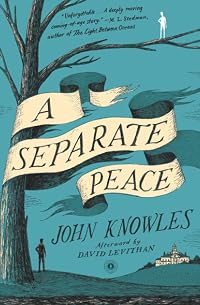
A Separate Peace
by John Knowles
On This Page
Description
Set at a boys' boarding school in New England during the early years of World War II, A Separate Peace is a harrowing and luminous parable of the dark side of adolescence. Gene is a lonely, introverted intellectual. Phineas is a handsome, taunting, daredevil athlete. What happens between the two friends one summer, like the war itself, banishes the innocence of these boys and their world. A bestseller for more than thirty years, A Separate Peace is John Knowles's crowning achievement and an show more undisputed American classic. show lessTags
Recommendations







Member Recommendations



Member Reviews
This is a frequently studied novel, and I can see its fertile ground. The relationship between Gene and Phineas is a complex one, viewed through a prism from Gene's point of view. Phineas is a rebellious rules flouter; or he's an innocent Pollyanna who doesn't understand the concept of rules; or he's manipulating a deeper game of one-upmanship with Gene, and his entire personality is a subterfuge. The background is World War II, providing a ticking clock as Gene and Phineas approach enlistment age. Gene shares in the general experience of the war as simultaneously dangerous and alluring. Phineas has a different kind of response, revelling in the peace they still enjoy in the moment. He is living in the present, while the rest of his show more classmates are swept up by their future. This becomes a kind of lifeline as Gene struggles with what's approaching.
The novel's primary fault is its blandness. At this all-white prep school there are no girls, no dating, no homosexuality; barely a hint of alcohol or driving; almost no music; no drugs, no gangs, no weapons. Everyone lives with their well-off parents, and the weirdest kid is only a naturalist who collects slugs and enjoys cross-country skiing. I am deeply surprised this book has been banned by anyone, ever (a teacher might want to lead with that mysterious fact, to keep the kids awake). But there's poignancy in scarcely being able to imagine coddled young men less well prepared for the horrors of war than these. show less
The novel's primary fault is its blandness. At this all-white prep school there are no girls, no dating, no homosexuality; barely a hint of alcohol or driving; almost no music; no drugs, no gangs, no weapons. Everyone lives with their well-off parents, and the weirdest kid is only a naturalist who collects slugs and enjoys cross-country skiing. I am deeply surprised this book has been banned by anyone, ever (a teacher might want to lead with that mysterious fact, to keep the kids awake). But there's poignancy in scarcely being able to imagine coddled young men less well prepared for the horrors of war than these. show less
This is a perfectly solid novel. The style is often lyrical, eloquent, is perceptive about the the workings of envy and insecurities of the teen years. I appreciated the emotional restraint that keeps the elegiacal tone from seeping too much into sentimentality. So I'm not sure what leaves me so unmoved by it, feeling this is a good, but not particularly profound novel that makes me wonder why it's earned such classic status. (Other than it's the perfect high school book with adolescent subjects--and relatively short.) It's told by Gene Forrester, looking back on events of around fifteen years ago at Devon, a New England Prep school. In the summer of 1942, a "brief burst of animosity, lasting only a second, a part of a second" on his show more part leads to tragedy. Knowles tries to connect up this brief moment to the war raging on outside the confines of the school. Knowles tells us "wars were made... by something ignorant in the human heart." Maybe it's that I resist that sentiment, particularly coming from Gene, that the story and its antiwar sentiments seems too predictable to me. Or maybe that I just feel Gene gets off too easy--both in terms of his friend Phineas' forgiveness and his own self-forgiveness which turns his impulsive act into a portal to epiphany. show less
I think a lot of people read this in high school, but I didn't. I decided to pick it up because I kept seeing it everywhere. My impressions:
1. There are almost no females in it. The lack of girls and the lack of interest in girls among these 16- to 18-year-old guys, made me think that the two main characters were in love with each other, which is probably just because I minored in gender studies. But, really, the total lack of anything sexual was an interesting choice.
2. This is a deep, dark book about living in wartime. I was reminded of how little the Iraq war affected my time in college compared to how tremendously WWII affected the boys at the boarding school in the story.
3. Obviously, this is also a story about the psychology of show more adolescence, particularly among young men, particularly in a competitive and isolated environment. The way they talked was so old-fashioned, though, that I kept picturing them as much younger, like 12 or 13.
4. How reliable of a narrator is Gene? Can Finny really be so perfect? I went back and forth on this. I kind of hated Gene, but I also felt so sorry for him.
5. Overall, a really fascinating book that I'm sorry to read all by myself with no professor to guide a discussion. show less
1. There are almost no females in it. The lack of girls and the lack of interest in girls among these 16- to 18-year-old guys, made me think that the two main characters were in love with each other, which is probably just because I minored in gender studies. But, really, the total lack of anything sexual was an interesting choice.
2. This is a deep, dark book about living in wartime. I was reminded of how little the Iraq war affected my time in college compared to how tremendously WWII affected the boys at the boarding school in the story.
3. Obviously, this is also a story about the psychology of show more adolescence, particularly among young men, particularly in a competitive and isolated environment. The way they talked was so old-fashioned, though, that I kept picturing them as much younger, like 12 or 13.
4. How reliable of a narrator is Gene? Can Finny really be so perfect? I went back and forth on this. I kind of hated Gene, but I also felt so sorry for him.
5. Overall, a really fascinating book that I'm sorry to read all by myself with no professor to guide a discussion. show less
(27) Every year around this time, I re-read a book I read many years ago. 'A Separate Peace' is one I read as a tween I think, and possibly even another time in school in close proximity to my first read, maybe circa 6th or 7th grade. I loved it then and thought about it long after turning the last page and it has not lost much of its mystique. Finny and Gene - best friends and roommates at a prestigious New England boys boarding school during WW2. The need to enlist or be drafted lies heavily over all their interactions despite the seemingly halcyon days and then tragedy strikes.
It is spare with elegant prose that is unadorned and devoid of gimmicks. Really? Can good novels still exist that are this straightforward? Excellent show more foreshadowing. Excellent thematic integrity. Pristine structure. Must be an English teacher's perfect novel. And it is moving and engaging. There are a few politically incorrect passages which perhaps render it unusable in today's ultra-PC society.
What really went down in the tree or on the staircase and is Gene truly to blame? His line of 'you don't cry at your own funeral' is fairly haunting. This book is so innocent in so many ways. Makes me think of these boys as a mother of two sons and causes my heart to ache. It is elegiac. It is wistful. It is not heavy-handed. I will hold on to this copy and give it to my boys for another 5-10 yrs from now. show less
It is spare with elegant prose that is unadorned and devoid of gimmicks. Really? Can good novels still exist that are this straightforward? Excellent show more foreshadowing. Excellent thematic integrity. Pristine structure. Must be an English teacher's perfect novel. And it is moving and engaging. There are a few politically incorrect passages which perhaps render it unusable in today's ultra-PC society.
What really went down in the tree or on the staircase and is Gene truly to blame? His line of 'you don't cry at your own funeral' is fairly haunting. This book is so innocent in so many ways. Makes me think of these boys as a mother of two sons and causes my heart to ache. It is elegiac. It is wistful. It is not heavy-handed. I will hold on to this copy and give it to my boys for another 5-10 yrs from now. show less
Originally published in 1959, A Separate Peace by John Knowles is a coming-of-age story set in a New England private boy’s school during World War II. The story is about friendship, competition and the inner doubts and fears of adolescent boys. There is a school of thought that pushes a homo-erotic dynamic as implied by the interactions between the two main characters, Gene and Phineas. This is subtle and open to an individuals’ interpretation of the relationship.
While Gene is an introvert and intellectual, Finny is an extroverted athlete who definitely has more control over their relationship. Whatever Finny wants to do, Gene, often reluctant, always follows along. As roommates, these opposites are always together. When Finny show more devises a daredevil club whose membership must jump from the limb of a tree into the river, Gene, although terrified, follows along. Gene admires Phineas but also is jealous of his ease with others and his ability to impress through actions. This jealousy flares up at various times, and eventually Gene acts upon impulse and this act of betrayal changes both boys forever.
A Separate Peace is beautifully written. It moves slowly but gives the reader vivid imagery and strong character development. World War II plays a vital part but always remains in the background, shaping the boy’s world, but not controlling it. The book varies itself, sometimes sad, sometimes humorous, always moving, and for me, it felt authentic to both the time and the place. show less
While Gene is an introvert and intellectual, Finny is an extroverted athlete who definitely has more control over their relationship. Whatever Finny wants to do, Gene, often reluctant, always follows along. As roommates, these opposites are always together. When Finny show more devises a daredevil club whose membership must jump from the limb of a tree into the river, Gene, although terrified, follows along. Gene admires Phineas but also is jealous of his ease with others and his ability to impress through actions. This jealousy flares up at various times, and eventually Gene acts upon impulse and this act of betrayal changes both boys forever.
A Separate Peace is beautifully written. It moves slowly but gives the reader vivid imagery and strong character development. World War II plays a vital part but always remains in the background, shaping the boy’s world, but not controlling it. The book varies itself, sometimes sad, sometimes humorous, always moving, and for me, it felt authentic to both the time and the place. show less
A Separate Peace is about a friendship between two opposites. Gene is smart, Phineas is athletic. Gene is sensitive, Phineas is carefree. Gene is reserved and cautious, Phineas is bold and daring. The one thing they have in common is being roommates at Devon, a prep school for boys. Throughout the entire story Gene is constantly in a mental tug-of-war with his feelings towards Finny. He is resentful of the way everything comes so easily to his athletic roommate (like when Phineas broke a long standing swimming record without even trying). It's as if Gene has to forcefully remind himself everyday they are best of friends. He tags along, a willing participant in Finny's daily adventures but he has to convince himself he is having fun. show more When Finny starts a secret society where members must jump from a tree into a river on school property Gene goes along with that as well, hating each and every jump. But, when Phineas falls out of the tree, missing the river completely things get complicated. Did Gene make his best friend and roommate fall? The psychological struggle of doubt that ensues is the central theme of the entire story. show less
Although this is a beautifully written book, I think 'harrowing and luminous' is a bit much. It centres around a group of 16/17 year old boys at what seems to be the least strict boarding school ever. As the date is 1942, the war hangs over them and shapes their views of the future and each other. The boys' ambivalence towards the war was my favourite aspect of the novel, in fact. None of them are unequivocally gung-ho and uncritically invested in heroism. Moreover, they are disdainful of such attitudes in teachers, parents, and other adults. Knowles conveys effectively the distance that the war had from everyday American life for these boys, in contrast to its immediacy in Europe.
At the centre of the book, however, is the relationship show more between Gene and Phineas, who are best friends. This I found somewhat irritating, because it seemed to be heavily implied that they were in love with one another. Their friendship could definitely be described as a romantic one, as well as seeming fraught with a tension that could be sexual. But the narrative never admits to these possibilities, which makes it seem a little baffling why the two are so emotionally invested in one another. It isn't so much subtle subtext as deliberate avoidance. To be fair, both characters seem equally baffled by the nature of their relationship as well. (Perhaps their classics lessons were extremely well censored?) The blurb of the edition I read also seemed to think it was a romance. Anyway, I found their interactions movingly written and the whole novel atmospheric. I was displeased with the ending, though. show less
At the centre of the book, however, is the relationship show more between Gene and Phineas, who are best friends. This I found somewhat irritating, because it seemed to be heavily implied that they were in love with one another. Their friendship could definitely be described as a romantic one, as well as seeming fraught with a tension that could be sexual. But the narrative never admits to these possibilities, which makes it seem a little baffling why the two are so emotionally invested in one another. It isn't so much subtle subtext as deliberate avoidance. To be fair, both characters seem equally baffled by the nature of their relationship as well. (Perhaps their classics lessons were extremely well censored?) The blurb of the edition I read also seemed to think it was a romance. Anyway, I found their interactions movingly written and the whole novel atmospheric. I was displeased with the ending, though. show less
Members
- Recently Added By
Lists

Classics you know you should have read but probably haven't
421 works; 408 members

Radcliffe's 100 Best Novel of the 20th Century
100 works; 32 members
PBS The Great American Read
100 works; 21 members

20th Century Literature
1,161 works; 55 members

Great American Novels
158 works; 40 members

Best School Stories
219 works; 22 members

National Book Award Finalists - Fiction
377 works; 12 members

Books You Read During High School (For School)
301 works; 52 members

1950s
340 works; 22 members
Unreliable Narrators
170 works; 43 members

Best Campus Novels
99 works; 18 members

New England Books
101 works; 10 members

Banned or Challenged Books
400 works; 41 members

NPRs your favorites: 100 Best Ever Teen Novels
237 works; 49 members
Favorite Coming of Age Novels.
164 works; 51 members

Dark Academia Novels
59 works; 11 members

Best Books Set in Boarding Schools
160 works; 57 members

Books Featured on Gilmore Girls
307 works; 21 members

Top Five Books of 2018
802 works; 265 members
Banned Books Week 2014
268 works; 63 members

The bookshelf of Lisa Simpson
23 works; 4 members
100 World Classics
99 works; 15 members
Books read by Charlie in "The Perks of Being a Wallflower"
12 works; 2 members

Blue Pyramid 1,276 Best Books of All Time
1,248 works; 32 members

Rory Gilmore Book Club
193 works; 5 members

New Authors to Read
21 works; 3 members

Amanda's Guaranteed Books
110 works; 5 members

1970s
657 works; 23 members

Shaykh Hamza's Book Recommendations
439 works; 3 members
Carole's List
445 works; 13 members
Historical Fiction
889 works; 91 members
Overdue Podcast
808 works; 9 members

Main Character is aged 10-19
363 works; 6 members
First Novels
373 works; 16 members

Favourite Discoveries Through LT
12 works; 2 members

Books Read in 2017
4,249 works; 130 members

Books set in high school
89 works; 7 members

Nifty Fifties
129 works; 13 members
American Lit for Eng 11 Research Project
368 works; 6 members

Reading Glasses Podcast
410 works; 3 members

Summer Reading 23
6 works; 1 member

Classics Book Club 2025
11 works; 1 member

Read with a Friend
17 works; 1 member

Recommended Reading : 600 Classics Reviewed, Editors of Salem Press, 2015
634 works; 6 members

The Story of the World: Activity Book Four: The Modern Age
333 works; 2 members
The Complete Rory Gilmore Reading List
506 works; 5 members

Books Read in 2025
4,128 works; 98 members
School Made Us Read It
380 works; 196 members

Books We Discovered On LibraryThing
530 works; 130 members

Before Austen Comes Aesop
318 works; 9 members

Books We Resisted Reading
178 works; 110 members

AP Lit
363 works; 6 members

the preppy handbook
36 works; 1 member

The Art of Manliness' 100+ Books Every Man Should Read
108 works; 2 members

Books Read in 2021
5,361 works; 114 members

Books Read in 2002
201 works; 8 members

Books Purchased July-December 2016
81 works; 1 member

Read
293 works; 4 members

Books Featuring Teens
25 works; 4 members

Meditations on Death
18 works; 3 members

Sonlight Books
1,487 works; 25 members

Books About Boys
175 works; 15 members
Best books I read in 2013
152 works; 3 members
Best of American Literature
146 works; 9 members
Five star books
1,767 works; 110 members

Unread books
1,063 works; 87 members
Author Information

19 Works 15,133 Members
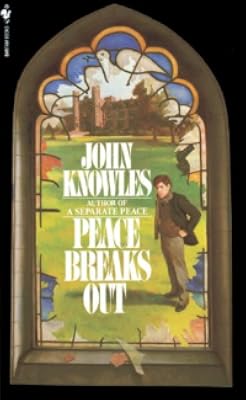
John Knowles was born in Fairmont, W.Va., on September 16, 1926. He began prep school at Phillips Exeter Academy in New Hampshire from 1942 to 1944 and was then inducted into the U.S. Army Air Corps. After World War II ended, he attended Yale University, graduating in 1949, and then worked as a reporter for the Hartford Courant. He eventually show more turned to freelance writing, often writing articles about travel. This took him to Europe where he spent much of the 1950s. In addition to this writing, he served as editor for Holiday magazine for a time. A Separate Peace, his first novel, was published in 1959 in England and the United States. Set in a prep school much like Exeter, the novel takes place during World War II and is about the impact of the war on young men on the homefront; the troubled relationship of the two main characters symbolizes the fear and suspicion that can lead to war between nations. Knowles received the William Faulkner Foundation Award for a First Novel and the Independent School Education Board Award. A Separate Peace continues to be one of the most widely read novels in high schools and colleges. Knowles's subsequent novels include Morning in Antibes (1962), A Vein of Riches (1978), which is set in his native West Virginia, and Peace Breaks Out (1981) which returns to the setting of A Separate Peace. He also wrote a non-fiction book, Double Vision: American Thoughts Abroad (1964). He remains best known, however, for his first novel. John Knowles has lived on Long Island, N.Y. since the early 1960s. (Bowker Author Biography) show less
Awards and Honors
Awards
Distinctions
Series
Belongs to Publisher Series
Work Relationships
Is contained in
Has the adaptation
Has as a study
Has as a supplement
Has as a commentary on the text
Has as a student's study guide
Has as a teacher's guide
Common Knowledge
- Canonical title*
- Pace separata
- Original title
- A Separate Peace
- Original publication date
- 1959
- People/Characters
- Gene Forrester; Elwin "Leper" Lepellier; Brinker Hadley; Phineas
- Important places
- Devon School, Devon, New Hampshire, USA; New Hampshire, USA
- Important events
- World War II
- Related movies
- A Separate Peace (1972 | IMDb); A Separate Peace (2004 | IMDb)
- Dedication
- To Bea and Jim with gratitude and love
- First words
- I went back to Devon School not long ago, and found it looking oddly newer than when I was a student there fifteen years before.
- Last words
- (Click to show. Warning: May contain spoilers.)All of them, all except Phineas, constructed at infinite cost to themselves these Maginot Lines against this enemy they thought they saw across the frontier, this enemy who never attacked that way—if he ever attacked at all; if he was indeed the enemy.
- Blurbers
- Miller, Warren; Menen, Aubrey
- Original language
- English
*Some information comes from Common Knowledge in other languages. Click "Edit" for more information.
Classifications
Statistics
- Members
- 14,292
- Popularity
- 521
- Reviews
- 205
- Rating
- (3.56)
- Languages
- 6 — English, French, German, Italian, Korean, Spanish
- Media
- Paper, Audiobook, Ebook
- ISBNs
- 73
- UPCs
- 2
- ASINs
- 69