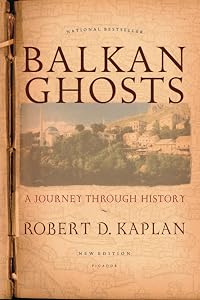
Balkan Ghosts: A Journey Through History
by Robert D. Kaplan
On This Page
Description
From the assassination that triggered World War I to the ethnic warfare in Serbia, Bosnia, and Croatia, the Balkans have been the crucible of the twentieth century, the place where terrorism and genocide first became tools of policy. Chosen as one of the Best Books of the Year by the New York Times, and greeted with critical acclaim as 'the most insightful and timely work on the Balkans to date'-The Boston Globe, Kaplan's prescient, enthralling, and often chilling political travelogue is show more already a modern classic. This new edition of the Balkan Ghost includes six opinion pieces written by Robert Kaplan about the Balkans between 1996 and 2000 beginning just after the implementation of the Dayton Peace Accords and ending after the conclusion of the Kosovo war, with the removal of Slobodan Milosevic from power. show lessTags
Recommendations














































Member Recommendations


John_Vaughan When you read Kaplan the sheer power of his acute observation shine...


Member Reviews
Kaplan is a very good writer. His years of reporting for big time magazines and newspapers sharpened his prose into what we see in this book; each piece an effortless melding of potent images and impressions with well-versed, concise summaries of the extremely complex histories of the regions and countries he is writing about. On that level, this book was a joy to read.
The reasons why someone would dislike this book are extremely obvious. Kaplan makes little effort to depict his subjects with any sympathy. He is unrelentingly pessimistic about the places he visits over the course of this book, and you can almost taste the acid dripping from each sentence. It's another testament to him as a practitioner of his craft that he can describe show more in such detail everything that annoys him about the people of the Balkans and the countries they've created. If you tend to take everything Kaplan says at face value, you'll come out of this book with no shortage of cutting, pinpoint stereotypes about Romanians, Croatians, Bulgarians, Greeks, etc.
All this vitriol leaves a sour taste in the mouth, especially when the writer is mostly talking about people that are poor and oppressed. But to hear Kaplan tell it, the people of the region are 100% to blame for the disasters that have befallen their countries, and it's not even over yet. Writing this book at the beginning of the 90s, Kaplan happened to predict with accuracy the bloodletting that would befall the Balkans in the decade to follow. One could probably argue that this prediction wasn't at all difficult to make, considering the historical background and state of affairs at the fall of the Eastern Bloc - but Kaplan seems to have gotten the credit anyway, at least it sounds that way from the self-satisfied foreword that accompanied my edition.
My biggest problem with this book isn't the negativity. For how strong the writing is, I would be down to come along for the ride, and I've enjoyed my fair share of misanthropic works of literature that don't suffer the slightest for being such. But Kaplan writes as if he *knows* exactly what the problems are and *exactly* how to fix them. He brings a handful of what I can only assume are his own personal bugaboos to bear into almost every diagnosis of what brought many of these countries to the brink of being a failed state, some of which have validity. Totalitarian Communism, ethnic hatred (specifically antisemitism), and the inherent backwardness of the "Orient" are in Kaplan's telling, the biggest offenders. The problem is how Kaplan takes for granted that all the things he thinks are bad simply are, with none of the probing and context with which he treats other aspects of the malaise that had fallen upon the region. Communism, in particular, receives the brunt of Kaplan's disdain, a view point that was perhaps more current in the immediate aftermath of the fall of the Eastern Bloc, but one which comes off as simplistic and gauche by the standards of today. More than once Kaplan refers to Communism having frozen these nations, leaving the half-century those regimes were in power a big grey spot in the history books, like the vast concrete apartment blocks that Kaplan decries for ruining the old world beauty of the places he visits. It's clear that Kaplan and I simply disagree on politics (he takes every chance he can to praise Reagan and capitalism) but I would have liked to hear a little more about why exactly he hated communism so, or at least some acknowledgement of the role partisan/leftist forces played in fighting the fascist regimes of WW2, or how people like Tito managed to hold together vast, ethnically disparate countries for decades. show less
The reasons why someone would dislike this book are extremely obvious. Kaplan makes little effort to depict his subjects with any sympathy. He is unrelentingly pessimistic about the places he visits over the course of this book, and you can almost taste the acid dripping from each sentence. It's another testament to him as a practitioner of his craft that he can describe show more in such detail everything that annoys him about the people of the Balkans and the countries they've created. If you tend to take everything Kaplan says at face value, you'll come out of this book with no shortage of cutting, pinpoint stereotypes about Romanians, Croatians, Bulgarians, Greeks, etc.
All this vitriol leaves a sour taste in the mouth, especially when the writer is mostly talking about people that are poor and oppressed. But to hear Kaplan tell it, the people of the region are 100% to blame for the disasters that have befallen their countries, and it's not even over yet. Writing this book at the beginning of the 90s, Kaplan happened to predict with accuracy the bloodletting that would befall the Balkans in the decade to follow. One could probably argue that this prediction wasn't at all difficult to make, considering the historical background and state of affairs at the fall of the Eastern Bloc - but Kaplan seems to have gotten the credit anyway, at least it sounds that way from the self-satisfied foreword that accompanied my edition.
My biggest problem with this book isn't the negativity. For how strong the writing is, I would be down to come along for the ride, and I've enjoyed my fair share of misanthropic works of literature that don't suffer the slightest for being such. But Kaplan writes as if he *knows* exactly what the problems are and *exactly* how to fix them. He brings a handful of what I can only assume are his own personal bugaboos to bear into almost every diagnosis of what brought many of these countries to the brink of being a failed state, some of which have validity. Totalitarian Communism, ethnic hatred (specifically antisemitism), and the inherent backwardness of the "Orient" are in Kaplan's telling, the biggest offenders. The problem is how Kaplan takes for granted that all the things he thinks are bad simply are, with none of the probing and context with which he treats other aspects of the malaise that had fallen upon the region. Communism, in particular, receives the brunt of Kaplan's disdain, a view point that was perhaps more current in the immediate aftermath of the fall of the Eastern Bloc, but one which comes off as simplistic and gauche by the standards of today. More than once Kaplan refers to Communism having frozen these nations, leaving the half-century those regimes were in power a big grey spot in the history books, like the vast concrete apartment blocks that Kaplan decries for ruining the old world beauty of the places he visits. It's clear that Kaplan and I simply disagree on politics (he takes every chance he can to praise Reagan and capitalism) but I would have liked to hear a little more about why exactly he hated communism so, or at least some acknowledgement of the role partisan/leftist forces played in fighting the fascist regimes of WW2, or how people like Tito managed to hold together vast, ethnically disparate countries for decades. show less
A bit torn. I eagerly devoured the history between these pages, but at the same time, his writing lacked both balance and technical panache. His view of the Orient was alarmingly one-sided and laughably out-of-date. I did feel, however, that certain essays in here (that's all it really is, a collection of travel essays and op-eds) are worth the price of admission. (I liked most of those on Romania and Bulgaria ... his views on Greece and Albania and especially Kosovo just rubbed me the wrong way.) Very mixed bag.
In Balkan Ghosts, Robert Kaplan provided a glimpse of modern Balkan life focusing principally on political, social and economic matters, with bits of religion appearing as it affected the other categories. Kaplan openly admired the works of earlier journalists who had featured prominently in making the Balkans known to Westerners. He particularly respected Rebecca West and John Reed and readily acknowledged their influence on his career and his book.
Kaplan, who spent many years in the Balkans as a journalist, recounted his experiences in order to make some sense of a part of the world that has fre-quently been misunderstood among the Western nations. He divided his work into four main sections: Yugoslavia, Romania, Bulgaria and Greece. show more Building on that framework, Kaplan related anecdotes and observations based on his experi-ences in the respective areas. Balkan Ghosts is not a single “Grand TourâÂ? but rather a composite of many visits over the 1980s and 1990s. Occasionally he explicitly referred to specific multiple visits to illustrate the change, or lack thereof, over time.
Kaplan revealed a gritty and raw culture. He indicated that he intentionally sought to blend in with the locals, as far as it was possible. He sought to avoid a scrubbed and sanitized picture that the local chamber of commerce or the na-tional tourist bureau might want to convey; instead, he tried to discover how eve-ryday people lived and what they thought and felt.
He peppered his narration of his personal experiences with bits of history in order to set the stage for current events. Kaplan displayed a discerning politi-cal acumen in his summations of the local affairs. His explanation of Croatian Catholicism, its tangled history and the intensity of the Croatsâ feelings about Archbishop Stepanic leave the reader less bewildered by how any sane people could act as they have. Similarly, his stories of the encounters with the Romani-ans and Moldovans helped explain how people could be caught up with intense nationalism and anti-Semitism.
The author stressed that Balkan culture is Eastern. He quoted Panayote Dimitras as saying, âÂÂGreeks are married to the East. The West is our mistress only. Like any mistress, the West excites and fascinates us, but our relationship with it is episodic and superficial.âÂ? Although the remark was aimed specifically at the Greeks, the attitude seems indicative of KaplanâÂÂs Balkan views in general.
Moreover, KaplanâÂÂs pages fairly drip with tales of vengeance and festering resentment â vengeance against Gypsies, against Jews, against Turks, against Croatians by Serbs, against Serbs by Croatians, resentment of Serbian domi-nance, resentment of Macedonian independence, and resentment of Bosnian Muslims. These feelings are not the good-natured rivalry where participants feign passionate opinions; rather, these emotions pervade the cultures and color trade, politics and religion. Indeed, a large contributing factor to these various hatreds is the conflict between religions, especially Orthodox Christianity, Roman Catholicism and Islam, though Judaism and Protestantism each play an occa-sional role as well. When discussing territorial reassignment after one or the other of the many wars, Kaplan pointed out that each nation insisted on the par-ticular historical mapping of its national boundaries when they enjoyed their larg-est expanse, regardless of how tenuous the justification to support such a posi-tion. In a similar vein, in the many and various ongoing conflicts, emotion rather than reason characterize the discourse. Since these conflicts frequently trace their origins to some form of religious controversy, it is not surprising that emotion calls the tune and calm reflection and level-headedness are secondary.
Kaplan left the reader with the idea that a true and lasting peace does not loom imminently on the Balkan horizon. He suggested that the untangling of complicated threads of resentment must first be addressed; he indicated that the mere imposition of order from outside powers will not suffice in an area where memories of past injustices linger for centuries, passed through the generations.
Alex Hunnicutt show less
Kaplan, who spent many years in the Balkans as a journalist, recounted his experiences in order to make some sense of a part of the world that has fre-quently been misunderstood among the Western nations. He divided his work into four main sections: Yugoslavia, Romania, Bulgaria and Greece. show more Building on that framework, Kaplan related anecdotes and observations based on his experi-ences in the respective areas. Balkan Ghosts is not a single “Grand TourâÂ? but rather a composite of many visits over the 1980s and 1990s. Occasionally he explicitly referred to specific multiple visits to illustrate the change, or lack thereof, over time.
Kaplan revealed a gritty and raw culture. He indicated that he intentionally sought to blend in with the locals, as far as it was possible. He sought to avoid a scrubbed and sanitized picture that the local chamber of commerce or the na-tional tourist bureau might want to convey; instead, he tried to discover how eve-ryday people lived and what they thought and felt.
He peppered his narration of his personal experiences with bits of history in order to set the stage for current events. Kaplan displayed a discerning politi-cal acumen in his summations of the local affairs. His explanation of Croatian Catholicism, its tangled history and the intensity of the Croatsâ feelings about Archbishop Stepanic leave the reader less bewildered by how any sane people could act as they have. Similarly, his stories of the encounters with the Romani-ans and Moldovans helped explain how people could be caught up with intense nationalism and anti-Semitism.
The author stressed that Balkan culture is Eastern. He quoted Panayote Dimitras as saying, âÂÂGreeks are married to the East. The West is our mistress only. Like any mistress, the West excites and fascinates us, but our relationship with it is episodic and superficial.âÂ? Although the remark was aimed specifically at the Greeks, the attitude seems indicative of KaplanâÂÂs Balkan views in general.
Moreover, KaplanâÂÂs pages fairly drip with tales of vengeance and festering resentment â vengeance against Gypsies, against Jews, against Turks, against Croatians by Serbs, against Serbs by Croatians, resentment of Serbian domi-nance, resentment of Macedonian independence, and resentment of Bosnian Muslims. These feelings are not the good-natured rivalry where participants feign passionate opinions; rather, these emotions pervade the cultures and color trade, politics and religion. Indeed, a large contributing factor to these various hatreds is the conflict between religions, especially Orthodox Christianity, Roman Catholicism and Islam, though Judaism and Protestantism each play an occa-sional role as well. When discussing territorial reassignment after one or the other of the many wars, Kaplan pointed out that each nation insisted on the par-ticular historical mapping of its national boundaries when they enjoyed their larg-est expanse, regardless of how tenuous the justification to support such a posi-tion. In a similar vein, in the many and various ongoing conflicts, emotion rather than reason characterize the discourse. Since these conflicts frequently trace their origins to some form of religious controversy, it is not surprising that emotion calls the tune and calm reflection and level-headedness are secondary.
Kaplan left the reader with the idea that a true and lasting peace does not loom imminently on the Balkan horizon. He suggested that the untangling of complicated threads of resentment must first be addressed; he indicated that the mere imposition of order from outside powers will not suffice in an area where memories of past injustices linger for centuries, passed through the generations.
Alex Hunnicutt show less
This book had been sitting on my bookshelf unread until the coronavirus quarantine occurred. I'm glad I waited the twenty-seven years. We now know that if this book didn't contribute to the Western mindset that delayed the NATO intervention in the Yugoslavian genocide then it at least exposed the rationale for that delay.
What I find most intriguing is the delay between the author's backpacking trip through the Balkans - May through October 1990 - and the book's publication in March 1993. Was no publisher interested until Yugoslavia erupted? And did the book require a rewrite then or was the prophetic tone of doom already present in the manuscript?
The book is only partially a travelogue although that doesn't become apparent until the show more final two chapters. That's where the bulk of the typographical errors I found were (pp. 182, 212, 218, 242, 243, 249, 269, 271, and 285). These chapters cover Bulgaria and Greece and the focus respectively is a government journalist, Guillermo Angelov who befriended the author and a prime minister, Andreas Papandreou who the author met on three occasions. It emerges here that the author lived and worked in Greece from 1981 through 1987 and visited Bulgaria five times during that period. I can't help but wonder if these chapters were hurriedly added at the editor's request to get the green light for publication. The author's contention that Greece is a Balkan nation is not well supported. (I have no Greek or Balkan ancestry.) Bulgaria is "a world of surging passion that contained a deep secret" but in the final analysis a "lovely little country" so it would be inaccurate to call the book a hatchet job of the Balkans across the board.
After the NATO intervention this book almost immediately no longer seemed prescient. As I followed the author from country to country I would check Wikipedia for an update and found the situation considerable better than this book would lead you to believe it should be. And its worth noting that the author skips Hungary completely and yet Hungary is the only nation that is now regularly castigated for fascist leanings. (The danger of a fascist resurgence is the book's main theme. Of the many books Kaplan refers to for historic Balkan background, the Dame Rebecca West's appears most often. I suspect Kaplan modeled his book on hers.)
The book breaks down as follows:
Croatia 9%
Serbia and Albania 7%
Macedonia 8%
Belgrade 2%
Romania 39%
Bulgaria 13%
Greece 19%
As with an inferior wine this book has not aged well.
The author came out in favor of the invasion of Iraq then later had the honesty to admit the mistake. The neoconservative intelligentsia is too numerous to say that any individual member of Kaplan's stature has blood on their hands. But after two bad calls (the Balkans and Iraq) one would hope he would find an occupation for which he is more suited. show less
What I find most intriguing is the delay between the author's backpacking trip through the Balkans - May through October 1990 - and the book's publication in March 1993. Was no publisher interested until Yugoslavia erupted? And did the book require a rewrite then or was the prophetic tone of doom already present in the manuscript?
The book is only partially a travelogue although that doesn't become apparent until the show more final two chapters. That's where the bulk of the typographical errors I found were (pp. 182, 212, 218, 242, 243, 249, 269, 271, and 285). These chapters cover Bulgaria and Greece and the focus respectively is a government journalist, Guillermo Angelov who befriended the author and a prime minister, Andreas Papandreou who the author met on three occasions. It emerges here that the author lived and worked in Greece from 1981 through 1987 and visited Bulgaria five times during that period. I can't help but wonder if these chapters were hurriedly added at the editor's request to get the green light for publication. The author's contention that Greece is a Balkan nation is not well supported. (I have no Greek or Balkan ancestry.) Bulgaria is "a world of surging passion that contained a deep secret" but in the final analysis a "lovely little country" so it would be inaccurate to call the book a hatchet job of the Balkans across the board.
After the NATO intervention this book almost immediately no longer seemed prescient. As I followed the author from country to country I would check Wikipedia for an update and found the situation considerable better than this book would lead you to believe it should be. And its worth noting that the author skips Hungary completely and yet Hungary is the only nation that is now regularly castigated for fascist leanings. (The danger of a fascist resurgence is the book's main theme. Of the many books Kaplan refers to for historic Balkan background, the Dame Rebecca West's appears most often. I suspect Kaplan modeled his book on hers.)
The book breaks down as follows:
Croatia 9%
Serbia and Albania 7%
Macedonia 8%
Belgrade 2%
Romania 39%
Bulgaria 13%
Greece 19%
As with an inferior wine this book has not aged well.
The author came out in favor of the invasion of Iraq then later had the honesty to admit the mistake. The neoconservative intelligentsia is too numerous to say that any individual member of Kaplan's stature has blood on their hands. But after two bad calls (the Balkans and Iraq) one would hope he would find an occupation for which he is more suited. show less
My library contains many books on the interface between travel and history, and one of my favourite authors in this genre is Robert Kaplan, who wrote "Balkan Ghosts" (1993). The book contains several parts, one of which deals with Kaplan’s trip through Romania in 1990, just after the overthrow of Ceausescu. The author takes you on an almost playful journey through Romania’s history, meanwhile traveling from Bucharest to the Danube Delta, to Iasi in Moldavia, to the painted monasteries in Bucovina, and then into Transylvania. Everywhere he meets interesting people who share not only their hospitality, but also their often differing views, which Kaplan manages to put in the relevant context. The picture he sketches is of a country show more full of past issues, from ethnic conflicts and peasant exploitation to war crimes and communist-party power abuse. Issues that, by 1990, obviously had not yet been dealt with. It will be interesting to see whether that has changed at all, in the past 25 years. The Bulgaria part, the result of several short visits in the 1980s and -90s, is less coherent, and as such less illustrative for a country in change. Kaplan’s contribution covers a number of Bulgaria-specific issues without being able to sketch the overall context. Still, a good book, from the time Kaplan was young, and not yet famous. show less
Well written, but tendentious and full of the worst kind of "ancient hatreds" nonsense. Docked a star for helping make the Balkans worse back in the '90s; politicians shouldn't be allowed to read Kaplan's books.
Journalist Robert Kaplan travelled through the Balkans during the late 1980s just before war broke out in the region. His travels took him to Croatia, Serbia, Macedonia, Romania, Bulgaria and Greece. This travel book includes good summaries of the history of each country and the regions with the country as well as interviews with an interesting and diverse cast of characters. What you hear from these interviews is the remarkable level of hatred simmering in the area. You also learn that what you hear for history of each area depends a lot upon who is doing the telling.
Although the book includes a few essays from a later period, the book still feels dated and makes the reader hunger for an updated history.
Although the book includes a few essays from a later period, the book still feels dated and makes the reader hunger for an updated history.
Members
- Recently Added By
Published Reviews
The remembrance of a historic role as "the shield of Christianity" against a terrible pagan enemy, performed without the aid of Christian Austrians, Hungarians, Italians or Balkan neighbors, and often performed while being stabbed in the back by them, informs the mutual enmities of the present. The Serbian militiaman raping Muslim women and murdering Muslim men in Bosnia-Herzegovina today show more sincerely believes he is avenging the injustices inflicted upon his nation 600 years ago. The Greek patriot who shouts that "there is only one Macedonia and that is in Greece" (rather than in the former Yugoslavia) is likewise purportedly defending the cultural heritage of Alexander the Great against rude and uncouth Slavic invaders. (Never mind that the Slavs have themselves been living in the region for some 1,300 years.) Mr. Kaplan spares no individual and no nation in his indictments ... show less
added by John_Vaughan
Lists

Non-Fiction Worth Reading
1,015 works; 254 members

Best Journalistic Travel
14 works; 4 members
Author Information

36+ Works 10,064 Members
Journalist Robert D. Kaplan is a contributing editor The Atlantic Monthly. He has traveled extensively, and his journeys through Yugoslavia and America have produced, respectively, Balkan Ghosts (which was nominated for a Pulitzer Prize) and An Empire Wilderness. Kapan is also the author of Monsoon: The Indian Ocean and the Future of American show more Power (Random House, 2010) and The Revenge of Geography (Random House, 2012) Kaplan has lectured at the FBI, the National Security Agency, the Pentagon's Joint Staff, major universities, the CIA, and business forums. (Bowker Author Biography) show less
Awards and Honors
Series
Belongs to Publisher Series
Common Knowledge
- Canonical title
- Balkan Ghosts: A Journey Through History
- Original publication date
- 1993; 2005-04-14 (1st Picador Ed.) (1st Picador Ed.)
- People/Characters
- Franz Ferdinand, Archduke of Austria; Milovan Djilas
- Important places
- Albania; Bosnia and Herzegovina; Bulgaria; Croatia; Greece; Macedonia (show all 10); Romania; Serbia; Yugoslavia; Balkans
- Dedication
- For Stephen and Linda Kaplan
- Quotations
- "In Timisoara I no longer felt that I was in Romania," Mr. Kaplan writes. "Romania was an echo of Dostoyevsky's world: the inside of a ghoulish, Byzantine icon, peopled by suffering and passionate figures whose minds were dis... (show all)torted by their own rage and belief in wild half-truths and conspiracies. In Timisoara, Romania was less a reality than a powerful memory."
- Original language
- English
Classifications
- Genres
- Travel, Nonfiction, General Nonfiction, History
- DDC/MDS
- 949.6 — History & geography History of Europe Greece, Albania, Yugoslavia, Serbia, Romania, Bulgaria Turkey and the Balkans
- LCC
- DR16 .K36 — History of Europe, Asia, Africa and Oceania Balkan Peninsula History of Balkan Peninsula Description and travel
- BISAC
Statistics
- Members
- 1,770
- Popularity
- 12,364
- Reviews
- 31
- Rating
- (3.85)
- Languages
- 6 — Dutch, English, German, Japanese, Polish, Spanish
- Media
- Paper, Audiobook, Ebook
- ISBNs
- 19
- ASINs
- 16