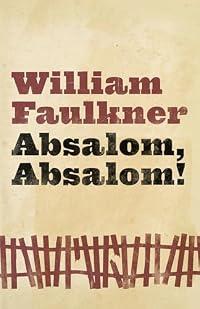
Absalom, Absalom!
by William Faulkner
On This Page
Description
ABSALOM, ABSALOM! tells the story of Thomas Sutpen, the enigmatic stranger who came to Jefferson township in the early 1830s. With a French architect and a band of wild Haitians, he wrung a fabulous plantation out of the muddy bottoms of the north Mississippi wilderness. Sutpen was a man, Faulker said, who wanted sons and the sons destroyed him. His tragedy left its impress not only on his contemporaries but also on men who came after, men like Quentin Compson, haunted even into the 20th show more century by Sutpen's legacy of ruthlessness and singleminded disregard for the human community. show lessTags
Recommendations
































Member Recommendations


Lyric of the Circle Heart: The Bowman Family Trilogy (American Literature Series) by William Eastlake
tootstorm Set in Navajo country, Eastlake's western trilogy shares a lot with Faulkner's mythopoeic Yoknapatawpha. With a taste of Kesey's lunacy. It's good, real friggin'good.
10

WSB7 Contrasting tragedies of brothers "bonding" with unknown half-brothers.
04

Member Reviews
I have read As I Lay Dying, The Sound and the Fury, and Light in August. However, Absalom, Absalom! is by far my favourite Faulkner. Indeed, without hesitation I would put it among the greatest books I have ever read.
I feel Absalom is almost neglected behind As I Lay Dying and The Sound and the Fury, the former of which I still consider a stunning piece of writing, but neither contain the towering, epic and biblical passages of which Absalom is entirely constructed. All the things I love about Faulkner come together most completely in this book and resonate so deeply and heavily: Mythical characters of the South that embody its underlying filth and decay; the scenery and landscape which you can feel sweltering and shimmering around show more you; the grand passages of such intense writing that builds up and up so confidently without faltering it shows no sign of collapsing under its own ambition.
Most clearly in Absalom is the style Cormac McCarthy is so overtly influenced by, which through his career he worked and moulded into his own.
The overall structure to Absalom's story also bears resemblance to One Hundred Years of Solitude (another of my all-time favourites), in that it details the rise and fall of an empire of sorts, told in the style of a legend.
Utterly recommended to anyone serious about literature. show less
I feel Absalom is almost neglected behind As I Lay Dying and The Sound and the Fury, the former of which I still consider a stunning piece of writing, but neither contain the towering, epic and biblical passages of which Absalom is entirely constructed. All the things I love about Faulkner come together most completely in this book and resonate so deeply and heavily: Mythical characters of the South that embody its underlying filth and decay; the scenery and landscape which you can feel sweltering and shimmering around show more you; the grand passages of such intense writing that builds up and up so confidently without faltering it shows no sign of collapsing under its own ambition.
Most clearly in Absalom is the style Cormac McCarthy is so overtly influenced by, which through his career he worked and moulded into his own.
The overall structure to Absalom's story also bears resemblance to One Hundred Years of Solitude (another of my all-time favourites), in that it details the rise and fall of an empire of sorts, told in the style of a legend.
Utterly recommended to anyone serious about literature. show less
It’s been called the great Southern novel. All I know is that it’s great. Ferocious, hateful, beautiful, full of clues (a detective story) and prophecy, but a novel after all that gets you by the scruff of the neck and drags you to the finish, like it or not. A Southern story, an American one, a tragedy—a bit of fossil, rough and cryptic.
This is the first Faulkner book I've read & it blew me away.
It's a powerhouse, a tragic (?) epic of the South.
It's not an easy read (or perhaps my brain is mush). Long, convoluted, strangely structured sentences or phrases. Overlapping, sometimes conflicting, versions & viewpoints. It did help me to read a sparknotes chapter summary after I finished each chapter in the book, just to make sure I was on track, following everything. Rarely do I contemplate reading a book a second time, but I think this is one I could & should read a second time.
Being born in the South & living most of my life in various places in the South, this book seemed oddly familiar but outdated, yet also timely & strange all at the same time.
There's so much to show more unpack here. Thinking of when Faulkner wrote this (& the fact that he was a Southerner), he was quite forthright in his facing of racism, of his looking at the Civil War, of looking at the grandiose & misguided manias that drive men. Certainly a literature course could spend a lot of time analyzing it.
A masterpiece. show less
It's a powerhouse, a tragic (?) epic of the South.
It's not an easy read (or perhaps my brain is mush). Long, convoluted, strangely structured sentences or phrases. Overlapping, sometimes conflicting, versions & viewpoints. It did help me to read a sparknotes chapter summary after I finished each chapter in the book, just to make sure I was on track, following everything. Rarely do I contemplate reading a book a second time, but I think this is one I could & should read a second time.
Being born in the South & living most of my life in various places in the South, this book seemed oddly familiar but outdated, yet also timely & strange all at the same time.
There's so much to show more unpack here. Thinking of when Faulkner wrote this (& the fact that he was a Southerner), he was quite forthright in his facing of racism, of his looking at the Civil War, of looking at the grandiose & misguided manias that drive men. Certainly a literature course could spend a lot of time analyzing it.
A masterpiece. show less
Along with The Brothers Karamazov, this is my favorite novel. What I love about Faulkner is his modernism, his total lack of sentimentality. Nothing or nobody is idealized. There are no Atticus Finches or Slims or Sonias here. Everyone is a fallen sinner in a fallen world. Even the character with the strongest morals, Goodhue Coldfield, is myopic and unloving to his daughters.
There is so much to say about Absalom, Absalom! that I don't know where to start. Another reviewer made a comparison to Picasso. I think this is apt. Faulkner's fracturing of the narrative is similar to Picasso's attempt in his Cubist paintings to capture multiple perspectives of his subject. We are not too sure how much to believe Quentin's retelling of the Sutpen show more story to his Harvard roommate - it is hearsay two generations removed from the events. And then Shreve, the roommate, hijacks the narrative and begins filling in details. How much of this is conjecture? There is the sense of a Romantic and mythical South, a shattered land that fascinates these young men, especially the Canadian Shreve.
There is a key moment when we hear about Thomas Sutpen's quelling of the slave uprising in Haiti:
". . . he just put the musket down and had someone unbar the door and then bar it behind him, and walked out into the darkness and subdued them, maybe by yelling louder, maybe by standing, bearing more than they believed any bones and flesh could or should (should, yes; that would be the terrible thing: to find flesh to stand more than flesh should be asked to stand); maybe at last they themselves turning in horror and fleeing from the white arms and legs shaped like theirs and from which blood could be made to spurt and flow as it could from theirs and containing and indomitable spirit which should have come from the same primary fire which theirs came from but which could not have, could not possibly have (he showed Grandfather the scars, one of which, Grandfather said, came pretty near leaving him a virgin for the rest of his life too) and then daylight came with no drums in it for the first time in eight days, and they emerged (probably the man and the daughter) and walked across the burned land with the bright sun shining down on it as if had happened, walking now in what must have been an incredible desolate solitude and peaceful quiet, and found him and brought him to the house: and when he recovered he and the girl were engaged. Then he stopped."
So we can discuss at length Faulkner's language and his cadence and his eternal sentences, but I just want to say that I think he is imitating / emulating / parodying the Southern loquacious voice, the incessant talking without speaking truth. Recounting events and details without reflection, without comment. The tendency of language to obfuscate and not illuminate.
More importantly, this passage is a clue to a central idea in the novel - Sutpen as Satan. I mean a Miltonian Satan, a Nietzschean Superman, a Dostoevskian Napoleon, not the boring old Biblical Satan. Sutpen seems to be able to overpower the rebelling slaves through sheer force of will, or will to power. The Haitian slaves employ voodoo to weaken their overlords, but something about Sutpen terrifies them.
There are other clues: the constant reference to Sutpen as an "ogre" (Rosa) or a "demon" (Shreve). Sutpen defies the rules of his society, while his one goal is to reach the pinnacle of the Southern class system as represented by the indolent plantation owner in Tidewater Virginia. Sutpen possesses a life force that is also destructive: his ambition, his envy, his will and strength are demonic in nature. We are reminded of Macbeth, Kurtz in Heart of Darkness. Sutpen employs the "forces of darkness" (his "wild niggers")to achieve his ends. The results are a curse placed on his offspring, the casual miscegenation and shunning of those with African blood, the Civil War as the hand of God that Sutpen both masters and is mastered by.
Faulkner is at the height of his powers here. His influence is clearly seen in Cormac McCarthy (especially Blood Meridian) and Robert Penn Warren. Even so, he stands alone as a singular and bloody voice from the deep South. show less
There is so much to say about Absalom, Absalom! that I don't know where to start. Another reviewer made a comparison to Picasso. I think this is apt. Faulkner's fracturing of the narrative is similar to Picasso's attempt in his Cubist paintings to capture multiple perspectives of his subject. We are not too sure how much to believe Quentin's retelling of the Sutpen show more story to his Harvard roommate - it is hearsay two generations removed from the events. And then Shreve, the roommate, hijacks the narrative and begins filling in details. How much of this is conjecture? There is the sense of a Romantic and mythical South, a shattered land that fascinates these young men, especially the Canadian Shreve.
There is a key moment when we hear about Thomas Sutpen's quelling of the slave uprising in Haiti:
". . . he just put the musket down and had someone unbar the door and then bar it behind him, and walked out into the darkness and subdued them, maybe by yelling louder, maybe by standing, bearing more than they believed any bones and flesh could or should (should, yes; that would be the terrible thing: to find flesh to stand more than flesh should be asked to stand); maybe at last they themselves turning in horror and fleeing from the white arms and legs shaped like theirs and from which blood could be made to spurt and flow as it could from theirs and containing and indomitable spirit which should have come from the same primary fire which theirs came from but which could not have, could not possibly have (he showed Grandfather the scars, one of which, Grandfather said, came pretty near leaving him a virgin for the rest of his life too) and then daylight came with no drums in it for the first time in eight days, and they emerged (probably the man and the daughter) and walked across the burned land with the bright sun shining down on it as if had happened, walking now in what must have been an incredible desolate solitude and peaceful quiet, and found him and brought him to the house: and when he recovered he and the girl were engaged. Then he stopped."
So we can discuss at length Faulkner's language and his cadence and his eternal sentences, but I just want to say that I think he is imitating / emulating / parodying the Southern loquacious voice, the incessant talking without speaking truth. Recounting events and details without reflection, without comment. The tendency of language to obfuscate and not illuminate.
More importantly, this passage is a clue to a central idea in the novel - Sutpen as Satan. I mean a Miltonian Satan, a Nietzschean Superman, a Dostoevskian Napoleon, not the boring old Biblical Satan. Sutpen seems to be able to overpower the rebelling slaves through sheer force of will, or will to power. The Haitian slaves employ voodoo to weaken their overlords, but something about Sutpen terrifies them.
There are other clues: the constant reference to Sutpen as an "ogre" (Rosa) or a "demon" (Shreve). Sutpen defies the rules of his society, while his one goal is to reach the pinnacle of the Southern class system as represented by the indolent plantation owner in Tidewater Virginia. Sutpen possesses a life force that is also destructive: his ambition, his envy, his will and strength are demonic in nature. We are reminded of Macbeth, Kurtz in Heart of Darkness. Sutpen employs the "forces of darkness" (his "wild niggers")to achieve his ends. The results are a curse placed on his offspring, the casual miscegenation and shunning of those with African blood, the Civil War as the hand of God that Sutpen both masters and is mastered by.
Faulkner is at the height of his powers here. His influence is clearly seen in Cormac McCarthy (especially Blood Meridian) and Robert Penn Warren. Even so, he stands alone as a singular and bloody voice from the deep South. show less
Faulkner shows you all the notes that are in the scale he'll be using, then builds them into chords, and transforms them into music. It doesn't follow a line to a point, it spins in circles around its object, capturing new shades each time the light hits differently. Or to steal Faulkner's metaphor: at the center is a rock striking a lake. The novel documents each ripple starting fresh from that center again. “That is the substance of remembering—sense, sight, smell: the muscles with which we see and hear and feel—not mind, not thought: there is no such thing as memory: the brain recalls just what the muscles grope for: no more, no less: and its resultant sum is usually incorrect and false and worthy only of the name of dream.” show more
Of course, this quote expresses a raison d'être for modernism itself, and so Absalom, Absalom! could be read as, not just an example of modernism, but presenting modernism as its thesis: where in life do any of us truly encounter linear plots? Experience goes frame by single frame, and whenever we tell a story we do so by reaching into the past: with all the groping and dreaming that this entails, all the contingencies of the present shaping the present moment and thus the dream itself. show less
Of course, this quote expresses a raison d'être for modernism itself, and so Absalom, Absalom! could be read as, not just an example of modernism, but presenting modernism as its thesis: where in life do any of us truly encounter linear plots? Experience goes frame by single frame, and whenever we tell a story we do so by reaching into the past: with all the groping and dreaming that this entails, all the contingencies of the present shaping the present moment and thus the dream itself. show less
Some might say that William Faulkner was the greatest and most influential American author of the last century. Absalom, Absalom! is his magnum opus, so therefore could be considered the greatest American novel of the 20th century. Ain’t that right?
I don’t expect anybody to believe that, but it is a magnificent novel nevertheless. Published in 1936 (the same year as Gone with the Wind) Faulkner claims Absalom, Absalom! is about ‘miscegenation’.
Set in the mythical kingdom of Yoknapatawpha Country, it’s an allegorical tale about the demise of plantation culture, and the old South’s inability to fully understand either the past or the future.
"the deep South dead since 1865 and peopled with garrulous outraged baffled show more ghosts"
The central character is Thomas Sutpen and its his “design” – respectability within the plantation culture - that is at the heart of the novel. His lack of any moral judgement ultimately becomes the force of his destruction. Racism shapes the narrative and Sutpen’s refusal to acknowledge his son (Charles Bon) due to his mother’s black blood leads to a series of tragic events that sees the collapse of his family and dynasty.
History and memory are key to the telling and retelling of the same story; different versions give it several narrative frames. It has a wonderfully Gothic opening, starting in “a dim hot airless room with the blinds closed” where Miss Rosa Coldfield recalls the story of Thomas Sutpen to a young Quentin Compson. The final narrative occurs in a room in Harvard when Shreve McCannon (a Canadian) asks Quentin (they are roommates) a simple question; “Tell about the South”. Shreve is the sounding board, the outsider, he is you and me. Herein lies the genius of the novel. By the end you have heard several versions of the story, some true, some half true, some pure conjecture. The lack of chronology can make it confusing and slightly maddening, but a it’s beautifully written and magnificent text.
Big thanks to the fabulous group I read it with, without whom I'd have been seriously lost.
I think Michael Gorra summarises reading Absalom, Absalom! perfectly in his book The Saddest Words: William Faulkner's Civil War
“No one can read it quickly or even entirely with pleasure, but anyone who can hear its flowered dissonance will know that such books are why read at all” show less
I don’t expect anybody to believe that, but it is a magnificent novel nevertheless. Published in 1936 (the same year as Gone with the Wind) Faulkner claims Absalom, Absalom! is about ‘miscegenation’.
Set in the mythical kingdom of Yoknapatawpha Country, it’s an allegorical tale about the demise of plantation culture, and the old South’s inability to fully understand either the past or the future.
"the deep South dead since 1865 and peopled with garrulous outraged baffled show more ghosts"
The central character is Thomas Sutpen and its his “design” – respectability within the plantation culture - that is at the heart of the novel. His lack of any moral judgement ultimately becomes the force of his destruction. Racism shapes the narrative and Sutpen’s refusal to acknowledge his son (Charles Bon) due to his mother’s black blood leads to a series of tragic events that sees the collapse of his family and dynasty.
History and memory are key to the telling and retelling of the same story; different versions give it several narrative frames. It has a wonderfully Gothic opening, starting in “a dim hot airless room with the blinds closed” where Miss Rosa Coldfield recalls the story of Thomas Sutpen to a young Quentin Compson. The final narrative occurs in a room in Harvard when Shreve McCannon (a Canadian) asks Quentin (they are roommates) a simple question; “Tell about the South”. Shreve is the sounding board, the outsider, he is you and me. Herein lies the genius of the novel. By the end you have heard several versions of the story, some true, some half true, some pure conjecture. The lack of chronology can make it confusing and slightly maddening, but a it’s beautifully written and magnificent text.
Big thanks to the fabulous group I read it with, without whom I'd have been seriously lost.
I think Michael Gorra summarises reading Absalom, Absalom! perfectly in his book The Saddest Words: William Faulkner's Civil War
“No one can read it quickly or even entirely with pleasure, but anyone who can hear its flowered dissonance will know that such books are why read at all” show less
81. Absalom, Absalom! by William Faulkner
OPD: 1936
format: 311-page paperback
acquired: April read: Nov 26 – Dec 7 time reading: 19:52, 3.8 mpp
rating: 4
genre/style: classic theme: Faulkner
locations: Mississippi, Massachusetts, and somewhere behind Sherman’s Civil War advance line
about the author: 1897-1962. American Noble Laureate who was born in New Albany, MS, and lived most of his life in Oxford, MS.
Well, at four minutes a page, I found this hard. This is my twelfth Faulkner novel as show more I work through his fiction. So, I don't say that randomly, this is hard for Faulkner.
Many serious critics and fans consider this his best work. He apparently thought so himself, delivering it to his publisher with the comment that he wrote the great American novel. It's The South, captured in the story of Colonel Thomas Sutpen. Sutpen arrived in Mississippi in 1833 with no known past, and acquired 100 acres of prime land from a Choctaw outside of fictional Jefferson, the Sutpen 100. Then he acquired respectability by marrying a woman in town, Ellen Coldfield, daughter of a devout shop owner. That is not say he wasn't considered wild or immoral. He came to town with 8 French-speaking slaves (illegally imported), fathered a child by one. He was arrested for the manner in which is acquired the material to furnish his house. He was crazy, but he acquired his respectability, had a son and daughter. And when the Civil War came, joined the Confederate army, as did his son. But at the end of the war, Sutpen now a widower, an odd sequence of events happened. His son shot his daughter's fiancé and his own best friend, a kind of dandy from New Orleans, and then this son disappeared. Sutpen's daughter, widowed before marriage, would never marry. Sutpen lost his name and lineage.
But we are not told this story in any direct manner. It's relayed through storytelling voices. First through Rosa Coldfield, the younger sister of Ellen. As an old lady, nearing her own death, she relays this story to a family friend, young Quentin Compson, about to leave for school at Harvard, in faraway northern Massachusetts. Her monotonous voice she relays this Quentin, in the hot Mississippi summer, in the stuffy indoors with aged dust motes, in long endless sentences. Quentin, puzzled, is taken in. That's the first section, the first telling. In the remaining length of the book Quentin sits with his roommate, Canadian student Shreve. Together they continue the story, partially through a letter from Quentin's father, and egged on continuously by a curiously shirtless Shreve in the freezing Massachusetts winter. At points Shreve is reading Quentin's father's letter to Quentin, the version of the story that was relayed to Quentin's father by Quentin's grandfather. Who is speaking, what is the source, how reliable is any of this, what is factual and what is conjecture.
Whatever it is, the weird story is not the point, it's what's under the story, the why. The story gets farther and farther out there, but never far enough to motivate these deranged characters. They are always worse than that.
One of the interesting aspects of the story, and also what makes it so difficult, is the way it's relayed. Whether Rosa Coldfield, Quentin, his father, Shreve, or at times, Quentin and Shreve in unison, to story is relayed in monotone, relentlessly, a dispassionate voice, except when Shreve cries, "Wait!", and Quentin never does wait. There is a possession. Like Virgil's Sibyl, this a Sibylline telling, and incantation, sometimes coming in two parallel voices. Sentences and paragraphs go on for pages, the voice carrying over, circling in on itself, making it very hard to keep track. I had to keep backtracking to figure out where I was (hence my four-minutes a page.)
In a backhanded criticism, I was never really bored. I was always interested, although often mentally exhausted. It has its own propelling force to carry you along. But in a more direct criticism, it's not my favorite Faulkner. The overall point simplifies down too much for me, by which I mean once I finished, I felt done. I don't spend time wondering on it, like I do most of Faulkner's other books. It wraps itself up. I've dug in while reading, and I'm leaving those holes as they are, incomplete, equipment derelict, nothing cleaned up, just lumps with scattered junk (perhaps in the Mississippi mud, and perhaps only there till the next heavy rain).
2024
https://www.librarything.com/topic/365030#8702439 show less
OPD: 1936
format: 311-page paperback
acquired: April read: Nov 26 – Dec 7 time reading: 19:52, 3.8 mpp
rating: 4
genre/style: classic theme: Faulkner
locations: Mississippi, Massachusetts, and somewhere behind Sherman’s Civil War advance line
about the author: 1897-1962. American Noble Laureate who was born in New Albany, MS, and lived most of his life in Oxford, MS.
"Why do you hate the South?"
"I don't hate it," Quentin said, quickly, at once, immediately, "I don't hate it," he said. I don't hate it he thought, panting in the cold air, the iron New England dark: I don't. I don't! I don't hate it! I don't hate it!
Well, at four minutes a page, I found this hard. This is my twelfth Faulkner novel as show more I work through his fiction. So, I don't say that randomly, this is hard for Faulkner.
Many serious critics and fans consider this his best work. He apparently thought so himself, delivering it to his publisher with the comment that he wrote the great American novel. It's The South, captured in the story of Colonel Thomas Sutpen. Sutpen arrived in Mississippi in 1833 with no known past, and acquired 100 acres of prime land from a Choctaw outside of fictional Jefferson, the Sutpen 100. Then he acquired respectability by marrying a woman in town, Ellen Coldfield, daughter of a devout shop owner. That is not say he wasn't considered wild or immoral. He came to town with 8 French-speaking slaves (illegally imported), fathered a child by one. He was arrested for the manner in which is acquired the material to furnish his house. He was crazy, but he acquired his respectability, had a son and daughter. And when the Civil War came, joined the Confederate army, as did his son. But at the end of the war, Sutpen now a widower, an odd sequence of events happened. His son shot his daughter's fiancé and his own best friend, a kind of dandy from New Orleans, and then this son disappeared. Sutpen's daughter, widowed before marriage, would never marry. Sutpen lost his name and lineage.
But we are not told this story in any direct manner. It's relayed through storytelling voices. First through Rosa Coldfield, the younger sister of Ellen. As an old lady, nearing her own death, she relays this story to a family friend, young Quentin Compson, about to leave for school at Harvard, in faraway northern Massachusetts. Her monotonous voice she relays this Quentin, in the hot Mississippi summer, in the stuffy indoors with aged dust motes, in long endless sentences. Quentin, puzzled, is taken in. That's the first section, the first telling. In the remaining length of the book Quentin sits with his roommate, Canadian student Shreve. Together they continue the story, partially through a letter from Quentin's father, and egged on continuously by a curiously shirtless Shreve in the freezing Massachusetts winter. At points Shreve is reading Quentin's father's letter to Quentin, the version of the story that was relayed to Quentin's father by Quentin's grandfather. Who is speaking, what is the source, how reliable is any of this, what is factual and what is conjecture.
Whatever it is, the weird story is not the point, it's what's under the story, the why. The story gets farther and farther out there, but never far enough to motivate these deranged characters. They are always worse than that.
One of the interesting aspects of the story, and also what makes it so difficult, is the way it's relayed. Whether Rosa Coldfield, Quentin, his father, Shreve, or at times, Quentin and Shreve in unison, to story is relayed in monotone, relentlessly, a dispassionate voice, except when Shreve cries, "Wait!", and Quentin never does wait. There is a possession. Like Virgil's Sibyl, this a Sibylline telling, and incantation, sometimes coming in two parallel voices. Sentences and paragraphs go on for pages, the voice carrying over, circling in on itself, making it very hard to keep track. I had to keep backtracking to figure out where I was (hence my four-minutes a page.)
In a backhanded criticism, I was never really bored. I was always interested, although often mentally exhausted. It has its own propelling force to carry you along. But in a more direct criticism, it's not my favorite Faulkner. The overall point simplifies down too much for me, by which I mean once I finished, I felt done. I don't spend time wondering on it, like I do most of Faulkner's other books. It wraps itself up. I've dug in while reading, and I'm leaving those holes as they are, incomplete, equipment derelict, nothing cleaned up, just lumps with scattered junk (perhaps in the Mississippi mud, and perhaps only there till the next heavy rain).
2024
https://www.librarything.com/topic/365030#8702439 show less
Members
- Recently Added By
Published Reviews
ThingScore 100
A poll of well over a hundred writers and critics, taken a few years back by Oxford American magazine, named William Faulkner’s “Absalom, Absalom!” the “greatest Southern novel ever written,” by a decisive margin
added by danielx
Lists

1001 Books You Must Read Before You Die
1,448 works; 1,132 members

Classics you know you should have read but probably haven't
421 works; 407 members

Radcliffe's 100 Best Novel of the 20th Century
100 works; 32 members
Novels from The Guardian's Great American Novelist Tournament
148 works; 24 members

Southern Fiction
212 works; 52 members

Great American Novels
158 works; 42 members

20th Century Literature
1,161 works; 55 members

The 100 Best Books of All Time by Norwegian Book Club (World Library)
104 works; 23 members
The Top Ten: Writers Pick Their Favorite Books
240 works; 31 members
Best Family Stories
241 works; 22 members

Best Gothic Fiction
110 works; 31 members
Larry McCaffery's 20th Century Greatest Hits: 100 English-Language Books
103 works; 12 members

Stream of Consciousness
87 works; 7 members
Favourite Books
1,817 works; 308 members
Canon de la narrativa universal del siglo XX
254 works; 6 members

Nobel Price Winners
222 works; 19 members
Blue Pyramid 1,276 Best Books of All Time
1,248 works; 32 members
The American Experience
173 works; 18 members
Best of American Literature
146 works; 9 members

Unread books
1,063 works; 87 members
Most difficult novels
68 works; 27 members

Backlisted
109 works; 9 members

1964 College Preparatory Reading List
202 works; 8 members
1,001 BYMRBYD Concensus
723 works; 27 members
Harold Bloom - The Western Canon: D. The Chaotic Age
833 works; 24 members
Banned or Challenged Books
400 works; 37 members
The Greatest Books
99 works; 5 members
Elegant Prose
80 works; 4 members

Books Read in 2023
5,547 works; 144 members

1930s
262 works; 5 members
Racism and Race Relations in Literature
48 works; 9 members

Books Set in Mississippi
15 works; 3 members

SHOULD Read Books!
354 works; 9 members

Schwob Nederland
207 works; 2 members

Tammen Keltainen kirjasto
81 works; 1 member
American Lit for Eng 11 Research Project
368 works; 6 members
Books I Read Before The Invention Of The Internet.
144 works; 1 member
Canon de la narrativa universal del s. XX (cicutadry)
499 works; 3 members

DigitalDreamDoor top 300
300 works; 4 members
The 150 Greatest Novels of All Time
150 works; 6 members

Recommended Reading : 600 Classics Reviewed, Editors of Salem Press, 2015
634 works; 6 members

The Atlantic's The Great American Novel
136 works; 12 members

Books to Purchase
5 works; 1 member

Books With the Most Memorable Titles
478 works; 158 members

Tagged 19th Century
104 works; 7 members

Mustich's 1000 Books to Read Before You Die: A Life Changing List
1,001 works; 18 members

AP Lit
363 works; 6 members

Greatest Books, allegedly
484 works; 9 members

Literary Works Read in College
316 works; 15 members

To read
23 works; 1 member

My TBR
371 works; 3 members

Books Read in 2018
4,360 works; 110 members

Beginner's Guide to Southern Gothic
22 works; 4 members
.
396 works; 1 member
Author Information

460+ Works 98,921 Members
Born in an old Mississippi family, William Faulkner made his home in Oxford, seat of the University of Mississippi. After the fifth grade he went to school only off and on-lived, read, and wrote much as he pleased. In 1918, refusing to enlist with the "Yankees," he joined the Canadian Air Force, and was transferred to the British Royal Air Force. show more After the war he studied a little at the University, did house painting, worked as a night superintendent at a power plant, went to New Orleans and became a friend of Sherwood Anderson, then to Europe and back home to Oxford. By this time he had written two novels. The Sound and the Fury followed in 1929. Financial success came with Sanctuary in 1931, which he assisted in filming. Faulkner 's novels are intense in their character portrayals of disintegrating Southern aristocrats, poor whites, and African Americans. A complex stream-of-consciousness rhetoric often involves Faulkner in lengthy sentences of anguished power. Most of his tales are set in the mythical Yoknapatawpha County, Mississippi, and are characterized by the use of many recurring characters from families of different social levels spanning more than a century. His best subjects are the old, dying South and the newer materialistic South. As I Lay Dying (1930), is a grotesquely tragicomic story about a family of poor southern whites. With Absalom, Absalom! (1936); the difficult parts of his famous short novel "The Bear" (published in Go Down, Moses, 1942); and the allegorical A Fable (1954), a non-Yoknapatawpha novel set in France during World War I; Faulkner returned to an innovative and difficult style that most readers have trouble with. Yet, interspersed among such works are collections of easily read stories originally published in popular magazines. There seems to be a growing sentiment among critics that the Snopes trilogy-The Hamlet (1940), The Town (1957), and The Mansion (1959)-for the most part an example of Faulkner's "moderate" style, could well be among his most important works. Faulkner was awarded the 1949 Nobel Prize for literature "for his powerful and artistically independent contribution to the new American novel," but it would appear now that he also deserved to win that honor for his contribution to world literature. When reporting his death, the Boston Globe quoted Faulkner's having once told an interviewer: "Since man is mortal, the only immortality for him is to leave something behind him that is immortal since it will always move. That is the artist's way of scribbling "Kilroy was here" on the wall of the final and irrevocable oblivion through which he must some day pass." In addition to the Nobel Prize, Faulkner received the Howells Medal of the American Academy of Arts and Letters in 1950, and in 1951 he was given the National Book Award for his Collected Stories Collected Stories. For his novel A Fable he received the National Book Award for the second time, as well as the Pulitzer Prize in 1955. The Reivers (1962) was awarded the Pulitzer Prize in 1963. In 1957 and 1958, he was the University of Virginia's first writer-in-residence, and in January 1959 he accepted an appointment as consultant on contemporary literature to the Alderman Library of that university. Although Faulkner was not without honors in his lifetime and has received world recognition since then, it is surprising to learn that, when Malcolm Cowley edited The Portable Faulkner in 1946, he found that almost all of Faulkner's books were out of print. By arranging selections from the works to form a continuous chronicle, Cowley deserves much of the credit for making readers aware of the way in which Faulkner was creating a fictive world on a scale grander than that of any novelist since Balzac. William Faulkner died in Oxford, Mississippi, in 1962. (Bowker Author Biography) show less
All Editions
Some Editions
Awards and Honors
Notable Lists
The Great American Novels (1936)
Daniel S. Burt's Novel 100 (017 – 17)
Series
Belongs to Publisher Series
Work Relationships
Is contained in
Absalom, Absalom! / Intruder in the Dust / Light in August / The Reivers / The Sound and the Fury by William Faulkner
Novels 1936-1940 : Absalom, Absalom! / The Unvanquished / If I Forget Thee, Jerusalem / The Hamlet by William Faulkner
Contains
Has as a reference guide/companion
Has as a study
Has as a commentary on the text
Has as a student's study guide
Common Knowledge
- Canonical title*
- Absalom, Absalom
- Original title
- Absalom, Absalom!
- Original publication date
- 1936
- People/Characters
- Quentin Compson; Shreve McCannon; Thomas Sutpen; Eulalia Bon; Charles Bon; Godhue Coldfield (show all 16); Ellen Coldfield; Rosa Coldfield; Henry Sutpen; Judith Sutpen; Clytie (Sutpen); Wash Jones; Melicent Jones; Milly Jones; Charles Etienne de Saint Valery Bon; Jim Bond (Bon)
- Important places
- Yoknapatawpha County, Mississippi, USA; Mississippi, USA
- First words
- From a little after two oclock until almost sundown of the long still hot weary dead September afternoon they sat in what Miss Coldfield still called the office because her father had called it that—a dim hot airless room w... (show all)ith the blinds all closed and fastened for forty-three summers because when she was a girl someone had believed that light and moving air carried heat and that dark was always cooler, and which (as the sun shone fuller and fuller on that side of the house) became latticed with yellow slashes full of dust motes which Quentin thought of as being flecks of the dead old dried paint itself blown inward from the scaling blinds as wind might have blown them.
- Quotations
- "Why do you hate the South?"
- Last words
- (Click to show. Warning: May contain spoilers.)I dont hate it!
- Blurbers
- Ellison, Ralph; Wilson, Edmund; Warren, Robert Penn
- Original language
- English
- Canonical DDC/MDS
- 813.52
- Canonical LCC
- PS3511.A86
*Some information comes from Common Knowledge in other languages. Click "Edit" for more information.
Classifications
Statistics
- Members
- 8,602
- Popularity
- 1,270
- Reviews
- 115
- Rating
- (4.11)
- Languages
- 24 — Arabic, Catalan, Chinese, Czech, Danish, Dutch, English, Estonian, Finnish, French, German, Greek, Hungarian, Italian, Norwegian (Bokmål), Farsi/Persian, Polish, Romanian, Russian, Serbian, Spanish, Swedish, Turkish, Portuguese (Portugal)
- Media
- Paper, Audiobook, Ebook
- ISBNs
- 96
- ASINs
- 83