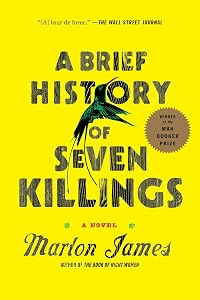
A Brief History of Seven Killings
by Marlon James
On This Page
Description
On December 3, 1976, just before the Jamaican general election and two days before Bob Marley was to play the Smile Jamaica Concert, gunmen stormed his house, machine guns blazing. The attack nearly killed the Reggae superstar, his wife, and his manager, and injured several others. Marley would go on to perform at the free concert on December 5, but he left the country the next day, not to return for two years. Deftly spanning decades and continents and peopled with a wide range of show more characters--assassins, journalists, drug dealers, and even ghosts--A Brief History of Seven Killings is the fictional exploration of that dangerous and unstable time and its bloody aftermath, from the streets and slums of Kingston in the 1970s, to the crack wars in 1980s New York, to a radically altered Jamaica in the 1990s. Brilliantly inventive and stunningly ambitious, this novel is a revealing modern epic that will secure Marlon James' place among the great literary talents of his generation. show lessTags
Recommendations






Member Recommendations

Member Reviews
If you've ever read Faulkner's As I Lay Dying, you'll remember the feeling of switching 1st person narrative with each chapter, and the multi-vocal layering and revealing of a story from different points of view. Marlon James has expanded this technique with more than a dozen main characters and a dozen more (or at least it felt like that number) minor characters, each telling their piece of a story that unfolds over several decades of Jamaican (with side trips to Miami and New York) intrigue involving The Singer (aka Bob Marley), Jamaican "posses", CIA agents, anti-Castro Cuban mercenaries, and Rolling Stone journalists. As James writes in the Afterward, it is "a novel that would be driven only by voice." The voices include nearly show more inscrutable (for the uninitiated) Jamaican English, American hipster English, Cuban Spanish translated into English, and a British "Sir" speaking from beyond the grave. Hold on to your dreads, it's a wild ride. (Brian) show less
(26) Wow. I am not entirely sure what to think about this novel. I don't know what is fact and what is fiction. I am blown away by the violence and the rawness. It felt incredibly authentic, but the book has made me conscious of the fact that I am a white girl who has never been to Jamaica and am probably racist and ignorant in my own sheltered way. And that is not a criticism. Sometimes it is more effective to alienate the reader from the characters before you bring them full-circle. This is loosely about Jamaica during the time of Bob Marley and how what began as political rivalry on a Caribbean island reverberated into gang warfare and crack in America in the 80's.
The novel begins with almost impenetrable Jamaican patois and jumps show more from one strangely named character to the next without spoon-feeding you the connections or interpreting what almost felt like another language. I spent a lot of time with the list of characters from the beginning and I constantly had to remind myself whose narrative I was reading. It took me the better part of a week to read the first 100 pages and I began to despair. But even though you are bamboozled, the novel grows on you such that you begin to understand the patois and start to put together what is going on.
It is a sad novel, really. I am not sure how I should be left feeling in the end. Very gritty, very graphic - not for the faint of heart. But the writing is nothing short of miraculous in its ability to transport. I found myself watching You-tube videos of Bob Marley concerts from the 70's with footage of the Jamaican ghetto and I felt as if I had been there. I don't know if I understood it all. I am about to go do my own 'Wikipedia' research to try and sort out fact from fiction. But --- well, wow -- is all I am left with. Me relatively speechless. show less
The novel begins with almost impenetrable Jamaican patois and jumps show more from one strangely named character to the next without spoon-feeding you the connections or interpreting what almost felt like another language. I spent a lot of time with the list of characters from the beginning and I constantly had to remind myself whose narrative I was reading. It took me the better part of a week to read the first 100 pages and I began to despair. But even though you are bamboozled, the novel grows on you such that you begin to understand the patois and start to put together what is going on.
It is a sad novel, really. I am not sure how I should be left feeling in the end. Very gritty, very graphic - not for the faint of heart. But the writing is nothing short of miraculous in its ability to transport. I found myself watching You-tube videos of Bob Marley concerts from the 70's with footage of the Jamaican ghetto and I felt as if I had been there. I don't know if I understood it all. I am about to go do my own 'Wikipedia' research to try and sort out fact from fiction. But --- well, wow -- is all I am left with. Me relatively speechless. show less
So here we are, 35 years after his death, and Bob Marley is still the only bona fide rock superstar to ever come out of a so-called third-world country. (Nothing against Fela, but how many times have you heard football crowds spontaneously sing "Zombie"?) Legend (and you'll never be able to not see that title as ironic again) is one of the best-selling Greatest Hits albums of all time and it is, of course, conspicuously free of songs like "Crazy Baldheads", "Rat Race", "Them Belly Full (But We Hungry)", "War", "Concrete Jungle", "Burnin' and Lootin'"... The Bob Marley of popular Western culture, the decontextualized "Get Up, Stand Up" and "Buffalo Soldier" notwithstanding, comes across as a non-threatening teddy bear singing about birds show more and love, his rastafarianism as Woodstock hippyisms, and Jamaica as a tropical paradise of beaches and gentle stoners with funny accents who are only too happy to serve any white tourists.
That’s what happens when you personify hopes and dreams in one person. He becomes nothing more than a literary device.
A Brief History... is not about Bob Marley. He's a constant presence in it, although never mentioned by name (he's "The Singer", too mythical to even need a name, a huge whale shark in a small pond of hungry piranhas; there's a difference between the stars and the superstars, between those you remember and those who shape an entire narrative), but he's not the subject of it. It's the failed assassination attempt against him in December of 1976 that provides the centre of the novel, but James uses it as a lynchpin to tell a much larger story. Several times I find myself thinking of The Wire, both in terms of scope and in terms of characterisation; this is praise, in my book.
And killing don’t need no reason. This is ghetto. Reason is for rich people. We have madness.
Really, the sheer ambition of A Brief History (which, to make the obvious point, is 700 pages long and covers several decades, arguably centuries, of history) is staggering, but not nearly impressive as the ease with which James pulls it off. Watch the way he shifts narrators (some of whom are long dead, others who die along the way, and some, miraculously, who survive). A dead politician, the boss of a Kingston ghetto, the local CIA operative, a Rolling Stone journalist born 10 years too late, a woman who just knew Marley for a night and now has to spend her life running, various hitmen and dealers and slum kids who are all part of a bigger story but also have their own lives to save or lose. Watch the way he paces the story, it's been a while since I read a literary novel with such great command of the humble cliffhanger, yet every chapter here adds to the depth of the story, tells us something new, shows us a new angle, even if it's just that a character is refusing to see something new. Watch the patois; no empty sacrifice on the cheap altar of authenticity, language shapes the world and vice versa. James not only lets his characters be eloquent in a mother tongue that most of his readers (it's an American novel in the sense that all expat novels are) will automatically think of as "broken" English (much like the CIA operatives in Kingston don't see why the Jamaicans can't see that they have their best interest in mind), and when they shift from one dialect to another, watch out because something is shifting with them.
People stupid. The dream didn't leave, people just don't know a nightmare when they right in the middle of one.
Nothing is allowed to lie still here. Every concept of class, race, gender, nation, sexuality, faith is turned over and smashed into each other. The good-natured reggae music are both rebel songs and homophobic screeds. A religion that promises exodus and freedom, but expects women to serve. (Much like some other holy texts you could mention.) I find myself wondering if this is an American novel or a Jamaican one; on the one hand, there's both Faulkner and DeLillo and Morrison lurking between the lines... On the other hand, few American novels would be so painfully aware of the influence of America on others. The question is, would it be possible to write the Great Jamaican Novel without Marley? Then again, why on Earth would you want to do that, when you'd have to forego things like this?
Three girls from Kashmir sling on bass, guitar and drums, fresh faces brimming out of burkas, propped up and held together by a backdrop of the Singer streaked in red, green and gold stripes, thick like pillars. They call themselves First Ray of Light, soul sisters to the Singer smiling with the rising sun. Out of a wrapped face comes a melody so fragile it almost vanishes in the air. But it lands on a drum that kicks the groove back up to where the song lingers, sweeps and soothes. Now the Singer is a balm to spread over broken countries. Soon, the men who kill girls issue a holy order and boys all over the valley vow to clean their guns, and stiffen their cocks, to hold down and take away. The Singer is support, but he cannot shield, and the band breaks away.
But in another city, another valley, another ghetto, another slum, another favela, another township, another intifada, another war, another birth, somebody is singing Redemption Song, as if the Singer wrote it for no other reason but for this sufferah to sing, shout, whisper, weep, bawl, and scream right here, right now.
There's so much passion in this novel, so much anger and love and grief and beauty. And James makes it all sing. show less
That’s what happens when you personify hopes and dreams in one person. He becomes nothing more than a literary device.
A Brief History... is not about Bob Marley. He's a constant presence in it, although never mentioned by name (he's "The Singer", too mythical to even need a name, a huge whale shark in a small pond of hungry piranhas; there's a difference between the stars and the superstars, between those you remember and those who shape an entire narrative), but he's not the subject of it. It's the failed assassination attempt against him in December of 1976 that provides the centre of the novel, but James uses it as a lynchpin to tell a much larger story. Several times I find myself thinking of The Wire, both in terms of scope and in terms of characterisation; this is praise, in my book.
And killing don’t need no reason. This is ghetto. Reason is for rich people. We have madness.
Really, the sheer ambition of A Brief History (which, to make the obvious point, is 700 pages long and covers several decades, arguably centuries, of history) is staggering, but not nearly impressive as the ease with which James pulls it off. Watch the way he shifts narrators (some of whom are long dead, others who die along the way, and some, miraculously, who survive). A dead politician, the boss of a Kingston ghetto, the local CIA operative, a Rolling Stone journalist born 10 years too late, a woman who just knew Marley for a night and now has to spend her life running, various hitmen and dealers and slum kids who are all part of a bigger story but also have their own lives to save or lose. Watch the way he paces the story, it's been a while since I read a literary novel with such great command of the humble cliffhanger, yet every chapter here adds to the depth of the story, tells us something new, shows us a new angle, even if it's just that a character is refusing to see something new. Watch the patois; no empty sacrifice on the cheap altar of authenticity, language shapes the world and vice versa. James not only lets his characters be eloquent in a mother tongue that most of his readers (it's an American novel in the sense that all expat novels are) will automatically think of as "broken" English (much like the CIA operatives in Kingston don't see why the Jamaicans can't see that they have their best interest in mind), and when they shift from one dialect to another, watch out because something is shifting with them.
People stupid. The dream didn't leave, people just don't know a nightmare when they right in the middle of one.
Nothing is allowed to lie still here. Every concept of class, race, gender, nation, sexuality, faith is turned over and smashed into each other. The good-natured reggae music are both rebel songs and homophobic screeds. A religion that promises exodus and freedom, but expects women to serve. (Much like some other holy texts you could mention.) I find myself wondering if this is an American novel or a Jamaican one; on the one hand, there's both Faulkner and DeLillo and Morrison lurking between the lines... On the other hand, few American novels would be so painfully aware of the influence of America on others. The question is, would it be possible to write the Great Jamaican Novel without Marley? Then again, why on Earth would you want to do that, when you'd have to forego things like this?
Three girls from Kashmir sling on bass, guitar and drums, fresh faces brimming out of burkas, propped up and held together by a backdrop of the Singer streaked in red, green and gold stripes, thick like pillars. They call themselves First Ray of Light, soul sisters to the Singer smiling with the rising sun. Out of a wrapped face comes a melody so fragile it almost vanishes in the air. But it lands on a drum that kicks the groove back up to where the song lingers, sweeps and soothes. Now the Singer is a balm to spread over broken countries. Soon, the men who kill girls issue a holy order and boys all over the valley vow to clean their guns, and stiffen their cocks, to hold down and take away. The Singer is support, but he cannot shield, and the band breaks away.
But in another city, another valley, another ghetto, another slum, another favela, another township, another intifada, another war, another birth, somebody is singing Redemption Song, as if the Singer wrote it for no other reason but for this sufferah to sing, shout, whisper, weep, bawl, and scream right here, right now.
There's so much passion in this novel, so much anger and love and grief and beauty. And James makes it all sing. show less
This is a dark and immersive recounting of the political events both governmental and criminal surrounding the assassination attempt of Bob Marley in December 1976 in Jamaica. Constructed as an oral history, the book follows a wide cast of characters as they navigate the historic moments before, during and after. Viscerally, unflinchingly detailed, this book refuses to cut away during terrifying scenes of torture and death.
As a complete neophyte to these events, I found myself bewildered but captivated. The various narrators all have powerful voices that command attention. Although many of the nuances escaped me, I'm sure, I found this to be a story I couldn't look away from even as it twisted my gut into knots.
I often struggle with show more oral histories because I can't remember all the character's names or how they fit together. This book was no exception to that difficulty, but I still found it compelling and meaningful to consume nonetheless. show less
As a complete neophyte to these events, I found myself bewildered but captivated. The various narrators all have powerful voices that command attention. Although many of the nuances escaped me, I'm sure, I found this to be a story I couldn't look away from even as it twisted my gut into knots.
I often struggle with show more oral histories because I can't remember all the character's names or how they fit together. This book was no exception to that difficulty, but I still found it compelling and meaningful to consume nonetheless. show less
High praise for a incredibly engrossing book. James gives us a set of arias by characters involved in the power struggles in the slums and government of Jamaica in the 1970s, and the fallout from the gang wars, political corruption and CIA involvement of the time, bringing the era forward to track the participants in the aftermath. The narrative is structured as overlapping monologues that don't hide the truth, but do provide different points of view so that the reader can piece together the action.
These monologues give the characters amazing clarify, whether in Jamaica, in the era of Bob Marley, or New York or Miami. in the years that follow. Central are the characters of Josey Wales, brilliant and vicious, and Nina Burgess, a woman in show more the wrong place at the wrong time, scrambling to stay alive. As the political struggles, the fate of the slums, begin to fade into the cocaine and crack epidemics of the 1980s, we learn the fate of each of the people we have come to know.
I'm reminded of the Schopenhauer curve described in The Naked and the Dead, as the drama and intensity climb through the narrative, and abruptly fall in the final chapters.
I did become impatient toward the end as each character still alive reached, in their own way, a point of release. But that really did not diminish the power of this story.
One thought about the language. James gives each character their own accent, dialect, and rhythm. I started reading the text, but decided to listen along to the recorded version to absorb the rhythm, pattern and grammar of Jamaican speech. Well worth the time. show less
These monologues give the characters amazing clarify, whether in Jamaica, in the era of Bob Marley, or New York or Miami. in the years that follow. Central are the characters of Josey Wales, brilliant and vicious, and Nina Burgess, a woman in show more the wrong place at the wrong time, scrambling to stay alive. As the political struggles, the fate of the slums, begin to fade into the cocaine and crack epidemics of the 1980s, we learn the fate of each of the people we have come to know.
I'm reminded of the Schopenhauer curve described in The Naked and the Dead, as the drama and intensity climb through the narrative, and abruptly fall in the final chapters.
I did become impatient toward the end as each character still alive reached, in their own way, a point of release. But that really did not diminish the power of this story.
One thought about the language. James gives each character their own accent, dialect, and rhythm. I started reading the text, but decided to listen along to the recorded version to absorb the rhythm, pattern and grammar of Jamaican speech. Well worth the time. show less
Heavy and beautiful. A cast of characters from street thugs to CIA operatives to a woman with a secret come together around a (real-life) plot to murder Bob Marley in December 1976. They scatter and later some of them end up in New York during the crack epidemic. The stream-of-consciousness narration, in each character’s distinct voice, is gorgeous. There’s the fun of picking favorites and heroes among the thugs, only to have something happen that reminds you they’re all monsters (oh, Weeper). There’s the subtle beauty of Jamaican patois and the humor of curse words based on menstrual pads.
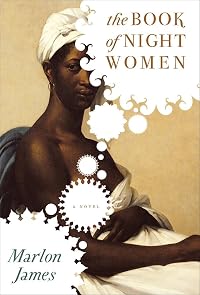
A Brief History is violent throughout, which is normal in a book about men whose business is violence. The violence is fomented directly by show more feuding political parties and indirectly by outsiders including the CIA, in a Cold-War proxy fight. James’s previous novel The Book of Night Women is set in the hyperviolent world of an eighteenth-century slave plantation. The two together might (or might not) make an argument that violence is baked into Jamaica from its very founding. I was fine with the violence as long as it stayed realistic, but as the book goes on it starts flaring up into set pieces of extreme violence, culminating in full-blown orgiastic cartoon violence in the last section, and that lost me a bit. So maybe 4.5/5 stars. Still, it’s a big beautiful book. show less
A Brief History is violent throughout, which is normal in a book about men whose business is violence. The violence is fomented directly by show more feuding political parties and indirectly by outsiders including the CIA, in a Cold-War proxy fight. James’s previous novel The Book of Night Women is set in the hyperviolent world of an eighteenth-century slave plantation. The two together might (or might not) make an argument that violence is baked into Jamaica from its very founding. I was fine with the violence as long as it stayed realistic, but as the book goes on it starts flaring up into set pieces of extreme violence, culminating in full-blown orgiastic cartoon violence in the last section, and that lost me a bit. So maybe 4.5/5 stars. Still, it’s a big beautiful book. show less
Marlon James takes all your exceptions about this wildy popular novel and blows them out of the water. James delivers in every aspect. There are many characters, but none are just simple names. Each character is memorable in his or her own way, and it's a show of talent that James was able to juggle his massive cast and make you still care about everyone. The novel takes place over a time period of 15 years, in a kind of culture that you've never thought about too much. There's a lot of violence, rape, and unconventional sex, but it never feels like it's there for purely shock value. It's a great novel and one i can't recommend enough.
Members
- Recently Added By
Published Reviews
ThingScore 100
If, like James, you’re from Jamaica, then recent history might suggest a gangster chronicle, and the central plot and metaphor of his novel is an intricate set of connections between the attempted assassination of the Singer and the rise and fall of a J.L.P.-connected crime boss called Josey Wales. The man who comes to kill the Singer, icon of peace, is a gangster whose export business is show more not reggae but cocaine. It doesn’t matter whether this hypothesis is factually verifiable. It isn’t. What matters is whether the story is persuasive and suggestive. show less
added by ozzer
Lists

Best Historical Fiction
620 works; 261 members

2015 Tournament of Books
16 works; 19 members

Best 21st Century Books (So Far)
670 works; 86 members

Recommend the 20 best books you've read in the last five years
2,168 works; 601 members

Best of World Literature
434 works; 52 members

Favourite Booker Prize contenders
73 works; 21 members
Booker Prize
491 works; 62 members

Pleasant Surprises: Books That Exceeded Our Expectations
418 works; 143 members

Must-Read Books by Black Authors
114 works; 92 members

Top Five Books of 2015
811 works; 240 members

40 Books to Read Before You’re 40
40 works; 4 members

Man Booker Prize Longlist 2015
13 works; 9 members

Top Five Books of 2017
757 works; 231 members

Vulture's 100 Best Books of the 21st Century (So Far)
98 works; 9 members

Backlisted
109 works; 9 members

50 Books from the Past 50 Years
50 works; 8 members

Black Authors
384 works; 32 members

This is the Canon: Decolonize Your Bookshelf in 50 Books
51 works; 5 members

Favorite Caribbean Books
60 works; 28 members

Books Read in 2016
4,666 works; 199 members

The Economist Best Fiction 2015
7 works; 1 member
Historical Fiction Lovers
88 works; 4 members

Dublin Literary Award Longlist 2016
148 works; 4 members

Books With Numbers in the Title
308 works; 13 members
Contemporary Fiction
109 works; 7 members

Books Set on Islands
190 works; 24 members
Books Read in 2015
3,299 works; 129 members

BBC Radio 4 Bookclub
340 works; 13 members

Books Read in 2017
4,249 works; 130 members

Books Read in 2022
5,168 works; 114 members

The Atlantic's The Great American Novel
136 works; 12 members

Best Audiobooks
240 works; 114 members

Fiction: Crime, Detective, Mystery
350 works; 3 members

.
184 works; 1 member

Vlogbrothers Book Recommendations
307 works; 4 members

My TBR list
38 works; 1 member

1001 Books You Must Read Before You Die
1,448 works; 1,134 members

Swinging Seventies
255 works; 18 members

Library List - Pulitzer Adjacent
40 works; 1 member
NYT 100 best books of 21st C
100 works; 31 members
Author Information

9+ Works 9,385 Members
Marlon James was born in Kingston, Jamaica in 1970. He studied literature at the University of the West Indies. He worked in advertising for more than a decade, as a copywriter, art director and graphic designer. He took a writing workshop in Kingston, Jamaica, and later enrolled in a writing program at Wilkes University in Pennsylvania. His first show more novel, John Crow's Devil, was published in 2005. His other novels include The Book of Night Women and A Brief History of Seven Killings, which won the Man Booker Prize for Fiction 2015. He teaches at Macalester College in St. Paul, Minnesota. (Bowker Author Biography) show less
Some Editions
Awards and Honors
Awards
Distinctions
The Guardian Book of the Day (2015-10-11)
Notable Lists
The Great American Novels (2014)
Series
Belongs to Publisher Series
L'eclèctica (262)
Work Relationships
Common Knowledge
- Canonical title
- A Brief History of Seven Killings
- Original title
- A Brief History of Seven Killings
- Original publication date
- 2014
- People/Characters
- Bob Marley; Nina Burgess; Arthur George Jennings; Bam-Bam; Barry Diflorio; Raymond Clarke (Papa-Lo) (show all 72); Josey Wales; Demus; Alex Pierce; Weeper; Tristan Phillips; John-John K; A-Plus; William Adler; Baxter; Betsy; Bill Bilson; Griselda Blanco; Orlando Bosch; Bullman; Buntin-Banton; Kim-Marie Burgess; Luis Hernán Rodrigo de las Casas (Doctor Love); Donald Casserley; Edgar Anatolyevich Cheporov; Chinaman; Chuck; Clark; Gail Colthirst; Gaston Colthirst; Kenneth Colthirst; Miles Copeland; Copper; Claire Diflorio; Dishrag; Eubie; Freddy; Funky Chicken; Funnyboy; Gael; Grant; Heckle; Louis Johnson; Junior Soul; Mark Lansing; Richard Lansing; Leggo Beast; Hernán Ricardo Lozano; Freddy Lugo; Tony McFerson; Peter Nasser; Nevis; Omar; Paco; Roland Palmer (Shotta Sherrif); Tony Pavarotti; Pig Tails; Priest; Sally Q; Ren-Dog; Renton; Sal Resnick; Romeo; Millicent Segree; Roger Theroux; Monifah Thibodeaux; Treetop; Ras Trent; Warren Tunney; Watson; Lindon Wolfsbricker; Dorcas Palmer
- Important places
- Kingston, Jamaica; New York, New York, USA; Miami, Florida, USA
- Epigraph
- Gonna tell the truth about it,
Honey, that's the hardest part.
—Bonnie Raitt, "Tangled and Dark"
If it no go so, it go near so.
—Jamaican proverb - Dedication
- To Maurice James
An extraordinary gentleman in a league of his own. - First words
- Listen.
Dead people never stop talking. Maybe because death is not death at all, just a detention after school. - Last words
- (Click to show. Warning: May contain spoilers.)-Kimmy?
- Publisher's editor
- Morrissey, Jake
- Blurbers
- Banks, Russell; Welsh, Irvine; Salewicz, Chris
- Original language
- English
- Canonical DDC/MDS
- 813.6
Classifications
Statistics
- Members
- 3,534
- Popularity
- 4,666
- Reviews
- 117
- Rating
- (3.87)
- Languages
- 11 — Catalan, Chinese, Dutch, English, French, German, Italian, Polish, Portuguese, Spanish, Swedish
- Media
- Paper, Audiobook, Ebook
- ISBNs
- 42
- ASINs
- 20
