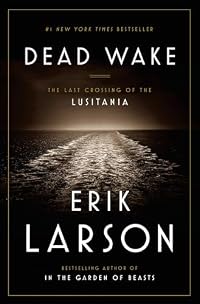
Dead Wake: The Last Crossing of the Lusitania
by Erik Larson
On This Page
Description
On May 1, 1915, a luxury ocean liner as richly appointed as an English country house sailed out of New York, bound for Liverpool, carrying a record number of children and infants. The passengers were anxious. Germany had declared the seas around Britain to be a war zone, and for months, its U-boats had brought terror to the North Atlantic. But the Lusitania was one of the era's great transatlantic "Greyhounds" and her captain, William Thomas Turner, placed tremendous faith in the gentlemanly show more strictures of warfare that for a century had kept civilian ships safe from attack. He knew, moreover, that his ship -- the fastest then in service -- could outrun any threat. Germany, however, was determined to change the rules of the game, and Walther Schwieger, the captain of Unterseeboot-20, was happy to oblige. Meanwhile, an ultra-secret British intelligence unit tracked Schwieger's U-boat, but told no one. As U-20 and the Lusitania made their way toward Liverpool, an array of forces both grand and achingly small -- hubris, a chance fog, a closely guarded secret, and more -- all converged to produce one of the great disasters of history. show lessTags
Recommendations





















Member Recommendations
The Other Side of the Night: The Carpathia, the Californian, and the Night the Titanic was Lost by Daniel Allen Butler
sweetbug Both books about famous ships lost at sea and the resulting rescue attempts, investigations and aftermaths
Member Reviews
Six-word review: Maritime calamity that shouldn't have happened.
Extended review:
Without realizing it at the time, I took this book out of the library on the one-hundredth anniversary of the sinking of RMS Lusitania. Reading of the events leading up to, during, and following this major marine catastrophe as they unfolded in the hours and days surrounding her torpedoing on May 7th of 1915 added an unexpected measure of drama to the experience.
Larson's book bears comparison to Walter Lord's A Night to Remember, a narrative account of the loss of the Titanic just three years earlier. Both present a description of the ship, a sketch of key personnel and a selection of passengers, and a minute-by-minute account of the climactic events as they show more happened. Both bring an up-close-and-personal perspective to our comprehension of a tragedy that is very difficult to encompass on the large scale.
And, significantly, both of them catalogue a staggering list of if-only's, all the factors that had to happen just so in order for the disaster to occur, a minor variation in which--even by a matter of only a few seconds--might have averted the fatal outcome.
The crucial difference, of course, is that whereas the Titanic disaster came about as the result of a collision with an iceberg, with an ample helping of human error and hubris in the mix, the Lusitania was deliberately sunk by a German U-boat committing an act of war. And, as the text makes very clear, that act could have been prevented if a number of people possessed of critical information had taken the necessary steps. Accident, error, delay, miscalculation, design flaws, inattention, stupidity, coincidence, and many other everyday mishaps had their part to play; but worst of all was the conscious choice on the part of certain officials to leave the vessel unescorted and issue a vague, ambiguous warning about the presence of danger. Whatever rationale guided that course of action, nearly 1200 passengers and crew on a commercial ocean liner paid the price, along with their families, friends, and fellow countrymen.
Larson's telling sets a solid framework on both sides of the Atlantic, from an emotionally preoccupied American president to the high-stakes military operations of Britain and Germany. Personal effects and diaries of victims along with records of survivors and eyewitnesses bring the story home. A hundred years is not such a long time; it's much too soon to forget. show less
Extended review:
Without realizing it at the time, I took this book out of the library on the one-hundredth anniversary of the sinking of RMS Lusitania. Reading of the events leading up to, during, and following this major marine catastrophe as they unfolded in the hours and days surrounding her torpedoing on May 7th of 1915 added an unexpected measure of drama to the experience.
Larson's book bears comparison to Walter Lord's A Night to Remember, a narrative account of the loss of the Titanic just three years earlier. Both present a description of the ship, a sketch of key personnel and a selection of passengers, and a minute-by-minute account of the climactic events as they show more happened. Both bring an up-close-and-personal perspective to our comprehension of a tragedy that is very difficult to encompass on the large scale.
And, significantly, both of them catalogue a staggering list of if-only's, all the factors that had to happen just so in order for the disaster to occur, a minor variation in which--even by a matter of only a few seconds--might have averted the fatal outcome.
The crucial difference, of course, is that whereas the Titanic disaster came about as the result of a collision with an iceberg, with an ample helping of human error and hubris in the mix, the Lusitania was deliberately sunk by a German U-boat committing an act of war. And, as the text makes very clear, that act could have been prevented if a number of people possessed of critical information had taken the necessary steps. Accident, error, delay, miscalculation, design flaws, inattention, stupidity, coincidence, and many other everyday mishaps had their part to play; but worst of all was the conscious choice on the part of certain officials to leave the vessel unescorted and issue a vague, ambiguous warning about the presence of danger. Whatever rationale guided that course of action, nearly 1200 passengers and crew on a commercial ocean liner paid the price, along with their families, friends, and fellow countrymen.
Larson's telling sets a solid framework on both sides of the Atlantic, from an emotionally preoccupied American president to the high-stakes military operations of Britain and Germany. Personal effects and diaries of victims along with records of survivors and eyewitnesses bring the story home. A hundred years is not such a long time; it's much too soon to forget. show less
It is difficult to find new words to use in reviewing Dead Wake. Erik Larson continues to write superbly, in an easy-flowing style that makes non-fiction come alive, creating tension even though we all know the outcome. His research is, as always, thorough and detailed. A mark of how good he is, is that I find myself also reading the 60 pages of notes he documents his story with.
As always, he is careful to present all sides of the event, showing up the ideas that are believed, yet false.
Coming through clearly is how those who steer a country in time of war consider objectives more important that the lives that will be lost. The British Admiralty clearly considered keeping the secret of their ability to monitor German transmissions more show more important than keeping over a thousand civilians safe. One wonders what they were saving the information for.
Dead Wake is an excellent read. show less
As always, he is careful to present all sides of the event, showing up the ideas that are believed, yet false.
Coming through clearly is how those who steer a country in time of war consider objectives more important that the lives that will be lost. The British Admiralty clearly considered keeping the secret of their ability to monitor German transmissions more show more important than keeping over a thousand civilians safe. One wonders what they were saving the information for.
Dead Wake is an excellent read. show less
 This review was written for LibraryThing Early Reviewers.
Exceptionally well-researched. But segments of this book are downright dull. Which was hard for me to fathom as I waded through.
Let me explain that I am a fan of Erik Larson and loved both the Devil in the White City and In the Garden of Beasts. And I am extremely interested in both World War I and the story of the sinking of the Lusitania. So you can imagine how excited I was to get my hands on this book.
But in this non-fiction account, Larson seemed to get lost in his own research and unable to judiciously limit what he included. (Just wait until you see the footnote list in the back, which accounts for about 25% of the pages in the book!) Details about individual passengers on the Lusitania's last voyage, what they ate, who met show more whom, and notes they wrote --- it simply weighed down the first half of the book. To the point where I found myself starting to skim.
Once Larson gets to the point where the ship is actually torpedoed, the narrative naturally became completely absorbing. The stories from survivors, the shameful lack of rescue efforts, and the political finger-pointing that followed made the last third of the book fascinating. But taken as a whole, it's not nearly as engrossing as the other Larson books I read. show less
Let me explain that I am a fan of Erik Larson and loved both the Devil in the White City and In the Garden of Beasts. And I am extremely interested in both World War I and the story of the sinking of the Lusitania. So you can imagine how excited I was to get my hands on this book.
But in this non-fiction account, Larson seemed to get lost in his own research and unable to judiciously limit what he included. (Just wait until you see the footnote list in the back, which accounts for about 25% of the pages in the book!) Details about individual passengers on the Lusitania's last voyage, what they ate, who met show more whom, and notes they wrote --- it simply weighed down the first half of the book. To the point where I found myself starting to skim.
Once Larson gets to the point where the ship is actually torpedoed, the narrative naturally became completely absorbing. The stories from survivors, the shameful lack of rescue efforts, and the political finger-pointing that followed made the last third of the book fascinating. But taken as a whole, it's not nearly as engrossing as the other Larson books I read. show less
“Please don't tell me that we're going to be subjected to this kind of inept writing,” I thought, when, on page 7, I encountered “the ship was booked to . . . carry nearly 2,000 people, or 'souls' . . . .” My suspicion deepened two pages on when I ran across a reference to the captain's holding “the record for a 'round' voyage, meaning round-trip, . . .” I fervently hoped that I was not going to be subjected to parenthetical comments every few pages giving unwanted and unneeded synonyms for perfectly comprehensible words in the text, thereby utterly destroying the flow of the narrative. Thankfully, this distracting technique rapidly disappeared, a third example appearing only much later when the author felt compelled to show more insult his readers again by lecturing us that the forecastle of a ship often appears spelled as “fo'c'sle.” Other than these three insults to readers' intelligence, I can levy no criticism against Dead Wake: The Last Crossing of the Lusitania, for it is an outstanding history and is otherwise written in a compelling and engaging style.
By introducing us to the captain and several passengers in the initial chapters, Larson enables us readers to become rather intimate with them and to see them as fellow beings with abilities, shortcomings, worries, loves and eccentricities. They represent the nearly 2,000 people aboard the fated ship and through them we come to care what befalls these doomed souls. We also come to view events through other eyes, those of the commander of Unterseeboot zwanzig, U-20, the submarine that launches the fatal torpedo.
Dead Wake also reaches beyond the Lusitania into the British Admiralty, and we learn something of the personalities and actions of a few significant government officials. We learn of Room 40, a precursor of Bletchley Park, the secret code-breaking operation of the government. Back in the still-isolationist United States, we see President Woodrow Wilson continuing to resist joining the far-off European war even as the bodies of U.S. citizens piled higher as Germany began more and more to disregard flags of neutral countries and to attack all shipping without exception. We wonder to what extent Wilson's personal grief over the death of his wife and his pursuit of the affections of Edith Bolling Galt distracted him from world affairs.
We are reminded that the sinking of the Lusitania did not precipitate entry of the U.S. into World War I and that, in fact, about two years passed between those two events. An intercepted telegram from the German foreign secretary, Arthur Zimmermann, to the the president of Mexico urged an alliance with Germany and, assuming victory by the Central Powers, offered to give the states of Texas, New Mexico and Arizona to Mexico. (Publication of that offer in U.S. newspapers was much more the death knell of isolationist sentiment than was the destruction of the Lusitania.)
Dead Wake, in short, is an excellent history of the years leading up to the entry of the U.S. in The Great War, years in which Germany held the upper hand at sea, years in which civilian passengers died in increasing numbers before the term “collateral damage” became common, years in which perhaps—just perhaps—British naval protection of ships such as the Lusitania was intentionally weak so that a disastrous attack, should one occur, might goad the U.S. into fighting alongside Allied forces. We understand why the British Admiralty ordered the recall of the only fast ship that had begun to sail to the rescue of survivors floundering in the frigid ocean. Erik Larson regales us with the known facts and suggests the possibilities in a non-fiction history book that is as captivating as any spy-thriller novel. I cannot envision a reader willingly putting this book down once he or she has once begun it. show less
By introducing us to the captain and several passengers in the initial chapters, Larson enables us readers to become rather intimate with them and to see them as fellow beings with abilities, shortcomings, worries, loves and eccentricities. They represent the nearly 2,000 people aboard the fated ship and through them we come to care what befalls these doomed souls. We also come to view events through other eyes, those of the commander of Unterseeboot zwanzig, U-20, the submarine that launches the fatal torpedo.
Dead Wake also reaches beyond the Lusitania into the British Admiralty, and we learn something of the personalities and actions of a few significant government officials. We learn of Room 40, a precursor of Bletchley Park, the secret code-breaking operation of the government. Back in the still-isolationist United States, we see President Woodrow Wilson continuing to resist joining the far-off European war even as the bodies of U.S. citizens piled higher as Germany began more and more to disregard flags of neutral countries and to attack all shipping without exception. We wonder to what extent Wilson's personal grief over the death of his wife and his pursuit of the affections of Edith Bolling Galt distracted him from world affairs.
We are reminded that the sinking of the Lusitania did not precipitate entry of the U.S. into World War I and that, in fact, about two years passed between those two events. An intercepted telegram from the German foreign secretary, Arthur Zimmermann, to the the president of Mexico urged an alliance with Germany and, assuming victory by the Central Powers, offered to give the states of Texas, New Mexico and Arizona to Mexico. (Publication of that offer in U.S. newspapers was much more the death knell of isolationist sentiment than was the destruction of the Lusitania.)
Dead Wake, in short, is an excellent history of the years leading up to the entry of the U.S. in The Great War, years in which Germany held the upper hand at sea, years in which civilian passengers died in increasing numbers before the term “collateral damage” became common, years in which perhaps—just perhaps—British naval protection of ships such as the Lusitania was intentionally weak so that a disastrous attack, should one occur, might goad the U.S. into fighting alongside Allied forces. We understand why the British Admiralty ordered the recall of the only fast ship that had begun to sail to the rescue of survivors floundering in the frigid ocean. Erik Larson regales us with the known facts and suggests the possibilities in a non-fiction history book that is as captivating as any spy-thriller novel. I cannot envision a reader willingly putting this book down once he or she has once begun it. show less
Today I'm going to tell you about Deep Wake: The Last Crossing of the Lusitania aka reason #5022 why I will never go on a cruise. I have an odd fascination with shipwrecks but also a deep, crushing fear of them. I cannot deal with images of sunken ships, statues, or really anything submerged under the water and nestled at the bottom of the ocean floor (you can also substitute ocean with sea, lake, or deep pool). Here is also where I confess that I am woefully ignorant about World War I. I always struggle to remember who was fighting in the war and what it was really about (I think this is still being puzzled over in some places). As far as the Lusitania, the only thing I knew was that it was a large passenger ship that had sunk (filling show more me with terror like the sinking of the Titanic and the film Poseidon with Kurt Russell). So I went into this book pretty much as a blank slate and by 30 pages in I was already spouting facts about it to my coworkers (who may never go on a cruise either). Like with all of Larson's works, he focuses on a major topic while interweaving storylines that occur parallel to the main event. For example, this book is about the Lusitania and its final voyage but in order to put that into context Larson had to discuss WWI and President Woodrow Wilson's state of mind in regards to the neutrality of the United States in that war (Wilson was one passionate dude, ya'll.). So not only did I learn about the machinations of the leading world powers of the early 20th century (Germany, Great Britain, and the U.S.A.) but I also got a glimpse into President Wilson's personal life, learned how submarines operate, and discovered that people really liked to smoke in 1915.
PS As mentioned in other posts, I love reading the end notes of nonfiction books because there are always fantastic little tidbits there that just didn't fit in the overall narrative of the book. Dead Wake was no exception. It led me to The Lusitania Resource which is a website dedicated to uncovering all of the facts of the sinking of the ship including primary documents, articles concerning the controversy of its significance to WWI, and much more. I highly recommend you check it out if nothing else than to whet your appetite for Larson's book. (Yes, I know that it's insane for me to be obsessed with this site after referencing my very real fears of traveling on a cruise ship but I like to have all of my facts ready for those trying to change my mind. It's perfectly normal.) show less
PS As mentioned in other posts, I love reading the end notes of nonfiction books because there are always fantastic little tidbits there that just didn't fit in the overall narrative of the book. Dead Wake was no exception. It led me to The Lusitania Resource which is a website dedicated to uncovering all of the facts of the sinking of the ship including primary documents, articles concerning the controversy of its significance to WWI, and much more. I highly recommend you check it out if nothing else than to whet your appetite for Larson's book. (Yes, I know that it's insane for me to be obsessed with this site after referencing my very real fears of traveling on a cruise ship but I like to have all of my facts ready for those trying to change my mind. It's perfectly normal.) show less
Larson is the master storyteller and can take one event that lasted 18 minutes and spread it out over 450 pages and still make it spell binding. Larson writes narrative non-fiction. The amount of research that went into this book was staggering. [Dead Wake] seems as if it's a suspense thriller. When reading [Dead Wake] one is never sure what the next chapter will bring: Wilson and Edith Galt's romance in DC, the intelligence operatives who worked in Britain's highly secret Room 40, the very wealthy passengers aboard The Lusitania, or Captain Schweiger of the U Boat 20.
Winston Churchill on Germans attacking the Lusitania and leaving civilians and crew “to perish in open boats or drown amid the waves was in the eyes of all seafaring show more peoples a grisly act, which hitherto had never been practised except by pirates”.
Larson even takes up the many sides of the historical debate: Was the Lusitania made a sitting duck for the Germans to take down so that the U.S. would enter the war? You will have to read the book to find out!
I highly recommend [Dead Wake]. 450 pages 5 stars show less
Winston Churchill on Germans attacking the Lusitania and leaving civilians and crew “to perish in open boats or drown amid the waves was in the eyes of all seafaring show more peoples a grisly act, which hitherto had never been practised except by pirates”.
Larson even takes up the many sides of the historical debate: Was the Lusitania made a sitting duck for the Germans to take down so that the U.S. would enter the war? You will have to read the book to find out!
I highly recommend [Dead Wake]. 450 pages 5 stars show less
Of the now three Larson books I've read, I believe this was my favorite. The two main narratives - that of the Lusitania's passengers and crew, and that of U-20's captain - are more closely intertwined than the two parallel (but never intersecting) narratives of Devil in the White City. The story itself was more compelling and clear than that in In the Garden of Beasts (I remember being frustrated with the main characters' inability or unwillingness to read the writing on the wall). The additional story threads - that of President Wilson's ultimately successful wooing of Edith Galt and his reluctance to enter the war, and the existence and activity of the secret Room 40 in the UK (a sort of Bletchley-before-Bletchley) - were relevant show more additions, particularly the latter.
As in many disaster narratives, there are so many "what if" moments and missed opportunities, from seemingly small ones like a two-hour delay leaving New York (which would have meant sailing through the dangerous area off the Irish coast in the fog, when the U-boat couldn't have attacked the ship, instead of in clear weather), to truly staggering ones like the information and protection that the Admiralty withheld from Captain Turner and the Cunard line.
Well-researched as always, Dead Wake should please Larson fans, as well as Titanic and WWI buffs. My galley copy didn't include the map at the beginning that the final copy is meant to have, and some images would have added to the story, but it was still quite satisfying.
Quotes (from the advance reader's edition)
Although this accumulation of facts - a fresh swarm of submarines, a grand liner under way in the face of a public warning - would seem a stimulus for sleepless nights among the top men of the Admiralty, neither the new surge in U-boat activity nor the imminent arrival of U-20 was communicated to Captain Turner. Nor was any effort made to escort the Lusitania or divert it from its course, as the Admiralty had done for the ship the preceding March... (108)
[A conversation between passenger George Kessler and Captain Turner about including passengers in lifeboat drills and assigning them to lifeboats in advance; Turner said Cunard had said the idea was "impractical."] (234)
Strangely, the ship had no escorts whatsoever. Even stranger, in Schwieger's view, was that the vessel was in these waters at all, especially after his two successful attacks the day before. That the ship "was not sent through the North Channel is inexplicable," he wrote in his log. (235)
The [torpedo's] track lingered on the surface like a long pale scar. In maritime vernacular, this trail of fading disturbance, whether from ship or torpedo, was called a "dead wake." (243)
Asked later how this feat had been achieved, [Seaman Leslie] Morton answered, "If you had to jump six or seven feet, or certainly drown, it is surprising what 'a hell of a long way' even older people can jump." (274)
[A woman approached Captain Turner on one of the rescue boats and] told Turner that her son's death had been unnecessary - that it was caused by the lack of organization and discipline among the crew. (299)
[British passenger Ruth M. Wordsworth wrote to the mother of a dead passenger, Preston Prichard] "I know you must be tempted to have the most terrible imaginings; may I tell you that although it was very awful, it was not so ghastly as you are sure to imagine it. When the thing really comes, God gives to each the help he needs to live or to die." (314)
At no time during the secret portions of the proceeding did the Admiralty ever reveal what it knew about the travels of U-20....Nor did the inquiry ever delve into why the Lusitania wasn't diverted to the safer North Channel route, and why no naval escort was provided....The question remains, why was the the ship left on its own, with a proven killer of men and ships dead ahead in its path? There is silence on the subject in the records of Room 40 held by the National Archives... (323)
[Naval historian Patrick Beesly said] "On the basis of the considerable volume of information which is now available, I am reluctantly compelled to state that on balance, the most likely explanation is that there was indeed a plot, however imperfect, to endanger the Lusitania in order to involve the United States in the war." (324) show less
As in many disaster narratives, there are so many "what if" moments and missed opportunities, from seemingly small ones like a two-hour delay leaving New York (which would have meant sailing through the dangerous area off the Irish coast in the fog, when the U-boat couldn't have attacked the ship, instead of in clear weather), to truly staggering ones like the information and protection that the Admiralty withheld from Captain Turner and the Cunard line.
Well-researched as always, Dead Wake should please Larson fans, as well as Titanic and WWI buffs. My galley copy didn't include the map at the beginning that the final copy is meant to have, and some images would have added to the story, but it was still quite satisfying.
Quotes (from the advance reader's edition)
Although this accumulation of facts - a fresh swarm of submarines, a grand liner under way in the face of a public warning - would seem a stimulus for sleepless nights among the top men of the Admiralty, neither the new surge in U-boat activity nor the imminent arrival of U-20 was communicated to Captain Turner. Nor was any effort made to escort the Lusitania or divert it from its course, as the Admiralty had done for the ship the preceding March... (108)
[A conversation between passenger George Kessler and Captain Turner about including passengers in lifeboat drills and assigning them to lifeboats in advance; Turner said Cunard had said the idea was "impractical."] (234)
Strangely, the ship had no escorts whatsoever. Even stranger, in Schwieger's view, was that the vessel was in these waters at all, especially after his two successful attacks the day before. That the ship "was not sent through the North Channel is inexplicable," he wrote in his log. (235)
The [torpedo's] track lingered on the surface like a long pale scar. In maritime vernacular, this trail of fading disturbance, whether from ship or torpedo, was called a "dead wake." (243)
Asked later how this feat had been achieved, [Seaman Leslie] Morton answered, "If you had to jump six or seven feet, or certainly drown, it is surprising what 'a hell of a long way' even older people can jump." (274)
[A woman approached Captain Turner on one of the rescue boats and] told Turner that her son's death had been unnecessary - that it was caused by the lack of organization and discipline among the crew. (299)
[British passenger Ruth M. Wordsworth wrote to the mother of a dead passenger, Preston Prichard] "I know you must be tempted to have the most terrible imaginings; may I tell you that although it was very awful, it was not so ghastly as you are sure to imagine it. When the thing really comes, God gives to each the help he needs to live or to die." (314)
At no time during the secret portions of the proceeding did the Admiralty ever reveal what it knew about the travels of U-20....Nor did the inquiry ever delve into why the Lusitania wasn't diverted to the safer North Channel route, and why no naval escort was provided....The question remains, why was the the ship left on its own, with a proven killer of men and ships dead ahead in its path? There is silence on the subject in the records of Room 40 held by the National Archives... (323)
[Naval historian Patrick Beesly said] "On the basis of the considerable volume of information which is now available, I am reluctantly compelled to state that on balance, the most likely explanation is that there was indeed a plot, however imperfect, to endanger the Lusitania in order to involve the United States in the war." (324) show less
This review was written for LibraryThing Early Reviewers.Members
- Recently Added By
Published Reviews
ThingScore 100
If creating “an experience” is Larson’s primary goal, then “Dead Wake” largely succeeds. There are brisk cameos by Churchill and Woodrow Wilson, desperate flurries of wireless messages and telegrams, quick flashes to London and Berlin. These passages have a crackling, propulsive energy that most other books about the Lusitania — often written for disaster buffs or steampunk show more aficionados — sorely lack. show less
added by private library
Lists

Disaster Books
74 works; 19 members

Recommend the 20 best books you've read in the last five years
2,167 works; 606 members

Top Five Books of 2015
811 works; 241 members

Best History Books about Disasters
33 works; 19 members

2016 Notable Books for Adults
26 works; 7 members

Top Five Books of 2022
736 works; 272 members

Accidents, Disasters, and Tragedies
175 works; 7 members

Non-Fiction Worth Reading
1,015 works; 260 members

2022 Challenge
24 works; 1 member

Best Maritime Non Fiction
11 works; 4 members

Books recommended by Calgary Public Library staff
1,588 works; 4 members

THE WAR ROOM
813 works; 24 members

Books Read in 2023
5,547 works; 145 members

Books Read in 2015
3,298 works; 126 members

2016 Book Club Choices
52 works; 7 members
Ten Books About Disasters at Sea
10 works; 2 members

Books Read in 2019
4,052 works; 110 members

Best Survival Stories
97 works; 15 members

Books Read in 2017
4,248 works; 130 members

To Read
617 works; 7 members

Nov. 2015 new books
38 works; 1 member

Books Read in 2020
4,379 works; 124 members
Author Information

15+ Works 57,038 Members
Erik Larson was born in Brooklyn on January 3, 1954. He graduated Summa Cum Laude from the University of Pennsylvania and went to graduate school at Columbia University. Larson worked for the Wall Street Journal and then began writing non-fiction books. He is the bestselling author of the National Book Award finalist and Edgar Award-winning, The show more Devil in the White City, which has been optioned for a feature film by Leonardo DiCaprio. He also wrote In the Garden of the Beasts, Issac's Storm, Thunderstruck and The Naked Consumer. Larson has taught non-fiction writing at San Francisco State University, the Johns Hopkins Writing Seminars, and the University of Oregon. (Bowker Author Biography) show less
Some Editions
Awards and Honors
Awards
Distinctions
The Guardian Book of the Day (2015-05-07)
Series
Belongs to Publisher Series
Le livre de poche (34490)
Work Relationships
Has as a reference guide/companion
Common Knowledge
- Canonical title*
- Lusitania. 1915, la dernière traversée
- Original title
- Dead Wake: The Last Crossing of the Lusitania
- Original publication date
- 2015-03-10
- People/Characters
- William Thomas Turner; Woodrow Wilson; Walther Schwieger; Charles Lauriat; Theodate Pope; Ellen Axson Wilson (show all 8); Edith Galt; Winston Churchill
- Important places
- Lusitania (Steamship); Atlantic Ocean; Coast of Ireland; New York, New York, USA; Washington, D.C., USA; Rome, Georgia, USA
- Important events
- Sinking of the Lusitania; World War I
- Epigraph
- The Captains are to remember that, whilst they are expected to use every diligence to secure a speedy voyage, they must run no risk which by any possibility might result in accident to their ships. They will ever bear in m... (show all)ind that the safety of the lives and property entrusted to their care is the ruling principle which should govern them in the navigation of their ships, and no supposed gain in expedition, or saving of time on the voyage, is to be purchased at the risk of accident.
"Rules to Be Observed in the Company's Service,"
The Cunard Steam-Ship Company Limited, March 1913
The first consideration is the safety of the U-boat.
ADM. REINHARD SCHEER
Germany's High Sea Fleet in the World War, 1919 - Dedication
- For Chris, Kristen, Lauren, and Erin
(and Molly and Ralphie, absent, but not forgotten) - First words
- On the night of May 6, 1915, as his ship approached the coast of Ireland, Capt. William Thomas Turner left the bridge and made his way to the first-class lounge, where passengers were taking part in a concert and talent show,... (show all) a customary feature of Cunard crossings.
- Last words
- (Click to show. Warning: May contain spoilers.)Her companion, Edwin Friend, had indeed been lost but was reported by members of the reconstituted American Society for Psychical Research to have paid the group several visits.
- Blurbers
- Martin, George R. R.; Grossman, Lev
- Original language
- English
- Canonical DDC/MDS
- 940.4514
- Canonical LCC
- D592.L8
*Some information comes from Common Knowledge in other languages. Click "Edit" for more information.
Classifications
Statistics
- Members
- 6,100
- Popularity
- 2,049
- Reviews
- 306
- Rating
- (4.14)
- Languages
- 10 — Dutch, English, Finnish, French, German, Italian, Polish, Portuguese, Russian, Spanish
- Media
- Paper, Audiobook, Ebook
- ISBNs
- 43
- ASINs
- 17
