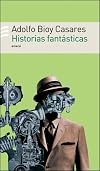
Extraordinary Tales
by Adolfo Bioy Casares, Jorge Luis Borges
On This Page
Description
Presents twelve stories about dogs, a poisonous mushroom, a fish, a flower that lost its petals, a cuckoo clock, the sunset, and other topics that highlight the importance of friendship and compassion.Tags
Recommendations































Member Reviews
This was an absolutely gripping read. It seems to be an anthology of short excerpts and "narratives" that have been selected, translated and edited by the two authors. In a foreword the two authors write that in some cases the translations are translations of translations, and while they have tried to go to the original sources, they were not always successful in doing so - for example they could not find in the original a short passage by Richard Burton which was in the Spanish edition!
Anyway, on to the work itself. The short narratives have many of the themes, motifs and imagery common to Borges' other works: dreams, labyrinths, mirrors, books, dopplegangers, prophecy and epiphany. They come from varied times and places - China, show more Arabia, Persia, Scandanavia, Europe, South America and so on. Some are, in the best Borgesian traditions synopses of other stories or books or narrated second hand. They seem to have been selected and arranged one after the other with some care, through the connections are not always obvious. I like to feel that the key to reading the book is provided by one particular piece which is 'The Pattern on the Carpet' which is an outtake from 'The London Adventure' by Arthur Machen in which he ruminates on a story by Henry James called 'The Pattern on the Carpet' which is about an author who has written many books which were all variations on one theme and that a common pattern, like the pattern of an Eastern carpet ran through them all. The story ends with the death of the author before he can reveal the nature of the pattern and one of his readers going through a whole shelf of his books trying to discern the pattern.
The stories from so many different and varied sources, I feel, are for Borges and Casares, variations on a similar theme. And it is entirely fitting that the narrative that alludes to this is a piece by an author writing about an author who has written about an author who has written countless variations on the same theme. Or, another way to look at it, The authors of this work are sharing with their readers a piece they read about another reader who read about a story about a reader who is trying to piece together the pattern that appears in a series of entirely imaginary books!
In such a way the short narratives flow from one to another, taking us backwards and forwards in time and in place, with the authorial voice changing constantly as well. There is a dreamlike quality to the reading experience, and I don't mind admitting that I did have some rather odd dreams last night, no doubt brought on by reading this before going to bed.
Perhaps my favourite narrative is the one that takes the common Borgesian motif of a labyrinth and turns it inside out: a Babylonian king has his architects design and construct a labyrinth so subtle that even the wisest men would lose themselves in it. He then tricked a visiting Arabian king into entering it, who wandered lost and confused for an entire day. In return the Arabian King vows to take the Babylonian king to a labyrinth that is even more impossible to escape from and takes and dumps him in the middle of the desert, "where there are no stairs to climb, nor doors to force, nor weary galleries to wander, nor walls to block your way." But the Babylonian King wanders lost and confused in the bare desert for the rest of his days, unable to escape this anti-labyrinth.
I loved this book and think I'll be dipping back into it again for days to come. Its a must for fans of Borges. show less
Anyway, on to the work itself. The short narratives have many of the themes, motifs and imagery common to Borges' other works: dreams, labyrinths, mirrors, books, dopplegangers, prophecy and epiphany. They come from varied times and places - China, show more Arabia, Persia, Scandanavia, Europe, South America and so on. Some are, in the best Borgesian traditions synopses of other stories or books or narrated second hand. They seem to have been selected and arranged one after the other with some care, through the connections are not always obvious. I like to feel that the key to reading the book is provided by one particular piece which is 'The Pattern on the Carpet' which is an outtake from 'The London Adventure' by Arthur Machen in which he ruminates on a story by Henry James called 'The Pattern on the Carpet' which is about an author who has written many books which were all variations on one theme and that a common pattern, like the pattern of an Eastern carpet ran through them all. The story ends with the death of the author before he can reveal the nature of the pattern and one of his readers going through a whole shelf of his books trying to discern the pattern.
The stories from so many different and varied sources, I feel, are for Borges and Casares, variations on a similar theme. And it is entirely fitting that the narrative that alludes to this is a piece by an author writing about an author who has written about an author who has written countless variations on the same theme. Or, another way to look at it, The authors of this work are sharing with their readers a piece they read about another reader who read about a story about a reader who is trying to piece together the pattern that appears in a series of entirely imaginary books!
In such a way the short narratives flow from one to another, taking us backwards and forwards in time and in place, with the authorial voice changing constantly as well. There is a dreamlike quality to the reading experience, and I don't mind admitting that I did have some rather odd dreams last night, no doubt brought on by reading this before going to bed.
Perhaps my favourite narrative is the one that takes the common Borgesian motif of a labyrinth and turns it inside out: a Babylonian king has his architects design and construct a labyrinth so subtle that even the wisest men would lose themselves in it. He then tricked a visiting Arabian king into entering it, who wandered lost and confused for an entire day. In return the Arabian King vows to take the Babylonian king to a labyrinth that is even more impossible to escape from and takes and dumps him in the middle of the desert, "where there are no stairs to climb, nor doors to force, nor weary galleries to wander, nor walls to block your way." But the Babylonian King wanders lost and confused in the bare desert for the rest of his days, unable to escape this anti-labyrinth.
I loved this book and think I'll be dipping back into it again for days to come. Its a must for fans of Borges. show less
la prosa es exquisita y el humor siempre fino. las premisas son ingeniosas, la intriga bien construida y las primeras 3/4 partes de cada cuento son un placer. las resoluciones de los cuentos son siempre apuradas y a la verdad son siempre decepcionantes. una lastima por que la voz del autor es muy amena, muy buena compañia.
The great Argentinian literary artists Jorge Luis Borges and Adolfo Bioy Casares have compiled over ninety tales of the fantastic, strange, imaginative, and, yes, the extraordinary - tales from around the world, from all times and places, ancient and modern, East and West. Some of the tales are as short as one or two or three lines, most one page and a few others two, three or four pages.. Highly recommended for your reading pleasure. Here are several of the shorter tales I particularly enjoyed, including the last tale by Adolfo Bioy Casares where I have also included my brief commentary:
THE WORK AND THE POET by R. F. Burton (1887)
The Hindu poet Tulsi Das composed the “Geste” of Hanuman and his army of monkeys. Years later, he was show more imprisoned in a stone tower by a king. In his cell he put himself to meditating, and from out of his meditation emerged Hanuman and his army of monkeys, and they conquered the city, burst into the tower, and freed Tulsi Das.
EUGENICS by Drummond (1618)
A lady of quality fell so deliriously in love with a certain Mr. Dodd, a Puritan preacher, that she begged her husband to allow her to use the marital bed for purposes of procreating an angel or a saint, but, permission having been granted, the birth was normal.
THE CASTLE by Diderot (1773)
Thus he arrived before a great castle on which façade were carved the words: I BELONG TO NO ONE AND TO ALL. BEFORE ENTERING YOU WERE ALREADY HERE. WHEN YOU LEAVE YOU WILL REMAIN.
THE DREAM OF CHUANG TZU noted by Herbert Allen Giles (1889)
Chuang Tzu dreamt he was a butterfly, and when he awoke, did not know if he was a man who had dreamt he was a butterfly or a butterfly who was dreaming he was a man.
THE MIRACLE noted by W. Somerset Maugham (1949-1951)
A Yogi wanted to cross a river and had not the penny to pay the ferryman, so he walked across the river on his feet. Another Yogi hearing of this said the miracle was only worth the penny it would have cost to cross by ferry.
SALVATION by Adolfo Bioy Casares (about 1955)
This is a story out of past times and kingdoms. A sculptor was walking in the garden of the palace in the company of a tyrant. Beyond and behind the Labyrinth for Illustrious Foreigners, at the far edge of the Grove dedicated for Decapitated Philosophers, the sculptor presented the tyrant with his latest work: a water-nymph as fountain. While the sculptor grew prolix with technical explanations and expanded in the intoxication of triumph, he began to notice a menacing shadow crossing the handsome face of his protector. He fathomed the cause, “How can a person of such indifferent quality,” the tyrant was surely thinking, “do what I, master of nations, cannot do?” At that moment a bird, which had settled to drink at the fountain, flew off with a flutter of wings in the air, and the sculptor thought of the idea which would save him. “No matter how insignificant they may be,” he said aloud, indicating the bird, “we must recognize that they fly better than we.”
Here are a number of features of this wonderful tale I particularly enjoy:
• Although this might be a direct slap at the current political dictatorship in Argentina of the time, Bioy Casares states directly the tale is of a far distant past, giving it a remote, universal, mythical quality;
• Labyrinth for illustrious foreigners and a grove dedicated to decapitated philosophers sounds ominous. In a modern dictatorship that is exactly the truth: keeping foreigners in the dark about what is really happening in the country and assassinating any free-thinking citizen who dares to disagree;
• The sculptor’s nymph fountain could be seen as a stand in for a fiction writer’s fantastic tale, the kind written by the author himself, his friend Jorge Luis Borges or his wife Silvina Ocampo.
• The artist is proud of his creation and loves to speak at length about the creative process, but such talk makes a powerful politician angry since, compared to an artist or creative writer, the politician is an unimaginative, no-talent power player.
• There could be trouble, but since the artist is especially perceptive and intuitive, he senses danger and, like a hunted wild animal, becomes keenly aware of surroundings - thus catching the flutter of a bird’s wing prompting him to speak the words that save his neck. I can imagine many artists and writers in Argentina and elsewhere on the globe at the time of dictatorship likewise becoming highly intuitive and thereby escaping prison, torture or death. show less
Creo que es una de las mejores antologías (si no la mejor) que haya leído jamás... y yo amo leer antologías. Sólo me gustaría saber por qué espere tantos, pero tantos años para leerla.
The great Argentinian literary artists Jorge Luis Borges and Adolfo Bioy Casares have compiled over ninety tales of the fantastic, strange, imaginative, and, yes, the extraordinary - tales from around the world, from all times and places, ancient and modern, East and West. Some of the tales are as short as one or two or three lines, most one page and a few others two, three or four pages.. Highly recommended for your reading pleasure. Here are several of the shorter tales I particularly enjoyed, including the last tale by Adolfo Bioy Casares where I have also included my brief commentary:
THE WORK AND THE POET by R. F. Burton (1887)
The Hindu poet Tulsi Das composed the “Geste” of Hanuman and his army of monkeys. Years later, he was show more imprisoned in a stone tower by a king. In his cell he put himself to meditating, and from out of his meditation emerged Hanuman and his army of monkeys, and they conquered the city, burst into the tower, and freed Tulsi Das.
EUGENICS by Drummond (1618)
A lady of quality fell so deliriously in love with a certain Mr. Dodd, a Puritan preacher, that she begged her husband to allow her to use the marital bed for purposes of procreating an angel or a saint, but, permission having been granted, the birth was normal.
THE CASTLE by Diderot (1773)
Thus he arrived before a great castle on which façade were carved the words: I BELONG TO NO ONE AND TO ALL. BEFORE ENTERING YOU WERE ALREADY HERE. WHEN YOU LEAVE YOU WILL REMAIN.
THE DREAM OF CHUANG TZU noted by Herbert Allen Giles (1889)
Chuang Tzu dreamt he was a butterfly, and when he awoke, did not know if he was a man who had dreamt he was a butterfly or a butterfly who was dreaming he was a man.
THE MIRACLE noted by W. Somerset Maugham (1949-1951)
A Yogi wanted to cross a river and had not the penny to pay the ferryman, so he walked across the river on his feet. Another Yogi hearing of this said the miracle was only worth the penny it would have cost to cross by ferry.
SALVATION by Adolfo Bioy Casares (about 1955)
This is a story out of past times and kingdoms. A sculptor was walking in the garden of the palace in the company of a tyrant. Beyond and behind the Labyrinth for Illustrious Foreigners, at the far edge of the Grove dedicated for Decapitated Philosophers, the sculptor presented the tyrant with his latest work: a water-nymph as fountain. While the sculptor grew prolix with technical explanations and expanded in the intoxication of triumph, he began to notice a menacing shadow crossing the handsome face of his protector. He fathomed the cause, “How can a person of such indifferent quality,” the tyrant was surely thinking, “do what I, master of nations, cannot do?” At that moment a bird, which had settled to drink at the fountain, flew off with a flutter of wings in the air, and the sculptor thought of the idea which would save him. “No matter how insignificant they may be,” he said aloud, indicating the bird, “we must recognize that they fly better than we.”
Here are a number of features of this wonderful tale I particularly enjoy:
• Although this might be a direct slap at the current political dictatorship in Argentina of the time, Bioy Casares states directly the tale is of a far distant past, giving it a remote, universal, mythical quality;
• Labyrinth for illustrious foreigners and a grove dedicated to decapitated philosophers sounds ominous. In a modern dictatorship that is exactly the truth: keeping foreigners in the dark about what is really happening in the country and assassinating any free-thinking citizen who dares to disagree;
• The sculptor’s nymph fountain could be seen as a stand in for a fiction writer’s fantastic tale, the kind written by the author himself, his friend Jorge Luis Borges or his wife Silvina Ocampo.
• The artist is proud of his creation and loves to speak at length about the creative process, but such talk makes a powerful politician angry since, compared to an artist or creative writer, the politician is an unimaginative, no-talent power player.
• There could be trouble, but since the artist is especially perceptive and intuitive, he senses danger and, like a hunted wild animal, becomes keenly aware of surroundings - thus catching the flutter of a bird’s wing prompting him to speak the words that save his neck. I can imagine many artists and writers in Argentina and elsewhere on the globe at the time of dictatorship likewise becoming highly intuitive and thereby escaping prison, torture or death. show less
"Hay varios mundos, varias Argentinas, varios futuros que nos esperan: en uno u otro desembocaremos de pronto."
Desde el viajante de comercio que escapa, por el camino de Rauch, de proyectiles que todavía no existen en el presente, hasta el frágil extraterrestre que soporta el rigor del verano leyendo diarios viejos en un galponcito, los personajes de este libro irradian la asombrosa inventiva de un maestro indiscutido del género fantástico. Los principales cuentos de Adolfo Bioy Casares están representados en la presente selección. El móvil que dispara las tramas puede ser atroz o sobrenatural pero ocurre siempre en escenarios cotidianos, como si de pronto terciara en la rutina una realidad más compleja. En "El gran Serafín" un show more profesor entrevé el fin del mundo en un despoblado balneario del sur de Buenos Aires; "Los afanes", "El lado de la sombra" y "El perjurio de la nieve" postulan una eternidad controlada, hecha de repeticiones o de pensamientos; en el extraordinario "La sierva ajena", un hombre-rata dirige desde una casona del Tigre una trágica parábola de sumisión.Las historias que proponen estas páginas funcionan como un inolvidable cinematógrafo fantástico donde el peligro, los amores y las maravillas resplandecen con el encanto de uno de los grandes escritores de la literatura argentina. show less
Desde el viajante de comercio que escapa, por el camino de Rauch, de proyectiles que todavía no existen en el presente, hasta el frágil extraterrestre que soporta el rigor del verano leyendo diarios viejos en un galponcito, los personajes de este libro irradian la asombrosa inventiva de un maestro indiscutido del género fantástico. Los principales cuentos de Adolfo Bioy Casares están representados en la presente selección. El móvil que dispara las tramas puede ser atroz o sobrenatural pero ocurre siempre en escenarios cotidianos, como si de pronto terciara en la rutina una realidad más compleja. En "El gran Serafín" un show more profesor entrevé el fin del mundo en un despoblado balneario del sur de Buenos Aires; "Los afanes", "El lado de la sombra" y "El perjurio de la nieve" postulan una eternidad controlada, hecha de repeticiones o de pensamientos; en el extraordinario "La sierva ajena", un hombre-rata dirige desde una casona del Tigre una trágica parábola de sumisión.Las historias que proponen estas páginas funcionan como un inolvidable cinematógrafo fantástico donde el peligro, los amores y las maravillas resplandecen con el encanto de uno de los grandes escritores de la literatura argentina. show less
Aug 7, 2020Spanish
Asir la esencia de lo narrativo pareciera constituir el propósito primordial de esta excelente y singularísima antología. Los textos más variados de distintas épocas y lugares y autores diversos se dan cita en estas páginas que, a no dudarlo, deleitarán con su sutil encanto y su doble escritura aun al lector más desprevenido.
Aug 24, 2021Spanish
Members
- Recently Added By
Author Information

111+ Works 8,468 Members
Adolfo Bioy Casares has collaborated with Jorge Luis Borges on a number of works. They compiled Anthology of Fantastic Literature (1940), a documentation of the development of Spanish American suprarealism, and Six Problems for Don Isidro Parodi (1981), a playful and inventive variation on the theme of the detective who cannot visit the scene of show more the crime. Bioy Casares's numerous works are characterized by intelligence and a sense of playful fantasy. The Invention of Morel (1953), concerns a scientist's illusions about immortality. Asleep in the Sun is a bizarre tale written in an epistolary form. Ultimately the recipient of the letter is left to wonder whether, in fact, the puzzle has any solution or whether, like much of Bioy Casares's and Borges's work, it is an inside joke between author and reader. (Bowker Author Biography) show less

859+ Works 58,630 Members
Born in Buenos Aires, Argentina, in 1899, Jorge Borges was educated by an English governess and later studied in Europe. He returned to Buenos Aires in 1921, where he helped to found several avant-garde literary periodicals. In 1955, after the fall of Juan Peron, whom he vigorously opposed, he was appointed director of the Argentine National show more Library. With Samuel Beckett he was awarded the $10,000 International Publishers Prize in 1961, which helped to establish him as one of the most prominent writers in the world. Borges regularly taught and lectured throughout the United States and Europe. His ideas have been a profound influence on writers throughout the Western world and on the most recent developments in literary and critical theory. A prolific writer of essays, short stories, and plays, Borges's concerns are perhaps clearest in his stories. He regarded people's endeavors to understand an incomprehensible world as fiction; hence, his fiction is metaphysical and based on what he called an esthetics of the intellect. Some critics have called him a mystic of the intellect. Dreamtigers (1960) is considered a masterpiece. A central image in Borges's work is the labyrinth, a mental and poetic construct, that he considered a universe in miniature, which human beings build and therefore believe they control but which nevertheless traps them. In spite of Borges's belief that people cannot understand the chaotic world, he continually attempted to do so in his writing. Much of his work deals with people's efforts to find the center of the labyrinth, symbolic of achieving understanding of their place in a mysterious universe. In such later works as The Gold of the Tigers, Borges wrote of his lifelong descent into blindness and how it affected his perceptions of the world and himself as a writer. Borges died in Geneva in 1986. (Bowker Author Biography) show less
All Editions
Some Editions
Series
Belongs to Publisher Series
Work Relationships
Contains
Is an abridged version of
Common Knowledge
- Canonical title
- Extraordinary Tales
- Original title
- Cuentos breves y extraordinarios
- Alternate titles*
- Kısa ve Olağanüstü Hikâyeler
- Original publication date
- 1955
- Disambiguation notice*
- Contenido:
- Nota preliminar • Adolfo Bioy Casares y Jorge Luis Borges
- La sentencia (西遊記) • Wu Ch'êng-ên
- El redentor secreto • no acreditado
- El aniquilación de los ogros • Lal Beh... (show all)ari Day
- Historia de Cecilia • Marco Tulio Cicerón
- El encuentro • no acreditado
- Difícil de contentar • Ibn Abd Rabbih (ابن عبد ربه)
- Argumentos anotados (Scattered Themes from the Note-Books of Nathaniel Hawthorne) • Nathaniel Hawthorne
- El sueño (蝴蝶的夢想) • Chuang Tzu (莊子)
- El ciervo escondido (得鹿梦) • Liehtse (列子)
- Los brahmanes y el león • no acreditado
- Un golem • no acreditado
- La vuelta del maestro • Adolfo Bioy Casares, Jorge Luis Borges, y Alexandra David-Neel
- Temor de la cólera • Ah'med el Qalyubi
- Andrómeda (Andromeda) • Samuel Butler
- El sueño (The Dream) • O. Henry
- La promesa del rey • no acreditado
- El juramiento del cautivo • no acreditado
- El intuitivo • Alfonso Reyes
- Cómo descubrí al Superhombre (How I Found the Superman) • G. K. Chesterton
- Un mito de Alejandro de La modification du Passé ou la seule base de la Tradition • Adrienne Bordenave
- La explicación (The Explanation ) • Edwin Broster
- La obra y el poeta (The Work and the Poet) • Sir Richard Francis Burton
- Eugenesia • William Drummond of Hawthornden
- La mendiga de Nápoles (La mendiante de Naples) • Max Jacob
- Un dios abandona a Alejandría de Βίοι Παράλληλοι • Plutarco
- La discípula (女學士) • 蒲松齡
- El noveno esclavo (The Ninth Slave) • Edward Gibbon
- Un vencedor • Diego de Saavedra Fajardo
- El peligroso taumaturgo (The Dangerous Wonder-Worker) • M. R. Werner
- El castillo • Denis Diderot
- La estatua • Plutarco
- La advertencia (The Warning) • Sir Richard Francis Burton
- Las facultades de Villena • Menéndez y Pelayo
- La sombra de las jugadas (The Shadow of the Moves, I • Edwin Morgan
- La sombra de las jugadas • Jorge Luis Borges
- Los ojos culpables • Ah'med Ech Chiruani
- El profeta, el pájaro y la red • Ah'med et Tortuchi
- Los ciervos celestiales (The Celestial Stag) • G. Willoughby-Meade
- El cocinero (Encore Fantômas) • Max Jacob
- Polemistas • Luis L. Antuñano
- Perplejidades del cobarde • Ah'med el Ibelichi
- La restitución de las llaves • no acreditado
- Sepulcros adiestrados • Marco Tulio Cicerón
- El silencio de las sirenas (Das Schweigen der Sirenen) • Franz Kafka
- La bofetada (The Blow) • Andrew Lang
- El dibujo del tapiz (The Pattern on the Carpet) • Arthur Machen
- Historia de los dos reyes y de los dos laberintos • Jorge Luis Borges
- La confesión • Manuel Peyrou
- Otra versión del Fausto • Fra Diavolo
- Hallazgo de un tesoro • Marcial Tamayo
- El mayor tormento • Emanuel Swedenborg
- Teología • H. Garro
- El imán (The Magnet) • Hesketh Pearson
- La raza inextinguible • Silvina Ocampo
- El gesto de la Muerte (Le jardinier et la Mort) • Jean Cocteau
- Fe, aluguna fe y ninguna fe (Faith, Half-Faith, and No Faith at All) • Robert Louis Stevenson
- El milagro (The Miracle) • W. Somerset Maugham
- Triunfo social (Social Success) • Logan Pearsall Smith
- El tren • Santiago Dabove
- Provocación castigada • Ah'med el Qalyubi
- Cuento (Supplice étrange) • Paul Valéry
- Prestigieux, Sans Doute • Aguirre Acevedo
- El ubicuo (The Ubiquitous One, I) • Moriz Winternitz
- El ubicuo • Jorge Luis Borges
- El descuido • Martin Buber
- La secta del Loto Blanco (Die Sekte vom weißen Lotos) • Richard Wilhelm
- La protección por el libro (Saved by the Book) • G. Willoughby-Meade
- El encuentro • Jorge Luis Borges
- Del agua de la isla (The Water on the Island) • Edgar Allan Poe
- Del rigor en la ciencia • Jorge Luis Borges
- El estudioso (The Dedicated Student) • Paul Adler y Michel Revon
- Vicisitudes del consuelo (The Vicissitudes of Consolation) • T. M. Chang
- La verdad sobre Sancho Panza (Die Wahrheit über Sancho Pansa) • Franz Kafka
- Un doble de Mahoma • Emanuel Swedenborg
- La salvación • Adolfo Bioy Casares
- En el insomnio • Virgilio Piñera
- Distraerse • Henri Michaux
- La tentación (The Egyptian Temptation) • Edward William Lane
- Un retrospectivo • Jorge Luis Borges
- El acusado (Eine Verhandlung) • Martin Buber
- El espectador • José Zorrilla
- Peligros del exceso de piedad • no acreditado
- Final para un cuento fantástico (Climax for a Ghost Story) • I. A. Ireland
- Cuatro reflexiones (Betrachtungen über Sünde, Leid, Hoffnung und den wahren Weg) • Franz Kafka
- Historia de zorros • Niu Chiao
- Por si acaso • Beda el Venerable
- Odin • Jorge Luis Borges y Delia Ingenieros
- Aurea Mediocritas • Tallemant des Réaux
*Some information comes from Common Knowledge in other languages. Click "Edit" for more information.
Classifications
Statistics
- Members
- 379
- Popularity
- 82,201
- Reviews
- 8
- Rating
- (3.95)
- Languages
- 12 — English, French, German, Greek, Italian, Japanese, Polish, Portuguese (Brazil), Russian, Spanish, Swedish, Turkish
- Media
- Paper, Ebook
- ISBNs
- 31
- ASINs
- 11