On This Page
Description
A second volume of historical speculation by experts in the field wonders what if Socrates had died on the battlefield at Delium or Eisenhower had finished off the Nazis in 1944, among other intriguing scenarios.Tags
Recommendations












Member Reviews
Another excellent collection of counterfactual historical essays edited by Robert Cowley. All are well-written and well-argued (some, naturally, more than others); the topics are all well-chosen and the book is certainly not a waste of your time. Counterfactual history exercises are often sniffed at, but Cowley successfully argues for the legitimacy of the approach: "There is no better way of understanding what did happen in history than to contemplate what very well might have happened. Counterfactual history has a way of making the stakes of a confrontation stand out in relief." (pg. xvii).
By mapping out contrary routes, the historians here shatter the complacency regarding what "we have come to accept as the natural course of world show more history" (pg. 102) and, in doing so, throw into sharp emphasis just how important certain factors were to a certain event, and how important a certain event was to historical developments. The counterfactual scenarios are all thought-provoking and some are scarily real and immediate. Anything that challenges complacency about the inevitability of things – not least the Disneyland moral that good always triumphs over evil just because – is very welcome in our worrying times. (The undermining of Brexit, the impact of mass migration, the assault on political freedoms… we can't just assume our worldview will be safe just because it is right.) The readability and high scholarship of the book is just a massive bonus to this timely reminder. show less
By mapping out contrary routes, the historians here shatter the complacency regarding what "we have come to accept as the natural course of world show more history" (pg. 102) and, in doing so, throw into sharp emphasis just how important certain factors were to a certain event, and how important a certain event was to historical developments. The counterfactual scenarios are all thought-provoking and some are scarily real and immediate. Anything that challenges complacency about the inevitability of things – not least the Disneyland moral that good always triumphs over evil just because – is very welcome in our worrying times. (The undermining of Brexit, the impact of mass migration, the assault on political freedoms… we can't just assume our worldview will be safe just because it is right.) The readability and high scholarship of the book is just a massive bonus to this timely reminder. show less
Að mörgu leyti áhugaverðar pælingar í þessu riti. Virtir fræðimenn og rithöfundar koma með innlegg um hvernig atburðir hefðu getað þróast með öðrum hætti en þeir gerðu í heimssögunni. Flest eiga þessi innlegg sameiginlegt að höfundarnir skoða hvort góðar líkur hafi verið á að atburðir þróuðust á annan veg og koma svo með getgátur um hvernig heimssagan hefði breyst.
Pælingarnar eru mistrúverðugar og áhugaverðar en einna skemmtilegust þótti mér frásögnin af því hversu afdrifarík áhrif kartaflan hafði á þróunina í Evrópu. Spánverjar fundu hana í Suður-Ameríku og kynnu notkun hennar í Evrópu eftir landafundina. En ef þeir hefðu ekki gert það hvað þá? Áhrif hennar eru show more ótrúlega mikil og bent er á að tilvera Prússlands byggðist til að mynda mikið til upp á kartöflunni því herir Prússlands átu lítið annað en kartöflur. show less
Pælingarnar eru mistrúverðugar og áhugaverðar en einna skemmtilegust þótti mér frásögnin af því hversu afdrifarík áhrif kartaflan hafði á þróunina í Evrópu. Spánverjar fundu hana í Suður-Ameríku og kynnu notkun hennar í Evrópu eftir landafundina. En ef þeir hefðu ekki gert það hvað þá? Áhrif hennar eru show more ótrúlega mikil og bent er á að tilvera Prússlands byggðist til að mynda mikið til upp á kartöflunni því herir Prússlands átu lítið annað en kartöflur. show less
I was a bit disappointed in this collection, but it was mostly a personal taste. Some of the writers’ styles were not to my liking. But several of the stories seemed to fall short of their promise, focusing more on the history around their chosen event and just suggestions of alternate sequences of events. The history of the potato was very interesting and the author raised some real question about what could have happened if any of a number of events had varied, but he did not write any real alternate stories. I felt this story didn’t deliver what the book promised.
Some of the stories worked very well, exploring Churchill’s politics and his influence on WWII.
Overall, I suspect the scope of speculative fiction doesn’t work well show more with the short story format. show less
Some of the stories worked very well, exploring Churchill’s politics and his influence on WWII.
Overall, I suspect the scope of speculative fiction doesn’t work well show more with the short story format. show less
http://nhw.livejournal.com/81157.html
A competent collection of essays on counterfactual history. The best is the one proposing the death of Charles I and his children in an outbreak of plague in 1641; the British throne would then have passed to his cousin Elizabeth, better known to history as the Winter Queen, who would have been more politically astute (Charles I tends to get a poor write-up) and would have managed the late 17th century British Isles much better though to the impoverishment of political thought. The author left out the important Irish dimension though. Another promising one about Napoleon's plans for North America didn't really chase the scenario as much as I wanted it to. I've also never been very convinced by the show more "Harold wins in 1066" scenario, given how Normanised 11th-century England already was. And the last essay, about the importance of the potato, really missed the point of the whole book by not putting forward an alternative path of history. show less
A competent collection of essays on counterfactual history. The best is the one proposing the death of Charles I and his children in an outbreak of plague in 1641; the British throne would then have passed to his cousin Elizabeth, better known to history as the Winter Queen, who would have been more politically astute (Charles I tends to get a poor write-up) and would have managed the late 17th century British Isles much better though to the impoverishment of political thought. The author left out the important Irish dimension though. Another promising one about Napoleon's plans for North America didn't really chase the scenario as much as I wanted it to. I've also never been very convinced by the show more "Harold wins in 1066" scenario, given how Normanised 11th-century England already was. And the last essay, about the importance of the potato, really missed the point of the whole book by not putting forward an alternative path of history. show less
I was a bit disappointed in this collection, but it was mostly a personal taste. Some of the writers' styles were not to my liking. But several of the stories seemed to fall short of their promise, focusing more on the history around their chosen event and just suggestions of alternate sequences of events. The history of the potato was very interesting and the author raised some real question about what could have happened if any of a number of events had varied, but he did not write any real alternate stories. I felt this story didn't deliver what the book promised.
Some of the stories worked very well, exploring Churchill's politics and his influence on WWII.
Overall, I suspect the scope of speculative fiction doesn't work well with show more the short story format. show less
Some of the stories worked very well, exploring Churchill's politics and his influence on WWII.
Overall, I suspect the scope of speculative fiction doesn't work well with show more the short story format. show less
I like the alternate history genre, but like these essays more for what they tell me about what happened then for any of their speculation about what might have been. Perhaps it's that most seem to come down on the side of Pangloss that this is the best of all possible worlds.
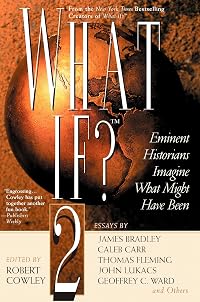
The path untrodden, counterfactual reality, or simply alternate history. Twenty-five of the 20th Century’s eminent historians look at what might have been in the essay anthology What If? 2 edited by contributor Robert Cowley.
The twenty-five essays range from 424 B.C. in Ancient Greece to the 1948 Elections in the United States covering a variety of topics though for roughly 300 of the 430 pages covered the time between 1912 and 1948. Unlike the previous volume, many of the essays focused on the actual event than going into an alternative scenario or would briefly speculate about things happening differently in the last two paragraphs. The essays that focused on the assignment that were good were Thomas K. Rabb’s essay on Charles I show more dying in 1641 of the plague and adverting the English Civil War, Alistair Horne’s fanciful piece on Napoleon III not taking Otto von Bismark’s bait to advert the Franco-Prussian war, George Feifer’s essay on Lenin on influencing the Russian Revolution, and Richard B. Frank’s essay on if the United States hadn’t dropped the atomic bombs.
What If? 2: Eminent Historians Imagine What Might Have Been is an interesting set of essays, a lot are knowledgeable for someone who doesn’t know specific points talked about however the “alternate” aspect was lacking compared to the previous collection. show less
The twenty-five essays range from 424 B.C. in Ancient Greece to the 1948 Elections in the United States covering a variety of topics though for roughly 300 of the 430 pages covered the time between 1912 and 1948. Unlike the previous volume, many of the essays focused on the actual event than going into an alternative scenario or would briefly speculate about things happening differently in the last two paragraphs. The essays that focused on the assignment that were good were Thomas K. Rabb’s essay on Charles I show more dying in 1641 of the plague and adverting the English Civil War, Alistair Horne’s fanciful piece on Napoleon III not taking Otto von Bismark’s bait to advert the Franco-Prussian war, George Feifer’s essay on Lenin on influencing the Russian Revolution, and Richard B. Frank’s essay on if the United States hadn’t dropped the atomic bombs.
What If? 2: Eminent Historians Imagine What Might Have Been is an interesting set of essays, a lot are knowledgeable for someone who doesn’t know specific points talked about however the “alternate” aspect was lacking compared to the previous collection. show less
Members
- Recently Added By
Author Information
Robert Cowley is the cofounder & editor of "MHQ: The Quarterly Journal of Military History" & the editor of the anthology "Experience of War". (Bowker Author Biography)
All Editions
Series

Work Relationships
Common Knowledge
- Canonical title
- What If? 2: Eminent Historians Imagine What Might Have Been
- Alternate titles
- More What If? Eminent Historians Imagine What Might Have Been
- Original publication date
- 2001
- First words
- One of the troubles of history as it is studied today is that people take it too seriously.
Classifications
Statistics
- Members
- 1,089
- Popularity
- 23,506
- Reviews
- 11
- Rating
- (3.47)
- Languages
- 5 — Chinese, English, Finnish, German, Korean
- Media
- Paper, Audiobook, Ebook
- ISBNs
- 15
- ASINs
- 7
