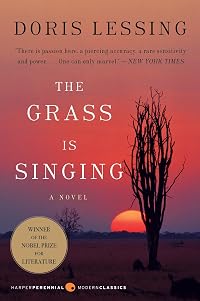
The Grass Is Singing
by Doris Lessing
On This Page
Description
"There is passion here, a piercing accuracy, a rare sensitivity and power. . . . One can only marvel." - New York Times Set in Southern Rhodesia under white rule, Doris Lessing's first novel is at once a riveting chronicle of human disintegration, a beautifully understated social critique, and a brilliant depiction of the quiet horror of one woman's struggle against a ruthless fate. Mary Turner is a self-confident, independent young woman who becomes the depressed, frustrated wife of an show more ineffectual, unsuccessful farmer. Little by little the ennui of years on the farm works its slow poison. Mary's despair progresses until the fateful arrival of Moses, an enigmatic black servant. Locked in anguish, Mary and Moses-master and slave-are trapped in a web of mounting attraction and repulsion, until their psychic tension explodes with devastating consequences. show lessTags
Recommendations











Member Recommendations
by andja

Member Reviews
My heart sank when The Grass is Singing was chosen for my next book group meeting. I've read two Lessings and have really struggled to find anything I like about her writing. But who am I to argue with the Nobel Prize Committee? I guess her writing just goes over my head. Anyway, I tried to approach this book with an open mind.
The story focuses on Mary, a South African townie who marries Dick, a Rhodesian farmer. Mary has gone through her childhood and twenties doing all the things that were expected - she does her work competently, she socialises - but at a kind of distance. No one ever touched her heart. One day she overhears people talking about her and pitying her; her life changes, her emotional balance is shattered. When Dick show more comes along she agrees to marry him, I think because she doesn't know what else to do with herself.
It's not a wise decision. Dick is a failed farmer, prone to jump from one grand scheme to another, always in debt and living in little more than an isolated shack. Mary has a shock when she understands what she has let herself in for; she wasn't made to be a farmer's wife. She slides into a deep depression which causes and is exacerbated by her fraught relationships with the 'natives' that work the farm. She despises them but also fears them deeply. Mary's marriage and sanity disintegrate over the years as the poverty, heat, fear and hatred become inescapable. She becomes entangled in a bizarre relationship with Moses, the black cook, in which the usual power structures are confused and corrupted. It doesn't end it well.
Dick and Mary are presented as universal figures (perhaps that's why they have common, plain names); they are products of the white community of Lessing's Rhodesian childhood. The black characters are sketchy, reflecting the fact that white people knew little of the lives of their servants and had no interest in wanting to know about them. The book was published in 1950 and I can imagine that such a stark exposure of the psychology of white power and the fragility of that power must have provoked comment. I certainly found it thought-provoking and am very glad I read it. show less
The story focuses on Mary, a South African townie who marries Dick, a Rhodesian farmer. Mary has gone through her childhood and twenties doing all the things that were expected - she does her work competently, she socialises - but at a kind of distance. No one ever touched her heart. One day she overhears people talking about her and pitying her; her life changes, her emotional balance is shattered. When Dick show more comes along she agrees to marry him, I think because she doesn't know what else to do with herself.
It's not a wise decision. Dick is a failed farmer, prone to jump from one grand scheme to another, always in debt and living in little more than an isolated shack. Mary has a shock when she understands what she has let herself in for; she wasn't made to be a farmer's wife. She slides into a deep depression which causes and is exacerbated by her fraught relationships with the 'natives' that work the farm. She despises them but also fears them deeply. Mary's marriage and sanity disintegrate over the years as the poverty, heat, fear and hatred become inescapable. She becomes entangled in a bizarre relationship with Moses, the black cook, in which the usual power structures are confused and corrupted. It doesn't end it well.
Dick and Mary are presented as universal figures (perhaps that's why they have common, plain names); they are products of the white community of Lessing's Rhodesian childhood. The black characters are sketchy, reflecting the fact that white people knew little of the lives of their servants and had no interest in wanting to know about them. The book was published in 1950 and I can imagine that such a stark exposure of the psychology of white power and the fragility of that power must have provoked comment. I certainly found it thought-provoking and am very glad I read it. show less
An exciting and interesting plot, vividly described setting, and a depth of understanding about severe culture clash without a hint of know-it-all attitude - what more could I want?
I loved this book. Lessing has written a novel that reads like a page turner but has the depth of a slow, studied book. The story of Mary Turner is revealed after we read of her murder on the first page of the book. Her childhood, her marriage, her experience of isolated farm life, and her complete ignorance of the native people of Southern Rhodesia, all combine to lead to her death in a complex and compelling way.
This book manages to be a look at marriage, a look at a white woman's available paths in Rhodesia, and a study of the interactions of the various show more races and socio-economic levels in Rhodesia all at the same time. And it remains readable and memorable while doing it.
I particularly loved that Lessing doesn't pretend to know more about the native Africans in her book than she actually does. Their emotions and lives are not at all described from their own point of view, only through the lens of the white people around them and a bit through their actions. I appreciated that she didn't try to enlighten those reading her book on "what Africans are like" - something that drove me crazy and seemed so demeaning to African culture in a book I read recently, [Out of Africa].
I highly recommend this. show less
I loved this book. Lessing has written a novel that reads like a page turner but has the depth of a slow, studied book. The story of Mary Turner is revealed after we read of her murder on the first page of the book. Her childhood, her marriage, her experience of isolated farm life, and her complete ignorance of the native people of Southern Rhodesia, all combine to lead to her death in a complex and compelling way.
This book manages to be a look at marriage, a look at a white woman's available paths in Rhodesia, and a study of the interactions of the various show more races and socio-economic levels in Rhodesia all at the same time. And it remains readable and memorable while doing it.
I particularly loved that Lessing doesn't pretend to know more about the native Africans in her book than she actually does. Their emotions and lives are not at all described from their own point of view, only through the lens of the white people around them and a bit through their actions. I appreciated that she didn't try to enlighten those reading her book on "what Africans are like" - something that drove me crazy and seemed so demeaning to African culture in a book I read recently, [Out of Africa].
I highly recommend this. show less
Doris Lessing’s formidable debut novel – published in 1950 – had me completely engrossed from its first troubled pages until the bitter end.
The book opens with the murder of Mary Turner and the arrest of the black man responsible for the deed.
Lessing draws one into the arid blazing heat of the African landscape in Southern Rhodesia in the 50s. The story is about Mary and Dick Turner, who met, got married and went to live in a little ramshackle home on a farm. They don't really like one another; in fact, sometimes each one is totally revolted by the other. But as neither wants to hurt the other's feelings, they live together, mostly in silence. Inside, they are filled with resentment and a build-up of debilitating negative show more energy.
Mary hates the searing heat, only marginally more than she loathes the black workers on the farm. There is no limit to her contempt for the natives, whom she deems savages. While Mary is at odds with nature, Dick is at peace with it.
In this novel, Lessing boldly thrashes out the theme of racism (as well as human isolation and alienation). While she explores racism in this society broadly, she also zones in particularly on the relationship between one white woman and her black male servant.
Though Mary and Dick Turner may well be the most unlikable characters I’ve come across, Lessing’s storytelling is superb. You may want to give up on the wretched Mary and Dick, but you cannot discard this book – not until you know exactly what has happened! Highly recommended. show less
The book opens with the murder of Mary Turner and the arrest of the black man responsible for the deed.
Lessing draws one into the arid blazing heat of the African landscape in Southern Rhodesia in the 50s. The story is about Mary and Dick Turner, who met, got married and went to live in a little ramshackle home on a farm. They don't really like one another; in fact, sometimes each one is totally revolted by the other. But as neither wants to hurt the other's feelings, they live together, mostly in silence. Inside, they are filled with resentment and a build-up of debilitating negative show more energy.
Mary hates the searing heat, only marginally more than she loathes the black workers on the farm. There is no limit to her contempt for the natives, whom she deems savages. While Mary is at odds with nature, Dick is at peace with it.
In this novel, Lessing boldly thrashes out the theme of racism (as well as human isolation and alienation). While she explores racism in this society broadly, she also zones in particularly on the relationship between one white woman and her black male servant.
Though Mary and Dick Turner may well be the most unlikable characters I’ve come across, Lessing’s storytelling is superb. You may want to give up on the wretched Mary and Dick, but you cannot discard this book – not until you know exactly what has happened! Highly recommended. show less
Published in 1950 and set in Southern Rhodesia (today’s Zimbabwe) in the 1940s, the book opens with a news announcement that Mary Turner, wife of struggling local British farmer Richard Turner, has been found murdered on her verandah. The couple’s house attendant, Moses, has been arrested. The neighboring successful farmer, Charlie Slatter, seems anxious to downplay the murder and move on. A young newcomer to the area, Tony Marston, wonders why the authorities do not want to find out what happened and why.
Though at first it appears to be a murder mystery, this story is so much more. It is an exploration of the racial divide in southern Africa between the white landowners and the native workers. It also portrays the role of women in show more society of the time and the expectation that they would marry. Mary is independent at the time but overhears gossip that causes her to make an unfortunate decision, which will drastically impact her life. Mary is a rather unlikeable character, but reasons behind her unpleasantness are gradually revealed.
I felt the underlying current of discord as I was reading. We know something bad will happen and the author does a great job of conveying the tensions to the reader, slowly building to the climax. I cannot say too much without spoiling, so suffice it to say that it is a complex multi-layered social commentary that induces a feeling of impending doom. Lessing spent her youth in this region of the world, so she was relying on first-hand experience. I can see why this book is considered a classic. show less
Though at first it appears to be a murder mystery, this story is so much more. It is an exploration of the racial divide in southern Africa between the white landowners and the native workers. It also portrays the role of women in show more society of the time and the expectation that they would marry. Mary is independent at the time but overhears gossip that causes her to make an unfortunate decision, which will drastically impact her life. Mary is a rather unlikeable character, but reasons behind her unpleasantness are gradually revealed.
I felt the underlying current of discord as I was reading. We know something bad will happen and the author does a great job of conveying the tensions to the reader, slowly building to the climax. I cannot say too much without spoiling, so suffice it to say that it is a complex multi-layered social commentary that induces a feeling of impending doom. Lessing spent her youth in this region of the world, so she was relying on first-hand experience. I can see why this book is considered a classic. show less
This short, intense and, I suspect, highly memorable book by Doris Lessing is a psychological portrait of a woman whose spirit is destroyed by her disastrous marriage and by her living conditions. It is also an exploration of exactly how white supremacy and colonialism in Africa was unjust, prejudicial and exploitative. These 200 pages pack a powerful punch and I can certainly understand how The Grass Is Singing earned it’s stature among twentieth-century literature.
I found this story to be original and thought provoking. The characters were sharply drawn, and, although there wasn’t one that I felt much sympathy for, their actions and attitudes painted a very clear picture of white African society. Barely a step away from whip show more toting slave owners, they felt full justification in their control over the black population. The story was also a vivid portrait of how powerless women were in this environment as well. Having no escape, nothing to plan or work toward, her dreams unfulfilled, the woman in this story goes slowly insane.
With this simple story, Doris Lessing exposes both the racial and gender inequality that British Colonialism supported and encouraged. The Grass is Singing is a disturbing story of doomed lives crumbling away under the hot African sun and is told with exceptional clarity and power. show less
I found this story to be original and thought provoking. The characters were sharply drawn, and, although there wasn’t one that I felt much sympathy for, their actions and attitudes painted a very clear picture of white African society. Barely a step away from whip show more toting slave owners, they felt full justification in their control over the black population. The story was also a vivid portrait of how powerless women were in this environment as well. Having no escape, nothing to plan or work toward, her dreams unfulfilled, the woman in this story goes slowly insane.
With this simple story, Doris Lessing exposes both the racial and gender inequality that British Colonialism supported and encouraged. The Grass is Singing is a disturbing story of doomed lives crumbling away under the hot African sun and is told with exceptional clarity and power. show less
Coming from a decent family in Southern Rhodesia, Mary prides herself on her ability to balance a full time office job and many friends with her sense of independence. She isn't tied down to anyone except for herself, and for that she is respected. At least, she thinks so until she overhears a conversation between two of her "friends" making dubious remarks about her age and being a spinster. While her anger at the comments slowly boiled, she resolved to marry. Her choice of husbands is a poor white farmer named Richard Turner. They first meet at the movies, and after a very brief courtship, she agrees to marry him and move to his small farm in Ngesi.
Unprepared for what little the farm offered, she tries at first to make the best of it. show more Making her own dresses from scraps of fabric, whitewashing the walls, taking over the management of the house. But the oppressive heat, the unproductive farm, the seclusion from their neighbors, and her contempt of the native servant who she feels enjoys too much freedom in the house, wears her down. Her constant firing of servants raises a few eyebrows with the locals, making it difficult for Richard to find someone willing to work. Unable to understand her gruffness, he chooses instead to ignore it by spending his time down at the fields, working on some new scheme in a sad attempt to create a profitable farm.
Left on her own, her dislike of the natives comes to a head when she spots one of the farm workers -- Moses -- slacking off. She confronts him, and he tells that he wanted some water. Angry at his disobedience, she strikes him. To her surprise, Moses appears unscathed by her actions, and she stalks away. Weeks later, Richard is forced to hire Moses as the house servant when no one else will take the job because of Mary's reputation. Once Mary realizes who this new servant is, a battle of wills begins between the two.
"The Grass Is Signing" focuses on the racial tensions between Mary, a white South African, and the native Moses. Mary believes that she is better than the natives who work on their farm, though she is considered white trash by local standards. She demands respect from the natives, and when one stands up to her, her supposed strength is revealed to be cowardice and paranoia. She's a remarkable character because not once did I like her. She's a terrible person, but that's one of the draws of the novel, watching how wretched she is and how that serves as her own version of Hell when Moses comes to work in the house, in her constant presence. A remarkable novel and definitely worth a read. show less
Unprepared for what little the farm offered, she tries at first to make the best of it. show more Making her own dresses from scraps of fabric, whitewashing the walls, taking over the management of the house. But the oppressive heat, the unproductive farm, the seclusion from their neighbors, and her contempt of the native servant who she feels enjoys too much freedom in the house, wears her down. Her constant firing of servants raises a few eyebrows with the locals, making it difficult for Richard to find someone willing to work. Unable to understand her gruffness, he chooses instead to ignore it by spending his time down at the fields, working on some new scheme in a sad attempt to create a profitable farm.
Left on her own, her dislike of the natives comes to a head when she spots one of the farm workers -- Moses -- slacking off. She confronts him, and he tells that he wanted some water. Angry at his disobedience, she strikes him. To her surprise, Moses appears unscathed by her actions, and she stalks away. Weeks later, Richard is forced to hire Moses as the house servant when no one else will take the job because of Mary's reputation. Once Mary realizes who this new servant is, a battle of wills begins between the two.
"The Grass Is Signing" focuses on the racial tensions between Mary, a white South African, and the native Moses. Mary believes that she is better than the natives who work on their farm, though she is considered white trash by local standards. She demands respect from the natives, and when one stands up to her, her supposed strength is revealed to be cowardice and paranoia. She's a remarkable character because not once did I like her. She's a terrible person, but that's one of the draws of the novel, watching how wretched she is and how that serves as her own version of Hell when Moses comes to work in the house, in her constant presence. A remarkable novel and definitely worth a read. show less
The Grass is Singing - Lessing
4 stars
“The crises of individuals, like the crises of nations, are not realized until they are over.”
This is Doris Lessing’s debut novel, originally published in 1950. The writing is powerfully evocative in a slow, understated, insidious way. This is South Africa under white rule. It’s disturbing. The novel begins with Mary Turner’s murder. It backtracks to an overview of her personal history before her marriage to Dick Turner. After the marriage, the book continues with the grinding, slow, and inevitable deterioration of a tragic situation.
This story is primarily a stark denouncement of South Africa’s racial exploitation. “What had happened was that the formal pattern of black-and-white, show more mistress-and-servant, had been broken by the personal relation; and when a white man in Africa by accident looks into the eyes of a native and sees the human being (which it is his chief preoccupation to avoid), his sense of guilt, which he denies, fumes up in resentment and he brings down the whip.” It was difficult and depressing to experience the attitudes of white supremacy expressed by these characters. Lessing gives a pointed description of how European newcomers move quickly from revulsion to complicity, adapting to the unspoken but rigid racial divides.
This is also a feminist novel. Lessing is demonstrating how Mary Turner is trapped within the limits of female expectations. I don’t know if the author expected me to have sympathy for the character or not. I certainly didn’t. I can’t think of a character that I’ve hated this much since Zeena in Ethan Frome. show less
4 stars
“The crises of individuals, like the crises of nations, are not realized until they are over.”
This is Doris Lessing’s debut novel, originally published in 1950. The writing is powerfully evocative in a slow, understated, insidious way. This is South Africa under white rule. It’s disturbing. The novel begins with Mary Turner’s murder. It backtracks to an overview of her personal history before her marriage to Dick Turner. After the marriage, the book continues with the grinding, slow, and inevitable deterioration of a tragic situation.
This story is primarily a stark denouncement of South Africa’s racial exploitation. “What had happened was that the formal pattern of black-and-white, show more mistress-and-servant, had been broken by the personal relation; and when a white man in Africa by accident looks into the eyes of a native and sees the human being (which it is his chief preoccupation to avoid), his sense of guilt, which he denies, fumes up in resentment and he brings down the whip.” It was difficult and depressing to experience the attitudes of white supremacy expressed by these characters. Lessing gives a pointed description of how European newcomers move quickly from revulsion to complicity, adapting to the unspoken but rigid racial divides.
This is also a feminist novel. Lessing is demonstrating how Mary Turner is trapped within the limits of female expectations. I don’t know if the author expected me to have sympathy for the character or not. I certainly didn’t. I can’t think of a character that I’ve hated this much since Zeena in Ethan Frome. show less
Members
- Recently Added By
Lists

1001 Books You Must Read Before You Die
1,448 works; 1,134 members

The Guardian's 1000 Novels Everyone Must Read
1,005 works; 548 members

Best of World Literature
435 works; 52 members
Best African Books
126 works; 46 members

1950s
340 works; 22 members

BBC Radio 4 Bookclub
341 works; 13 members

Books Read in 2014
2,343 works; 89 members

1,001 BYMRBYD Concensus
723 works; 27 members

Africa
109 works; 8 members

Books Read in 2007
326 works; 8 members

First Novels
373 works; 16 members

Books Read in 2017
4,249 works; 130 members

Books Set In Africa
81 works; 4 members

Nifty Fifties
129 works; 13 members

Country Life
13 works; 3 members

Literary Works Read in College
316 works; 15 members

Mustich's 1000 Books to Read Before You Die: A Life Changing List
1,001 works; 19 members

Books You Read For University
184 works; 3 members

Florida
366 works; 3 members

BBC World Book Club
265 works; 5 members

Books Read in 2026
1,969 works; 66 members

World Book Club (BBC World Service)
212 works; 1 member

Five star books
1,767 works; 109 members
Author Information

262+ Works 37,143 Members
Doris Lessing was born in Kermanshah, Persia (later Iran) on October 22, 1919 and grew up in Rhodesia (the present-day Zimbabwe). During her two marriages, she submitted short fiction and poetry for publication. After moving to London in 1949, she published her first novel, The Grass Is Singing, in 1950. She is best known for her 1954 Somerset show more Maugham Award-winning experimental novel The Golden Notebook. Her other works include This Was the Old Chief's Country, the Children of Violence series, the Canopus in Argos - Archives series, and Alfred and Emily. She has received numerous awards for her work including the 2001 Prince of Asturias Prize in Literature, the David Cohen British Literature Prize, and the 2007 Nobel Prize for Literature. She died on November 17, 2013 at the age of 94. (Bowker Author Biography) show less
Some Editions
Awards and Honors
Notable Lists
Series
Belongs to Publisher Series
Work Relationships
Is contained in
Has the adaptation
Has as a student's study guide
Common Knowledge
- Canonical title
- The Grass Is Singing
- Original title
- The grass is singing
- Original publication date
- 1950
- People/Characters
- Mary Turner; Dick Turner; Charlie Slatter; Moses
- Important places
- Rhodesia; Southern Rhodesia
- Related movies
- Killing Heat (1981 | IMDb)
- Epigraph
- It is by the failures and misfits of a
civilization that one can best judge its
weaknesses.
-- Author unknown
In this decayed hole among the mountains
In the faint moonlight, the grass is singing
Over the tumbled graves, about the chapel
There is the empty chapel, only the wind's home.
It has no windows, and the door ... (show all)swings,
Dry bones can harm no one.
Only a cock stood on the rooftree
Co co rico, co co rico
In a flash of lightning. Then a damp gust
Bringing rain
Ganga was sunken, and the limp leaves
Waited for rain, while the black clouds
Gathered far distant, over Himavant.
The jungle crouched, humped in silence.
Then spoke the thunder
-- from The Waste Land by T. S. Eliot
with grateful acknowledgements to the
author and to Messrs Faber & Faber - Dedication
- To
Mrs GLADYS MAASDORP
of Southern Rhodesia
for whom I feel the greatest
affection and admiration - First words
- Mary Turner, wife of Richard Turner, a farmer at Ngesi, was found murdered on the front verandah of their homestead yesterday morning.
- Quotations
- She tenderly submitted herself to this miraculous three months of the winter, when the country was freed from its menace. Even the veld looked different, flaming for a few brief weeks into red and gold and russet, before the ... (show all)trees became solid masses of heavy green. It was as if this winter had been sent especially for her, to send a tingle of vitality into her, to save her from her helpless dullness.
- Last words
- (Click to show. Warning: May contain spoilers.)And there he would remain until his pursuers, in their turn, came to find him.
- Original language
- English
- Disambiguation notice
- WorldCat has ISBN 9001548431 for
The Grass is Singing by Doris Lessing AND FOR
A Kiss Before Dying by Ira Levin AND FOR
The Picture of Dorian Gray by Oscar Wilde AND FOR
Of Mice ... (show all)and Men by John Steinbeck AND FOR
The Power and the Glory by Graham Greene
Classifications
Statistics
- Members
- 2,437
- Popularity
- 8,000
- Reviews
- 79
- Rating
- (3.93)
- Languages
- 19 — Basque, Chinese, Czech, Danish, Dutch, English, Finnish, French, German, Hungarian, Icelandic, Italian, Norwegian (Bokmål), Norwegian, Polish, Portuguese, Spanish, Swedish, Turkish
- Media
- Paper, Audiobook, Ebook
- ISBNs
- 83
- ASINs
- 33