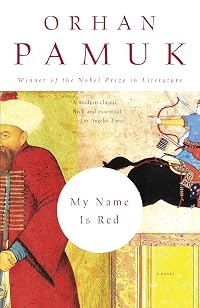
My Name Is Red
by Orhan Pamuk
On This Page
Description
At once a fiendishly devious mystery, a beguiling love story, and a brilliant symposium on the power of art, My Name Is Red is a transporting tale set amid the splendor and religious intrigue of sixteenth-century Istanbul, from one of the most prominent contemporary Turkish writers. The Sultan has commissioned a cadre of the most acclaimed artists in the land to create a great book celebrating the glories of his realm. Their task: to illuminate the work in the European style. But because show more figurative art can be deemed an affront to Islam, this commission is a dangerous proposition indeed. The ruling elite therefore mustn’t know the full scope or nature of the project, and panic erupts when one of the chosen miniaturists disappears. The only clue to the mystery–or crime? –lies in the half-finished illuminations themselves. Part fantasy and part philosophical puzzle, My Name is Red is a kaleidoscopic journey to the intersection of art, religion, love, sex and power. Translated from the Turkish by Erda M Göknar show lessTags
Recommendations






Member Recommendations



Member Reviews
Orhan Pamuk depicts his characters as exquisitely and minutely as the miniaturists of Istanbul depict their horses, leaves, women and warriors, and tells his tale as meticulously as the masters of old. A murder mystery that opens with the corpse describing his death and immediate afterlife, the quest for the killer involves an exploration of the clash between the old styles of illustration and illumination of the East and the new, Venetian style of the West which threatens to corrupt and supplant the other. The philosophies and spirtuality and politics of style and imitation are debated and explored and illuminated through parables and tales.
Slightly heavy - wrong word - slightly slow and absorbing going for a January full of other show more stresses and distractions and obligations, but well worth working through, triumphant and gorgeous and ultimately sad; a potentially immortal work of art to immortalise the passing of a style of art that was supposed to be immortal. show less
Slightly heavy - wrong word - slightly slow and absorbing going for a January full of other show more stresses and distractions and obligations, but well worth working through, triumphant and gorgeous and ultimately sad; a potentially immortal work of art to immortalise the passing of a style of art that was supposed to be immortal. show less
I've had this novel on my shelves for some time, acquired more because I wanted to read something by this Nobel laureate than knowing the story itself.
The basic premise is that a man named Black returns to Istanbul from self-imposed exile. He had left the home of his uncle, Enishte, when his uncle refused to permit Black to marry his daughter, Shekure. Upon return Black learns that his Enishte has been commissioned by the Sultan to create an illustrated book glorifying the empire. The work is highly controversial, because the Sultan wishes the book to be illustrated in the European style. Enishte has hired other local miniaturists to help, but keeps each one's work secret from the others. Now one of them has been murdered, and Enishte show more wishes Black to discover who the murderer is.
Aside from the murder mystery, the book is about the conflict in the sixteenth-century between Eastern and Western art. As depicted in the book, an Eastern artist's prestige is based on how well he can mimic a historical style. Individual style is discouraged and signing a work is practically sacrilegious. New works are created by putting different elements together, each element a replica of the ideal form first iconized generations ago. Thus a horse in one painting will look identical to a horse in another painting. Even people are drawn as ideals, not as reflections of reality. In the West, however, and particularly Italy, painting is highly individualized, and portraits are very popular. In addition, Western art uses perspective, whereas Eastern art is still using a horizontal line. Other differences, such as the placement of a person in the center of the canvas, is seen not just as a stylistic choice, but as a religious one. Enishte, who visited Italy as an envoy, is eager to fulfill the Sultan's desire for a Western-style chronicle, whereas the local leader of the miniaturists sees such a commission as dangerous and possibly an affront to Islam.
Another interesting aspect of the novel is that each chapter is told from the first-person point of view of a different character, including the subjects of paintings, such as a tree or a dog, and Death itself. The first chapter, for instance, is entitled, "I am a Corpse." This technique heightens the tension of the search for the murderer, who narrates his own chapters. It also allows for the author to play with who has a voice and contrast their internal dialogue with their outward actions.
Although not a mystery reader, I found this one to be highly literary, historically interesting, and clever. In addition it was fun, and I read it quite quickly. Recommended for those who like art history or The Name of the Rose. show less
The basic premise is that a man named Black returns to Istanbul from self-imposed exile. He had left the home of his uncle, Enishte, when his uncle refused to permit Black to marry his daughter, Shekure. Upon return Black learns that his Enishte has been commissioned by the Sultan to create an illustrated book glorifying the empire. The work is highly controversial, because the Sultan wishes the book to be illustrated in the European style. Enishte has hired other local miniaturists to help, but keeps each one's work secret from the others. Now one of them has been murdered, and Enishte show more wishes Black to discover who the murderer is.
Aside from the murder mystery, the book is about the conflict in the sixteenth-century between Eastern and Western art. As depicted in the book, an Eastern artist's prestige is based on how well he can mimic a historical style. Individual style is discouraged and signing a work is practically sacrilegious. New works are created by putting different elements together, each element a replica of the ideal form first iconized generations ago. Thus a horse in one painting will look identical to a horse in another painting. Even people are drawn as ideals, not as reflections of reality. In the West, however, and particularly Italy, painting is highly individualized, and portraits are very popular. In addition, Western art uses perspective, whereas Eastern art is still using a horizontal line. Other differences, such as the placement of a person in the center of the canvas, is seen not just as a stylistic choice, but as a religious one. Enishte, who visited Italy as an envoy, is eager to fulfill the Sultan's desire for a Western-style chronicle, whereas the local leader of the miniaturists sees such a commission as dangerous and possibly an affront to Islam.
Another interesting aspect of the novel is that each chapter is told from the first-person point of view of a different character, including the subjects of paintings, such as a tree or a dog, and Death itself. The first chapter, for instance, is entitled, "I am a Corpse." This technique heightens the tension of the search for the murderer, who narrates his own chapters. It also allows for the author to play with who has a voice and contrast their internal dialogue with their outward actions.
Although not a mystery reader, I found this one to be highly literary, historically interesting, and clever. In addition it was fun, and I read it quite quickly. Recommended for those who like art history or The Name of the Rose. show less
This is the first novel by Pamuk that I have read, and I shall certainly continue to his explore his works. My Name Is Red is set in the 16th -century Ottoman Empire amidst the politics and connivings of the Emperor's foremost miniature illustrators. The plot is a murder mystery -- at the beginning of the book, one of the miniaturists is murdered by another -- we know who is murdered, but obviously, not who murdered him. The motivations for the murder are wrapped up in the practices and beliefs about illustration in the Muslim world. I found the discussions about Islamic art fascinating and enlightening. Pamuk also explores both the influence of European Renaissance theories of perspective and artistic individuality and the changes show more brought about by the Mongol conquest and subsequent Chinese influence on traditional Islamic art. As the consequences of inter-cultural contacts is one of my semi-obsessive interests, Pamuk's novel was highly satisfying. show less
I really enjoy reading prize-winning authors. I have a long-term goal to read all Booker, Pulitzer, Orange and Nobel winners. But with my latest read I learned that just because an author won a prize, and just because umpteen people have raved about said author, doesn’t mean I will enjoy their work.
Orhan Pamuk won the 2006 Nobel Prize for Literature. My Name is Red is set in the late 16th century during the Ottoman Empire. The central figures are artists, miniaturist painters working for Sultan Murat III, who had several books produced during his reign, all including the work of prominent Ottoman miniaturists. The book is a mystery, beginning with the murder of a miniaturist. The story is told from numerous points of view. All of show more this initially intrigued me, but I didn’t make it past page 85. The intricacies of miniaturist painting, the parables and cultural references, the unbearably slow development of the mystery … I found myself getting lost, re-reading, and repeatedly falling asleep in my chair. What have I missed? Was I crazy to throw My Name is Red at the wall? show less
Orhan Pamuk won the 2006 Nobel Prize for Literature. My Name is Red is set in the late 16th century during the Ottoman Empire. The central figures are artists, miniaturist painters working for Sultan Murat III, who had several books produced during his reign, all including the work of prominent Ottoman miniaturists. The book is a mystery, beginning with the murder of a miniaturist. The story is told from numerous points of view. All of show more this initially intrigued me, but I didn’t make it past page 85. The intricacies of miniaturist painting, the parables and cultural references, the unbearably slow development of the mystery … I found myself getting lost, re-reading, and repeatedly falling asleep in my chair. What have I missed? Was I crazy to throw My Name is Red at the wall? show less
This book is an elaborate murder mystery centering around a group of miniaturists working at the end of the 16th century in the Ottoman Empire. Pamuk explores the personalities of the characters in the book as well as the sensibilities of the time through this art form which later lost its popularity.
Each chapter is narrated by a different character, some that are left unknown to the reader. The narration is playful and even a bit "naughty" at times, and there was one point where descriptions seemed to be drawn out. The method of shifting back and forth between the story tellers kept me entertained and I enjoyed the interplay of perspectives.
The book is never gory or violent, but often dark and mysterious, and some of the incidents show more made me squeamish (readers will know which ones I am talking about!) despite their subtlety. I was particularly interested in the book's setting and the relationship between, the Turks, Persians and the Venetians in both an artistic and historical sense. Also, Pamuk's work weaves a number of interesting themes - religion, art, personal relationships, love and human nature which makes it a complex and interesting tale.
My Name is Red is considered a classic in Turkey and is said to have aided in Pamuk get the Nobel Prize for Literature. show less
Each chapter is narrated by a different character, some that are left unknown to the reader. The narration is playful and even a bit "naughty" at times, and there was one point where descriptions seemed to be drawn out. The method of shifting back and forth between the story tellers kept me entertained and I enjoyed the interplay of perspectives.
The book is never gory or violent, but often dark and mysterious, and some of the incidents show more made me squeamish (readers will know which ones I am talking about!) despite their subtlety. I was particularly interested in the book's setting and the relationship between, the Turks, Persians and the Venetians in both an artistic and historical sense. Also, Pamuk's work weaves a number of interesting themes - religion, art, personal relationships, love and human nature which makes it a complex and interesting tale.
My Name is Red is considered a classic in Turkey and is said to have aided in Pamuk get the Nobel Prize for Literature. show less
"I am nothing but a corpse now, a body at the bottom of a well." The first line is classic, and an excellent opening. The way the book is constructed is also fascinating. It's a murder mystery of sorts, but far removed from Dorothy Sayers, this book is a puzzle of philosophical, ideological, historical, and religious elements, mixed with romance. The book is told entirely in the first person, but as you traverse from one chapter to the next, the perspective changes from one character to another. The first chapter, for example, is told by a dead man; several chapters are told by the murderer; and other mysterious narrators include a gold coin, a picture of a tree, the color red, and death.
The story revolves around a group of miniaturists show more living in Istanbul in 1591. The Sultan has commissioned a special book in his honor, and four of these great painters are working on this book. One of them, under the workshop name Elegant, has been murdered and tossed into a well. The circumstances surrounding this murder, the book, and the relationships between the characters are the substance of this book.
It is easy to get lost in Pamuk's vast swaths of text as he describes in detail the intricacies of a painting, the innermost thoughts of a murderer, the history of illuminations, or a miniaturist's painstaking explanation of his philosophy of painting using a set of lengthy parables. Yet, I found that I became glued to the book, always wondering what would happen to the characters. Pamuk does an excellent job of piecing together this story as told by the different individuals, and is mostly successful in altering his style accordingly. The pace of the story varies wildly from one chapter to the next, as though we are witnessing a game of chess; several chapters will go by without any major incident, but they are always followed by a chapter or two that will make your heart pound with anticipation. show less
The story revolves around a group of miniaturists show more living in Istanbul in 1591. The Sultan has commissioned a special book in his honor, and four of these great painters are working on this book. One of them, under the workshop name Elegant, has been murdered and tossed into a well. The circumstances surrounding this murder, the book, and the relationships between the characters are the substance of this book.
It is easy to get lost in Pamuk's vast swaths of text as he describes in detail the intricacies of a painting, the innermost thoughts of a murderer, the history of illuminations, or a miniaturist's painstaking explanation of his philosophy of painting using a set of lengthy parables. Yet, I found that I became glued to the book, always wondering what would happen to the characters. Pamuk does an excellent job of piecing together this story as told by the different individuals, and is mostly successful in altering his style accordingly. The pace of the story varies wildly from one chapter to the next, as though we are witnessing a game of chess; several chapters will go by without any major incident, but they are always followed by a chapter or two that will make your heart pound with anticipation. show less
The intrigue for this story is set in Ottoman Istanbul in the world of text illumination, miniature painting and its painters. It’s a compelling murder mystery, love story and a treatise on art and religion that craftily weaves fact with fiction. Every chapter is like a little short story told in a different voice by a different narrator, and the voices are really varied and coloured with their own humour and wit. Even a colour is given a voice (hence My Name is Red) alongside a number of beings: a horse, death, a dead body, and lots of others besides regular male and female characters. The language is beautiful, and the whole philosophical aspect of art as a reflection of perfection or imperfection, individualism and style, show more immortalization, religion and God is elegantly and thoughtfully delivered. show less
Members
- Recently Added By
Published Reviews
ThingScore 100
The new one, ''My Name Is Red,'' is by far the grandest and most astonishing contest in Pamuk's internal East-West war. Translated with fluid grace by Erdag M. Goknor, the novel is set in the late 16th century, during the reign of Sultan Murat III, a patron of the miniaturists whose art had come over from Persia in the course of the previous hundred years. It was a time when the Ottomans' show more confidence in unstoppable empire had begun to be shaken by the power of the West -- their defeat at Lepanto had taken place only a few years earlier -- as well as by its cultural vitality and seductiveness. show less
added by jlelliott
Lists

The Guardian's 1000 Novels Everyone Must Read
1,005 works; 551 members

Best of World Literature
435 works; 52 members

Best books about books
209 works; 106 members

Best Historical Fiction
620 works; 261 members

1001 Books You Must Read Before You Die
1,448 works; 1,134 members

Best Contemporary Literary Fiction (Around the Last 30 Years)
388 works; 122 members

Historical Fiction
889 works; 91 members

Canon de la narrativa universal del siglo XX
254 works; 6 members

1990s
309 works; 17 members

Nobel Price Winners
222 works; 20 members

BBC Radio 4 Bookclub
341 works; 13 members

International IMPAC Dublin Literary Award
179 works; 6 members

Books Read in 2023
5,617 works; 144 members

Unread books
1,063 works; 87 members

To Read - Literature / Fiction
26 works; 1 member

a picture or a thousand words
39 works; 5 members

I Can't Finish This Book
189 works; 22 members

Maybe This Year? Books to Look Forward To
412 works; 9 members

Literature in Translation
113 works; 5 members

SHOULD Read Books!
354 works; 9 members

Books Read in 2022
5,218 works; 114 members

Books Read in 2017
4,249 works; 130 members

Books Read in 2020
4,379 works; 124 members

Favorite Books in Translation
320 works; 133 members

La Clave está en el Lienzo: Novelas Descifradas a Través del Arte
5 works; 1 member

Recommended Reading : 600 Classics Reviewed, Editors of Salem Press, 2015
634 works; 6 members

Top Five Books of 2025
954 works; 303 members

100 knjiga
100 works; 1 member
Best Mysteries With a Historical Setting
292 works; 160 members
Canon de la narrativa universal del s. XX (cicutadry)
499 works; 3 members

Dead narrators
50 works; 4 members

BBC World Book Club
265 works; 5 members

Books Read in 2021
5,361 works; 114 members

Around the World in 80 Books
79 works; 4 members

Books with Colourful Titles
171 works; 8 members

Art of Reading
188 works; 5 members

Set in the 15th and 16th Centuries
28 works; 4 members

A Rainbow of Books: Colors in the Title
570 works; 24 members

TED 2013 Summer Reading List
190 works; 13 members

World Book Club (BBC World Service)
212 works; 1 member
Talk Discussions
Past Discussions
Vbadics - My Name Is Red in 75 Books Challenge for 2012 (May 2012)
Author Information

107+ Works 32,957 Members
Orhan Pamuk was born in Istanbul, Turkey on June 7, 1952. After graduating from Robert College in Istanbul, he studied architecture at the Istanbul Technical University. After three years, he decided to become a writer and graduated from the Institute of Journalism at the University of Istanbul in 1976. In 1982, he published his first novel Cevdet show more Bey and His Sons, which received both the Orhan Kemal and Milliyet literary prizes. His novel, My Name Is Red, won the French Prix Du Meilleur Livre Etranger, the 2002 Italian Grinzane Cavour, and the 2003 International IMPAC Dublin Literary Award. He has received numerous Turkish and international literary awards for his works including the 2006 Nobel Prize in Literature. His recent work includes A Strangeness in My Mind. (Bowker Author Biography) Orhan Pamuk is the author of six previous novels, including "The White Castle" & "The New Life". He lives in Istanbul with his family. (Publisher Provided) show less
Some Editions
Awards and Honors
Awards
Distinctions
Notable Lists
Series
Belongs to Publisher Series
Work Relationships
Is contained in
Contains
Has as a commentary on the text
Has as a student's study guide
Common Knowledge
- Canonical title*
- Il mio nome è rosso
- Original title
- Benim Adım Kırmızı
- Original publication date
- 1998; 2001 (English: Göknar) (English: Göknar)
- People/Characters
- Black; Sheküre; Olive; Butterfly; Stork; Elegant Effendi (show all 12); Enishte Effendi; Shekure; Orhan; Shevket; Hasan; Master Osman
- Important places
- Istanbul, Turkey; Ottoman Empire
- Epigraph
- You slew a man then fell out with another concerning him. (Koran, "The Cow," 72)
The blind and the seeing are not equal. (Koran, "The Creator," 19)
To God belongs the East and the West. (Koran, "The Cow," 115) - Dedication
- For Rüya
- First words
- I am nothing but a corpse now, a body at the bottom of a well.
- Quotations
- Over long years, as we gaze at book after book and illustration after illustration, we come to learn the following: A great painter does not content himself by affecting us with his masterpieces; ultimately, he succeeds in ch... (show all)anging the landscape of our minds. Once a miniaturist's artistry enters our souls this way, it becomes the criterion for the beauty of our world.
Books, which we mistake for consolation, only add depth to our sorrow.
Painting is the silence of thought and the music of sight.
Colour is the touch of the eye, music to the deaf, a word out of the darkness.
An artist's skill depends on carefully attending to the beauty of the present moment, taking everything down to the minutest detail seriously while, at the same time, stepping back from the world, which takes itself too serio... (show all)usly, and as if looking into a mirror, allowing for the distance and eloquence of a jest. - Last words
- (Click to show. Warning: May contain spoilers.)For the sake of a delightful and convincing story, there isn't a lie Orhan wouldn't deign to tell.
- Blurbers
- Altinel, Avkat; Freely, Maureen; Hensher, Philip; Updike, John; Eder, Richard
- Original language
- Turkish
- Disambiguation notice*
- Original title: Benim adim Kirmizi
*Some information comes from Common Knowledge in other languages. Click "Edit" for more information.
Classifications
- Genres
- Fiction and Literature, General Fiction, Historical Fiction, Mystery
- DDC/MDS
- 894.3533 — Literature & rhetoric Literatures of other languages Literatures of Altaic, Uralic, Hyperborean, Dravidian languages; literatures of miscellaneous languages of south Asia Turkic languages Turkish Turkish fiction 1850–2000
- LCC
- PL248 .P34 .B4613 — Language and Literature Languages and literatures of Eastern Asia, Africa, Oceania Languages of Eastern Asia, Africa, Oceania Turkic languages
- BISAC
Statistics
- Members
- 7,762
- Popularity
- 1,464
- Reviews
- 185
- Rating
- (3.77)
- Languages
- 36 — Albanian, Arabic, Bosnian, Bulgarian, Catalan, Chinese, Czech, Danish, Dutch, English, Estonian, Finnish, French, German, Greek, Hebrew, Hungarian, Italian, Japanese, Kurdish, Lithuanian, Malayalam, Norwegian (Nynorsk), Norwegian (Bokmål), Farsi/Persian, Polish, Portuguese, Romanian, Russian, Serbian, Slovak, Spanish, Swedish, Thai, Turkish, Urdu
- Media
- Paper, Audiobook, Ebook
- ISBNs
- 124
- ASINs
- 40