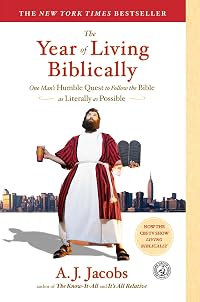
The Year of Living Biblically: One Man's Humble Quest to Follow the Bible as Literally as Possible
by A. J. Jacobs
On This Page
Description
Raised in a secular family but interested in the relevance of faith in our modern world, A.J. Jacobs decides to attempt to obey the Bible as literally as possible for one full year. He vows to follow the Ten Commandments. To be fruitful and multiply. To love his neighbor. But also to obey the hundreds of less publicized rules: to avoid wearing clothes made of mixed fibers; to stone adulterers. The resulting spiritual journey is at once funny and profound, reverent and irreverent, personal show more and universal and will make you see history's most influential book with new eyes. Jacobs embeds himself in a cross-section of communities that take the Bible literally: he tours a creationist museum and sings hymns with Amish; he dances with Hasidic Jews and does Scripture study with Jehovah's Witnesses. He wrestles with seemingly archaic rules that baffle the 21st-century brain, and he discovers ancient wisdom of startling relevance.--From publisher description. show lessTags
Recommendations



Member Recommendations
schatzi this is the author's first book; his exploits in "The Know-It-All" are sometimes referred to in "The Year of Living Biblically"
80
kiwiflowa Kevin Roose was A.J. Jacobs college intern for this book and decided to do a similar experiment. He enrolled for a semester at the Christian fundamentalist college Liberty University founded by Jerry Falwell.
60
The Happiness Project: Or, Why I Spent a Year Trying to Sing in the Morning, Clean My Closets, Fight Right, Read Aristotle, and Generally Have More Fun by Gretchen Rubin
ansate similar thoughtful project. turns out they share a writers group!
30
No Impact Man: The Adventures of a Guilty Liberal Who Attempts to Save the Planet and the Discoveries He Makes About Himself and Our Way of Life in the Process by Colin Beavan
Deesirings Both of these are a memoir of a "rules-based" experience of living for a one year period


ijustgetbored Another author-experiment, this one by an Orthodox Jew who decides to immerse himself in Christianity for a year in order to strengthen his own faith.
yokai Deux expériences différentes dans le domaine de la religion.
Member Reviews
From the very first page, I felt like quoting this guy! His humor is so infectious, his metaphors are simply awesome. I caught myself laughing out loud.
But it's not all jokes - the author took this task of living a year according to the Bible very much seriously. You have to admire that. And he has managed to have a more open mind than I would have ever been able to in such a situation, and I honestly think he tried to be as objective as humanly possible. He sincerely searches for answers, wholeheartedly dives into the weirdest of situations. And his logic throughout all this is pretty solid. I liked his interpretation of Biblical stories, I appreciated his zestful opinions on matters that he strongly believes in while doing his best show more to see things from the point of view of Christian fundamentalists and Bible literalists. He entered into this research as an agnostic and emerged from it as a "reverent agnostic" in his own words, gratitude for things in life being one of the greatest feelings that he came away with. And what of this common question: "What if I follow the moral teachings of Jesus but don't worship him as God?"... Definitely food for thought.
I found the book quite helpful to someone like me - who is not a practicing Christian but is curious about the Bible in a historical sense.
I can't help but add a few quotes from the book (not the goofy ones, but the serious, ruminative kind). Like here, for instance, he talks about the way the Bible was written:
"Hardcore believers say that the Bible emerged from God's oven like a fully baked cake. Or, to be precise, several fully baked pieces. Moses transcribed the first 5 books. King David wrote Psalms. The Gospel of St. Luke was written solely by St. Luke. Every book of the Bible was written by a singular author who transcribed God's words.
The alternative is called the documentary hypothesis. This says that the Bible has many, many authors and editors. The first 5 books of Moses didn't come from Moses alone. They are a patchwork from four anonymous sources who have been named J, E, P, and D. Each writer has his own linguistic quirks and theological passions. P, for instance, short for "Priestly", was fascinated by the laws. The sections on food and sex prohibitions in Leviticus, for instance, come from the Priestly source. The passages have been chopped and pieced together by various editors. In short, the hypothesis says that the Bible has evolved, like humans themselves. Like a Wikipedia entry."
And here is a very interesting quote about Ecclesiastes (I can certainly see why he likes this part of the Bible so much!):
"Ecclesiastes is probably my favorite book of the Bible... Every time I read it, .... I feel the thrill of recognizing thoughts that I have had myself, but that I've never been able to capture in such a beautiful language. And I feel the oddity of finding myself on the same wavelength as a man who lived 2 thousand years ago.... ... The author of Ecclesiastes says: "The race is not to the swift, nor the battle to the strong, nor bread to the wise, nor riches to the intelligent, nor favor to the men of skill; but time and chance happen to them all".
"Ecclesiastes says that life is uncertain. "Vapor of vapors... all is vapors" (This is a more accurate translation of the phrase usually rendered: "vanity of vanities... all is vanity" ). We can never hope to plumb the mystery of God's mind. Bad things happen to good people. Idiots and geniuses, saints and sinners - we all die. The best we can do is try to appreciate the great things that God had given us - food, drink, the pleasure of honest work. We should follow the commandments, but we should do so with no guarantee that they will pay off in this life." "
And this interesting thought:
"It's exactly what I was most afraid of with religion. To embrace religion, you have to surrender some control. But what if it's a slippery slope, and you lose all control, slide right past the Judeo-Christian mainstream, and end up in a yurt kneeling in front of a guy wearing a tablecloth who has renamed you Lotus Petal?"
And then this powerful thought:
"How can the Bible be so wise in some places and so barbaric in others? And why should we put any faith in a book that includes such brutality? "
Here I agree with the author as well:
"... and though I think Jesus as a great man, I don't come away from the experience accepting him as a savior".
This also rings a bell in my own thinking (it's about gratitude, or counting one's blessings):
"It's an odd way to live. But also kind of great and powerful. I've never before been so aware of the thousands of little good things, the thousands of things that go right every day. Sometimes my thank-yous are directed at no one in particular. It's more of an appreciation than a thanks. A reminder to myself: "Pay attention, pal. Savor this moment." "
Also - questioning the praising of God:
"I've always found the praising-god parts of the Bible and my prayer book awkward.. And why should God need to be praise in the first place? God shouldn't be insecure. He's the ultimate being."
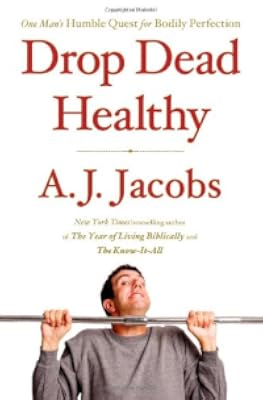
(I came to like A.J.Jacobs from his latest book - the amusingly informative "Drop Dead Healthy", which led me to his Biblical experiment, and which will probably lead to his earlier book "The-Know-It-All" - looks like I am discovering him backwards!). show less
But it's not all jokes - the author took this task of living a year according to the Bible very much seriously. You have to admire that. And he has managed to have a more open mind than I would have ever been able to in such a situation, and I honestly think he tried to be as objective as humanly possible. He sincerely searches for answers, wholeheartedly dives into the weirdest of situations. And his logic throughout all this is pretty solid. I liked his interpretation of Biblical stories, I appreciated his zestful opinions on matters that he strongly believes in while doing his best show more to see things from the point of view of Christian fundamentalists and Bible literalists. He entered into this research as an agnostic and emerged from it as a "reverent agnostic" in his own words, gratitude for things in life being one of the greatest feelings that he came away with. And what of this common question: "What if I follow the moral teachings of Jesus but don't worship him as God?"... Definitely food for thought.
I found the book quite helpful to someone like me - who is not a practicing Christian but is curious about the Bible in a historical sense.
I can't help but add a few quotes from the book (not the goofy ones, but the serious, ruminative kind). Like here, for instance, he talks about the way the Bible was written:
"Hardcore believers say that the Bible emerged from God's oven like a fully baked cake. Or, to be precise, several fully baked pieces. Moses transcribed the first 5 books. King David wrote Psalms. The Gospel of St. Luke was written solely by St. Luke. Every book of the Bible was written by a singular author who transcribed God's words.
The alternative is called the documentary hypothesis. This says that the Bible has many, many authors and editors. The first 5 books of Moses didn't come from Moses alone. They are a patchwork from four anonymous sources who have been named J, E, P, and D. Each writer has his own linguistic quirks and theological passions. P, for instance, short for "Priestly", was fascinated by the laws. The sections on food and sex prohibitions in Leviticus, for instance, come from the Priestly source. The passages have been chopped and pieced together by various editors. In short, the hypothesis says that the Bible has evolved, like humans themselves. Like a Wikipedia entry."
And here is a very interesting quote about Ecclesiastes (I can certainly see why he likes this part of the Bible so much!):
"Ecclesiastes is probably my favorite book of the Bible... Every time I read it, .... I feel the thrill of recognizing thoughts that I have had myself, but that I've never been able to capture in such a beautiful language. And I feel the oddity of finding myself on the same wavelength as a man who lived 2 thousand years ago.... ... The author of Ecclesiastes says: "The race is not to the swift, nor the battle to the strong, nor bread to the wise, nor riches to the intelligent, nor favor to the men of skill; but time and chance happen to them all".
"Ecclesiastes says that life is uncertain. "Vapor of vapors... all is vapors" (This is a more accurate translation of the phrase usually rendered: "vanity of vanities... all is vanity" ). We can never hope to plumb the mystery of God's mind. Bad things happen to good people. Idiots and geniuses, saints and sinners - we all die. The best we can do is try to appreciate the great things that God had given us - food, drink, the pleasure of honest work. We should follow the commandments, but we should do so with no guarantee that they will pay off in this life." "
And this interesting thought:
"It's exactly what I was most afraid of with religion. To embrace religion, you have to surrender some control. But what if it's a slippery slope, and you lose all control, slide right past the Judeo-Christian mainstream, and end up in a yurt kneeling in front of a guy wearing a tablecloth who has renamed you Lotus Petal?"
And then this powerful thought:
"How can the Bible be so wise in some places and so barbaric in others? And why should we put any faith in a book that includes such brutality? "
Here I agree with the author as well:
"... and though I think Jesus as a great man, I don't come away from the experience accepting him as a savior".
This also rings a bell in my own thinking (it's about gratitude, or counting one's blessings):
"It's an odd way to live. But also kind of great and powerful. I've never before been so aware of the thousands of little good things, the thousands of things that go right every day. Sometimes my thank-yous are directed at no one in particular. It's more of an appreciation than a thanks. A reminder to myself: "Pay attention, pal. Savor this moment." "
Also - questioning the praising of God:
"I've always found the praising-god parts of the Bible and my prayer book awkward.. And why should God need to be praise in the first place? God shouldn't be insecure. He's the ultimate being."
(I came to like A.J.Jacobs from his latest book - the amusingly informative "Drop Dead Healthy", which led me to his Biblical experiment, and which will probably lead to his earlier book "The-Know-It-All" - looks like I am discovering him backwards!). show less
Acquired via BookCrossing 11 Dec 2009 - secret santa gift at BCBirm Christmas meal
A.J. Jacobs likes an intellectual, properly *challenging" challenge. Last time we met him, he was reading the Encyclopedia Britannica from cover to cover. So he's a bit more rigorous than others of the authors whose books go into my "quest" tag group on LibraryThing. This time round, inspired by his secularised but interesting family and his responsibilities to his young son, Jacobs decides to try to follow the Bible literally, for a year.
Although some of the rules are a bit odd, and you could approach the task on different levels, this is not a frivolous undertaking, but a serious attempt to look at the place religion and rules have in people's lives. show more Jacobs draws together a group of spiritual advisors, of various religions, and also visits different groups as he goes along. He spends more time on the Old Testament than the New, then looks into claims that the New Testament "cancels out" some of the O.T. rules and regulations.
Jacobs explains both the rules, his reactions to them, and others' thoughts on them clearly and succintly. He freely admits that he's not religious at the beginnning of the year; by the end he is finding comfort in prayer and, while not overtly religious still, a changed man, definitely slower and more thankful for family and everyday things.
This isn't po-faced though. There are plenty of jokes, plenty of self-deprecation and also a celebration of the people he finds a kindred feeling with along the way, from a deep South snake-handler to the jolly Jewish festival-goers with their beards and smiles. Oh, and he grows a *great* beard, too.
Highly recommended, and I'll be offering this on a book ring soon. show less
A.J. Jacobs likes an intellectual, properly *challenging" challenge. Last time we met him, he was reading the Encyclopedia Britannica from cover to cover. So he's a bit more rigorous than others of the authors whose books go into my "quest" tag group on LibraryThing. This time round, inspired by his secularised but interesting family and his responsibilities to his young son, Jacobs decides to try to follow the Bible literally, for a year.
Although some of the rules are a bit odd, and you could approach the task on different levels, this is not a frivolous undertaking, but a serious attempt to look at the place religion and rules have in people's lives. show more Jacobs draws together a group of spiritual advisors, of various religions, and also visits different groups as he goes along. He spends more time on the Old Testament than the New, then looks into claims that the New Testament "cancels out" some of the O.T. rules and regulations.
Jacobs explains both the rules, his reactions to them, and others' thoughts on them clearly and succintly. He freely admits that he's not religious at the beginnning of the year; by the end he is finding comfort in prayer and, while not overtly religious still, a changed man, definitely slower and more thankful for family and everyday things.
This isn't po-faced though. There are plenty of jokes, plenty of self-deprecation and also a celebration of the people he finds a kindred feeling with along the way, from a deep South snake-handler to the jolly Jewish festival-goers with their beards and smiles. Oh, and he grows a *great* beard, too.
Highly recommended, and I'll be offering this on a book ring soon. show less
The Year of Living Biblically is one of the funniest books I’ve read in a long time. A.J. Jacobs tells the amusing but thought provoking story of the year he spent trying to live, literally, by the rules of the Bible.
Jacobs’ first task is to figure out what those biblical rules are. He struggles to understand how they apply to modern life in general, and to his own life in particular. There are so many rules in the Bible, and many of them are seemingly contradictory.
One of the easiest rules to understand, but one of the most difficult to follow, is the rule against lying. Jacobs struggles to keep even seemingly insignificant lies from escaping his mouth. His attempts are very funny. His battles against coveting and lusting are show more particularly difficult, since he also works at Esquire magazine.
Jacobs researches numerous Judeo-Christian religious traditions. In the name of his research, he visits an Old Order Amish community, Hasidic Jews, the Creation Museum, and the late Jerry Falwell’s Liberty University. It would be very easy for a gifted writer to ridicule these fundamental believers, but he remains interested and respectful.
While reading this book, I had to laugh out many times. This doesn’t happen so often with me. It’s so rare to find a funny, literate, interesting book. I highly recommend this one! show less
Jacobs’ first task is to figure out what those biblical rules are. He struggles to understand how they apply to modern life in general, and to his own life in particular. There are so many rules in the Bible, and many of them are seemingly contradictory.
One of the easiest rules to understand, but one of the most difficult to follow, is the rule against lying. Jacobs struggles to keep even seemingly insignificant lies from escaping his mouth. His attempts are very funny. His battles against coveting and lusting are show more particularly difficult, since he also works at Esquire magazine.
Jacobs researches numerous Judeo-Christian religious traditions. In the name of his research, he visits an Old Order Amish community, Hasidic Jews, the Creation Museum, and the late Jerry Falwell’s Liberty University. It would be very easy for a gifted writer to ridicule these fundamental believers, but he remains interested and respectful.
While reading this book, I had to laugh out many times. This doesn’t happen so often with me. It’s so rare to find a funny, literate, interesting book. I highly recommend this one! show less
A.J. Jacobs set out to follow the Bible's words, as literally as possible, for an entire year. As ambitious of a task as this seems, it is not entirely uncharacteristic of Jacobs, given his previous book, “The Know-It-All”, which documents his reading of the Encyclopedia Britannica from A to Z. With the guidance of Rabbis, Priests, professors and friends, Jacobs sets out on his quest and ends up learning a lot about himself along the way. He explores a number of religious sects and groups, including Chassidic Jews, Red Letter Christians, the Amish and even a trip to Israel to visit the Samaritans.
When I started reading this book, I wasn't sure what to expect but I was intrigued by the concept and I had to find out more. From the show more start, I found this book incredibly interesting and really easy to read, despite it being a work of non-fiction. Jacobs has a witty and fun way with words which kept me amused and informed at the same time. His anecdotes are always humorous and in keeping with important themes that he discusses in the book.
Jacobs does a great job of addressing misconceptions found in the Bible and lending explanations to the seemingly bizarre commandments that are seldom understood or even contemplated. While it is difficult to remain completely objective when exploring topics like religion, Jacobs approaches each experience with an open mind and an open heart with just the right amount of inevitable skepticism.
“The Year of Living Biblically” is very funny and yet simultaneously insightful. Because Jacobs gained a great deal from this quest, readers will too. I really appreciated the respectful way he addressed the laws of the Bible and tried to show their greater purpose and meaning.
This book is required reading for anyone, no matter what your beliefs, there is something each and every person can learn from this thought-provoking book.
http://bookopolis.blogspot.com show less
When I started reading this book, I wasn't sure what to expect but I was intrigued by the concept and I had to find out more. From the show more start, I found this book incredibly interesting and really easy to read, despite it being a work of non-fiction. Jacobs has a witty and fun way with words which kept me amused and informed at the same time. His anecdotes are always humorous and in keeping with important themes that he discusses in the book.
Jacobs does a great job of addressing misconceptions found in the Bible and lending explanations to the seemingly bizarre commandments that are seldom understood or even contemplated. While it is difficult to remain completely objective when exploring topics like religion, Jacobs approaches each experience with an open mind and an open heart with just the right amount of inevitable skepticism.
“The Year of Living Biblically” is very funny and yet simultaneously insightful. Because Jacobs gained a great deal from this quest, readers will too. I really appreciated the respectful way he addressed the laws of the Bible and tried to show their greater purpose and meaning.
This book is required reading for anyone, no matter what your beliefs, there is something each and every person can learn from this thought-provoking book.
http://bookopolis.blogspot.com show less
A few years ago an American journalist decided on a year-long project, to go biblically native. What would it be like to go to the source of Judaism and Christianity by following the commandments in the Bible as literally as possible.
Being a liberal, secular man in New York, the project probably started out as a way to ridicule the religious texts, but A.J. Jacobs take the projects seriously enough to quickly see that the texts are not as insane as common jokes make them seem, especially when it turns out that some of the strangest commandments are partly flawed translations to English.
The book is fun, interesting and still respectful. The author in the end wrote a book, an account day-by-day that describes the challenges and the people show more he met and I would say that it is not the strange commandments that turn out to be hardest (not shaving or cutting the corners of the hair is not very difficult) but the simplest things. Not lying, not jaywalking, not working on the sabbath. Those things are not even things that non-religious people object to in general, but a life-time of small white lies and pride and ambition puts the whole project in jeopardy.
My conclusion after reading the book is that it is not the texts that are flawed, but humans, and especially human interpretation of them. We have lost the historical context, we have lost the language (for instance, one part of the bible talks about specific kind of birds by name and we cannot know what birds they meant) and that means nobody can any longer read the bible with any certainty.
A fact that is not lost even on the orthodox fundamentalists. The difference is that they try very hard in face of uncertainty (and end up somewhere quite far from the original intention I think) while most close-to-secular Jews and Catholics and Protestants (and most likely Muslims which partly use the same texts though that aspect is not covered in the book) choose to ignore the "strangest" parts.
Would I recommend this book? Well, maybe. It's not a book you read from start to finish without being able to let it go, but I think it might be a nice "one page at a time" book for places where you spend short periods of time, because it is thinking about what is written that brings value, not the reading itself. Also, a warning, it is probably hard to meditate over religion for a year without it changing you and your relationships. show less
Being a liberal, secular man in New York, the project probably started out as a way to ridicule the religious texts, but A.J. Jacobs take the projects seriously enough to quickly see that the texts are not as insane as common jokes make them seem, especially when it turns out that some of the strangest commandments are partly flawed translations to English.
The book is fun, interesting and still respectful. The author in the end wrote a book, an account day-by-day that describes the challenges and the people show more he met and I would say that it is not the strange commandments that turn out to be hardest (not shaving or cutting the corners of the hair is not very difficult) but the simplest things. Not lying, not jaywalking, not working on the sabbath. Those things are not even things that non-religious people object to in general, but a life-time of small white lies and pride and ambition puts the whole project in jeopardy.
My conclusion after reading the book is that it is not the texts that are flawed, but humans, and especially human interpretation of them. We have lost the historical context, we have lost the language (for instance, one part of the bible talks about specific kind of birds by name and we cannot know what birds they meant) and that means nobody can any longer read the bible with any certainty.
A fact that is not lost even on the orthodox fundamentalists. The difference is that they try very hard in face of uncertainty (and end up somewhere quite far from the original intention I think) while most close-to-secular Jews and Catholics and Protestants (and most likely Muslims which partly use the same texts though that aspect is not covered in the book) choose to ignore the "strangest" parts.
Would I recommend this book? Well, maybe. It's not a book you read from start to finish without being able to let it go, but I think it might be a nice "one page at a time" book for places where you spend short periods of time, because it is thinking about what is written that brings value, not the reading itself. Also, a warning, it is probably hard to meditate over religion for a year without it changing you and your relationships. show less
Another really enjoyable read from the author of The Know-it-All. I started reading this on New Year’s Day on my flight to visit my family and finished it the day we got back from vacation. The premise is that Jacobs wants to spend one year trying to obey all the laws in the Bible literally. This can be especially difficult with laws that insist he kill magicians, stone adulterers, never cut his beard, and never touch a woman when she’s “unclean” (menstruating – a rule his wife finds particularly annoying and offensive.) He reads different translations and religious texts and consults with some religious authorities, but on the whole he wants to approach the project on his own. While I was reading it several people asked me if show more he was making fun of religious people, and I honestly don’t think he was. I felt like he approached the whole thing with sincere curiosity. He wasn’t raised with any kind of organized religion (a great quote, he says his family was Jewish but only in the sense that The Olive Garden is an Italian restaurant) and he wants to know what it is that such a huge segment of the population is experiencing that he doesn’t. Not only does he try to follow the laws, he’s tries to believe the things the Bible says are all true. While the results are often hilariously funny, I don’t think it’s at the expense of religious people. It’s just a natural result of the process and Jacobs’ personality.
In the end he does admit that he set out at least partly with the intention of proving that his goal is impossible. Nobody in modern society can actually follow all the laws in the Bible literally, if they ever could. When fundamentalist Christians complain that other Christians pick and choose which rules to follow, they are really doing the same thing themselves because everyone is. And while he doesn’t come out of the experience a complete convert, he has definitely been changed by it. show less
In the end he does admit that he set out at least partly with the intention of proving that his goal is impossible. Nobody in modern society can actually follow all the laws in the Bible literally, if they ever could. When fundamentalist Christians complain that other Christians pick and choose which rules to follow, they are really doing the same thing themselves because everyone is. And while he doesn’t come out of the experience a complete convert, he has definitely been changed by it. show less
I particularly enjoyed this book because Jacobs, like me, grew up in a very secular environment with a quizzical view of the Bible and all things religious. I enjoyed his intellectual honesty, his sense of humour, his willingness to give credit to people whose views he doesn't necessarily share while being clear about where he stands. As always, I'm impressed with his wife's tolerance and ability to cope with his shenanigans.
There are a few poignant moments which show how the Bible can help in trying times and I was pleased by the conclusion: the Bible did transform him, if only by connecting him more meaningfully to his roots and giving him a new reverence for life.
There are a few poignant moments which show how the Bible can help in trying times and I was pleased by the conclusion: the Bible did transform him, if only by connecting him more meaningfully to his roots and giving him a new reverence for life.
Members
- Recently Added By
Published Reviews
ThingScore 85
Performance art or not, this is a well-researched, informative and entirely absorbing read.
added by Katya0133
Jacobs's discussions with his advisers and with men representing other religions make up the most thoughtful and insightful sections of the book.
added by Katya0133
The author's determination despite constant complications from his modern secular life (wife, job, family, NYC) underscores both the absurdity of his plight and its profundity.
added by Katya0133
Lists

Best Laugh Out Loud Books
143 works; 49 members

Books Read in 2012
816 works; 34 members

My Year Spent Doing Something Stupid so I Could Write This Book
31 works; 5 members
Unshelved Book Clubs
579 works; 5 members

Books You Couldn't Finish
202 works; 32 members

KayStJ's to-read list
1,616 works; 11 members

Christianity Books You've Read
179 works; 18 members
Author Information

17+ Works 13,688 Members
A.J. Jacobs is an editor at Esquire magazine and the author of The New York Times bestsellers The Year of Living Biblically, My Life as an Experiment, and The Know-It-All.
Some Editions
Awards and Honors
Awards
Distinctions
Work Relationships
Common Knowledge
- Original publication date
- 2007
- People/Characters
- A. J. Jacobs; Julie Schoenberg Jacobs; Jasper Jacobs
- Important places
- New York, New York, USA
- Dedication
- To Julie
- First words
- As I write this, I have a beard that makes me resemble Moses.
- Quotations
- The Hebrew scriptures prescribe a tremendous amount of capital punishment. Think Saudi Arabia, multiply by Texas, then triple that.
At times—not all the time, but sometimes—the entire world takes on a glow of sacredness, like someone has flipped on a[n] unfathomably huge halogen lamp and made the universe softer, fuller, less menacing. (p.153)
All well and good, right? The only thing is, this is not the God of the Israelites. This is not the God of the Hebrew Scriptures. That God is an interactive God. He rewards people and punishes them. &... (show all)nbsp;He argues with them, negotiates with them, forgives them, and occasionally smites the. The God of the Hebrew Scriptures has human emotions—love and anger. (p.153) - Last words
- (Click to show. Warning: May contain spoilers.)Jasper and I leave the post office, turn left, and head toward home for a quiet Friday night.
- Publisher's editor
- Rucci, Marysue; Weisbach, Rob; Rosenthal, David; Meyer, Victoria; Boyle, Aileen; Guest, Tracey (show all 13); Prosser, Julia; Wasielewski, Leah; Seow, Jackie; Berger, Marcella; Florio, Marie; Healy, Lisa; Smith, Ginny
- Blurbers
- Feiler, Bruce; O'Rourke, P.J.; Wallis, Jim; Ellenson, David; Hodgman, John; Spong, John Shelby (show all 9); Roach, Mary; Karlin, Ben; Collins, Francis S.
- Original language
- English US
- Canonical DDC/MDS
- 220
Classifications
Statistics
- Members
- 5,013
- Popularity
- 2,789
- Reviews
- 202
- Rating
- (3.79)
- Languages
- 9 — Chinese, Dutch, English, Finnish, French, German, Italian, Portuguese, Spanish
- Media
- Paper, Audiobook, Ebook
- ISBNs
- 38
- ASINs
- 14