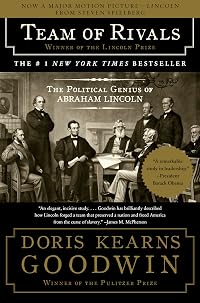
Team of Rivals: The Political Genius of Abraham Lincoln
by Doris Kearns Goodwin
On This Page
Description
This multiple biography is centered on Lincoln's mastery of men and how it shaped the most significant presidency in the nation's history. Historian Goodwin illuminates Lincoln's political genius, as the one-term congressman rises from obscurity to prevail over three gifted rivals to become president. When Lincoln emerged as the victor at the Republican National Convention, his rivals were dismayed. Throughout the turbulent 1850s, each had energetically sought the presidency as the conflict show more over slavery led inexorably to civil war. That Lincoln succeeded, Goodwin demonstrates, was because of his extraordinary ability to put himself in the place of other men, to experience what they were feeling, to understand their motives and desires. It was this that enabled Lincoln to bring his disgruntled opponents together, create the most unusual cabinet in history, and marshal their talents to the task of preserving the Union. show lessTags
Recommendations




Member Recommendations

Member Reviews
I come to this amazing book late in the game, after having read [[Dorris Kearns Goodwin]]’s memoir [Wait ‘Til Next Year]. But there are very few current historians writing such well-researched yet accessible books. Honestly, while the text is littered with quotation marks and footnotes, it reads like a novel of political intrigue. For Republicans these days to invoke Lincoln as the father of their party is the worst kind of misdirection. Lincoln was, above all, a kind man, engaged in thoughtful governance and willing to do absolutely anything to keep the peace, save the union, and abolish slavery. Some historians pull certain events out of context to shame him for coming to the cause late, but Goodwin makes clear that he was always show more part of the cause but had his eyes open about how quickly to move the cause. While it wasn’t fast enough or strident enough for some, both at the time and in hindsight, he moved as quickly as he could. And his uncanny sense of timing turns out to be the product of many late nights filled with agonizing work.
Best, most prescient quote for our time from Lincoln, on the nature of his struggle, which is our struggle today –
”I consider the central idea pervading this struggle is the necessity that is upon us, of proving that popular government is not an absurdity. We must settle this question now, whether in a free government the minority have the right to break up the government whenever they choose. If we fail it will go far to prove the incapability of the people to govern themselves.”
5 bones!!!!!
Highly recommended show less
Best, most prescient quote for our time from Lincoln, on the nature of his struggle, which is our struggle today –
”I consider the central idea pervading this struggle is the necessity that is upon us, of proving that popular government is not an absurdity. We must settle this question now, whether in a free government the minority have the right to break up the government whenever they choose. If we fail it will go far to prove the incapability of the people to govern themselves.”
5 bones!!!!!
Highly recommended show less
As of this writing, there are 90 other reviews of this book on LibraryThing, so detailed descriptions of its content would seem rather superfluous...let me just cut to my opinion: this is easily one of my most absorbing reads for this year.
It didn't start that way. The first few chapters were interesting but it was easy to set the book down for one reason or another. I enjoyed the content but it had a bit of an episodic feel to it as the author moved from Lincoln to Seward to Chase to Bates and back, round robin.
All that changed when we reached May, 1860 and all the figures were drawn into a single story. From Lincoln's surprise nomination as the Republican candidate for the Presidency onward, I felt as if Doris Kearns Goodwin had show more plunked me down as a fly on the wall and I was actually there. Lincoln and his cabinet became real and only the demands of my job or my eyes closing of their own accord kept me from opening it. I feel that, although she is obviously a bit in love with her main character, Goodwin accomplished the objective of the book's subtitle, showing us the political genius of Lincoln. More than just a history lesson—however analytical and in-depth such a lesson might be—she manages to convey the certainty that this was, perhaps, the only man who could have navigated the country through those years intact and that his assassination in 1865 cost both the North and the South in the following years.
Beyond Lincoln, she also gives us the members of his cabinet. Some remain relatively minor participants in the drama, but Seward, Stanton and Chase leap into life...no longer just names but fleshed out figures whom I can admire (for the first two) or faintly despise (the third).
For anyone even vaguely interested in the era, the people or the war, this is a must-read. show less
It didn't start that way. The first few chapters were interesting but it was easy to set the book down for one reason or another. I enjoyed the content but it had a bit of an episodic feel to it as the author moved from Lincoln to Seward to Chase to Bates and back, round robin.
All that changed when we reached May, 1860 and all the figures were drawn into a single story. From Lincoln's surprise nomination as the Republican candidate for the Presidency onward, I felt as if Doris Kearns Goodwin had show more plunked me down as a fly on the wall and I was actually there. Lincoln and his cabinet became real and only the demands of my job or my eyes closing of their own accord kept me from opening it. I feel that, although she is obviously a bit in love with her main character, Goodwin accomplished the objective of the book's subtitle, showing us the political genius of Lincoln. More than just a history lesson—however analytical and in-depth such a lesson might be—she manages to convey the certainty that this was, perhaps, the only man who could have navigated the country through those years intact and that his assassination in 1865 cost both the North and the South in the following years.
Beyond Lincoln, she also gives us the members of his cabinet. Some remain relatively minor participants in the drama, but Seward, Stanton and Chase leap into life...no longer just names but fleshed out figures whom I can admire (for the first two) or faintly despise (the third).
For anyone even vaguely interested in the era, the people or the war, this is a must-read. show less
As usual, I seem to be pushing against the river. All the reviews on this tome are positively stellar -- to the 5th degree. My poor offering is a meagre 3.
Goodwin is an exceptional historian. Research should have been her middle name. But -- and it's quite a big one --
The book would have been vastly improved if a good editor had taken charge.
This book reads like ... you asked someone for a recipe on how to bake a cake, and she starts by telling you how to grow wheat; then walks you through milling the grain into flour, down the line to raising chickens and collecting the eggs. My god, by the time you get to the cake, you've starved yourself and three subsequent generations.
A good editor would have sliced at least 200 pages and given show more more substance to the importance of this team of rivals. The relevance of the momentous symphony created by this team is almost drowned by the irrelevant preamble.
All the minutiae that Goodwin gathers on the respective players is interesting, perhaps, but doesn't add to the central argument. The trivialities of childhood toe-stubbings and early disappointments in love of one and all do not belong in such a work. They belong in a biography dedicated solely to that individual: therein, one could expand to heart's content and would in that case be appreciated by the reader. Herein, it made me forget what/who the book was about, almost.
After sifting through the mound (sorry, can't seem to get that cake imagery out of my head) of froth and frivolity, the book is excellent and I appreciated learning a few things about Lincoln that made clear his exceptional contribution to the building of the United States of America. I appreciated, perhaps for the first time, the political astuteness of the man, stripped clean of his "aw shucks" image that has often been portrayed in other biographies. When Goodwin finally gets down to it, she is immensely capable of delivering good solid writing, with a purpose. show less
Goodwin is an exceptional historian. Research should have been her middle name. But -- and it's quite a big one --
The book would have been vastly improved if a good editor had taken charge.
This book reads like ... you asked someone for a recipe on how to bake a cake, and she starts by telling you how to grow wheat; then walks you through milling the grain into flour, down the line to raising chickens and collecting the eggs. My god, by the time you get to the cake, you've starved yourself and three subsequent generations.
A good editor would have sliced at least 200 pages and given show more more substance to the importance of this team of rivals. The relevance of the momentous symphony created by this team is almost drowned by the irrelevant preamble.
All the minutiae that Goodwin gathers on the respective players is interesting, perhaps, but doesn't add to the central argument. The trivialities of childhood toe-stubbings and early disappointments in love of one and all do not belong in such a work. They belong in a biography dedicated solely to that individual: therein, one could expand to heart's content and would in that case be appreciated by the reader. Herein, it made me forget what/who the book was about, almost.
After sifting through the mound (sorry, can't seem to get that cake imagery out of my head) of froth and frivolity, the book is excellent and I appreciated learning a few things about Lincoln that made clear his exceptional contribution to the building of the United States of America. I appreciated, perhaps for the first time, the political astuteness of the man, stripped clean of his "aw shucks" image that has often been portrayed in other biographies. When Goodwin finally gets down to it, she is immensely capable of delivering good solid writing, with a purpose. show less
With the immense number of books written about Abraham Lincoln, one would think that there is hardly room for another. Yet Goodwin has written a superb addition to the literature on Lincoln, examining the relationships, not only between Lincoln and his Cabinet members, three of whom were his rivals for the 1860 Republican nomination, but among the Cabinet members themselves, showing how Lincoln was aware of the differences and tensions and managed to extract from each man the best that man had to offer the country.
The first part of the book examines the lives of the four candidates up until the 1860 Republican convention: William Henry Seward from New York, considered at the time an abolitionist; Salmon P. Chase of Ohio, a radical show more Republican; Edward Bates of Missouri, a slave-holding, conservative Republican, and Lincoln himself, a moderate from Illinois. In a series of chapters, she recounts the lives and political development of each man in turn; in “longing to Rise”, she brings the story of each to young adulthood; in “The Lure of Politics”, what brought each of them into public service; and continues, in succeeding chapters to follow each through the turbulent years preceding 1860. She gives her greatest attention in each chapter to Lincoln, but the accounts of the other men are extremely absorbing.
I found this structure disturbing, because all four men were fascinating characters; I’d just settle in with Seward, in, for example, “The Lure of Politics”, when suddenly Goodwin would shift to Bates or to Chase, which jarred me. But it did give a sense of contemporaneity to the accounts; you really are following each man up until the fateful year of 1860, not just reading a biography of each. The accounts are excellent on pointing up both similarities and differences in attitudes and approaches to the major question of the day, which was slavery. During those early chapters, you also meet important political figures such as Thurlow Weed, Charles Sumner and others who, if reading biographies of the 4 men separately, would not not appear in one or more of them.
The story of the Republican nomination is well known, but Goodwin adds details of errors made by Seward, Chase’s delusions of support, and Bates’ lack of organization that really fill out and explain what happened at the convention--how Lincoln, who was not quite the unknown as most believe, and his managers snatched the nomination away from Seward (Bates and Chase never really had a chance although they were in the running). It is a marvel of good writing coupled with enough drama for a novel in itself.
Goodwin thoroughly goes into Lincoln’s reasons for choosing his Cabinet the way he did; there really is nothing new there, but what is new and fascinating is the way those chosen viewed not only the President but each other. Lincoln had the most incredibly disparate and divided group of human beings to ever fill those positions: radical, moderate and conservative Republicans, war Democrats, the works--many of whom at least in the beginning viewed themselves as far better equipped to run the country than Lincoln. Throughout the book, in a masterful way, Goodwin recounts the shifting alliances and perceptions, the rivalries, and the antagonisms; she is especially good at portraying Chase, who was a brilliant Secretary of the Treasury, who was obsessively driven by his need to be President, as a man of little to no integrity while posturing as the purest of abolitionists and one who had only the country in mind. Chase winds up as a despicable character--something Lincoln knew well and did not lose sight of but for whom he had understanding; his handling of Chase alone is a marvel. Throughout all this we see other, lesser known figures and the roles they played. Montgomery Blair was the Postmaster General, from a politically powerful Maryland slave-holding family. The family home of his father, Frank Blair, is now the official guest house of the government and the place where the President-elect and his family stays just before the inauguration. Gideon Welles from New England was the extremely competent Secretary of the Navy. Edwin Stanton, the gruff, irascible Secretary of War performed miracles in handling the army. Bates was the Attorney General and played a crucial role in providing Lincoln with the legal opinions he needed, especially on the war powers of the Presidency, which Lincoln used to publish the Emancipation Proclamation. Goodwin makes it clear that with the exception of Chase, who was blinded by ambition, all of Lincoln’s cabinet, including later additions, loved and respected Lincoln; Seward was Lincoln’s best friend.
The story of the war years in any decent writer’s hands is a page-turner, and Goodwin handles it well, weaving the political and military situation in with the accounts of Lincoln’s dealings with the Cabinet, with Congress, with the armies, and with the people. She demonstrates Lincoln’s genius at never getting ahead of the people, but preparing them for those leaps forward, such as the Emancipation Proclamation, in which he believed. The tension of the summer of 1864, in which it appeared that Lincoln would lose the election is well-done; and Goodwin really pulls a coup by making it clear that the fall of Atlanta, which happened 3 days after the Democratic convention that nominated McClellan as its candidate, was a perfect piece of timing on Fate’s part to give Lincoln the election.
Everyone knows the ending to the story. I, for one, can never keep from crying. For 143 years, the United States paid the price of Lincoln’s assassination.
Most accounts of Lincoln’s death end, as Goodwin’s does, with Stanton’s famous “Now he belongs to the ages”. But most accounts do not give any details of the attempt on Seward’s life, which was part of the assassination plot; Seward and his son Fred were so gravely injured that it was thought both men would die. Others in the house at the time, including a soldier who was stationed to guard Seward, were badly injured as well.
The book ends with an epilogue that briefly recounts the lives of the major characters in the drama. Seward lived to remain as Secretary of State under a much, much lesser man, Andrew Johnson, and satisfied himself with yet another controversial act in a controversial career, the purchase of Alaska, widely know as Seward’s Folly. Bates retired from public life. Chase schemed unsuccessfully to the end to become president. Stanton basically worked himself to death. Mary Lincoln never recovered from Lincoln’s death. After living in the blazing light of one of the greatest leaders the world has ever known, they ended up as ordinary mortals, with ordinary lives and deaths.
Team of Rivals is a brilliant book. show less
The first part of the book examines the lives of the four candidates up until the 1860 Republican convention: William Henry Seward from New York, considered at the time an abolitionist; Salmon P. Chase of Ohio, a radical show more Republican; Edward Bates of Missouri, a slave-holding, conservative Republican, and Lincoln himself, a moderate from Illinois. In a series of chapters, she recounts the lives and political development of each man in turn; in “longing to Rise”, she brings the story of each to young adulthood; in “The Lure of Politics”, what brought each of them into public service; and continues, in succeeding chapters to follow each through the turbulent years preceding 1860. She gives her greatest attention in each chapter to Lincoln, but the accounts of the other men are extremely absorbing.
I found this structure disturbing, because all four men were fascinating characters; I’d just settle in with Seward, in, for example, “The Lure of Politics”, when suddenly Goodwin would shift to Bates or to Chase, which jarred me. But it did give a sense of contemporaneity to the accounts; you really are following each man up until the fateful year of 1860, not just reading a biography of each. The accounts are excellent on pointing up both similarities and differences in attitudes and approaches to the major question of the day, which was slavery. During those early chapters, you also meet important political figures such as Thurlow Weed, Charles Sumner and others who, if reading biographies of the 4 men separately, would not not appear in one or more of them.
The story of the Republican nomination is well known, but Goodwin adds details of errors made by Seward, Chase’s delusions of support, and Bates’ lack of organization that really fill out and explain what happened at the convention--how Lincoln, who was not quite the unknown as most believe, and his managers snatched the nomination away from Seward (Bates and Chase never really had a chance although they were in the running). It is a marvel of good writing coupled with enough drama for a novel in itself.
Goodwin thoroughly goes into Lincoln’s reasons for choosing his Cabinet the way he did; there really is nothing new there, but what is new and fascinating is the way those chosen viewed not only the President but each other. Lincoln had the most incredibly disparate and divided group of human beings to ever fill those positions: radical, moderate and conservative Republicans, war Democrats, the works--many of whom at least in the beginning viewed themselves as far better equipped to run the country than Lincoln. Throughout the book, in a masterful way, Goodwin recounts the shifting alliances and perceptions, the rivalries, and the antagonisms; she is especially good at portraying Chase, who was a brilliant Secretary of the Treasury, who was obsessively driven by his need to be President, as a man of little to no integrity while posturing as the purest of abolitionists and one who had only the country in mind. Chase winds up as a despicable character--something Lincoln knew well and did not lose sight of but for whom he had understanding; his handling of Chase alone is a marvel. Throughout all this we see other, lesser known figures and the roles they played. Montgomery Blair was the Postmaster General, from a politically powerful Maryland slave-holding family. The family home of his father, Frank Blair, is now the official guest house of the government and the place where the President-elect and his family stays just before the inauguration. Gideon Welles from New England was the extremely competent Secretary of the Navy. Edwin Stanton, the gruff, irascible Secretary of War performed miracles in handling the army. Bates was the Attorney General and played a crucial role in providing Lincoln with the legal opinions he needed, especially on the war powers of the Presidency, which Lincoln used to publish the Emancipation Proclamation. Goodwin makes it clear that with the exception of Chase, who was blinded by ambition, all of Lincoln’s cabinet, including later additions, loved and respected Lincoln; Seward was Lincoln’s best friend.
The story of the war years in any decent writer’s hands is a page-turner, and Goodwin handles it well, weaving the political and military situation in with the accounts of Lincoln’s dealings with the Cabinet, with Congress, with the armies, and with the people. She demonstrates Lincoln’s genius at never getting ahead of the people, but preparing them for those leaps forward, such as the Emancipation Proclamation, in which he believed. The tension of the summer of 1864, in which it appeared that Lincoln would lose the election is well-done; and Goodwin really pulls a coup by making it clear that the fall of Atlanta, which happened 3 days after the Democratic convention that nominated McClellan as its candidate, was a perfect piece of timing on Fate’s part to give Lincoln the election.
Everyone knows the ending to the story. I, for one, can never keep from crying. For 143 years, the United States paid the price of Lincoln’s assassination.
Most accounts of Lincoln’s death end, as Goodwin’s does, with Stanton’s famous “Now he belongs to the ages”. But most accounts do not give any details of the attempt on Seward’s life, which was part of the assassination plot; Seward and his son Fred were so gravely injured that it was thought both men would die. Others in the house at the time, including a soldier who was stationed to guard Seward, were badly injured as well.
The book ends with an epilogue that briefly recounts the lives of the major characters in the drama. Seward lived to remain as Secretary of State under a much, much lesser man, Andrew Johnson, and satisfied himself with yet another controversial act in a controversial career, the purchase of Alaska, widely know as Seward’s Folly. Bates retired from public life. Chase schemed unsuccessfully to the end to become president. Stanton basically worked himself to death. Mary Lincoln never recovered from Lincoln’s death. After living in the blazing light of one of the greatest leaders the world has ever known, they ended up as ordinary mortals, with ordinary lives and deaths.
Team of Rivals is a brilliant book. show less
62. Team of Rivals: The Political Genius of Abraham Lincoln by Doris Kearns Goodwin (2005, 763 pages, read Aug 15-Nov 17)
Lincoln was the perfect president. He was awkward, humble, and brilliant, morally pure to the deepest part of his heart, yet manipulative to great effect, and yet thoroughly reasonable. The oddball politician who won arguments through that underused, politically suicidal technique of presenting his actual reasoning. It seems that practically every single person who came across Lincoln in any capacity, came away with a strong sense of affection and admiration. That's the myth, and, if I can believe Goodwin, it's remarkably accurate.
This is one of the best books I've read this year. It starts out a little slow as show more Goodwin puts a good number of pages into Lincoln's opponents for the Republican presidential nomination for the 1859 election. These guys are interesting and each becomes a key member of Lincoln's cabinet, but they aren't Lincoln. Once the book centers on Lincoln, if became a terrific pick-me-up. Every time I put the book down, it would be with sense of inspiration. Goodwin does a masterful job of bringing out Lincoln's character and his relationships with various key people. His plodding methods that would drag out problems, and yet, in the end resolve them to wide approval. His masterful sense of timing, of when to wait and when to act. And his deep understanding of the people around him...and how to win them over. He knew people's strengths, and once he had power, how to control them so that they focused in the place he wanted them to focus. For example, Henry Seward, brilliant, arrogant and crushed by his defeat by Lincoln, is, upon that day of assassination, both Lincoln's most valuable and most dedicated adviser.
As I'm writing this, and trying to actually constrain my Lincoln-awe to get something useful out, I keep thinking to myself there must be more to this, Goodwin must have manipulated this history to his advantage. And my skeptical side thinks maybe she did. But, set that aside, let Lincoln be my hero for now. I'll need to read more about him later, anyway. For now I'll keep him up there in that vaguely defined lofty place, in all the color Goodwin has brought out of him and presented, our poet president, our one true national hero. Maybe I'll read the Gettysburg address one more time.
(You can find this review on my 2012 LT thread here: http://www.librarything.com/topic/138560#3772632 ) show less
Lincoln was the perfect president. He was awkward, humble, and brilliant, morally pure to the deepest part of his heart, yet manipulative to great effect, and yet thoroughly reasonable. The oddball politician who won arguments through that underused, politically suicidal technique of presenting his actual reasoning. It seems that practically every single person who came across Lincoln in any capacity, came away with a strong sense of affection and admiration. That's the myth, and, if I can believe Goodwin, it's remarkably accurate.
This is one of the best books I've read this year. It starts out a little slow as show more Goodwin puts a good number of pages into Lincoln's opponents for the Republican presidential nomination for the 1859 election. These guys are interesting and each becomes a key member of Lincoln's cabinet, but they aren't Lincoln. Once the book centers on Lincoln, if became a terrific pick-me-up. Every time I put the book down, it would be with sense of inspiration. Goodwin does a masterful job of bringing out Lincoln's character and his relationships with various key people. His plodding methods that would drag out problems, and yet, in the end resolve them to wide approval. His masterful sense of timing, of when to wait and when to act. And his deep understanding of the people around him...and how to win them over. He knew people's strengths, and once he had power, how to control them so that they focused in the place he wanted them to focus. For example, Henry Seward, brilliant, arrogant and crushed by his defeat by Lincoln, is, upon that day of assassination, both Lincoln's most valuable and most dedicated adviser.
As I'm writing this, and trying to actually constrain my Lincoln-awe to get something useful out, I keep thinking to myself there must be more to this, Goodwin must have manipulated this history to his advantage. And my skeptical side thinks maybe she did. But, set that aside, let Lincoln be my hero for now. I'll need to read more about him later, anyway. For now I'll keep him up there in that vaguely defined lofty place, in all the color Goodwin has brought out of him and presented, our poet president, our one true national hero. Maybe I'll read the Gettysburg address one more time.
(You can find this review on my 2012 LT thread here: http://www.librarything.com/topic/138560#3772632 ) show less
There's little I can add to the other rave reviews. The view of history as the account of great individuals might be out of fashion, but this book would convince all but the most sceptical that Lincoln was indispensable for the outcome of the Civil War. The author has a hard time covering her distaste for the self-righteous Salmon Chase, nor for the self-aggrandising and maddeningly immobile George MacLellan, but for other major characters, she displays a depth of understanding that matches her thesis: Lincoln displayed his greatness not only by surrounding himself with his defeated rivals for the nomination, but then through strength of character becoming the undisputed master of the administration, winning the admiration of the others show more in the process. This could well be an unrivalled feat in the annals of government. Unreservedly recommended. show less
Team of Rivals by Doris Kearns Goodwin
This is one of those books that has been on my TBR pile for a long time having gotten a lot of hype several years ago when Obama was reading the book and supposedly assembling his own team of rivals cabinet. Ultimately, it took an audiobook version for me to really get into the story because it is a very thick non-fiction book.
All that being said, I loved Team of Rivals and it has gone to the top of my list for reads this year. Kearns Goodwin uses the lives of several member's of Lincoln's cabinet to illustrate Lincoln's life. The primary comparisons are with William Seward, Edward Bates, and Salmon Chase who all contended with Lincoln for the 1860 Republican nomination although the stories of Edwin show more Stanton and the Blair family also figure prominently in the story.
The book opens with a discussion of just how unlikely a candidate Lincoln was for the 1860 Republican nomination and how, to the outside world, he was the least likely of the four men vying for the nomination to receive it. From there, the book moves backward to explain the formative years of the four men and how they came to the 1860 convention with a better chance of the nomination than Lincoln.
Once Lincoln wins the nomination and then the presidency, the book talks about how Lincoln turned each man into an ally and brought them into his cabinet where each served successfully and to the benefit of the country as a whole.
Finally, the book accounts, in detail, the Civil War, the Emancipation Proclamation, the Gettysburg Address and so on all the way up to Lincoln's assassination. However, where the book really shines is in the details of the lesser known struggles that Lincoln faced - whether it was placating warring factions in the Republican party, keeping border states from seceding, defusing international disputes with England, etc. Through it all, Kearns Goodwin portrays Lincoln as having almost supernatural powers of compassion, patience, forgiveness, and humor yet she also humanizes him too. It is a remarkable portrayal of America's greatest president and a fascinating read. show less
This is one of those books that has been on my TBR pile for a long time having gotten a lot of hype several years ago when Obama was reading the book and supposedly assembling his own team of rivals cabinet. Ultimately, it took an audiobook version for me to really get into the story because it is a very thick non-fiction book.
All that being said, I loved Team of Rivals and it has gone to the top of my list for reads this year. Kearns Goodwin uses the lives of several member's of Lincoln's cabinet to illustrate Lincoln's life. The primary comparisons are with William Seward, Edward Bates, and Salmon Chase who all contended with Lincoln for the 1860 Republican nomination although the stories of Edwin show more Stanton and the Blair family also figure prominently in the story.
The book opens with a discussion of just how unlikely a candidate Lincoln was for the 1860 Republican nomination and how, to the outside world, he was the least likely of the four men vying for the nomination to receive it. From there, the book moves backward to explain the formative years of the four men and how they came to the 1860 convention with a better chance of the nomination than Lincoln.
Once Lincoln wins the nomination and then the presidency, the book talks about how Lincoln turned each man into an ally and brought them into his cabinet where each served successfully and to the benefit of the country as a whole.
Finally, the book accounts, in detail, the Civil War, the Emancipation Proclamation, the Gettysburg Address and so on all the way up to Lincoln's assassination. However, where the book really shines is in the details of the lesser known struggles that Lincoln faced - whether it was placating warring factions in the Republican party, keeping border states from seceding, defusing international disputes with England, etc. Through it all, Kearns Goodwin portrays Lincoln as having almost supernatural powers of compassion, patience, forgiveness, and humor yet she also humanizes him too. It is a remarkable portrayal of America's greatest president and a fascinating read. show less
Members
- Recently Added By
Published Reviews
ThingScore 100
"We needed the strongest men of the party in the cabinet," Lincoln replied. "These were the very strongest men. Then I had no right to deprive the country of their services." They were indeed strong men, Goodwin notes. "But in the end, it was the prairie lawyer from Springfield who would emerge as the strongest of them all."
added by John_Vaughan
"But this immense, finely boned book is no dull administrative or bureaucratic history; rather, it is a story of personalities -- a messianic drama, if you will -- in which Lincoln must increase and the others must decrease."
added by bookfitz
Lists

Best Biographies
216 works; 26 members

Top Five Books of 2013
1,562 works; 721 members

Lincoln
7 works; 4 members

100 books to read in a lifetime
102 works; 37 members

Non-Fiction Worth Reading
1,015 works; 261 members
Best Biographies of U.S. Presidents
61 works; 6 members

Recommend the 20 best books you've read in the last five years
2,168 works; 606 members

World History
4 works; 1 member

Books recommended by Barack Obama
295 works; 28 members

Obama Reads
181 works; 3 members

Política - Clásicos
164 works; 2 members

al.vick-parents books
301 works; 1 member

Tagged Civil War
16 works; 4 members

Female Author
1,235 works; 67 members

r/History Recommended Reading List
603 works; 12 members

Biographies of American Presidents
39 works; 4 members

History & Political Science: US
158 works; 1 member

My List
302 works; 1 member

Top Five Books of 2023
767 works; 317 members

Club Read's Recommended Nonfiction Written by Women
618 works; 30 members

.
184 works; 1 member

Presidents and First Ladies
25 works; 6 members

2024-2025 Ezra Klein Guest Recommendations
213 works; 6 members
Talk Discussions
Past Discussions
2012 Team of Rivals Group Read, November in 75 Books Challenge for 2012 (January 2013)
Group reading of The Team of Rivals by Doris Kearns Goodwin, in November 2012 in 75 Books Challenge for 2012 (November 2012)
Author Information

17+ Works 23,245 Members
Doris Kearns Goodwin was born in Brooklyn, New York on January 4, 1943. She received a bachelor of arts degree from Colby College in 1964 and a Ph.D. in government from Harvard University in 1968. She taught at Harvard University and worked as an assistant to President Lyndon Johnson during his last year in the White House. She has written show more numerous books including The Fitzgeralds and the Kennedys, Lyndon Johnson and the American Dream, Wait Till Next Year, and The Bully Pulpit: Theodore Roosevelt, William Howard Taft, and the Golden Age of Journalism, and Leadership: In Turbulent Times. She has received numerous awards including Pulitzer Prize in history, the Harold Washington Literary Award, the Ambassador Book Award for No Ordinary Time: Franklin and Eleanor Roosevelt: The Home Front in World War II, and the Lincoln Prize and the Book Prize for American History for Team of Rivals: The Political Genius of Abraham Lincoln. (Bowker Author Biography) show less
Some Editions
Awards and Honors
Awards
Distinctions
Series
Belongs to Publisher Series
Work Relationships
Has the adaptation
Is abridged in
Common Knowledge
- Canonical title
- Team of Rivals: The Political Genius of Abraham Lincoln
- Original title
- Team of Rivals: The Political Genius of Abraham Lincoln
- Original publication date
- 2005-10-25
- People/Characters
- Abraham Lincoln; Edward Bates; Salmon P. Chase; Ulysses S. Grant; Mary Todd Lincoln; William Henry Seward (show all 26); Edwin M. Stanton; Gideon Welles; Montgomery Blair; John Hay; George B. McClellan; Thurlow Weed; Kate Chase Sprague; Francis Preston Blair; Francis Preston Blair, Jr.; Noah Brooks; Simon Cameron; Stephen A. Douglas; Frederick Douglass; Ulysses S. Grant; Thomas "Tad' Lincoln; Robert Todd Lincoln; George B. McClellan; John G. Nicolay; Frances Miller Seward; Charles Sumner
- Important places
- Washington, D.C., USA; Springfield, Illinois, USA; Auburn, New York, USA; White House, Washington, D.C., USA; Anderson Cottage, Soldiers Home, Washington, D.C., USA; Illinois, USA (show all 9); Fort Sumter, Charleston Harbor, South Carolina, USA; Richmond, Virginia, USA; War Department Telegraph Office, Washington, D.C., USA
- Important events
- Kansas-Nebraska Act (1854); Lincoln-Douglas Debates (1858); Republican National Convention (1860); United States presidential election (1860, 1864); Presidency of Abraham Lincoln (1861 | 1865); Lincoln's First Inaugural Address (1861) (show all 14); American Civil War (1861 | 1865); Peninsula Campaign (1862); Emancipation Proclamation (1863-01-01); Gettysburg Address (1863-11); Lincoln's Second Inaugural Address (1865); 13th Amendment to the U.S. Constitution; Reconstruction Era of the United States; 19th century
- Related movies
- Lincoln (2012 | IMDb)
- Epigraph
- "The conduct of the republican party in this nomination is a remarkable indication of small intellect, growing smaller. They pass over ... statesmen and able men, and they take up a fourth rate lecturer, who cannot speak goo... (show all)d grammar." —The New York Herald (May 19, 1860), commenting on Abraham Lincoln's nomination for president at the Republican National Convention.
"Why, if the old Greeks had had this man, what trilogies of plays—what epics—would have been made out of him! How the rhapsodes would have recited him! How quickly that quaint tall form would have enter'd into the regio... (show all)n where men vitalize gods, and gods devinify men! But Lincoln, his times, his death—great as any, any age—being altogether to our own." —Walt Whitman, "Death of Abraham Lincoln," 1879.
"The greatness of Napoleon, Caesar or Washington is only moonlight by the sun of Lincoln. His example is universal and will last thousands of years. ... He was bigger than his country—bigger than all the Presidents togethe... (show all)r ... and as a great character he will live as long as the world lives." —Leo Tolstoy, The World, New York, 1909. - Dedication
- For Richard M. Goodwin, my husband of thirty years
- First words
- On May 18, 1860, the day when the Republican Party would nominate its candidate for president, Abraham Lincoln was up early.
- Quotations
- After all, to [Simon] Cameron was attributed the oft-quoted definition: "an honest politician is one who, when he is bought, stays bought."
- Last words
- (Click to show. Warning: May contain spoilers.)The deathless name he sought form the start had grown far beyond Sangamon County and Illinois, reached across the truly United States, until his legacy, as Stanton had surmised at the moment of his death, belonged not only to America but to the ages - to be revered and sung throughout all time.
- Blurbers
- Kakutani, Michiko; Rhodehamel, John; Winik, Jay; McPherson, James M.; Wills, Garry; Brinkley, Douglas (show all 9); Williams, Frank J.; Holzer, Harold; Schwartz, Thomas F
- Original language
- English
- Canonical DDC/MDS
- 973.7092
- Canonical LCC
- E457.45
Classifications
- Genres
- History, General Nonfiction, Biography & Memoir, Nonfiction
- DDC/MDS
- 973.7092 — History & geography History of North America United States Civil War Era (1857-1865) Civil War
- LCC
- E457.45 — History of the United States United States Civil War period, 1861-1865 Lincoln's administrations, 1861-April 15, 1865
- BISAC
Statistics
- Members
- 11,273
- Popularity
- 806
- Reviews
- 243
- Rating
- (4.44)
- Languages
- 5 — Chinese, Czech, English, French, Portuguese
- Media
- Paper, Audiobook, Ebook
- ISBNs
- 42
- UPCs
- 1
- ASINs
- 57