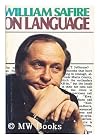
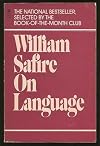
On Langauge
by William Safire
On This Page
Description
Written by a New York Times columnist renowned for his crotchety wit, this tome enlightens readers concerning proper usage, correct pronunciation, the roots of daily discourse, and the vacuous lingo in which "subsume" is co-opting "co-opt", word-burning stoves become "energy systems", and stores that sell eyeglasses squint out at the public as "vision centers". The author is aided in his campaign for precision and clarity in language by a legion of word buffs, language lovers, and learned show more eccentrics. show lessTags
Recommendations





















Member Reviews
An old collection of William Safire's New York Times columns on English words and their correct usage, most of which also feature short letters of feedback from his readers.
The question of what, exactly, constitutes "proper English" and who gets to define it can be a hugely contentious one. Personally, I believe that having and following rules (or having rules and breaking them judiciously) is a fairly important thing when it comes to communicating smoothly and effectively, and that people who wr1te liek, this!!! can't really be said to be behaving in a particularly civilized fashion. On the other hand, I have a vanishingly small amount of patience for people who try to impose arbitrary and ill-fitting rules on language, deride any show more usage they haven't known since childhood as barbarous, and get their kicks by wagging their fingers gleefully at their supposed linguistic inferiors. Safire makes an attempt to avoid being one of those second kind, but he does nevertheless tend to wander back and forth across the boundary of what I consider to be annoying prescriptivism. He's still interesting, though, and often entertaining to read, and I have come away from this thinking a little harder -- perhaps even a little too self-consciously -- about my own word choices.
Somewhat surprisingly, the fact that this was published in 1980 and consists of material written in the 70's actually makes it more worth reading rather than less. It was sort of fascinating to see what words and phrases he reports as being new and strange now seem perfectly ordinary and unremarkable, which have long since disappeared without trace, and which just feel old-fashioned. show less
The question of what, exactly, constitutes "proper English" and who gets to define it can be a hugely contentious one. Personally, I believe that having and following rules (or having rules and breaking them judiciously) is a fairly important thing when it comes to communicating smoothly and effectively, and that people who wr1te liek, this!!! can't really be said to be behaving in a particularly civilized fashion. On the other hand, I have a vanishingly small amount of patience for people who try to impose arbitrary and ill-fitting rules on language, deride any show more usage they haven't known since childhood as barbarous, and get their kicks by wagging their fingers gleefully at their supposed linguistic inferiors. Safire makes an attempt to avoid being one of those second kind, but he does nevertheless tend to wander back and forth across the boundary of what I consider to be annoying prescriptivism. He's still interesting, though, and often entertaining to read, and I have come away from this thinking a little harder -- perhaps even a little too self-consciously -- about my own word choices.
Somewhat surprisingly, the fact that this was published in 1980 and consists of material written in the 70's actually makes it more worth reading rather than less. It was sort of fascinating to see what words and phrases he reports as being new and strange now seem perfectly ordinary and unremarkable, which have long since disappeared without trace, and which just feel old-fashioned. show less
In my library this is one of the books that I would grab if the house caught fire. On Language was also the name of the weekly New York Times column where Safire wrote essays about grammar, syntax, and usage of the English language. I have re-read favorite essays many times. Here's his partial list of his never-say-neverism:
*Avoid run-on sentences they are hard to read.
*Don't use no double negatives.
*Use the semicolon properly, always use it where it is appropriate, and never where it isn't.
*Reserve the apostrophe for it's proper use and omit it when its not needed.
*Writing carefully, dangling participles must be avoided.
*Proofread carefully to see if you any words out.
His audience was well educated and responded even to small show more details. In his essay on coffee idioms, Safire reported a statistic on daily coffee consumption on a winter's day. Someone challenged him:
"Dear Mr. Safire....By the way, do Americans really drink 460 million cups a day? Even if half the country consumes coffee that would be four and a half cups per person each day. Does our country seem that awake to you?"
Many complain that English is complex, inconsistent, and mysterious. William Safire turned language study into playtime. show less
*Avoid run-on sentences they are hard to read.
*Don't use no double negatives.
*Use the semicolon properly, always use it where it is appropriate, and never where it isn't.
*Reserve the apostrophe for it's proper use and omit it when its not needed.
*Writing carefully, dangling participles must be avoided.
*Proofread carefully to see if you any words out.
His audience was well educated and responded even to small show more details. In his essay on coffee idioms, Safire reported a statistic on daily coffee consumption on a winter's day. Someone challenged him:
"Dear Mr. Safire....By the way, do Americans really drink 460 million cups a day? Even if half the country consumes coffee that would be four and a half cups per person each day. Does our country seem that awake to you?"
Many complain that English is complex, inconsistent, and mysterious. William Safire turned language study into playtime. show less
Ratings
Members
- Recently Added By
Author Information

39+ Works 5,061 Members
William Safire was born on Dec. 17, 1929. He attended Syracuse University, but dropped out after two years. He began his career as a reporter for The New York Herald Tribune. He had also been a radio and television producer and a U.S. Army correspondent. From 1955 to 1960, Safire was vice president of a public relations firm in New York City, and show more then became president of his own firm. He was responsible for bringing Nixon and Nikita Khrushchev together in 1959. In 1968, he joined the campaign of Richard Nixon as a senior White House speechwriter for Nixon. Safire joined The New York Times in 1973 as a political columnist. He also writes a Sunday column, On Language, which has appeared in The New York Times Magazine since 1979. This column on grammar, usage, and etymology has led to the publication of 10 books and made him the most widely read writer on the English language. William Safire was the winner of the 1978 Pulitzer Prize for distinguished commentary. He is a trustee for Syracuse University. Since 1995 he has served as a member of the Pulitzer Board. He is the author of Freedom (1987), a novel of Lincoln and the Civil War. His other novels include Full Disclosure (1977), Sleeper Spy (1995) and Scandalmonger (2000). His other titles include a dictionary, a history, anthologies and commentaries. (Bowker Author Biography) show less
Common Knowledge
- Canonical title
- On Langauge
- Original publication date
- 1980
- People/Characters
- William Safire
- Dedication
- To "Peter Porcupine"
- First words
- They were sitting around in the executive editor's office on the third floor of The New York Ties, breaking their heads over a new column in the Sunday Magazine.
- Last words
- (Click to show. Warning: May contain spoilers.)"One of the members said that after 4 o'clock in the afternoon, he had a hard time remembering the name of the committee, so we said that the hell with it and went back to House Foreign Affairs.
Classifications
- Genres
- Nonfiction, General Nonfiction, Reference
- DDC/MDS
- 428.00973 — Language English & Old English languages Standard English usage (Prescriptive linguistics) standard subdivisions and translation standard subdivisions History, geographic treatment, biography
- LCC
- PE1421 .S23 — Language and Literature English language English Modern English
Statistics
- Members
- 375
- Popularity
- 83,143
- Reviews
- 3
- Rating
- (3.85)
- Languages
- English
- Media
- Paper
- ISBNs
- 4
- ASINs
- 6