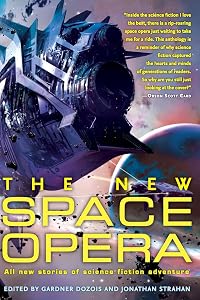
The New Space Opera
by Gardner Dozois (Editor), Jonathan Strahan (Editor)
The New Space Opera (1), Xeelee Sequence (Collections and Selections — Short Story - Remembrance)
On This Page
Description
This dazzling anthology includes epic interstellar adventures, tales of space and wonder, from some of the brightest names in science fiction. Authors include Kage Baker, Stephen Baxter, Gregory Benford, Tony Daniel, Greg Egan, Peter F. Hamilton, Gwyneth Jones, James Patrick Kelly, Nancy Kress, Ken Macleod, Paul J. McAuley, Ian McDonald, Robert Reed, Alastair Reynolds, Mary Rosenblum, Robert Silverberg, Dan Simmons, and Walter Jon Williams.Tags
Recommendations


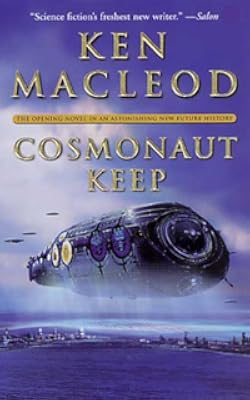
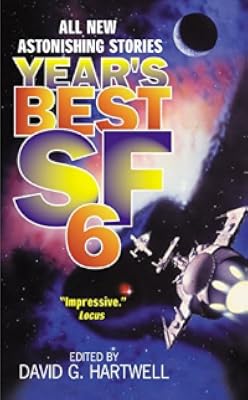
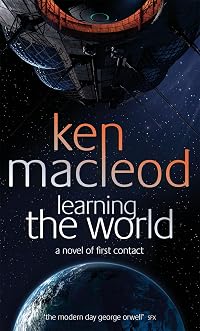
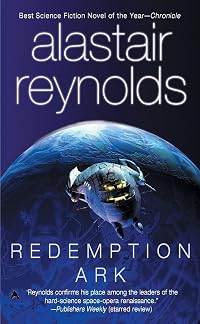
Member Recommendations
Member Reviews
Rating System:
5 Excellent
4 Very Good
3 Good
2 Fair
1 Poor
0 Awful
“Saving Tiamaat” by Gwyneth Jones - 2
“Verthandi’s Ring” by Ian McDonald - 2
“Hatch” by Robert Reed - 4
“Winning Peace” by Paul J. McAuley - 3
“Glory” by Greg Egan - 3
“Maelstorm” by Kage Baker - 5
“Blessed by an Angel” by Peter F. Hamilton - 5
“Who’s Afraid of Wolf 359?” by Ken Macleod - 4
“The Valley of the Gardens” by Tony Daniel - 5
“Dividing the Sustain” by James Patrick Kelly - 4
“Minla’s Flowers” by Alastair Reynolds - 5
“Splinters of Glass” by Mary Rosenblum - 5
“Remembrance” by Stephen Baxter - 4
“The Emperor and the Maula” by Robert Silverberg - 4
“The Worm Turns” by Greg Benford - 4
“Send Them Flowers” by Walter show more Jon Williams - 4
“Art of War” by Nancy Kress - 4
“Muse of Fire” by Dan Simmons - 5
The first two stories, “Saving Tiamaat” and “Verthandi’s Ring”, left me cold. I really didn’t connect with them, though the former ended well. The latter was so far in the future with vast time scales and god like technology that it seemed like I was reading mythology. After going 0 for 2, I was afraid that I might’ve made a mistake in picking up this book.
But the third story, “Hatch” by Robert Reed, got me. The story is the latest in a series of tales which take place on an alien constructed, Jupiter-sized starship circumnavigating the galaxy. Humans, and many other aliens, are just along for the ride.
“Winning Peace” and “Glory” were solid stories. The former dealt with a post-interstellar war treasure hunt while the latter concerned an archaeological dig on an alien world in the midst of a cold war threatening to turn hot.
Things took a turn for the better after that.
“Maelstorm” is about the amusing misadventures of a production company on Mars performing a retro form of entertainment known as “plays.”
There’s nothing amusing about the diabolical exploits of the titular character in “Blessed by an Angel.” It brought the promise of immortality, but the price was one’s soul. And “no” really wasn’t an answer it wanted to hear.
“Who’s Afraid of Wolf 359?” takes the clever play on words and runs with it.
“The Valley of the Gardens”, one of a few stories in which humanity gets its ass handed to it, skillfully pits bio-engineered humans versus an extra-universal lifeform that achieved sentience when the universe only contained subatomic particles.
“Dividing the Sustain” is another amusing tale in which humans re-engineer themselves with strange physical characteristics to avoid becoming stale.
“Minla’s Flowers” shows that no matter how hard you try to save a world from destruction, you inevitably wind up destroying it. Good intentions and roads to brimstone destinations and all that. This was my first Alastair Reynolds story. I'm now on my third book.
“Splinters of Glass” is an excellent tale of intrigue and love beneath the ice on Europa.
“Remembrance” is another Earth’s ass gets brutally kicked story. The problem is, no one remembers it. Well, one guy does.
“The Emperor and the Maula” is a bit gentler in its ass kicking of Earth. Humor salves the wound though. In order to save our world, a woman seeks an audience with the Emperor. But as Earth is considered barbaric, barbarians are to be executed upon setting foot upon the capitol world.
Corporations will always be up to shenanigans. Hostile takeovers for competitors will go on, whether the prize is greater telecom market share or wormholes. In “The Worm Turns” a plucky woman is sent out to traverse a wormhole before someone else can snatch away the rights to it.
“Send Them Flowers” lets us know that the laws of physics may change from one to universe to the next but love triangles are still messy.
History shows us that you can learn a lot about a culture by studying its art. In “Art of War” the same holds true for aliens, but whoever heard of soldiers as artists?
“Muse of Fire” ends the book on a spectacular note. A Shakespearean production company is tasked with performing various works of the Great Bard for humanity’s alien overlords. The performance of the work will determine whether our species lives or dies.
All in all, this is a great collection of stories that will please most sci-fi fans. Hard sci-fi purists are the only group that I don’t see enjoying this anthology. I’ll have to pick up volume two and see what great tales Messrs Dozois and Strahan have gathered for us to read. show less
5 Excellent
4 Very Good
3 Good
2 Fair
1 Poor
0 Awful
“Saving Tiamaat” by Gwyneth Jones - 2
“Verthandi’s Ring” by Ian McDonald - 2
“Hatch” by Robert Reed - 4
“Winning Peace” by Paul J. McAuley - 3
“Glory” by Greg Egan - 3
“Maelstorm” by Kage Baker - 5
“Blessed by an Angel” by Peter F. Hamilton - 5
“Who’s Afraid of Wolf 359?” by Ken Macleod - 4
“The Valley of the Gardens” by Tony Daniel - 5
“Dividing the Sustain” by James Patrick Kelly - 4
“Minla’s Flowers” by Alastair Reynolds - 5
“Splinters of Glass” by Mary Rosenblum - 5
“Remembrance” by Stephen Baxter - 4
“The Emperor and the Maula” by Robert Silverberg - 4
“The Worm Turns” by Greg Benford - 4
“Send Them Flowers” by Walter show more Jon Williams - 4
“Art of War” by Nancy Kress - 4
“Muse of Fire” by Dan Simmons - 5
The first two stories, “Saving Tiamaat” and “Verthandi’s Ring”, left me cold. I really didn’t connect with them, though the former ended well. The latter was so far in the future with vast time scales and god like technology that it seemed like I was reading mythology. After going 0 for 2, I was afraid that I might’ve made a mistake in picking up this book.
But the third story, “Hatch” by Robert Reed, got me. The story is the latest in a series of tales which take place on an alien constructed, Jupiter-sized starship circumnavigating the galaxy. Humans, and many other aliens, are just along for the ride.
“Winning Peace” and “Glory” were solid stories. The former dealt with a post-interstellar war treasure hunt while the latter concerned an archaeological dig on an alien world in the midst of a cold war threatening to turn hot.
Things took a turn for the better after that.
“Maelstorm” is about the amusing misadventures of a production company on Mars performing a retro form of entertainment known as “plays.”
There’s nothing amusing about the diabolical exploits of the titular character in “Blessed by an Angel.” It brought the promise of immortality, but the price was one’s soul. And “no” really wasn’t an answer it wanted to hear.
“Who’s Afraid of Wolf 359?” takes the clever play on words and runs with it.
“The Valley of the Gardens”, one of a few stories in which humanity gets its ass handed to it, skillfully pits bio-engineered humans versus an extra-universal lifeform that achieved sentience when the universe only contained subatomic particles.
“Dividing the Sustain” is another amusing tale in which humans re-engineer themselves with strange physical characteristics to avoid becoming stale.
“Minla’s Flowers” shows that no matter how hard you try to save a world from destruction, you inevitably wind up destroying it. Good intentions and roads to brimstone destinations and all that. This was my first Alastair Reynolds story. I'm now on my third book.
“Splinters of Glass” is an excellent tale of intrigue and love beneath the ice on Europa.
“Remembrance” is another Earth’s ass gets brutally kicked story. The problem is, no one remembers it. Well, one guy does.
“The Emperor and the Maula” is a bit gentler in its ass kicking of Earth. Humor salves the wound though. In order to save our world, a woman seeks an audience with the Emperor. But as Earth is considered barbaric, barbarians are to be executed upon setting foot upon the capitol world.
Corporations will always be up to shenanigans. Hostile takeovers for competitors will go on, whether the prize is greater telecom market share or wormholes. In “The Worm Turns” a plucky woman is sent out to traverse a wormhole before someone else can snatch away the rights to it.
“Send Them Flowers” lets us know that the laws of physics may change from one to universe to the next but love triangles are still messy.
History shows us that you can learn a lot about a culture by studying its art. In “Art of War” the same holds true for aliens, but whoever heard of soldiers as artists?
“Muse of Fire” ends the book on a spectacular note. A Shakespearean production company is tasked with performing various works of the Great Bard for humanity’s alien overlords. The performance of the work will determine whether our species lives or dies.
All in all, this is a great collection of stories that will please most sci-fi fans. Hard sci-fi purists are the only group that I don’t see enjoying this anthology. I’ll have to pick up volume two and see what great tales Messrs Dozois and Strahan have gathered for us to read. show less
An excellent anthology of short stories. Most of them are original for this collection, and they all have at least a modicum of literary merit. Dan Simmons’ “Muse of Fire” has more than a modicum.
This is a collection of stories that I expected to be more or less excellent and brilliant, but I ended up pretty disappointed. I was surprised by having several stories that I simply didn't like at all or thought were just too strange. Some were actually boring. I won't try to review or critique each of the 18 stories, although I'll comment on most. Every one of these stories is by an established and well regarded author. A number of the stories in the collection I felt were rather weak, and some also did not give me any of that "space opera" feeling that this collection is supposedly about. These stories are all over the map for style and quality and I certainly would not use this collection as an introduction to the genre of science show more fiction. A list of all the stories and authors (from ISFDB) follows my comments. There are some excellent stories in this collection but there is way too much yuck included here with them.
Another disappointment with this anthology lies with the introductions to the stories. To put it simply, most are lousy and not much more than a long recitation of all the various stories and novels written by the author. It would be nice to get a bit more or in most cases ANY information from the editors about why the story was chosen, what it represents, etc. Really lacking here for most stories.
The opening story, Gwyneth Jones' "Saving Tiamaat", was nearly incomprehensible and really put me off and I didn't even finish it. It seems to me to be a poor choice as an editor to start off with such a challenging difficult to comprehend story. I fear it also affected my enjoyment of the ultra far future story that followed by Ian McDonald, which I disliked also as being entirely too strange. I was about ready to bail on this collection at this point. Robert Reed's far future "Hatch" was better, and a little intriguing. I've read a lot of Reed's short fiction over the years and find it to be more hit than miss, but I didn't really like this either. The fourth story, Paul McAuley's "Winning Peace", a post space war prisoner escape yarn was the first story I actually sort of liked.
The fifth story here, Greg Egan's "Glory" is the first very good to excellent story in this anthology. A meld of hard science fiction with space opera where two mathmatician/archaeologists of a far future human culture encounter and insert themselves into a less advanced culture. The method of accomplishing this was mind boggling to me. A lot going on in this one and a little wild and "sense of wonder" at the start of it. Kage Baker's "Maelstrom", set on Mars, followed, but hardly space opera. Sometimes I enjoy Kage Baker's stories, sometimes not so much. "Maestrom" is one of those supposed to be clever and amusing stories that just didn't charm me for very long. Other readers might enjoy it more than I did.
Here's some trivia for Ken MacLeod's "Who's Afraid of Wolf 359?". The page headers in the uncorrected proof I read show the story as "Who's Afraid of Virginia Wolf 359?". An unmemorable story that I didn't like. Nor did I like James Patrick Kelly's "Dividing The Sustain".
I enjoyed Tony Daniel's inventive "The Valley of the Gardens" quite a lot until the end where it sort of rolled over and went to sleep. Alastair Reynolds' "Minla's Flowers" is the only story here that I have read before, and I liked it quite a bit, considering it one of the stronger stories in the collection, and I enjoyed re-reading it.
"Splinters of Glass", a novelette by Mary Rosenblum is set on Europa and was wonderfully inventive, exciting and rich with details and I liked it a lot. I wish more of the stories in this anthology were this good.
I'm a longtime fan of Robert Silverberg's stories. That bias may have slightly influenced my feeling that "The Emperor and the Maula" is one of the 2 or 3 best stories in this anthology. Nevertheless this is just a well told highly imaginative story set in the far future where humans were conquered by a huge galactic civilzation. A human woman, Laylah, travels against all taboos to the planet of the conquerors. More or less, this is Scheherazade in space. Wonderful story.
Dan Simmon's "Muse of Fire" is one of the other "best" stories in this anthology.
I have the second book in this series on hand which I may or may not tackle later this year.
•6 • Saving Tiamaat • shortstory by Gwyneth Jones
•24 • Verthandi's Ring • shortstory by Ian McDonald
•39 • Hatch • shortstory by Robert Reed
•66 • Winning Peace • shortstory by Paul J. McAuley
•88 • Glory • novelette by Greg Egan
•112 • Maelstrom • novelette by Kage Baker
•143 • Blessed by an Angel • shortstory by Peter F. Hamilton
•158 • Who's Afraid of Wolf 359? • shortstory by Ken MacLeod
•170 • The Valley of the Gardens • novelette by Tony Daniel
•202 • Dividing the Sustain • novelette by James Patrick Kelly
•234 • Minla's Flowers • novella by Alastair Reynolds
•291 • Splinters of Glass • novelette by Mary Rosenblum
•316 • Remembrance • shortstory by Stephen Baxter
•334 • The Emperor and the Maula • novelette by Robert Silverberg
•379 • The Worm Turns • shortstory by Gregory Benford
•401 • Send Them Flowers • novelette by Walter Jon Williams
•436 • Art of War • shortstory by Nancy Kress
•454 • Muse of Fire • novella by Dan Simmons show less
Another disappointment with this anthology lies with the introductions to the stories. To put it simply, most are lousy and not much more than a long recitation of all the various stories and novels written by the author. It would be nice to get a bit more or in most cases ANY information from the editors about why the story was chosen, what it represents, etc. Really lacking here for most stories.
The opening story, Gwyneth Jones' "Saving Tiamaat", was nearly incomprehensible and really put me off and I didn't even finish it. It seems to me to be a poor choice as an editor to start off with such a challenging difficult to comprehend story. I fear it also affected my enjoyment of the ultra far future story that followed by Ian McDonald, which I disliked also as being entirely too strange. I was about ready to bail on this collection at this point. Robert Reed's far future "Hatch" was better, and a little intriguing. I've read a lot of Reed's short fiction over the years and find it to be more hit than miss, but I didn't really like this either. The fourth story, Paul McAuley's "Winning Peace", a post space war prisoner escape yarn was the first story I actually sort of liked.
The fifth story here, Greg Egan's "Glory" is the first very good to excellent story in this anthology. A meld of hard science fiction with space opera where two mathmatician/archaeologists of a far future human culture encounter and insert themselves into a less advanced culture. The method of accomplishing this was mind boggling to me. A lot going on in this one and a little wild and "sense of wonder" at the start of it. Kage Baker's "Maelstrom", set on Mars, followed, but hardly space opera. Sometimes I enjoy Kage Baker's stories, sometimes not so much. "Maestrom" is one of those supposed to be clever and amusing stories that just didn't charm me for very long. Other readers might enjoy it more than I did.
Here's some trivia for Ken MacLeod's "Who's Afraid of Wolf 359?". The page headers in the uncorrected proof I read show the story as "Who's Afraid of Virginia Wolf 359?". An unmemorable story that I didn't like. Nor did I like James Patrick Kelly's "Dividing The Sustain".
I enjoyed Tony Daniel's inventive "The Valley of the Gardens" quite a lot until the end where it sort of rolled over and went to sleep. Alastair Reynolds' "Minla's Flowers" is the only story here that I have read before, and I liked it quite a bit, considering it one of the stronger stories in the collection, and I enjoyed re-reading it.
"Splinters of Glass", a novelette by Mary Rosenblum is set on Europa and was wonderfully inventive, exciting and rich with details and I liked it a lot. I wish more of the stories in this anthology were this good.
I'm a longtime fan of Robert Silverberg's stories. That bias may have slightly influenced my feeling that "The Emperor and the Maula" is one of the 2 or 3 best stories in this anthology. Nevertheless this is just a well told highly imaginative story set in the far future where humans were conquered by a huge galactic civilzation. A human woman, Laylah, travels against all taboos to the planet of the conquerors. More or less, this is Scheherazade in space. Wonderful story.
Dan Simmon's "Muse of Fire" is one of the other "best" stories in this anthology.
I have the second book in this series on hand which I may or may not tackle later this year.
•6 • Saving Tiamaat • shortstory by Gwyneth Jones
•24 • Verthandi's Ring • shortstory by Ian McDonald
•39 • Hatch • shortstory by Robert Reed
•66 • Winning Peace • shortstory by Paul J. McAuley
•88 • Glory • novelette by Greg Egan
•112 • Maelstrom • novelette by Kage Baker
•143 • Blessed by an Angel • shortstory by Peter F. Hamilton
•158 • Who's Afraid of Wolf 359? • shortstory by Ken MacLeod
•170 • The Valley of the Gardens • novelette by Tony Daniel
•202 • Dividing the Sustain • novelette by James Patrick Kelly
•234 • Minla's Flowers • novella by Alastair Reynolds
•291 • Splinters of Glass • novelette by Mary Rosenblum
•316 • Remembrance • shortstory by Stephen Baxter
•334 • The Emperor and the Maula • novelette by Robert Silverberg
•379 • The Worm Turns • shortstory by Gregory Benford
•401 • Send Them Flowers • novelette by Walter Jon Williams
•436 • Art of War • shortstory by Nancy Kress
•454 • Muse of Fire • novella by Dan Simmons show less
What is "space opera"? The introduction succinctly and accurately calls it romantic adventure science fiction told on a grand scale. It then traces the history of the sub-genre from its stirrings in the 1890s to its full-fledged birth in the 1920s to its nadir in the 1960s and 1970s, when the New Wave made it unfashionable, to its rebirth, while American authors were developing cyberpunk, at the hands of the British in the 1980s and 1990s.
For that grand scale, I'd specify vast scales of time and space and weaponry. The fate of species - their lives or at least their sanity and cultural viability - should be at stake and not some mere individual's happiness or survival. Some of the stories in this collection are good but not space show more opera. Some are both. But there aren't enough good stories of any type to give this collection a higher rating.
The following stories fall in the unsuccessful and not even space opera category. The setup for Gwyneth Jones "Saving Timaat", the narrator helping in the negotiations between representatives of two warring groups, the one cannibalistic predators on the other, is good but the emotional connection of the narrator to the cannibal chief and her motivations are too oblique. James Patrick Kelly's "Dividing the Sustain" is a would-be comedy of manners about a courier aboard a ship of communist colonists and the steps he takes to get close to the captain's estranged wife, subject of an unaccountable infatuation, and to avoid getting "stale", a consequence of longevity treatments. Not at all interesting. Nancy Kress has put out some wonderful work, particularly when she engages in speculating about the consequences of biotech. However, her "Art of War" seems just a writerly exercise in developing the title phrase into a story and playing around with the cliché of stern military father (here a stern military mom) and a disappointing son. The story's war between alien Teli and humans and the place each species' art plays in the struggle just didn't have the grand feel of space opera.
In the good but not space opera category are several works. Paul J. McAuley's "Winning Peace" has the flavor if not the plot of Sergio Leone's movie The Good, the Bad and the Ugly or a film noir. Its protagonist, sold into slavery after being taken prisoner in humanity's civil war, is offered freedom in exchange for aiding in the quest for an alien artifact. He, however, has other plans - as do all the human and alien principals in this story. Mary's Rosenblum's "Splinters of Glass" is a chase story initiated when the protagonist's old girlfriend, from whom he's been hiding, shows up with assassins in tow. He and the woman head out into the fissures of an ice world. Walter Jon Williams' "Sends Them Flowers" has an interesting background - alternate universes differentiated not by divergences from some historical point but slightly different physical laws - and a couple of interesting characters tramping about in their inherited spaceship. However, the problems of the duo, most of them caused by the womanizing of the ex-con, don't have the grandiosity required by space opera.
In the not very engaging but still space opera category are several stories. Kage Baker's "Maelstrom" gets in here solely because its Martian setting, with a group of misfits trying, in an unsuccessfully humorous plot, to stage Edgar Poe's "Descent into the Maelstrom" evokes the spirit of the American West, one of the spiritual ancestors of the space opera. Gregory Benford's "The Worm Turns", sequel to his "A Worm in the Well", has lots of hard science with a cometary prospector and her artificial intelligence heading through a wormhole. But I found the story, even with its encounters with aliens on the other side of the wormhole - they're not at all happy about seeing humans, the resulting conversations between the aliens and AI, and the banter between machine and prospector uninvolving. Robert Reed's "Hatch" has a promising set up: survivors of the Polypond War live on the outside of the Great Ship (setting for several Reed stories) and scavenge materials castoff by the cloud-like biomech Polypond. However, the ending is too obscure and wrecks an interesting story. Tony Daniel's "The Valley of the Gardens" has a key ingredient of space opera: a vast war between aliens from another universe and humans, a war humans are loosing, And the plot, alternating between the unexpected human victory in that war and its consequences on a young man's world, was intriguing. The payoff, though, seems another writerly exercise in contrived symmetry between the two halves of the story, and the relation between a soldier and his weapon a badly literalized metaphor.
Another story marred by a too neat plot contrivance is Ian McDonald's "Verthandi's Ring". However, it's not marred enough to keep it out of the good and space opera category. Like some of the best stories in this collection, it brings the red in tooth and claw Darwinian struggle for existence into the ecosystem of the whole universe. When two species with superscience compete, there can be no peaceful co-existence because each wants and needs all the material and energy resources of the universe. Here it is not a simple version of humanity struggling with the aliens but the many clades man has evolved into. Alien mathematical archaeology and how advanced cultures find the will to survive - as well as an opening of diamond hard science fiction describing an unusual alien probe - are in Greg Egan's excellent "Glory". Peter F. Hamilton's "Blessed by an Angel" is set in the universe of his Commonwealth. It shows that civil wars may be fought over how to control humanity's impulse to go into the box and embrace a life of lotus-eating in virtual reality. Here the conflict is not overt, doesn't involve fleets of ships, is fought with subversion and espionage but the stakes are still for the race's future. Ken Macleod is a socialist whose fiction is loved by libertarians. Here he brings his wry, cynical take on the futility of all political systems and combines it with evolutionary design strategy to show how the unfortunate inhabitants of Wolf 359 are part of an experiment to solve some old political problems. The title asks "Who's Afraid of Wolf 359?" It turns out that a lot of people should be. Alastair Reynold's "Minla's Flowers", part of his Husker sequence and direct prequel to "Merlin's Gun", has Merlin stumbling across a human world threatened with extinction, in 70 years, by a breakdown of the alien Waynet transportation network. In and out of stasis as he tries to help them develop the tech to migrate offworld, he watches a little girl develop into an unpleasant, Stalinesque leader. Stephen Baxter was one of the British revivers of space opera. His Xeelee story "Remembrance" features man's first encounter with alien invaders and the resulting bitter conflict, for which Baxter pulls out three nifty bits of diverse and credible science, teaches the hard lesson that peaceful co-existence between man and alien is a doomed and foolish notion. The redoubtable Robert Silverberg has a human woman from the backwater of an alien empire confront the Emperor and, reminiscent of Scherezade in the Arabian Nights, use her wiles to effect her purposes. "The Emperor and the Maula" doesn't really have the science and technology of new space opera, but it's definitely still space opera. One of the longest stories in the book, it's enthralling all the time. Also long and enthralling is Dan Simmon's "Muse of Fire". In a world of god-like aliens where humans are merely slaves, a troupe of Shakespearean actors is compelled to put on performances for their masters with the fate of humanity hanging in the balance. It manages to touch on the effects of art in a harsh world without engaging in easy pieties about art's power and benefits. show less
For that grand scale, I'd specify vast scales of time and space and weaponry. The fate of species - their lives or at least their sanity and cultural viability - should be at stake and not some mere individual's happiness or survival. Some of the stories in this collection are good but not space show more opera. Some are both. But there aren't enough good stories of any type to give this collection a higher rating.
The following stories fall in the unsuccessful and not even space opera category. The setup for Gwyneth Jones "Saving Timaat", the narrator helping in the negotiations between representatives of two warring groups, the one cannibalistic predators on the other, is good but the emotional connection of the narrator to the cannibal chief and her motivations are too oblique. James Patrick Kelly's "Dividing the Sustain" is a would-be comedy of manners about a courier aboard a ship of communist colonists and the steps he takes to get close to the captain's estranged wife, subject of an unaccountable infatuation, and to avoid getting "stale", a consequence of longevity treatments. Not at all interesting. Nancy Kress has put out some wonderful work, particularly when she engages in speculating about the consequences of biotech. However, her "Art of War" seems just a writerly exercise in developing the title phrase into a story and playing around with the cliché of stern military father (here a stern military mom) and a disappointing son. The story's war between alien Teli and humans and the place each species' art plays in the struggle just didn't have the grand feel of space opera.
In the good but not space opera category are several works. Paul J. McAuley's "Winning Peace" has the flavor if not the plot of Sergio Leone's movie The Good, the Bad and the Ugly or a film noir. Its protagonist, sold into slavery after being taken prisoner in humanity's civil war, is offered freedom in exchange for aiding in the quest for an alien artifact. He, however, has other plans - as do all the human and alien principals in this story. Mary's Rosenblum's "Splinters of Glass" is a chase story initiated when the protagonist's old girlfriend, from whom he's been hiding, shows up with assassins in tow. He and the woman head out into the fissures of an ice world. Walter Jon Williams' "Sends Them Flowers" has an interesting background - alternate universes differentiated not by divergences from some historical point but slightly different physical laws - and a couple of interesting characters tramping about in their inherited spaceship. However, the problems of the duo, most of them caused by the womanizing of the ex-con, don't have the grandiosity required by space opera.
In the not very engaging but still space opera category are several stories. Kage Baker's "Maelstrom" gets in here solely because its Martian setting, with a group of misfits trying, in an unsuccessfully humorous plot, to stage Edgar Poe's "Descent into the Maelstrom" evokes the spirit of the American West, one of the spiritual ancestors of the space opera. Gregory Benford's "The Worm Turns", sequel to his "A Worm in the Well", has lots of hard science with a cometary prospector and her artificial intelligence heading through a wormhole. But I found the story, even with its encounters with aliens on the other side of the wormhole - they're not at all happy about seeing humans, the resulting conversations between the aliens and AI, and the banter between machine and prospector uninvolving. Robert Reed's "Hatch" has a promising set up: survivors of the Polypond War live on the outside of the Great Ship (setting for several Reed stories) and scavenge materials castoff by the cloud-like biomech Polypond. However, the ending is too obscure and wrecks an interesting story. Tony Daniel's "The Valley of the Gardens" has a key ingredient of space opera: a vast war between aliens from another universe and humans, a war humans are loosing, And the plot, alternating between the unexpected human victory in that war and its consequences on a young man's world, was intriguing. The payoff, though, seems another writerly exercise in contrived symmetry between the two halves of the story, and the relation between a soldier and his weapon a badly literalized metaphor.
Another story marred by a too neat plot contrivance is Ian McDonald's "Verthandi's Ring". However, it's not marred enough to keep it out of the good and space opera category. Like some of the best stories in this collection, it brings the red in tooth and claw Darwinian struggle for existence into the ecosystem of the whole universe. When two species with superscience compete, there can be no peaceful co-existence because each wants and needs all the material and energy resources of the universe. Here it is not a simple version of humanity struggling with the aliens but the many clades man has evolved into. Alien mathematical archaeology and how advanced cultures find the will to survive - as well as an opening of diamond hard science fiction describing an unusual alien probe - are in Greg Egan's excellent "Glory". Peter F. Hamilton's "Blessed by an Angel" is set in the universe of his Commonwealth. It shows that civil wars may be fought over how to control humanity's impulse to go into the box and embrace a life of lotus-eating in virtual reality. Here the conflict is not overt, doesn't involve fleets of ships, is fought with subversion and espionage but the stakes are still for the race's future. Ken Macleod is a socialist whose fiction is loved by libertarians. Here he brings his wry, cynical take on the futility of all political systems and combines it with evolutionary design strategy to show how the unfortunate inhabitants of Wolf 359 are part of an experiment to solve some old political problems. The title asks "Who's Afraid of Wolf 359?" It turns out that a lot of people should be. Alastair Reynold's "Minla's Flowers", part of his Husker sequence and direct prequel to "Merlin's Gun", has Merlin stumbling across a human world threatened with extinction, in 70 years, by a breakdown of the alien Waynet transportation network. In and out of stasis as he tries to help them develop the tech to migrate offworld, he watches a little girl develop into an unpleasant, Stalinesque leader. Stephen Baxter was one of the British revivers of space opera. His Xeelee story "Remembrance" features man's first encounter with alien invaders and the resulting bitter conflict, for which Baxter pulls out three nifty bits of diverse and credible science, teaches the hard lesson that peaceful co-existence between man and alien is a doomed and foolish notion. The redoubtable Robert Silverberg has a human woman from the backwater of an alien empire confront the Emperor and, reminiscent of Scherezade in the Arabian Nights, use her wiles to effect her purposes. "The Emperor and the Maula" doesn't really have the science and technology of new space opera, but it's definitely still space opera. One of the longest stories in the book, it's enthralling all the time. Also long and enthralling is Dan Simmon's "Muse of Fire". In a world of god-like aliens where humans are merely slaves, a troupe of Shakespearean actors is compelled to put on performances for their masters with the fate of humanity hanging in the balance. It manages to touch on the effects of art in a harsh world without engaging in easy pieties about art's power and benefits. show less
An excellent selection of 18 tales in the "new space opera" genre, a somewhat darker, more hard-science take on the classic space opera stories. The editors provide an introduction to each story that will lead you to more of the author’s works. The stories themselves are engaging on their own, and are good representatives of the authors I’ve read elsewhere (I’ve already read novels by 13 of the 18). If you want to catch someone up on recent developments in science fiction writing, this is a good place to start.
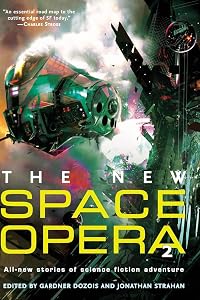
This is a good collection of modern scifi stories featuring some sort of conflicts with aliens. However, I have to disagree that there's any 'space opera' here. The preface mentions that there's a debate about what space opera means in today's genre. Old time space opera featured space ships and aliens and human heroes and space combat. There are heroes in these stories, mostly, and usually aliens, but some don't have spaceships, and there's definitely no space combat. I feel the title is very misleading. However, its still a great collection, even including Dan Simmon's obsession with Shakespeare.
I love space opera. Big galactic wars, spaceships as big as cities, empires that stretch across galaxies, big ideas, and fun to read in a light popcorn summer-movie way.
Unfortunately to many of these short stories aren't space opera at all - merely mediocre science fiction stories.
There are a few standouts; Dan Simmons does his usual terrific job at short fiction with "Muse of Fire" - who knew that Shakespeare will save us all in the future? Alastair Reynolds "Minla's Flowers" details how to advance a civilization in short order to advert a disaster - with unintended consequences. And my favorite "The Emperor and the Maula" written by the master Robert Silverberg that is a future retelling of the legend of Sheherazade beautifully written.
Unfortunately to many of these short stories aren't space opera at all - merely mediocre science fiction stories.
There are a few standouts; Dan Simmons does his usual terrific job at short fiction with "Muse of Fire" - who knew that Shakespeare will save us all in the future? Alastair Reynolds "Minla's Flowers" details how to advance a civilization in short order to advert a disaster - with unintended consequences. And my favorite "The Emperor and the Maula" written by the master Robert Silverberg that is a future retelling of the legend of Sheherazade beautifully written.
Members
- Recently Added By
Author Information

Gardner Dozois was born in Salem, Massachusetts on July 23, 1947. After working as an Army journalist, he became a science fiction and fantasy editor and author. He was the founding editor of The Year's Best Science Fiction anthologies and editor of Asimov's from 1984 until 2004. His work as an editor received more than 40 Hugo Awards, 40 Nebula show more Awards, and 30 Locus Awards. He received the Hugo Award for Best Professional Editor 15 times between 1988 and his retirement from Asimov's in 2004. He wrote books including Strangers and short stories including The Peacemaker and Morning Child, which won the Nebula Award for Short Story in 1983 and 1984, respectively. He also collaborated with George R. R. Martin on a series of themed anthologies including Songs of the Dying Earth, Old Mars, Dangerous Women, and Rogues. In 2011, Dozois was inducted into the Science Fiction Hall of Fame. He died on May 27, 2018 at the age of 70. (Bowker Author Biography) show less

Jonathan Strahan was born in 1964 in Belfast, Northern Ireland. He is an editor and publisher of science fiction. His family moved to Perth, Western Australia in 1968, and he graduated from the University of Western Australia with a Bachelor of Arts in 1986. In 1990 he co-founded Eidolon: The Journal of Australian Science Fiction and Fantasy, and show more worked on it as co-editor and co-publisher until 1999. He was also co-publisher of Eidolon Books which published Robin Pen's The Secret Life of Rubber-Suit Monsters, Howard Waldrop's Going Home Again, Storm Constantine's The Thorn Boy, and Terry Dowling's Blackwater Days. In 2015 he was nominated in the editor and anthology categories for the Locus Awards with the title Reach for Infinity. In 2018, he won the 2017 Aurealis Awards for the best Australian anthology for his book, Infinity Wars. (Bowker Author Biography) show less
All Editions
Some Editions
Awards and Honors
Awards
Series


Work Relationships
Contains
Common Knowledge
- Canonical title
- The New Space Opera
- Alternate titles
- The New Space Opera: All New Stories of Science Fiction Adventure
- Original publication date
- 2007
- Dedication
- For Jack Dann,
friend across two continents and two lifetimes,
and
for all those writers who have kept the paper spaceships
flying across the years - Blurbers
- Card, Orson Scott; Haldeman, Joe; Stross, Charles; Vinge, Vernor
- Original language
- English
Classifications
- Genres
- Science Fiction, Fiction and Literature
- DDC/MDS
- 813.0876608 — Literature & rhetoric American literature in English American fiction in English By type Genre fiction Adventure fiction Speculative fiction Fantasy Collections
- LCC
- PS648 .S3 .N47 — Language and Literature American literature American literature Collections of American literature Prose (General)
- BISAC
Statistics
- Members
- 621
- Popularity
- 47,138
- Reviews
- 22
- Rating
- (3.64)
- Languages
- Czech, English, French
- Media
- Paper, Audiobook, Ebook
- ISBNs
- 12
- ASINs
- 4