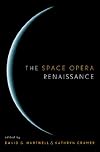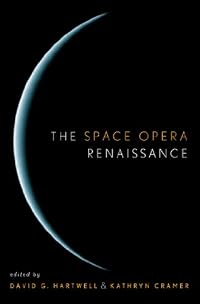
The Space Opera Renaissance
by David G. Hartwell (Editor), Kathryn Cramer (Editor)
Honor Harrington Universe (Collections and Selections — 09.07 "Ms. Midshipwoman Harrington")
On This Page
Description
"Space opera," once a derisive term for cheap pulp adventure, has come to mean something more in modern SF: compelling adventure stories told against a broad canvas, and written to the highest level of skill. Indeed, it can be argued that the "new space opera" is one of the defining streams of modern SF.Now, World Fantasy Award-winning anthologists David G. Hartwell and Kathryn Cramer have compiled a definitive overview of this subgenre, both as it was in the days of the pulp magazines, and show more as it has become in 2005. Included are major works from genre progenitors like Jack Williamson and Leigh Brackett, stylish midcentury voices like Cordwainer Smith and Samuel R. Delany, popular favorites like David Drake, Lois McMaster Bujold, and Ursula K. Le Guin, and modern-day pioneers such as Iain M. Banks, Steven Baxter, Scott Westerfeld, and Charles Stross.At the Publisher's request, this title is being sold without Digital Rights Management Software (DRM) applied. show lessTags
Recommendations









Member Recommendations
Member Reviews
The Space Opera Renaissance is the kind of book that deserves to drift in stately orbit around a gas giant while "Also sprach Zarathustra" plays. It's a massive tome of a book, 941 pages, 32 stories, close to 90 years of science fiction history. There are some very good stories in this collection. With this much diversity, you're sure to find something that you love, and the authors read like a who's who's of the field.
Space opera has always been something of an archaism, as science fiction tried to carve out a niche as serious literature. While early pioneers like E.E. 'Doc' Smith and Olaf Stapledon could imagine mythologies of cosmological scope, much of the early pulps were filled with poorly written adventurous tripe, the 'horse show more operas' of cheap western fiction redone on the Red Hills of Mars, rather than the Dakotas. Serious science fiction in the vein of Campbell's Astounding Science Fiction could discuss the engineering challenges of rocketry as a venue for a kind of Heinlein-Clarke 'competent hero', a man handier with a slide rule than a ray blaster. New Wave and cyberpunk turned defiant against outer space, conquering new realms of inner space and cyberspace. Yet the flame remained alive in the hands of M. John Harrison, and then a host of British retro-scifi writers (Banks, Hamilton, Reynolds) who imagined new kinds of post-imperial space opera. As fans, we love space opera, even as we're embarrassed by it.
Yet there's also an unbalanced quality to this collection, editorial choices that I found puzzling. No stories by Doc Smith or M. John Harrison, despite their status as grandmasters of the genre. Cramer and Hartwell use the page count to include complete novellas, but the early stories are some very rough pulps that outstay their welcome. Lois McMaster Bujold is represented by "Weatherman", which is a fantastic character study but entirely planetbound, while David Drake gets a fragment of a story about a Roman legion kidnapped and used as intersteller mercenaries, another mud bound adventure.
Space opera is a big tent of a sub-genre, but if I were to define it, it'd be about a certain grandeur of scope, of clashing planets and galaxies at stake, as well as a larger-than-life quality of its characters. It's a big universe, but with a fast spaceship, they can make it their own. There's lot of room to construct, parody, deconstruct the genre, to generate that necessary sensation of awe. There's a spot for a really great thematic collection, one that links the history of the genre to it's future, and frustratingly this is not that. I doubt anyone knew more about science-fiction than Hartwell, and Cramer was his partner of almost 20 years. So it's not enough for them to pick good stories. I want perfect stories, and this collection is about 500 pages overweight for perfection. show less
Space opera has always been something of an archaism, as science fiction tried to carve out a niche as serious literature. While early pioneers like E.E. 'Doc' Smith and Olaf Stapledon could imagine mythologies of cosmological scope, much of the early pulps were filled with poorly written adventurous tripe, the 'horse show more operas' of cheap western fiction redone on the Red Hills of Mars, rather than the Dakotas. Serious science fiction in the vein of Campbell's Astounding Science Fiction could discuss the engineering challenges of rocketry as a venue for a kind of Heinlein-Clarke 'competent hero', a man handier with a slide rule than a ray blaster. New Wave and cyberpunk turned defiant against outer space, conquering new realms of inner space and cyberspace. Yet the flame remained alive in the hands of M. John Harrison, and then a host of British retro-scifi writers (Banks, Hamilton, Reynolds) who imagined new kinds of post-imperial space opera. As fans, we love space opera, even as we're embarrassed by it.
Yet there's also an unbalanced quality to this collection, editorial choices that I found puzzling. No stories by Doc Smith or M. John Harrison, despite their status as grandmasters of the genre. Cramer and Hartwell use the page count to include complete novellas, but the early stories are some very rough pulps that outstay their welcome. Lois McMaster Bujold is represented by "Weatherman", which is a fantastic character study but entirely planetbound, while David Drake gets a fragment of a story about a Roman legion kidnapped and used as intersteller mercenaries, another mud bound adventure.
Space opera is a big tent of a sub-genre, but if I were to define it, it'd be about a certain grandeur of scope, of clashing planets and galaxies at stake, as well as a larger-than-life quality of its characters. It's a big universe, but with a fast spaceship, they can make it their own. There's lot of room to construct, parody, deconstruct the genre, to generate that necessary sensation of awe. There's a spot for a really great thematic collection, one that links the history of the genre to it's future, and frustratingly this is not that. I doubt anyone knew more about science-fiction than Hartwell, and Cramer was his partner of almost 20 years. So it's not enough for them to pick good stories. I want perfect stories, and this collection is about 500 pages overweight for perfection. show less
http://nwhyte.livejournal.com/1611839.html
Huge anthology (941 pages) of mostly excellent stories, very few of which I had actually read before (Lois McMaster Bujold's "Weatherman", Peter F. Hamilton's "Escape Route" and Allen Steele's "The Death of Captain Future" - all great stories), tracing the space opera sub-genre through the decades. It's not always my favourite mode (and I found myself choking at short stories by a couple of writers whose longer works I have also bounced off) but the selection is generally good. In particular I appreciated the early stories from Edmond Hamilton, Jack Williamon, Clive Jackson and especially Leigh Brackett ("Enchantress of Venus") - shamefully, I am not sure that I had read anything at all by her show more previously, but I must repair that omission. The longest story is "The Survivor" by Donald Kingsbury, set in the Man-Kzin wars cycle originated by Larry Niven, a gruesome and disturbing though well-written tale. In general this is well worth looking out for. show less
Huge anthology (941 pages) of mostly excellent stories, very few of which I had actually read before (Lois McMaster Bujold's "Weatherman", Peter F. Hamilton's "Escape Route" and Allen Steele's "The Death of Captain Future" - all great stories), tracing the space opera sub-genre through the decades. It's not always my favourite mode (and I found myself choking at short stories by a couple of writers whose longer works I have also bounced off) but the selection is generally good. In particular I appreciated the early stories from Edmond Hamilton, Jack Williamon, Clive Jackson and especially Leigh Brackett ("Enchantress of Venus") - shamefully, I am not sure that I had read anything at all by her show more previously, but I must repair that omission. The longest story is "The Survivor" by Donald Kingsbury, set in the Man-Kzin wars cycle originated by Larry Niven, a gruesome and disturbing though well-written tale. In general this is well worth looking out for. show less
I came to this book with a fairly clear definition in my own mind as to what space opera is: a science fiction adventure story with a healthy dash of escapism, typically built around swashbuckling and/or western tropes, with the underlying assurance that in the end good will triumph over evil. For me space opera isn’t supposed to make any pretense of a following the laws of physics, economics, or evolutionary biology. The original Star Wars trilogy and the Miles Vorkosigan books (both of which I love dearly), are paradigms of space opera in my eyes.
After reading this book (which, at 941 pages, took me about two months to get through), I’m still not entirely sure that I understand what David Hartwell and Kathryn Cramer think Space show more Opera is. Anything scifi and “epic,” as far as I can tell, which seems a useless and trivial definition to me.
All but five of the 32 included stories were new to me, and I certainly found a few authors whose work I will further investigate. Coming to a subgenre survey anthology like this one expects to like some of the stories, and not be crazy about others, and that was indeed my experience here. Of the stories that were new to me, my favorites were “Empire Star” by Samuel R. Delany, “Ring Rats” by R Garcia y Robertson, “Enchantress of Venus” by Leigh Brackett, “Grist” by Tony Daniel and the delicious parody “Space Opera” by Michael Kandel. On the other end of the spectrum, I gave 3s and 4s (out of 10) to “The Swordsmen of Varnis” by Clive Jackson, “The Great Game” by Stephen Baxter, “Lost Sorceress of the Silent Citadel” by Michael Moorcock, “Aurora in Four Voices” by Catherine Asaro, “The Star Steelers” by Edmond Hamilton, and “Fool’s Errand” by Sarah Zettel.
The introductory materials were well done. show less
After reading this book (which, at 941 pages, took me about two months to get through), I’m still not entirely sure that I understand what David Hartwell and Kathryn Cramer think Space show more Opera is. Anything scifi and “epic,” as far as I can tell, which seems a useless and trivial definition to me.
All but five of the 32 included stories were new to me, and I certainly found a few authors whose work I will further investigate. Coming to a subgenre survey anthology like this one expects to like some of the stories, and not be crazy about others, and that was indeed my experience here. Of the stories that were new to me, my favorites were “Empire Star” by Samuel R. Delany, “Ring Rats” by R Garcia y Robertson, “Enchantress of Venus” by Leigh Brackett, “Grist” by Tony Daniel and the delicious parody “Space Opera” by Michael Kandel. On the other end of the spectrum, I gave 3s and 4s (out of 10) to “The Swordsmen of Varnis” by Clive Jackson, “The Great Game” by Stephen Baxter, “Lost Sorceress of the Silent Citadel” by Michael Moorcock, “Aurora in Four Voices” by Catherine Asaro, “The Star Steelers” by Edmond Hamilton, and “Fool’s Errand” by Sarah Zettel.
The introductory materials were well done. show less
I was very excited to receive this book, as Tor is an outstanding publisher, Hartwell an excellent editor, and space opera perhaps my favorite genre in all forms of literatrure. The fundamental problem with this book , alas, is that space opera, by definition, is expansive. Short form space opera is like short form opera: a sort of YouTube version of the good stuff.
After a year of effort going through this anthology, here are my impressions.
+ is hit, - is miss:
+ The Star Stealers (1929) by Edmond Hamilton
Alien cones piloting a dark star attempt to steal the Sun.
+ The Prince of Space (1931) by Jack Williamson
Martian invasion thwarted by mysterious privateer and a scientist.
+ Enchantress of Venus (1949) by Leigh Brackett
John Stark has savage eyes and kicks ass... on Venus.
+ The Swordsmen of Varnis (1953) by Clive Jackson
Light hearted jab at space opera clichés and their incongruences.
- The Game of Rat and Dragon (1955) by Cordwainer Smith
Space demons fought with help from telepathic cats.
+ Empire Star (1966) by Samuel R. Delany
An education in time travel and different perspectives on life.
- show more Zirn Left Unguarded, the Jenghik Palace in Flames, Jon Westerley Dead (1972) by Robert Sheckley
A mangled pastiche.
+ Temptation (1999) by David Brin
Dolphins choose between fantasy and reality.
- Ranks of Bronze (1986) by David Drake
Roman mercenaries fight for aliens without too many questions.
+ Weatherman (1990) by Lois McMaster Bujold
Mystery on a cold military camp. Miles Vorkosigan an imperial spy is born.
- A Gift from Culture (1987) by Iain M. Banks
Incoherent story of terrorism with smart weapons.
+ Orphans of the Helix (1999) by Dan Simmons
Posthumans resolve an interplanetary misunderstanding, save lives.
- The Well Wishers (1997) by Colin Greenland
Hardboiled spacewoman pesters a has-been starlet on Neptunian moon.
+ Escape Route (1987) by Peter F. Hamilton
Spaceship captain outsmarts foes with time loops.
- Ms. Midshipwoman Harrington (2001) by David Weber
Career advancement for a space cadet with an annoyingly cute pet.
- Aurora in Four Voices (1998) by Catherine Asaro
Rescue of a luddite framed and trapped by a mad artist.
+ Ring Rats (2002) by R. Garcia y Robertson
Space urchin outsmarts criminals, becomes hero.
+ The Death of Captain Future (1995) by Allen Steele
Asteroid threatens Mars and a plague the rest of humanity; a madman dies.
+ A Worm in the Well (1995) by Gregory Benford
Exotic gravitating object makes a fortune for a freelance pilot.
- The Survivor (1991) by Donald M. Kingsbury
A repulsive alien experiments with human brains and FTL.
+ Fool's Errand (1993) by Sarah Zettel
Resident space ship entertainers have a special relationship with AIs.
- The Shobies' Story (1990) by Ursula K. Le Guin
The sensors don't work. Right! Lets make shit up about what they should read.
- The Remoras (1994) by Robert Reed
Genetic engineering envy leads to humiliation and debt.
- Recording Angel (1995) by Paul J. McAuley
A human leads a world of mostly mindless drones to revolt.
- The Great Game (2003) by Stephen Baxter
War in space for war's sake... and dark matter.
- Lost Sorceress of the Silent Citadel (2002) by Michael Moorcock
Homage to Leigh Brackett, as if only names were changed.
+ Space Opera (1997) by Michael Kandel
Humorous review of a fictional Space Opera opera.
- Grist (1998) by Tony Daniel
Nanotechnology, time travel, and interplanetary war.
+ The Movements of Her Eyes (2000) by Scott Westerfeld
Human girl and her AI growing up and rebelling together.
- Spirey and the Queen (1996) by Alastair Reynolds
Robots acquire sentience and a plan, keep bios around just in case.
- Bear Trap (2000) by Charles Stross
Elaborate setup for a financial lingo pun.
+ Guest Law (1997) by John C. Wright
Moral tradition from legend. Legend from a kernel of truth. show less
+ is hit, - is miss:
+ The Star Stealers (1929) by Edmond Hamilton
Alien cones piloting a dark star attempt to steal the Sun.
+ The Prince of Space (1931) by Jack Williamson
Martian invasion thwarted by mysterious privateer and a scientist.
+ Enchantress of Venus (1949) by Leigh Brackett
John Stark has savage eyes and kicks ass... on Venus.
+ The Swordsmen of Varnis (1953) by Clive Jackson
Light hearted jab at space opera clichés and their incongruences.
- The Game of Rat and Dragon (1955) by Cordwainer Smith
Space demons fought with help from telepathic cats.
+ Empire Star (1966) by Samuel R. Delany
An education in time travel and different perspectives on life.
- show more Zirn Left Unguarded, the Jenghik Palace in Flames, Jon Westerley Dead (1972) by Robert Sheckley
A mangled pastiche.
+ Temptation (1999) by David Brin
Dolphins choose between fantasy and reality.
- Ranks of Bronze (1986) by David Drake
Roman mercenaries fight for aliens without too many questions.
+ Weatherman (1990) by Lois McMaster Bujold
Mystery on a cold military camp. Miles Vorkosigan an imperial spy is born.
- A Gift from Culture (1987) by Iain M. Banks
Incoherent story of terrorism with smart weapons.
+ Orphans of the Helix (1999) by Dan Simmons
Posthumans resolve an interplanetary misunderstanding, save lives.
- The Well Wishers (1997) by Colin Greenland
Hardboiled spacewoman pesters a has-been starlet on Neptunian moon.
+ Escape Route (1987) by Peter F. Hamilton
Spaceship captain outsmarts foes with time loops.
- Ms. Midshipwoman Harrington (2001) by David Weber
Career advancement for a space cadet with an annoyingly cute pet.
- Aurora in Four Voices (1998) by Catherine Asaro
Rescue of a luddite framed and trapped by a mad artist.
+ Ring Rats (2002) by R. Garcia y Robertson
Space urchin outsmarts criminals, becomes hero.
+ The Death of Captain Future (1995) by Allen Steele
Asteroid threatens Mars and a plague the rest of humanity; a madman dies.
+ A Worm in the Well (1995) by Gregory Benford
Exotic gravitating object makes a fortune for a freelance pilot.
- The Survivor (1991) by Donald M. Kingsbury
A repulsive alien experiments with human brains and FTL.
+ Fool's Errand (1993) by Sarah Zettel
Resident space ship entertainers have a special relationship with AIs.
- The Shobies' Story (1990) by Ursula K. Le Guin
The sensors don't work. Right! Lets make shit up about what they should read.
- The Remoras (1994) by Robert Reed
Genetic engineering envy leads to humiliation and debt.
- Recording Angel (1995) by Paul J. McAuley
A human leads a world of mostly mindless drones to revolt.
- The Great Game (2003) by Stephen Baxter
War in space for war's sake... and dark matter.
- Lost Sorceress of the Silent Citadel (2002) by Michael Moorcock
Homage to Leigh Brackett, as if only names were changed.
+ Space Opera (1997) by Michael Kandel
Humorous review of a fictional Space Opera opera.
- Grist (1998) by Tony Daniel
Nanotechnology, time travel, and interplanetary war.
+ The Movements of Her Eyes (2000) by Scott Westerfeld
Human girl and her AI growing up and rebelling together.
- Spirey and the Queen (1996) by Alastair Reynolds
Robots acquire sentience and a plan, keep bios around just in case.
- Bear Trap (2000) by Charles Stross
Elaborate setup for a financial lingo pun.
+ Guest Law (1997) by John C. Wright
Moral tradition from legend. Legend from a kernel of truth. show less
An anthology of science fiction stories, from the 60s on.
Ratings
Members
- Recently Added By
Author Information


All Editions
Some Editions
Series

Work Relationships
Is contained in
Common Knowledge
- Canonical title
- The Space Opera Renaissance
- Original publication date
- 2007-07
Classifications
- Genres
- Science Fiction, Fiction and Literature
- DDC/MDS
- 813.0876208 — Literature & rhetoric American literature in English American fiction in English By type Genre fiction Adventure fiction Speculative fiction Science fiction Collections and anthologies Anthologies
- LCC
- PS648 .S3 .S55 — Language and Literature American literature American literature Collections of American literature Prose (General)
- BISAC
Statistics
- Members
- 304
- Popularity
- 104,946
- Reviews
- 6
- Rating
- (3.64)
- Languages
- English
- Media
- Paper, Ebook
- ISBNs
- 3
- ASINs
- 3