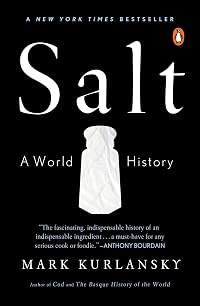
Salt: A World History
by Mark Kurlansky
On This Page
Description
Mark Kurlansky, the bestselling author of Cod and The Basque History of the World, here turns his attention to a common household item with a long and intriguing history: salt. The only rock we eat, salt has shaped civilization from the very beginning, and its story is a glittering, often surprising part of the history of humankind. A substance so valuable it served as currency, salt has influenced the establishment of trade routes and cities, provoked and financed wars, secured empires, and show more inspired revolutions. Populated by colorful characters and filled with an unending series of fascinating details, Kurlansky's kaleidoscopic history is a supremely entertaining, multi-layered masterpiece.. show less
Tags
Recommendations






Member Recommendations
Member Reviews
Leave it to Kurlansky to take an ordinary item like salt and make it utterly fascinating. Who knew how much of our world was shaped by the need for salt? Wars were fought over it, and civilizations rose and fell because of it. True to form, Kurlansky's book is accessible, far-reaching, and all but un-put-downable.
Homer called salt a divine substance. Plato described it as especially dear to the gods. Today we take salt for granted, a common, inexpensive substance that seasons food or clears ice from roads, a word used casually in expressions ("salt of the earth," take it with a grain of salt") without appreciating their deeper meaning. However, as Mark Kurlansky so brilliantly relates in his world- encompassing new book, salt—the only rock we eat—has shaped civilization from the very beginning. Its story is a glittering, often surprising part of the history of mankind. Until about 100 years ago, when modern chemistry and geology revealed how prevalent it is, salt was one of the most sought-after commodities, and no wonder, for without it show more humans and animals could not live. Salt has often been considered so valuable that it served as currency, and it is still exchanged as such in places today. Demand for salt established the earliest trade routes, across unknown oceans and the remotest of deserts: the city of Jericho was founded almost 10,000 years ago as a salt trading center. Because of its worth, salt has provoked and financed some wars, and been a strategic element in others, such as the American Revolution and the Civil War. Salt taxes secured empires across Europe and Asia and have also inspired revolution (Gandhi's salt march in 1930 began the overthrow of British rule in India); indeed, salt has been central to the age-old debate about the rights of government to tax and control economies. The story of salt encompasses fields as disparate as engineering, religion, and food, all of which Kurlansky richly explores. Few endeavors have inspired more ingenuity than salt making, from the natural gas furnaces of ancient China to the drilling techniques that led to the age of petroleum, and salt revenues have funded some of the greatest public works in history, including the Erie Canal, and even cities (Syracuse, New York). Salt's ability to preserve and to sustain life has made it a metaphorical symbol in all religions. Just as significantly, salt has shaped the history of foods like cheese, sauerkraut, olives, and more, and Kurlansky, an award-winning food writer, conveys how they have in turn molded civilization and eating habits the world over. Salt is veined with colorful characters, from Li Bing, the Chinese bureaucrat who built the world's first dam in 250 BC, to Pattillo Higgins and Anthony Lucas who, ignoring the advice of geologists, drilled an east Texas salt dome in 1901 and discovered an oil reserve so large it gave birth to the age of petroleum. From the sinking salt towns of Cheshire in England to the celebrated salt mine on Avery Island in Louisiana; from the remotest islands in the Caribbean where roads are made of salt to rural Sichaun province, where the last home-made soya sauce is made, Mark Kurlansky has produced a kaleidoscope of history, a multi-layered masterpiece that blends economic, scientific, political, religious, and culinary records into a rich and memorable tale. show less
An entire book about salt? Is this even possible?
Mark Kurlansky pulls it off admirably in his own style, looking at human history by tracing its interaction with salt.
Salt has been a purifier, preservative, medicine, even money. Hundreds of places around the world are named for their connection to salt. Explorers made it across great oceans because of salt. Even language has been heavily impacted by salt.
This is sneakily one of the best non-fiction books ever. Kurlansky takes something we all overlook and makes us appreciate its role in our lives.
This is the book that started me reading History again. Well, maybe not the book, but certainly an important book.
More reviews at my WordPress site, Ralphsbooks.
Mark Kurlansky pulls it off admirably in his own style, looking at human history by tracing its interaction with salt.
Salt has been a purifier, preservative, medicine, even money. Hundreds of places around the world are named for their connection to salt. Explorers made it across great oceans because of salt. Even language has been heavily impacted by salt.
This is sneakily one of the best non-fiction books ever. Kurlansky takes something we all overlook and makes us appreciate its role in our lives.
This is the book that started me reading History again. Well, maybe not the book, but certainly an important book.
More reviews at my WordPress site, Ralphsbooks.
So, I love microhistories. There's just something SO satisfying about learning a lot about the world by ostensibly learning about something small and contained. And Salt is basically the ur-microhistory -- one of the first and most famous books in the genre.
By my typical standards of microhistory, Salt is a win: every conversation I had while reading it eventually came around to me saying something like "so did you know that one of the major advantages of the North in the civil war is that they had more salt mines?" and (since I read it while in Austria) "did you know that they used to open salt mines to the general public as adventure rides?" And I did learn a lot about (broader) history through the infinity stories of "this area used show more to belong to tribe, but nation came and took it over because it had a good access to sea salt" but overall, I found the book boring. Not that the topic was boring, but, well Kurlansky's writing style was not ideal for me...he simply doesn't have any form of linking information. He'll state a sentence but not link it to related concepts in the chapter, or provide any sort of information about why that particular fact is interesting. If background information is needed for context he doesn't provide it. My own textbook writing is filled with linking phrases like "therefore, it follows that..." or "in light of this, it's particularly interesting that..." to keep the reader grounded in how things relate to each other. Also, each chapter contains recipes for no clear reason. Often the recipes use quantities that aren't defined anywhere and Kurlansky won't tell us what he intends the recipe to be an example of?
Kurlansky also perseverates on some topics: like salted fish. I think there were three chapters on salted fish, and yes, this is a microhistory, but there's really a limit of how much I want to know about salted fish.
But the content was excellent and I'm glad I read it. Just, next time, hopefully with any degree of structure show less
By my typical standards of microhistory, Salt is a win: every conversation I had while reading it eventually came around to me saying something like "so did you know that one of the major advantages of the North in the civil war is that they had more salt mines?" and (since I read it while in Austria) "did you know that they used to open salt mines to the general public as adventure rides?" And I did learn a lot about (broader) history through the infinity stories of "this area used show more to belong to tribe, but nation came and took it over because it had a good access to sea salt" but overall, I found the book boring. Not that the topic was boring, but, well Kurlansky's writing style was not ideal for me...he simply doesn't have any form of linking information. He'll state a sentence but not link it to related concepts in the chapter, or provide any sort of information about why that particular fact is interesting. If background information is needed for context he doesn't provide it. My own textbook writing is filled with linking phrases like "therefore, it follows that..." or "in light of this, it's particularly interesting that..." to keep the reader grounded in how things relate to each other. Also, each chapter contains recipes for no clear reason. Often the recipes use quantities that aren't defined anywhere and Kurlansky won't tell us what he intends the recipe to be an example of?
Kurlansky also perseverates on some topics: like salted fish. I think there were three chapters on salted fish, and yes, this is a microhistory, but there's really a limit of how much I want to know about salted fish.
But the content was excellent and I'm glad I read it. Just, next time, hopefully with any degree of structure show less
Much like Mark Felt's advice to Woodward and Bernstein to "follow the money," Mark Kurlansky follows the salt wherever it may lead. Salt: A World History is truly global in its scope, traveling from ancient China and Egypt to Morton Salt, often jumping between geographically disparate regions to follow the themes of salt mining, salt as a food preservative, and modern understandings of salt. At first, these leaps may jar the reader, but the larger themes are easily apparent and the internal logic holds true.
Kurlansky appears to have left no possible source unmentioned and his work touches on politics, religion, language, food, technology, trade, travel, and every other topic remotely related to salt. His book could easily serve as a show more world history primer for those who have never pursued an academic interest in history while simultaneously offering new insights to academic historians. In his introduction, Kurlansky writes, "The search for love and the search for wealth are always the two best stories. But while a love story is timeless, the story of a quest for wealth, given enough time, will always seem like the vain pursuit of a mirage" (p. 13). Though there are no longer wars to control salt, Kurlansky so thoroughly demonstrates its importance both throughout history and in modern times, that readers could never view the various quests for salt as pursuits of a mirage. Kurlansky has succeeded in writing that rare work: a readable and comprehensive history book. show less
Kurlansky appears to have left no possible source unmentioned and his work touches on politics, religion, language, food, technology, trade, travel, and every other topic remotely related to salt. His book could easily serve as a show more world history primer for those who have never pursued an academic interest in history while simultaneously offering new insights to academic historians. In his introduction, Kurlansky writes, "The search for love and the search for wealth are always the two best stories. But while a love story is timeless, the story of a quest for wealth, given enough time, will always seem like the vain pursuit of a mirage" (p. 13). Though there are no longer wars to control salt, Kurlansky so thoroughly demonstrates its importance both throughout history and in modern times, that readers could never view the various quests for salt as pursuits of a mirage. Kurlansky has succeeded in writing that rare work: a readable and comprehensive history book. show less
Absolutely gorgeous and thought provoking book about humanity's relationship with the only rock we eat. From the very first handful of paragraphs, it's obvious the author has a keen interest in the subject, and a sharp sense of humour. Every chapter is mind blowing. Ancient and far reaching, the story of this ubiquitous compound that has changed lives around the dinner table and altered the path of empires is truly enlightening. Highly recommend it.
I didn’t know exactly what I was getting into when I picked up Salt, but what I got was quite literally a world history of salt. At its core, this book asserts that “since the beginning of civilization, salt was one of the most sought-after commodities in human history.” I can’t say I’ve ever put that much though into salt beyond its use as a condiment.
Salt is not meant to be a sexy book, but it captured the complexities of salt with more appeal than I expected. I would assume that most people think about salt for its culinary uses, and Kurlansky pays a lot of attention to how different cultures used salt for maintaining food supplies with limited technologies. By the end of the book, though, I was tired of reading about show more salted meat and fish. Salt is good for more than just cooking, though, so Kurlanksy gave examples of various cultural or local practices that made salt significant – these included burial practices and transportation uses.
There is a significant focus on methods of gathering salt, from early solar evaporation of brine to more modern drilling. While not the most provocative of topics, Kurlanksy uses the development in production methods to underscore how salt was used to prop up socioeconomic inequality across every society examined. These tied into the larger picture of how salt was used as a financial commodity. I found this aspect of the book to be most compelling as it spun salt through some of the most significant world events of recorded history. Control of salt sources was often as political as economic, and Kurlansky highlighted salt’s role in colonialism in Africa, the Americas and the Caribbean. Understanding how societies developed or collapsed as a result of salt abundance or scarcity was a welcome surprise, as was the look at how societies were shaped by the exploitation of just one natural resource.
While Salt is both interesting and informative, it’s also long. I suspect the same depth and quality of information could have been achieved with more intentional editing. I also found the recipes dispensable. While these illustrated techniques for how various societies used salt and or recipes for which salt was a significant ingredient, they also felt cumbersome and redundant after a few chapters.
I found Salt to be an enjoyable, if not lengthy, read. It’s best enjoyed in spurts, as I often found I needed a break after a few chapters to cleanse my reading palate. Nonetheless, it’s a different lens through which to look at ancient and modern society and how the control of one resource was integral to every culture, for better or for worse. show less
Salt is not meant to be a sexy book, but it captured the complexities of salt with more appeal than I expected. I would assume that most people think about salt for its culinary uses, and Kurlansky pays a lot of attention to how different cultures used salt for maintaining food supplies with limited technologies. By the end of the book, though, I was tired of reading about show more salted meat and fish. Salt is good for more than just cooking, though, so Kurlanksy gave examples of various cultural or local practices that made salt significant – these included burial practices and transportation uses.
There is a significant focus on methods of gathering salt, from early solar evaporation of brine to more modern drilling. While not the most provocative of topics, Kurlanksy uses the development in production methods to underscore how salt was used to prop up socioeconomic inequality across every society examined. These tied into the larger picture of how salt was used as a financial commodity. I found this aspect of the book to be most compelling as it spun salt through some of the most significant world events of recorded history. Control of salt sources was often as political as economic, and Kurlansky highlighted salt’s role in colonialism in Africa, the Americas and the Caribbean. Understanding how societies developed or collapsed as a result of salt abundance or scarcity was a welcome surprise, as was the look at how societies were shaped by the exploitation of just one natural resource.
While Salt is both interesting and informative, it’s also long. I suspect the same depth and quality of information could have been achieved with more intentional editing. I also found the recipes dispensable. While these illustrated techniques for how various societies used salt and or recipes for which salt was a significant ingredient, they also felt cumbersome and redundant after a few chapters.
I found Salt to be an enjoyable, if not lengthy, read. It’s best enjoyed in spurts, as I often found I needed a break after a few chapters to cleanse my reading palate. Nonetheless, it’s a different lens through which to look at ancient and modern society and how the control of one resource was integral to every culture, for better or for worse. show less
Members
- Recently Added By
Published Reviews
Who would have thought that musings on an edible rock could run to 450 breathless pages?
Let me hasten to add that Salt turns out to be far from boring. With infectious enthusiasm, Kurlansky leads the reader on a 5,000-year sodium chloride odyssey through China, India, Egypt, Japan, Morocco, Israel, Africa, Italy, Spain, Germany, Austria, England, Scandinavia, France and the US, highlighting show more the multifarious ways in which this unassuming chemical compound has profoundly influenced people's lives. show less
Let me hasten to add that Salt turns out to be far from boring. With infectious enthusiasm, Kurlansky leads the reader on a 5,000-year sodium chloride odyssey through China, India, Egypt, Japan, Morocco, Israel, Africa, Italy, Spain, Germany, Austria, England, Scandinavia, France and the US, highlighting show more the multifarious ways in which this unassuming chemical compound has profoundly influenced people's lives. show less
added by mysterymax
Lists

Best "Foodie" Books
114 works; 40 members

r/History Recommended Reading List
603 works; 12 members

2021 Christmas Gifts
66 works; 13 members

Books Read in 2016
4,666 works; 197 members

SomethingAwful TBB BOTM
66 works; 2 members

r/AskHistorians' Recommended Books
1,068 works; 19 members

The r/Chemistry Recommended Books
87 works; 1 member

Books Read in 2023
5,638 works; 147 members

What do you know about Food?
13 works; 1 member

Weirdo Nonfiction
138 works; 3 members

Unread books
1,063 works; 87 members
Author Information

49+ Works 21,565 Members
Mark Kurlansky is the author of The Basque History of the World, the New York Times bestseller Cod: A Biography of the Fish that Changed the World (among the New York Public Library's Best Books of the Year in 1998), as well as A Chosen Few: The Resurrection of European Jewry; A Continent of Islands: Searching for the Caribbean Destiny, and show more several acclaimed works of short fiction and journalism about the Caribbean. He spent seven years as the Caribbean correspondent for the Chicago Tribune. He lives in New York City. (Bowker Author Biography) show less
Some Editions
Awards and Honors
Awards
Distinctions
Series
Belongs to Publisher Series
Llibres a l'abast (378)
Work Relationships
Is abridged in
Common Knowledge
- Canonical title
- Salt: A World History
- Original title
- Salt. A World History
- Original publication date
- 2002-01-01
- Epigraph
- The real price of every thing, what every thing really costs to the man who wants to acquire it, is the toil and trouble of acquiring it.
—Adam Smith, The Wealth of Nations, 1776
All our invention and progress seem to result in endowing material forces with intellectual life, and in stultifying human life into a material force.
—Karl Marx, speech, 1856
Dreams are not so different from deeds as some may think. All the deeds of men are only dreams at first. And in the end, their deeds dissolve into dreams.
—Theodore Herzel, Old New Land, 1902
A country is never as poor as when it seems filled with riches.
—Laozi quoted in the Yan tie lun,
A Discourse on Salt and Iron, 81 B.C.
At the time when Pope Pius VII had to leave Rome, which had been conquered by revolutionary French, the committee of the Chamber of Commerce in London was considering the herring fishery. One member of the committee obser... (show all)ved that, since the Pope had been forced to leave Rome, Italy was probably going to become a Prtestant country. "Heaven help us," cried another member. "What," responded the first, "would you be upset to see the number of good Protestants increase?" "No," the other answered," it isn't that, but suppose there are no more Catholics, what shall we do with our herring?"
—Alexander Dumas, Le grand dictionnaire de cuisine, 1873
It is an old remark, that all arts and sciences have a mutual dependence upon each other. . . . thus mean, very different in genius and pursuits, become mutually subservient to each other; and a very useful kind of commerc... (show all)e is established by which the old arts are improved, and new ones daily invented.
—William Brownrigg,
The Art of Making Common Salt, London, 1748 - Dedication
- To my parents, Roslyn Solomon and Philip Mendel Kurlansky, who taught me to love books and music
and
to Talia Feiga, who opened worlds while she slept in the crook of my arm. - First words
- Introduction
I bought the rock in Spanish Catalonia, in the rundown hillside mining town of Cardonia.
Chapter One
A Mandate of Salt
Once I stood on the bank of a rice paddy in rural Sichuan Province, and a lean and aging Chinese peasant, wearing a faded forty-year-old blue jacked issued by the Mao government in the... (show all) early years of the Revolution, stood knee deep in water and apropos of absolutely nothing shouted defiantly at me, "We Chinese invented many things!" - Last words
- (Click to show. Warning: May contain spoilers.)Fixing the true value of salt, one of earth's most accessible commodities, has never been easy.
- Publisher's editor
- Miller, Nancy
- Blurbers
- Bourdain, Anthony
- Original language
- English
- Disambiguation notice
- Do not combine Salt: A History with The Story of Salt. The Story of Salt is a much shorter, illustrated version of Salt aimed at children.
Classifications
- Genres
- History, General Nonfiction, Nonfiction, Science & Nature, Food & Cooking
- DDC/MDS
- 553.63209 — Natural sciences & mathematics Earth sciences; geology Economic geology Earthy economic minerals Rock salt; Gypsum
- LCC
- TN900 .K865 — Technology Mining engineering. Metallurgy Mining engineering. Metallurgy Nonmetallic minerals
- BISAC
Statistics
- Members
- 6,986
- Popularity
- 1,705
- Reviews
- 182
- Rating
- (3.72)
- Languages
- 12 — Catalan, Dutch, English, Finnish, French, German, Italian, Polish, Portuguese, Spanish, Swedish, Turkish
- Media
- Paper, Audiobook, Ebook
- ISBNs
- 38
- ASINs
- 20