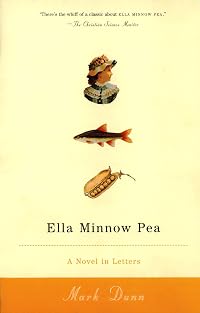
Ella Minnow Pea
by Mark Dunn
On This Page
Description
A hilarious and moving story of one girl’s fight for freedom of expression, as well as a linguistic tour de force sure to delight word lovers everywhereElla Minnow Pea is a girl living happily on the fictional island of Nollop off the coast of South Carolina. Nollop was named after Nevin Nollop, author of the immortal phrase containing all the letters of the alphabet, “The quick brown fox jumps over the lazy dog.”
Now Ella finds herself acting to save her friends, family, and fellow show more citizens from the encroaching totalitarianism of the island’s Council, which has banned the use of certain letters of the alphabet as they fall from a memorial statue of Nevin Nollop. As the letters progressively drop from the statue they also disappear from the novel. The result is "a love letter to alphabetarians and logomaniacs everywhere" (Myla Goldberg, bestselling author of Bee Season). show less
Tags
Recommendations

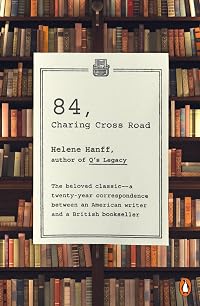
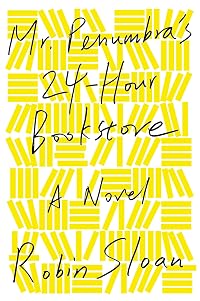
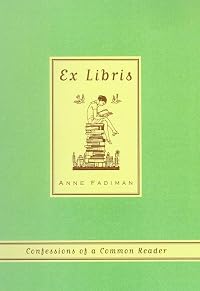
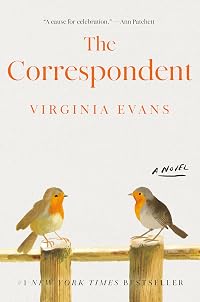

Member Recommendations

SylviaC Both stories use a light touch to look at language and censorship.
20
amysisson Both are deceptively simple stories that highlight absurdity in human behavior.
21
bookwoman247 Word play and language are an intregal part of both books. Ella Minnow Pea is a bit more sophisticated, but for adults or teens who enjoyed Haroun and the Sea of Stories, I think they will also find Ella Minnow Pea very enjoyable.
21
4leschats Similar aspects of word play demonstrate how the abstract nature of language creates, alters, and describes our concrete experiences.
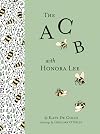
GirlMisanthrope Short sweet charming book , featuring the alphabet

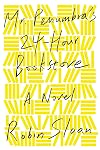
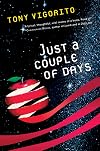
sturlington Breakdown of language
Member Reviews
5***** and a ❤
On a fictitious island nation off the coast of South Carolina, the people pride themselves on their literacy and writing. Their founder, Nevin Nollop, is credited with writing "The quick brown fox jumps over the lazy dog." A sentence that contains all the letters of the alphabet, and which is memorialized in the town square. But when a letter tile falls from the monument, the Council takes that as a "sign" from above, and decrees that they should no longer use THAT letter. The far-reaching ramifications of this, and subsequent, decrees (as more letters fall from the monument) test the imagination, strength and patience of the residents.
The novel is told in epistolary form, and their missives adhere to the ever more show more restrictive rules as the book progresses. From finding synonyms to creative substitute spellings and even use of numbers, Ella and her friends and family try valiantly to maintain communication. You wouldn’t think the loss of one letter of the alphabet would have much impact. But what if you lost “V” and could no longer express your love? Or “H” and could no longer worship? More importantly, as residents flee the restrictions (or are forced out due to violating the laws), the entire society begins to crumble. Still, Ella and a handful of family and friends fight against the edicts and with the hope of returning their beloved island nation to a place where literacy is once again appreciated.
I had read this before and had a lovely discussion about it with my college roommate’s daughter. A few years ago she gave me the special illustrated gift edition, which has been sitting patiently on my shelves along with other “special” books. I’m so glad I took it off the shelf and read it at this time. This is a wonderful little satire on the use/abuse of power, but it is also a love letter to all of us who love and cherish words.
* * * * * * * * * * * * * * * * *
UPDATE: 02Dec14 - reread the book and updated my review.
* * * * * * * * * * * * * * * * *
UPDATE: 08Sep20
I read this again and am horrified to recognize behavior in our current government's leaders that mimic the behavior of the leaders of this island nation. I didn't find it so funny this time around. Nor quite so enjoyable. Instead I felt anxious and afraid ... much like Ella and the other citizens of Nollop as their society crumbles. Still, I'm leaving my rating as it is. show less
On a fictitious island nation off the coast of South Carolina, the people pride themselves on their literacy and writing. Their founder, Nevin Nollop, is credited with writing "The quick brown fox jumps over the lazy dog." A sentence that contains all the letters of the alphabet, and which is memorialized in the town square. But when a letter tile falls from the monument, the Council takes that as a "sign" from above, and decrees that they should no longer use THAT letter. The far-reaching ramifications of this, and subsequent, decrees (as more letters fall from the monument) test the imagination, strength and patience of the residents.
The novel is told in epistolary form, and their missives adhere to the ever more show more restrictive rules as the book progresses. From finding synonyms to creative substitute spellings and even use of numbers, Ella and her friends and family try valiantly to maintain communication. You wouldn’t think the loss of one letter of the alphabet would have much impact. But what if you lost “V” and could no longer express your love? Or “H” and could no longer worship? More importantly, as residents flee the restrictions (or are forced out due to violating the laws), the entire society begins to crumble. Still, Ella and a handful of family and friends fight against the edicts and with the hope of returning their beloved island nation to a place where literacy is once again appreciated.
I had read this before and had a lovely discussion about it with my college roommate’s daughter. A few years ago she gave me the special illustrated gift edition, which has been sitting patiently on my shelves along with other “special” books. I’m so glad I took it off the shelf and read it at this time. This is a wonderful little satire on the use/abuse of power, but it is also a love letter to all of us who love and cherish words.
* * * * * * * * * * * * * * * * *
UPDATE: 02Dec14 - reread the book and updated my review.
* * * * * * * * * * * * * * * * *
UPDATE: 08Sep20
I read this again and am horrified to recognize behavior in our current government's leaders that mimic the behavior of the leaders of this island nation. I didn't find it so funny this time around. Nor quite so enjoyable. Instead I felt anxious and afraid ... much like Ella and the other citizens of Nollop as their society crumbles. Still, I'm leaving my rating as it is. show less
Clever writing!! Interesting study of linguistics while also a commentary of irrational governments. I was sucked right in and flew through this in just a few hours. A small island nation's government inexplicably determines a supernatural force is guiding the changes to their language. Drunk on the power they wield over the ever shrinking populace, their proclamations become ever more ridiculous and destructive to their people and culture. Almost too far gone to be saved by anyone, an accidental turn of phrase is enough to save the few remaining natives and restore emigrants to their former lives while taking down the corrupt counsellors. As a lover of language, watching the tale unfold with fewer and fewer letters at the author's show more disposal was indeed fascinating all by itself! show less
I wasn't sure what to expect from this book when I started reading it. Sure, it'd gotten a great review in the Christian Science Monitor, which is where I'd first heard of it, but the whole thing sounded gimmicky and contrived. But it was an epistolary novel, which I generally like, so I plunged in. And yes, it's contrived--it has to be--but it works. And in between the vanishing letters (and the author's cleverness in being able to write with less and less of the alphabet available to him) is a tale of political tyranny and a tribute to freedom of expression: not bad for a novel of only 208 pages.
Oh, and I enjoyed reading something not dumbed down to the lowest common denominator--it's been a while since I've read a novel where I show more needed to look some words up in the dictionary. show less
Oh, and I enjoyed reading something not dumbed down to the lowest common denominator--it's been a while since I've read a novel where I show more needed to look some words up in the dictionary. show less
This was a delightful little tale of censorship and abuse of power by parochial bureaucrats. On the fictional utopian yet luddite island of Nollop, home of Nevin Nollop, coiner of the pangram "The quick brown fox jumps over the lazy dog," letters from the famous phrase begin to fall off the memorial to this honored ancestor. The High Council decides that it is the will of Nollop that the fallen letters be stricken from the spoken and written language of the unusually articulate Nollopians.
The story is told in the form of correspondence among the Nollopians that progressively eschews the forbidden letters as they fall one by one.
The eponymous heroine (eventually reduced to signing her letters "LMNOP") persists in trying to save the day show more with a clever word game, remaining witty even when down to those five letters: "No mo Nollop pomp! No mo Nollop poo poo!"
This was the funny, clever novel I'd hoped The Eyre Affair would be but wasn't. It was charming, it was clever, it had me looking in the dictionary, and it had me scribbling on my bookmark right along with Ella as we tried to solve the puzzle that could save Nollop.
The original hardcover edition's subtitle, "A Progressively Lipogrammatic Epistolary Fable," suits the tone of the text to a T, but I have to say that the punnishing "A Novel in Letters" isn't entirely out of place either. show less
The story is told in the form of correspondence among the Nollopians that progressively eschews the forbidden letters as they fall one by one.
The eponymous heroine (eventually reduced to signing her letters "LMNOP") persists in trying to save the day show more with a clever word game, remaining witty even when down to those five letters: "No mo Nollop pomp! No mo Nollop poo poo!"
This was the funny, clever novel I'd hoped The Eyre Affair would be but wasn't. It was charming, it was clever, it had me looking in the dictionary, and it had me scribbling on my bookmark right along with Ella as we tried to solve the puzzle that could save Nollop.
The original hardcover edition's subtitle, "A Progressively Lipogrammatic Epistolary Fable," suits the tone of the text to a T, but I have to say that the punnishing "A Novel in Letters" isn't entirely out of place either. show less
I have wanted to read this book for a long time, solely based on its title. It is an epistolary novel set on a fictional island called Nollop, after the man who created the phrase "The quick brown fox jumps over the lazy dog." When the tiles of the letters of this phrase begin falling off the statue of Nollop, the town council takes it as a sign that Nollop wants the letter banished from the alphabet. First comes Z, then Q, and so on.
While the book is highly entertaining as the townspeople must find new words to use to avoid penalties and banishment, it is really a look at how totalitarianism is a problem in society, and the overreach of zealots who misinterpret or cast their beliefs on others, and how we must fight back against this, show more else society as we know it will cease to exist.
I loved it, especially in light of the extremes presented in society today. show less
While the book is highly entertaining as the townspeople must find new words to use to avoid penalties and banishment, it is really a look at how totalitarianism is a problem in society, and the overreach of zealots who misinterpret or cast their beliefs on others, and how we must fight back against this, show more else society as we know it will cease to exist.
I loved it, especially in light of the extremes presented in society today. show less
This fable of alphabetic elision seems more urgent now, I think, than even in the burgeoning days of the so-called Global War on Terror when it was first published. So much of our discourse is now mediated and overruled by algorithms intended to incite and/or placate that a Bureau of Letter Enforcement seems superfluous--and yet we are more thoroughly surveilled than ever.
The happy ending of the story, while cleverly constructed, rings a Lyttle hollow.
The happy ending of the story, while cleverly constructed, rings a Lyttle hollow.
Parable, satire, or just plain fun, this delightful little novelette traces the misfortunes which befall the inhabitants of a mythical island off the coast of South Carolina when letters begin disappearing from the alphabet.
The island, you see, was the home of the equally mythical Nevin Nollop, he who composed that catchy little phrase “the quick brown fox jumps over the lazy dog.” It’s a pangram, you see – a sentence including all 26 letters of the alphabet, and useful to typesetters, beginning typists, code writers, and anyone else who has need to corral individual symbols into coherent words. Their commemorative statue to Nollop, decorated with tiles spelling out his claim to immortality, is beginning to age somewhat, and one show more day – horrors! – one of the tiles slips from its mortar and crashes to the ground. Whereupon the Ruling Council decides this to be a message from beyond the grave – that the saintly Nollop is decreeing that henceforth no one should use the fallen letter (this one happens to be “Z”) in either spoken or written form.
As additional tiles begin to fall, additional letters are banned, and author Dunn dutifully soldiers on without them in the narrative, which is composed entirely of letters and written notes between characters. One could become very analytical about this, and discuss the conflict between the human drive to communicate and the equally compelling drive to remain part of one’s culture, or draw parallels between repressive dictatorships and freedom of speech. Or one could simply sit back and enjoy the fun as the remaining letters are gang-pressed into service to get the point across.
A few sub-plots emerge – a couple of romances, attempts to either unseat the Ruling Council or to convince them to rescind their draconian rulings, and a final desperate project to create a new pangram, thus proving Nollop was not divinely inspired. But the real fun is just watching the language emerge as the characters unwillingly play a kind of linguistic Jenga – how many letters can they extract before the whole language collapses?
Great fun for word lovers. And be sure to read the datelines on the notes and letters, which become progressively sillier as writers struggle gamely on as more bits of the alphabet elude them. show less
The island, you see, was the home of the equally mythical Nevin Nollop, he who composed that catchy little phrase “the quick brown fox jumps over the lazy dog.” It’s a pangram, you see – a sentence including all 26 letters of the alphabet, and useful to typesetters, beginning typists, code writers, and anyone else who has need to corral individual symbols into coherent words. Their commemorative statue to Nollop, decorated with tiles spelling out his claim to immortality, is beginning to age somewhat, and one show more day – horrors! – one of the tiles slips from its mortar and crashes to the ground. Whereupon the Ruling Council decides this to be a message from beyond the grave – that the saintly Nollop is decreeing that henceforth no one should use the fallen letter (this one happens to be “Z”) in either spoken or written form.
As additional tiles begin to fall, additional letters are banned, and author Dunn dutifully soldiers on without them in the narrative, which is composed entirely of letters and written notes between characters. One could become very analytical about this, and discuss the conflict between the human drive to communicate and the equally compelling drive to remain part of one’s culture, or draw parallels between repressive dictatorships and freedom of speech. Or one could simply sit back and enjoy the fun as the remaining letters are gang-pressed into service to get the point across.
A few sub-plots emerge – a couple of romances, attempts to either unseat the Ruling Council or to convince them to rescind their draconian rulings, and a final desperate project to create a new pangram, thus proving Nollop was not divinely inspired. But the real fun is just watching the language emerge as the characters unwillingly play a kind of linguistic Jenga – how many letters can they extract before the whole language collapses?
Great fun for word lovers. And be sure to read the datelines on the notes and letters, which become progressively sillier as writers struggle gamely on as more bits of the alphabet elude them. show less
Members
- Recently Added By
Lists

Recommend the 20 best books you've read in the last five years
2,168 works; 606 members

Amusing Book Titles
146 works; 39 members

Experimental Literature
141 works; 19 members

Epistolary Books
105 works; 24 members

Speculative Fiction: Slipstream Literature
166 works; 16 members

Books Featured on Gilmore Girls
307 works; 21 members

Top Five Books of 2021
604 works; 181 members

Dystopian and Apocalyptic Literature
350 works; 74 members

Top Five Books of 2016
795 works; 228 members

A Novel Cure
742 works; 23 members

Books Set on Islands
190 works; 24 members

Books Read in 2014
2,343 works; 89 members
Fiction with Women's Names in the Title
378 works; 15 members

Books as Objects & Metatextual Works
32 works; 3 members

Animals in the Title
498 works; 11 members

The Complete Rory Gilmore Reading List
506 works; 5 members

Books With the Most Memorable Titles
478 works; 158 members

Top Five Books of 2024
795 works; 264 members

Books We Discovered On LibraryThing
530 works; 130 members

Favorite Epistolary Fiction
143 works; 144 members

Books discovered on LibraryThing
256 works; 36 members

Rory Gilmore Challenge 101-200
33 works; 1 member

Books Read in 2021
5,361 works; 114 members

Books Read in 2012
816 works; 34 members
KayStJ's to-read list
1,616 works; 11 members

Gimmicks
56 works; 12 members

BingoDOG - Language in Fiction
35 works; 12 members

Espistolary
20 works; 1 member
Author Information

21 Works 5,354 Members
Some Editions
Awards and Honors
Distinctions
Notable Lists
Work Relationships
Has as a student's study guide
Common Knowledge
- Canonical title
- Ella Minnow Pea
- Alternate titles
- Ella Minnow Pea: A Progressively Lipogrammatic Epistolary Fable; Ella Minnow Pea: A Novel in Letters; Ella Minnow Pea: A Novel without Letters
- Original publication date
- 2001
- People/Characters
- Ella Minnow Pea; Nevin Nollop; Tassie; Amos Minnow Pea; Gwenette Minnow Pea
- Important places
- Nollop (fictitious island nation)
- Epigraph
- In the beginning was the Word.
- Gospel of John, Chapter 1, Verse 1
The wicked peon quivered,
then gazed balefully at the judges
who examined him.
- Anonymous Typesetter - Dedication
- For Mary
- First words
- Nollopton. Sunday, July 23. Dear Cousin Tassie, Thank you for the lovely postcards.
- Quotations
- For the present, it is easier for us to turn away. Our repulsion, you see, will not spur us to revolt until this plague moves much closer to home.
- Last words
- (Click to show. Warning: May contain spoilers.)We're all quite curious to know.
- Blurbers
- Goldberg, Myla
- Canonical DDC/MDS
- 813.6
- Canonical LCC
- PS3604.U56
Classifications
Statistics
- Members
- 4,584
- Popularity
- 3,184
- Reviews
- 280
- Rating
- (3.87)
- Languages
- English, German, Spanish
- Media
- Paper, Audiobook, Ebook
- ISBNs
- 17
- ASINs
- 11