
On This Page
Description
Fantasy. Fiction. Literature. Historical Fiction. A dazzling blend of military history, high-flying fantasy, and edge-of-your-seat adventure, Naomi Novik's Temeraire novels, set in an alternate Napoleonic era in which intelligent dragons have been harnessed as weapons of war, are more than just perennial bestsellers-they are a worldwide phenomenon. Now, in Tongues of Serpents, Naomi Novik is back, along with the dragon Temeraire and his rider and friend, Captain Will Laurence. Convicted of show more treason despite their heroic defense against Napoleon's invasion of England, Temeraire and Laurence-stripped of rank and standing-have been transported to the prison colony at New South Wales in distant Australia, where, it is hoped, they cannot further corrupt the British Aerial Corps with their dangerous notions of liberty for dragons. Temeraire and Laurence carry with them three dragon eggs intended to help establish a covert in the colony and destined to be handed over to such second-rate, undesirable officers as have been willing to accept so remote an assignment-including one former acquaintance, Captain Rankin, whose cruelty once cost a dragon its life. Nor is this the greatest difficulty that confronts the exiled dragon and rider: Instead of leaving behind all the political entanglements and corruptions of the war, Laurence and Temeraire have instead sailed into a hornet's nest of fresh complications. For the colony at New South Wales has been thrown into turmoil after the overthrow of the military governor, one William Bligh-better known as Captain Bligh, late of HMS Bounty. Bligh wastes no time in attempting to enlist Temeraire and Laurence to restore him to office, while the upstart masters of the colony are equally determined that the new arrivals should not upset a balance of power precariously tipped in their favor. Eager to escape this political quagmire, Laurence and Temeraire take on a mission to find a way through the forbidding Blue Mountains and into the interior of Australia. But when one of the dragon eggs is stolen from Temeraire, the surveying expedition becomes a desperate race to recover it in time-a race that leads to a shocking discovery and a dangerous new obstacle in the global war between Britain and Napoleon. Tongues of Serpents is the sixth entry in Naomi Novik's Temeraire series. Books one through five are available from Random House Audio. show lessTags
Recommendations
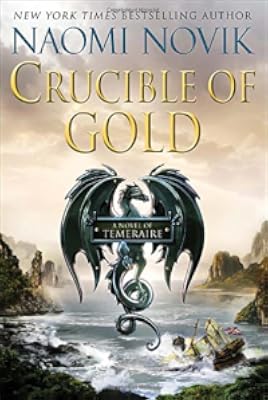




















Member Recommendations
Member Reviews
Tongues of Serpents is the seventh book in in Naomi Novik's Temeraire Series. It picks up where the last book left off, with Celestial dragon Temeraire and Captain William Laurence sentenced to be transported to the penal colony in New South Wales, following their exile from Britain for treason. The book is a mix of historical fiction and fantasy. It is set during the Napoleonic Wars but contains a Dragon Aerial Corps and other mythical creatures, in this case sea serpents. The book differs from earlier entries in the series, with less emphasis on military action and more on exploration and survival. Australia is a land without dragons. In fact, the British send three eggs with the escort to try to establish an initial dragon colony, show more which does not quite go as planned.
The novel tackles colonialism as a running theme through its portrayal of the settlement at Sydney, interactions with Aboriginal peoples, and battles at sea to protect trading routes. Temeraire's outside perspective points out many flaws in colonial thinking and the damage done by claiming "empty" lands. The bulk of the narrative involves a journey to rescue a stolen dragon egg, which sets up the clash between colonial powers with indigenous people and foreign traders. Other themes relate to loyalty, displacement, and ethics. There is much more complexity here than simply an adventure story.
It is more character-driven than some of the previous books. Laurence's character arc centers on reconciling his ingrained sense of duty with his past actions and uncertain future. Temeraire experiences a growing disillusionment with human politics, though his loyalty to Laurence remains unwavering. There are several new dragons in this book, each with a separate and distinct personality. I am amazed at the author’s ability to provide such unique characterizations for each new dragon. I listened to the audiobook, brilliantly narrated by Simon Vance, who brings these characters to life. It is always delightful to spend time with Temeraire, Laurence, and company. show less
The novel tackles colonialism as a running theme through its portrayal of the settlement at Sydney, interactions with Aboriginal peoples, and battles at sea to protect trading routes. Temeraire's outside perspective points out many flaws in colonial thinking and the damage done by claiming "empty" lands. The bulk of the narrative involves a journey to rescue a stolen dragon egg, which sets up the clash between colonial powers with indigenous people and foreign traders. Other themes relate to loyalty, displacement, and ethics. There is much more complexity here than simply an adventure story.
It is more character-driven than some of the previous books. Laurence's character arc centers on reconciling his ingrained sense of duty with his past actions and uncertain future. Temeraire experiences a growing disillusionment with human politics, though his loyalty to Laurence remains unwavering. There are several new dragons in this book, each with a separate and distinct personality. I am amazed at the author’s ability to provide such unique characterizations for each new dragon. I listened to the audiobook, brilliantly narrated by Simon Vance, who brings these characters to life. It is always delightful to spend time with Temeraire, Laurence, and company. show less
In this volume of the Temeraire series, Captain Laurence—along with Temeraire, of course—has been exiled to Australia following his betrayal of Britain back in book four. Laurence must find some way to navigate no longer being allowed to serve technically, while still also being of use to his country.
I think this is probably one of the lesser installments of the series, but I still enjoyed it immensely. Novik conjures up character, place, and society with skill in equal measure; I love Laurence and Temeraire, of course, and the bits with Captain Bligh are fun but also kind of horrifying. The worst part of Temeraire's world are of course part of ours as well. Like with Throne of Jade and Horn of Ivory, some of the book hinges show more around discovering that a non-European society makes its own complex and interesting use of dragons. I have to say, an anti-orientalist bent is honestly not what I expected from this series going in! But it very mush is interested in using dragonriding to interrogate the way Britain sees the rest of the world. I think what hold this one back is it's more of a travelogue, without a strong sense of climax, but it was a journey I enjoyed nonetheless. show less
I think this is probably one of the lesser installments of the series, but I still enjoyed it immensely. Novik conjures up character, place, and society with skill in equal measure; I love Laurence and Temeraire, of course, and the bits with Captain Bligh are fun but also kind of horrifying. The worst part of Temeraire's world are of course part of ours as well. Like with Throne of Jade and Horn of Ivory, some of the book hinges show more around discovering that a non-European society makes its own complex and interesting use of dragons. I have to say, an anti-orientalist bent is honestly not what I expected from this series going in! But it very mush is interested in using dragonriding to interrogate the way Britain sees the rest of the world. I think what hold this one back is it's more of a travelogue, without a strong sense of climax, but it was a journey I enjoyed nonetheless. show less
This is perhaps not as fast-paced as previous novels in the series—there are fewer battles, and so not as many big set pieces. I still enjoyed this tremendously, however, because there was much more scope for character development, and I feel as if I now know Laurence much better than I did previously. I sadly missed Jane Roland—present only in some hilarious letters—but Roland fille is shaping fair to be as much of a character as her mother, and the new dragon characters introduced are all very entertaining.
Most of all, I loved the bits and pieces of world-building which we got throughout—of the Iroquois and Ojibwe raising their dragons; of the Tswana invading Europe and South America in order to gain revenge for, and halt, the show more slave trade; more mention of the empire of the Incas; Emily Roland's matter-of-fact mention of the issues she has to deal with as the only female member of a dragon crew; Australia with English and Chinese trading posts, not to mention active, involved indigenous peoples. (Oh, oh, and the Chinese using the sea serpents for trade! That is ingenious, and not something I would ever have thought of.)
I would dearly love a map of the world as it is in this universe, because I am so curious as to where the boundaries differ from the early nineteenth century world as we know it—though perhaps such a thing would spoil any future surprises Novik may have for us? And certainly the ending which we are given here does leave the stage wide open for any number of things—now that Laurence has finally made the decision to leave the Corps and the government's demands behind him, who knows what shall happen? show less
Most of all, I loved the bits and pieces of world-building which we got throughout—of the Iroquois and Ojibwe raising their dragons; of the Tswana invading Europe and South America in order to gain revenge for, and halt, the show more slave trade; more mention of the empire of the Incas; Emily Roland's matter-of-fact mention of the issues she has to deal with as the only female member of a dragon crew; Australia with English and Chinese trading posts, not to mention active, involved indigenous peoples. (Oh, oh, and the Chinese using the sea serpents for trade! That is ingenious, and not something I would ever have thought of.)
I would dearly love a map of the world as it is in this universe, because I am so curious as to where the boundaries differ from the early nineteenth century world as we know it—though perhaps such a thing would spoil any future surprises Novik may have for us? And certainly the ending which we are given here does leave the stage wide open for any number of things—now that Laurence has finally made the decision to leave the Corps and the government's demands behind him, who knows what shall happen? show less
Novik's a very good writer -- some of her recent books are outright excellent, and dear favourites of ours -- but for our tastes, the Temeraire series that started her writing career seems clearly to be her self-training grounds. The characterizations and dialogue is strong from the get-go of the very first novel, but the plots, ah ... Less so. At least here, by the sixth novel, there is marked improvement even there: The incredibly frustrating "problem is introduced, characters momentarily fret, problem is easily solved, new problem is introduced, characters momentarily fret, problem is easily solved" formula that has thankfully been vanishing bit by bit, novel by novel, is finally virtually gone. The uneven pacing that sometimes have show more plagued these books also seem to have improved a lot. Alas, that leaves the plot itself. This book barely has one, and it becomes very apparent this is the case very early on. It is a moving-pieces-around-the-chessboard-feeling book, characters are processing, interacting, to some extent growing (in a couple of cases literally), and the world is being expanded. But nothing all that interesting ever really happens until the last fifty pages or so.
The series has had a bit of a tendency towards alternating between action packed novels and uneventful novels, and we were indeed due one of the latter after book 5, which was probably our strongest reading experience of the entire series to date.
By and large, this was a reasonably entertaining, if not that rewarding, read, proving again that Novik's very good at making us care about her characters, as evidenced by how we keep sticking with these books. Laurence in particular is wonderful -- somehow, a character every bit as special as Temeraire insists he is. And hopefully, the final three installments will be a very exciting set of novels with this groundwork out of the way. Certainly, book 7 is due as a roller-coaster entry, and fingers crossed book 8 will break the every-other streak. show less
The series has had a bit of a tendency towards alternating between action packed novels and uneventful novels, and we were indeed due one of the latter after book 5, which was probably our strongest reading experience of the entire series to date.
By and large, this was a reasonably entertaining, if not that rewarding, read, proving again that Novik's very good at making us care about her characters, as evidenced by how we keep sticking with these books. Laurence in particular is wonderful -- somehow, a character every bit as special as Temeraire insists he is. And hopefully, the final three installments will be a very exciting set of novels with this groundwork out of the way. Certainly, book 7 is due as a roller-coaster entry, and fingers crossed book 8 will break the every-other streak. show less
The Temeraire series answers the age-old question, "How would the Napoleonic Wars change if dragons existed?"
In the first book, [b:His Majesty's Dragon|28876|His Majesty's Dragon (Temeraire, #1)|Naomi Novik|http://photo.goodreads.com/books/1167957693s/28876.jpg|726205], the answer is that not much would change--all the European nations have dragons, and they treat them like a cross between pets and battleships. The only real change is that communication is slightly faster and some additional battles are fought in the air. The main character, Laurence, is a British naval captain who befriends the dragon Temeraire; the first book is their introduction to aerial warfare. It's a wonderful story. But Novik complicates the narrative in a show more very satisfying way with the next book, [b:Throne of Jade|14069|Throne of Jade (Temeraire, #2)|Naomi Novik|http://photo.goodreads.com/books/1166575829s/14069.jpg|2213322], which widens the world to include China. Further books take Laurence and Temeraire through Africa and finally, to Australia, all the while fighting Napoleon's forces and allies every inch of the way. The series slowly reveals itself to be a colonialist narrative told from a very post-colonialist pov. We are presented with classic European views and politics--the slave trade, use of opium for trade purposes, Manifest Destiny, etc--but the existence of dragons changes the result. When European traders take people as slaves from Africa, the African dragons and their warriors fight back, exceedingly effectively. The spread of European settlers in the Americas is very different, because the native Americans have plenty of defenses of their own. It's fascinating!
But the series is not just a game of "what if"--it's a deeply satisfying character study of the uncomfortably honorable Laurence, the brilliant-but-jejune Temeraire, and the diverse cast of side characters. Although there are a few battles in [b:Tongues of Serpents|7038489|Tongues of Serpents A Novel of Temeraire (Temeraire, #6)|Naomi Novik|http://photo.goodreads.com/books/1262669469s/7038489.jpg|7287326], the majority of the plot is simply Temeraire and Laurence treking across Australia.
Laurence has always been a character driven by honor and duty--his sense of responsibility toward England weighed heavily and constantly upon his shoulders. But after [b:Victory of Eagles|891593|Victory of Eagles (Temeraire, #5)|Naomi Novik|http://ecx.images-amazon.com/images/I/61eYT1zu1UL._SL75_.jpg|3102331], he has lost his taste for war, even against England's enemies. Although many called him a traitor for his mercy, he maintained his patriotism. But in this book, he must question his own loyalty to his embattled nation.
Although I think this series is easily the most mature look at the Napoleonic wars OR dragons that I've ever read, there's a great deal of humor and adventure in it, as well. The dragons each have fabulous personalities that clash horribly (they read a lot like scaly, half-ton cats). And there's nothing to get the blood up like fighting sea-serpents! show less
In the first book, [b:His Majesty's Dragon|28876|His Majesty's Dragon (Temeraire, #1)|Naomi Novik|http://photo.goodreads.com/books/1167957693s/28876.jpg|726205], the answer is that not much would change--all the European nations have dragons, and they treat them like a cross between pets and battleships. The only real change is that communication is slightly faster and some additional battles are fought in the air. The main character, Laurence, is a British naval captain who befriends the dragon Temeraire; the first book is their introduction to aerial warfare. It's a wonderful story. But Novik complicates the narrative in a show more very satisfying way with the next book, [b:Throne of Jade|14069|Throne of Jade (Temeraire, #2)|Naomi Novik|http://photo.goodreads.com/books/1166575829s/14069.jpg|2213322], which widens the world to include China. Further books take Laurence and Temeraire through Africa and finally, to Australia, all the while fighting Napoleon's forces and allies every inch of the way. The series slowly reveals itself to be a colonialist narrative told from a very post-colonialist pov. We are presented with classic European views and politics--the slave trade, use of opium for trade purposes, Manifest Destiny, etc--but the existence of dragons changes the result. When European traders take people as slaves from Africa, the African dragons and their warriors fight back, exceedingly effectively. The spread of European settlers in the Americas is very different, because the native Americans have plenty of defenses of their own. It's fascinating!
But the series is not just a game of "what if"--it's a deeply satisfying character study of the uncomfortably honorable Laurence, the brilliant-but-jejune Temeraire, and the diverse cast of side characters. Although there are a few battles in [b:Tongues of Serpents|7038489|Tongues of Serpents A Novel of Temeraire (Temeraire, #6)|Naomi Novik|http://photo.goodreads.com/books/1262669469s/7038489.jpg|7287326], the majority of the plot is simply Temeraire and Laurence treking across Australia.
Laurence has always been a character driven by honor and duty--his sense of responsibility toward England weighed heavily and constantly upon his shoulders. But after [b:Victory of Eagles|891593|Victory of Eagles (Temeraire, #5)|Naomi Novik|http://ecx.images-amazon.com/images/I/61eYT1zu1UL._SL75_.jpg|3102331], he has lost his taste for war, even against England's enemies. Although many called him a traitor for his mercy, he maintained his patriotism. But in this book, he must question his own loyalty to his embattled nation.
Although I think this series is easily the most mature look at the Napoleonic wars OR dragons that I've ever read, there's a great deal of humor and adventure in it, as well. The dragons each have fabulous personalities that clash horribly (they read a lot like scaly, half-ton cats). And there's nothing to get the blood up like fighting sea-serpents! show less
It’s been ages since I caught up with Temeraire and his captain Laurence in Naomi Novik’s lovingly-created alternate Napoleonic history. Luckily the library had just the right book at the right time and so I plunged in with gusto. Novik’s novels choose a different part of the world each time, to add variety both to the adventures and to the kinds of creatures we encounter: for this is a world full of dragons, serpents and other strange creatures. And our heroes’ current location is home to some of the strangest creatures even without the blessing of fantasy: as the curtain rises, we find gentleman and dragon newly arrived in Australia, exiled as punishment for their supposed treason. But it’s a sensitive time in the colony and show more the sudden arrival of two dragons (not to mention three soon-to-hatch eggs) adds a new frisson to the prickly aftermath of the Rum Rebellion...
For the full review, please see my blog:
https://theidlewoman.net/2018/08/16/tongues-of-serpents-naomi-novik/ show less
For the full review, please see my blog:
https://theidlewoman.net/2018/08/16/tongues-of-serpents-naomi-novik/ show less
The adventures in this book are less involving than the battle scenes of the previous volumes. However, Laurence seems to be in the process of a crisis of personality. He has endured tremendous changes in his life so far: first a shift from the prestige of naval service to the socially outcast aviator corp, his exposure to dragons in other cultures, where they are recognized as intelligent beings, the challenge to his patriotism when he learns his government intends to keep the cure for dragon plague away from the dragons that serve Napoleon, and his resulting conviction for treason and exile to Australia. By the end of this volume he is inclined to turn away from war and politics, disgusted by destruction and by England's wrongheaded show more foreign policy. Temeraire serves as the voice of innocence pointing out the emperor's nakedness when he wonders aloud why England, a small nation, should feel entitled to monopolize so much of the world's trade. show less
Members
- Recently Added By
Lists

Here There Be Dragons
143 works; 23 members

Speculative Fiction to Read
706 works; 32 members

Biggest Disappointments
606 works; 168 members

mom
729 works; 1 member

Books Read in 2025
4,091 works; 97 members

Best Alternate History
111 works; 60 members
Author Information

53+ Works 60,003 Members
Naomi Novik was born in New York on April 30, 1973. She received a Bachelor's degree in English literature at Brown University and a Master's degree in Computer Science from Columbia University. She participated in the design and development of the computer game Neverwinter Nights: Shadows of Undrentide. Her first novel, His Majesty's Dragon, was show more published in 2006 and was the start of the Temeraire series. She has won the John W. Campbell Award for Best New Writer, the Compton Crook Award for Best First Novel, and the Locus Award for Best First Novel. Her book, Uprooted, won the 2016 Nebula Award for Best Novel. (Bowker Author Biography) show less

Naomi Novik is a LibraryThing Author, an author who lists their personal library on LibraryThing.
Some Editions
Awards and Honors
Distinctions
Series

Work Relationships
Is contained in
Common Knowledge
- Canonical title
- Tongues of Serpents
- Original title
- Tongues of Serpents
- Original publication date
- 2010-07-13
- People/Characters
- Temeraire; William Laurence; Granby; Iskierka; Tharkay; Rankin [Temeraire] (show all 10); Caesar; Demane; Kulingile; Tharunka
- Important places
- Australia; Sydney, New South Wales, Australia
- Important events
- Rum Rebellion
- Dedication
- For my father, Samuel Novik,
who also came over the sea to another country - First words
- There were few streets in the main port of Sydney which deserved the name, besides the one main thoroughfare, and even that bare packed dirt, lined only with a handful of small and wretched buildings that formed all the perma... (show all)nence of the colony.
- Last words
- (Click to show. Warning: May contain spoilers.)"I have been thinking, Laurence, we might have a pavilion up before the winter."
- Blurbers*
- King, Stephen
- Original language
- English
*Some information comes from Common Knowledge in other languages. Click "Edit" for more information.
Classifications
Statistics
- Members
- 2,203
- Popularity
- 9,197
- Reviews
- 103
- Rating
- (3.50)
- Languages
- 5 — Dutch, English, French, German, Polish
- Media
- Paper, Audiobook, Ebook
- ISBNs
- 23
- ASINs
- 15
