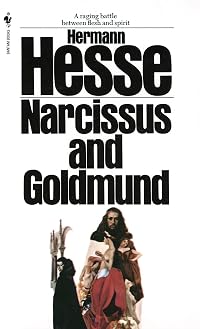
Narcissus and Goldmund
by Hermann Hesse
On This Page
Description
Narcissus and Goldmund is the story of a passionate yet uneasy friendship between two men of opposite character. Narcissus, an ascetic instructor at a cloister school, has devoted himself solely to scholarly and spiritual pursuits. One of his students is the sensual, restless Goldmund, who is immediately drawn to his teacher's fierce intellect and sense of discipline. When Narcissus persuades the young student that he is not meant for a life of self-denial, Goldmund sets off in pursuit of show more aesthetic and physical pleasures, a path that leads him to a final, unexpected reunion with Narcissus. show lessTags
Recommendations


















Member Recommendations

CGlanovsky A young man on a journey, both literally and spiritually. Philosophical.
30


olonec book about an artist's path
Member Reviews
Hesse seems to set out exploring the question of which life is superior: a quiet and safe one of study and the accumulation of knowledge, or the embracing of risk and adventure? Narziss and Goldmund are like Hesse split in half, each half exaggerated into a full person, or either half of a sympathizing reader: the reasoning self (Narziss), and the fun-loving emotional portion (Goldmund). I expected a more back-and-forth approach, but it's almost entirely Goldmund's story and it emerges that what Hesse is actually comparing is the intellectual world with the real one, where only the spiritual can bridge the divide. He allocates art to being stimulated by a fulsome indulgence in life experience rather than as an intellectual exercise, and show more into this I read Hesse's opinion on the genesis of his writing. I came away feeling unaffected by the critique of my approach to my own life; but that last bit about art intersecting with the spiritual, and what actually feeds it, is something to mull over. show less
Published in 1930, on the surface, this novel is about two medieval seminary friends who embody polar opposite personalities. Narcissus represents thinking and logic, studying and measuring. He lives a cloistered life of self-denial. Goldmund, on the other hand, lives life based in nature, feelings, and sensuality. He leaves the seminary to embark on an unplanned journey through the forests, and for a time, becomes an artist and sculptor. The novel contains elements of philosophy and explores the human need for self-realization. It examines the dichotomy between intellect and emotion, reason and passion, as exemplified by the titular characters.
The two friends start out together, but the storyline soon shifts focus to Goldmund's show more picaresque wanderings. He camps in the woods, visits a series of villages, meets fellow wayfarers, partakes of food and drink in taverns, finds work here and there, and takes pleasure in relationships with many women. He encounters people suffering from Black Plague and death seems to lurk around every corner.
Narcissus and Goldmund embark on parallel quests for identity and meaning. For Narcissus, the journey unfolds inwardly within the confines of the monastery. His pursuit of spiritual enlightenment is marked by order, self-discipline, and intellectual rigor. In contrast, Goldmund finds his freedoms through his wanderings, the pursuit of sensory experiences, and artistic expression. He travels across the landscape of medieval Europe, where he encounters a myriad of characters and experiences that shape his understanding of the world and himself.
I particularly enjoyed the theme of searching for personal fulfillment during chaotic times. I also enjoyed the manner in which Hesse writes of the sensual world, without the contemporary necessity to rely on graphic sex – this book proves it can be done and it is done expertly here. I would have liked to know more about Narcissus’s inner struggles in the cloister. There are certainly hints of homosexuality and a conflict between his disciplined religious life and his interior desires. We learn much more about Goldmund since the bulk of the story follows his wanderings. So overall, it is quite a philosophical and thought-provoking novel that perhaps could have used a bit more balance between the two characters’ lives. show less
The two friends start out together, but the storyline soon shifts focus to Goldmund's show more picaresque wanderings. He camps in the woods, visits a series of villages, meets fellow wayfarers, partakes of food and drink in taverns, finds work here and there, and takes pleasure in relationships with many women. He encounters people suffering from Black Plague and death seems to lurk around every corner.
Narcissus and Goldmund embark on parallel quests for identity and meaning. For Narcissus, the journey unfolds inwardly within the confines of the monastery. His pursuit of spiritual enlightenment is marked by order, self-discipline, and intellectual rigor. In contrast, Goldmund finds his freedoms through his wanderings, the pursuit of sensory experiences, and artistic expression. He travels across the landscape of medieval Europe, where he encounters a myriad of characters and experiences that shape his understanding of the world and himself.
I particularly enjoyed the theme of searching for personal fulfillment during chaotic times. I also enjoyed the manner in which Hesse writes of the sensual world, without the contemporary necessity to rely on graphic sex – this book proves it can be done and it is done expertly here. I would have liked to know more about Narcissus’s inner struggles in the cloister. There are certainly hints of homosexuality and a conflict between his disciplined religious life and his interior desires. We learn much more about Goldmund since the bulk of the story follows his wanderings. So overall, it is quite a philosophical and thought-provoking novel that perhaps could have used a bit more balance between the two characters’ lives. show less
This is an extremely trite and obvious thing to say, but it must be said: Herman Hesse is a wonderful writer. His translator must also take some credit. I found 'Narcissus and Goldmund' utterly riveting. I haven't viscerally enjoyed the style and atmosphere of a novel so intensely since I read [b:Summer|52842705|Summer (Seasonal, #4)|Ali Smith|https://i.gr-assets.com/images/S/compressed.photo.goodreads.com/books/1575105411l/52842705._SX50_SY75_.jpg|73242841]. The measured and philosophical, yet tenderly emotional, tone is quite distinctive from other writers. I would find myself carried along by the lyrical prose espousing love and the natural world, then be absolutely floored by a paragraph like this:
Reading something like that, you have to sit down. If you are already sitting down, you might need to lie down. I don't really know how to respond to it in words, other than, "Ooof". Hesse's themes are so universal and examined so beautifully that it's hard to imagine 'Narcissus and Goldmund' losing its classic status. Life, death, love, art, freedom, and conflict are all examined with extraordinary astuteness and subtlety within a mere 250 pages.
I suppose I should mention the plot and characters, as they aren't mere flimsy props for philosophical abstractions. In medieval Germany, Goldmund is sent to a monastery school by his father as a teenager and makes friends with Narcissus, an older boy with such scholarly talents that he acts as a student teacher. The pair have an intense and romantic friendship that changes them both. Narcissus leads Goldmund to realise that the religious life of the mind is not suited to him, so Goldmund departs for an itinerant life of wandering through the world seducing women. Meanwhile Narcissus remains in the monastery and takes holy orders. The majority of the narrative follows Goldmund's progress. One of the most powerful sequences was his experience of the Black Death. This encounter with a Jewish girl whose father has been murdered in a pogrom will linger in my memory:
There is so much to 'Narcissus and Goldmund' that deserves (and has undoubtedly received) vastly more detailed analysis than I could ever offer. It is rich in meanings. Instead, I will comment on the foreword by Graham Cox. This is brief and sincere. He states, 'It is a book that you can never grow out of because you grow into it.' That I can well understand. A quote on the back cover calls it, 'The quintessential book of adolescence', yet I don't think I would have appreciated it nearly as much in my teens. Hesse considers the dilemmas of later years just as insightfully as those of adolescence. I was also intrigued that Cox wrote, 'I think we can all see ourselves in Goldmund.' I can't, not one bit. Instead, I saw a little of myself in the aloof, intellectual, ascetic Narcissus. The relationship between the two has the particular intensity of love between people who accept and value their immense differences of personality, habits, and priorities. Like Narcissus, I greatly admire friends who can throw themselves into adventure, intense emotions, and artistic creativity, while not wishing to emulate them. Hesse focuses on Goldmund's journey, but does not take sides between the lives chosen by his two protagonists. Goldmund often doubts himself and Narcissus is clearly not without regret. Although I find Goldmund's choices much harder to understand than those of Narcissus, the writing gives such full account of why both make them that I am entirely sympathetic. Actually, I think it's more than that. The whole book invites intense empathy for all of those it depicts, in part by emphasising what all living beings share: life, death, and uncertainty. show less
Perhaps, he thought, the root ofshow more
all art, and perhaps of all intellectual activity, is the fear of death. We fear it, we shudder at the ephemeral nature of things, we grieve to see the constant cycle of fading flowers and falling leaves and are aware in our own hearts of the certainty that we too are ephemeral and will soon fade away. So when as artists we create images, and as thinkers we search for laws and formulate ideas, we do so in order to salvage something from the great Dance of Death, to create something that will outlast our lifetime. The woman after whom the master fashioned his beautiful Madonna may have already faded or died, and soon he too will be dead: others will live in his house, others will eat at his table. But his work will remain. In the quiet monastery church it will continue to shine for another hundred years and much longer; it will always remain beautiful, always smile with that same mouth which is as full of life as it is of sadness.
Reading something like that, you have to sit down. If you are already sitting down, you might need to lie down. I don't really know how to respond to it in words, other than, "Ooof". Hesse's themes are so universal and examined so beautifully that it's hard to imagine 'Narcissus and Goldmund' losing its classic status. Life, death, love, art, freedom, and conflict are all examined with extraordinary astuteness and subtlety within a mere 250 pages.
I suppose I should mention the plot and characters, as they aren't mere flimsy props for philosophical abstractions. In medieval Germany, Goldmund is sent to a monastery school by his father as a teenager and makes friends with Narcissus, an older boy with such scholarly talents that he acts as a student teacher. The pair have an intense and romantic friendship that changes them both. Narcissus leads Goldmund to realise that the religious life of the mind is not suited to him, so Goldmund departs for an itinerant life of wandering through the world seducing women. Meanwhile Narcissus remains in the monastery and takes holy orders. The majority of the narrative follows Goldmund's progress. One of the most powerful sequences was his experience of the Black Death. This encounter with a Jewish girl whose father has been murdered in a pogrom will linger in my memory:
"Listen," he said, "don't you see that death is all around us, that in every house and every town people are dying, that there is misery and death everywhere? Even the rage of those stupid people who burned your father to death is nothing but anguish and despair, simply the result of unbearable suffering. Look, soon death will come for us too, and our bodies will decay somewhere under the sky, and moles will play dice with our bones. Until then, let us live and be kind to each other. Oh Rebekka, it would be such a waste of your white neck and your little foot! Dear, beautiful girl, come with me - all I want is to see you and look after you!"
He went on and on pleading until it suddenly became clear even to him that it was useless to woo her with words or reasons. He fell silent and looked at her sorrowfully. Her proud, regal face was rigid with rejection.
"That's how you are," she said at last, in a voice of hatred and contempt, "that's how you Christians are! First you help a daughter bury her father, whom your people have murdered and whose little fingernail is worth more than you, and hardly has that been done when the girl is supposed to fall into your arms and go to bed with you! That's how you are! At first I thought you might be a good person. But how could you be good? Oh, you're all pigs!"
There is so much to 'Narcissus and Goldmund' that deserves (and has undoubtedly received) vastly more detailed analysis than I could ever offer. It is rich in meanings. Instead, I will comment on the foreword by Graham Cox. This is brief and sincere. He states, 'It is a book that you can never grow out of because you grow into it.' That I can well understand. A quote on the back cover calls it, 'The quintessential book of adolescence', yet I don't think I would have appreciated it nearly as much in my teens. Hesse considers the dilemmas of later years just as insightfully as those of adolescence. I was also intrigued that Cox wrote, 'I think we can all see ourselves in Goldmund.' I can't, not one bit. Instead, I saw a little of myself in the aloof, intellectual, ascetic Narcissus. The relationship between the two has the particular intensity of love between people who accept and value their immense differences of personality, habits, and priorities. Like Narcissus, I greatly admire friends who can throw themselves into adventure, intense emotions, and artistic creativity, while not wishing to emulate them. Hesse focuses on Goldmund's journey, but does not take sides between the lives chosen by his two protagonists. Goldmund often doubts himself and Narcissus is clearly not without regret. Although I find Goldmund's choices much harder to understand than those of Narcissus, the writing gives such full account of why both make them that I am entirely sympathetic. Actually, I think it's more than that. The whole book invites intense empathy for all of those it depicts, in part by emphasising what all living beings share: life, death, and uncertainty. show less
Having loved Hermann Hesse's Siddhartha, I picked up Narziss and Goldmund with great confidence. I had read it described as his most accessible work, the one easiest to read and with the most universal message. Unfortunately, none of those turned out to be true for me. Whilst it had quite a few good lines, it was, in my opinion, unnecessarily slow and its central philosophical message rather muddled. There are some brief flashes of inspiration regarding the dichotomy between the spiritual and the rational, between the man and the woman, the mother and father, and so on, but unlike Siddhartha, these concepts are not made easier to grasp by being rendered in novel form.
Hesse holds that the world is built on opposites, on division. Man or show more woman, vagabond or citizen, lover or thinker - no breath could be both in and out, none could be man and wife, free and yet orderly, knowing the urge of life and the joy of intellect. Always the one paid for the other, though each was equally precious and essential." He seems to maintain that our lives only have meaning "if both these goods could be achieved, and life herself had not been cleft by the barren division of alternatives." (both quotes from page 238). In other words, it is only through unification, rather than pursuing one single road (i.e. a life of intellect, or a life of passion) that one finds fulfilment. There is a nice conflict going on within Goldmund throughout the novel as he tries to align the two within himself, and a similar conflict to a lesser extent with Narziss. Indeed, it is Narziss who, towards the end of the book, muses: "Were men really made to live an ordered life, its virtues and duties set to the ringing of a bell?... Had not God made man with lusts and pride in him, with blood and darkness in his heart, with the freedom to sin, love and despair?" (pg. 287).
Hesse seems to advocate a sort of spiritual compromise, wherein people can pursue one road (i.e. a life of passion, for Goldmund) as long as they perceive and appreciate in others evidence of another road (i.e. intellect, in Narziss). "It is not our task to come together," Narziss says, "as little as it would be the task of sun and moon, of sea and land... Our destiny is not to become one. It is to behold each other for what we are, each perceiving and honouring it in his opposite; each finding his fulfilment and completion." (pp 43-44). Yet Hesse seems to undermine this theme of unification with Goldmund's final words of the book, wherein he asserts that Narziss, who has dedicated himself to a life of learning, is incomplete because he is beholden only to the father and "knows no mother", even though Narziss recognises and values that quality in Goldmund. As I say, it seems a very muddled philosophy Hesse is presenting, and I finished the book feeling rather dissatisfied.
Indeed, this dissatisfaction was enhanced by the negative reaction I had to the character of Goldmund. Arrogant, conceited and disparaging towards women, Goldmund is one of the most unlikeable protagonists I have ever encountered. A large chunk of the book consists of Goldmund on his vagabond travels, sleeping with many women (who often inexplicably fall into bed with him at the drop of a hat); usually these women are the wife or daughter of the man whose hospitality, shelter and food he is enjoying. He frequently speaks of "mastering" these "wenches", including shamelessly trying to court a grieving Jewish girl whose father has just been murdered and burned by an angry mob. He sees only beautiful women as his "equals" (he has no time for one woman, Maria, as she is rather plain and has a limp, even though she is consistently kind to him) and whenever he continues on his travels, he never feels the need to say goodbye to any of them ("It was not worth the trouble of taking seriously, so he said farewell to none but his landlord." (pg. 184)). It is hinted at early in the book that some of these women are beaten by their husbands for straying, though Goldmund is unmoved by this. Despite this behaviour, we are clearly intended by the author to see Goldmund as devoted, in his way, to all these women - "truer than the best of husbands" (pg. 289) - as after all he is searching for the spiritual "mother" to complement the "father". We are supposed to see him as this thoughtful, spiritual seeker of life's truths. But, in trying to find out the meaning of his life, he shamelessly wrecks many others' lives in his wake, particularly those women. In the end I didn't really give a shit about his selfish spiritual fulfilment.
With the preceding paragraph you may think I'm missing the point; criticising the characters of what is essentially a philosophical treatise in novel form, but it was all rather unpleasant for me and so I could not fully engage with the philosophising. Even when I could, though occasionally agreeable, I did not think the philosophical message was coherent or interesting enough to warrant the effort the book required me to put in. I'll continue to read Hesse's books, as I still remember how much I loved Siddhartha, but I'll be much less confident next time around." show less
Hesse holds that the world is built on opposites, on division. Man or show more woman, vagabond or citizen, lover or thinker - no breath could be both in and out, none could be man and wife, free and yet orderly, knowing the urge of life and the joy of intellect. Always the one paid for the other, though each was equally precious and essential." He seems to maintain that our lives only have meaning "if both these goods could be achieved, and life herself had not been cleft by the barren division of alternatives." (both quotes from page 238). In other words, it is only through unification, rather than pursuing one single road (i.e. a life of intellect, or a life of passion) that one finds fulfilment. There is a nice conflict going on within Goldmund throughout the novel as he tries to align the two within himself, and a similar conflict to a lesser extent with Narziss. Indeed, it is Narziss who, towards the end of the book, muses: "Were men really made to live an ordered life, its virtues and duties set to the ringing of a bell?... Had not God made man with lusts and pride in him, with blood and darkness in his heart, with the freedom to sin, love and despair?" (pg. 287).
Hesse seems to advocate a sort of spiritual compromise, wherein people can pursue one road (i.e. a life of passion, for Goldmund) as long as they perceive and appreciate in others evidence of another road (i.e. intellect, in Narziss). "It is not our task to come together," Narziss says, "as little as it would be the task of sun and moon, of sea and land... Our destiny is not to become one. It is to behold each other for what we are, each perceiving and honouring it in his opposite; each finding his fulfilment and completion." (pp 43-44). Yet Hesse seems to undermine this theme of unification with Goldmund's final words of the book, wherein he asserts that Narziss, who has dedicated himself to a life of learning, is incomplete because he is beholden only to the father and "knows no mother", even though Narziss recognises and values that quality in Goldmund. As I say, it seems a very muddled philosophy Hesse is presenting, and I finished the book feeling rather dissatisfied.
Indeed, this dissatisfaction was enhanced by the negative reaction I had to the character of Goldmund. Arrogant, conceited and disparaging towards women, Goldmund is one of the most unlikeable protagonists I have ever encountered. A large chunk of the book consists of Goldmund on his vagabond travels, sleeping with many women (who often inexplicably fall into bed with him at the drop of a hat); usually these women are the wife or daughter of the man whose hospitality, shelter and food he is enjoying. He frequently speaks of "mastering" these "wenches", including shamelessly trying to court a grieving Jewish girl whose father has just been murdered and burned by an angry mob. He sees only beautiful women as his "equals" (he has no time for one woman, Maria, as she is rather plain and has a limp, even though she is consistently kind to him) and whenever he continues on his travels, he never feels the need to say goodbye to any of them ("It was not worth the trouble of taking seriously, so he said farewell to none but his landlord." (pg. 184)). It is hinted at early in the book that some of these women are beaten by their husbands for straying, though Goldmund is unmoved by this. Despite this behaviour, we are clearly intended by the author to see Goldmund as devoted, in his way, to all these women - "truer than the best of husbands" (pg. 289) - as after all he is searching for the spiritual "mother" to complement the "father". We are supposed to see him as this thoughtful, spiritual seeker of life's truths. But, in trying to find out the meaning of his life, he shamelessly wrecks many others' lives in his wake, particularly those women. In the end I didn't really give a shit about his selfish spiritual fulfilment.
With the preceding paragraph you may think I'm missing the point; criticising the characters of what is essentially a philosophical treatise in novel form, but it was all rather unpleasant for me and so I could not fully engage with the philosophising. Even when I could, though occasionally agreeable, I did not think the philosophical message was coherent or interesting enough to warrant the effort the book required me to put in. I'll continue to read Hesse's books, as I still remember how much I loved Siddhartha, but I'll be much less confident next time around." show less
Over the past several months, I've typed all kinds of angry words in my reviews about how the authors of the books I read fail to justify the hedonistic behavior of their characters. Discontented young man after discontented young man loses himself in women and trinkets, only to remain just as miserable as he always was. "How could you possibly live a life that so obviously won't make you happy?" I yell stupidly at the pages. "At least sell me on this a little!" Until Hermann Hesse, no author ever had.
The title characters in Narcissus and Goldmund are very different people. Narcissus is a devout ascetic, a monk who loves being a monk. His friend Goldmund, although originally wishing to be like Narcissus, has what Hesse datedly calls a show more "feminine mind." He prizes the world of romance over knowledge, and he leaves their monastery to explore all the beautiful things that life has to offer.
You might already think this has a prodigal son sort of feel to it, and you'd be right. Of course bad things happen to Goldmund, and of course he eventually comes back to the monastery. What makes the book great, though, is that despite Goldmund's failures and Narcissus' successes, each reader will have a different take on which man lived a better life. The two friends' last conversation in particular forces Narcissus (and the reader) to reflect on what reserved asceticism and introspective study are worth in a world full of so many things about which one could be passionate.
I understand Goldmund in a way that I don't understand Dorian Gray, Jean des Esseintes, and all the other self-indulgent narcissists that worm their way into classic literature. His visions of both the mother of the world (Eve) and his own mother inspire him to live through extreme acts of love, whether it be sex, art, or something else. He never stops living selfishly, but once he grows up a little after finding his feet in the world, his activity gains a purpose that goes beyond simple pleasures. Whether he's having dirty sex in a barn or gallant, highbrow sex in a palace, he's not thinking of himself. He's thinking of the beauty of mankind.
I'm still not on board with the guy, though. There are ways to perform extreme acts of love without cuckolding every farmer in Europe.
A little over halfway through his journey, Goldmund becomes a professional artist, carving and molding statues under the tutelage of a great craftsman, Master Nicklaus. He exhibits a natural talent for art, and by the time he leaves Master Nicklaus' studio, he has created a work worthy of being compared to his teacher's best. Goldmund, I believe, would like to think that his artistic skill has been buoyed by his worldly experiences, that the life he has led enables him to make things he never could have if he'd stayed in the monastery. Interestingly enough, the masterpiece in question is a statue of Narcissus.
At this point, Hesse gives us several questions to answer. Is Goldmund's interpretation of Narcissus affected by his experiences in the outside world? Is Goldmund right that his experience has been just as much of a boon to his artistic endeavors as his knack for the craft has been? If the answer to both questions is no, then what has Goldmund's lifestyle been worth? Weirdly enough, it might have been worth more than his friend's.
Narcissus has remained in the bubble of his monastery, working in the service of knowledge rather than anything tangible. If you were to compare the two without knowing them, you would quickly say that Narcissus lived the far nobler life. But as the book comes to an end, it is Goldmund who finds peace and Narcissus who restlessly questions his own decisions. That doesn't make one right and one wrong. Plenty of awful morons sleep soundly every night while the best among us toss and turn, but it's worth considering what might be upsetting Narcissus.
I mentioned Goldmund's first masterpiece earlier and questioned its relationship to his lifestyle, but there is no question on the source of his final masterpiece. After returning to the monastery, Goldmund begins fashioning a statue of Lydia, a young girl he fell in love with many years ago. This statue is without a doubt a product of his journey.
Being the reader makes it easy to see how important Narcissus is to everything Goldmund produced. Without Narcissus guiding him, Goldmund never leaves the monastery to live and love in the world. Without Narcisuss, Goldmund never makes it back to the monastery to create a symbol of his experiences. It would be easy to say that Hesse is making an "it takes all kinds" sort of point here with his main characters, but what kind of consolation would that be for Narcissus? Saying, "It takes all kinds" doesn't make all kinds equally laudable. Norm Macdonald never learned how to drive, but if a taxi driver were to go through an existential crisis of some sort, it wouldn't make sense to show him Norm's new Netflix special and go, "You're somehow an equal part in this." Just because someone couldn't do it without you doesn't mean you couldn't have done something else, something different, maybe even something better without that other person suffering from it.
Narcissus was always aware of his intellectual capabilities and believed he knew how God wanted him to use them. At the end of the book, he comes to the same realization that we all must: we'll never get a complete answer on whether we lived the right way, and any praise we receive or self-satisfaction we might feel will always be washed away by the unceasing waves of the what-ifs.
Narcissus is overflowing with what-ifs, and Goldmund has his fair share as well, all of which hit the reader hard. But the saddest collection of this book's what-ifs lies on the shoulders of poor little Marie. When Goldmund is working with Master Nicklaus, he rents a room from a friendly family whose daughter, Marie, has a bad hip and is forced to walk with a limp. Like every other woman in the book (Hesse is not one for nuanced female characters), she falls in love with Goldmund, but due to her deformity and homeliness, she somehow manages to be the only woman in which Goldmund doesn't take an interest. One night, while Goldmund is out with a hot rich lady, Marie waits up for him to come home, as he doesn't have a key. When Goldmund gets home, he realizes how late it is and how much effort it must have taken for her to stay up for him.
While Narcissus and Goldmund didn't enthrall me in the way that Steppenwolf did, I continue to be amazed by Hesse's ability to write about internal anguish. He manages to be powerful without being harsh or aggressive, a trait that to this point I've never seen anyone else master. I turn to his books for the same reason people would turn to Goldmund's statues: for consolation, confirmation, and strength. show less
The title characters in Narcissus and Goldmund are very different people. Narcissus is a devout ascetic, a monk who loves being a monk. His friend Goldmund, although originally wishing to be like Narcissus, has what Hesse datedly calls a show more "feminine mind." He prizes the world of romance over knowledge, and he leaves their monastery to explore all the beautiful things that life has to offer.
You might already think this has a prodigal son sort of feel to it, and you'd be right. Of course bad things happen to Goldmund, and of course he eventually comes back to the monastery. What makes the book great, though, is that despite Goldmund's failures and Narcissus' successes, each reader will have a different take on which man lived a better life. The two friends' last conversation in particular forces Narcissus (and the reader) to reflect on what reserved asceticism and introspective study are worth in a world full of so many things about which one could be passionate.
I understand Goldmund in a way that I don't understand Dorian Gray, Jean des Esseintes, and all the other self-indulgent narcissists that worm their way into classic literature. His visions of both the mother of the world (Eve) and his own mother inspire him to live through extreme acts of love, whether it be sex, art, or something else. He never stops living selfishly, but once he grows up a little after finding his feet in the world, his activity gains a purpose that goes beyond simple pleasures. Whether he's having dirty sex in a barn or gallant, highbrow sex in a palace, he's not thinking of himself. He's thinking of the beauty of mankind.
I'm still not on board with the guy, though. There are ways to perform extreme acts of love without cuckolding every farmer in Europe.
A little over halfway through his journey, Goldmund becomes a professional artist, carving and molding statues under the tutelage of a great craftsman, Master Nicklaus. He exhibits a natural talent for art, and by the time he leaves Master Nicklaus' studio, he has created a work worthy of being compared to his teacher's best. Goldmund, I believe, would like to think that his artistic skill has been buoyed by his worldly experiences, that the life he has led enables him to make things he never could have if he'd stayed in the monastery. Interestingly enough, the masterpiece in question is a statue of Narcissus.
At this point, Hesse gives us several questions to answer. Is Goldmund's interpretation of Narcissus affected by his experiences in the outside world? Is Goldmund right that his experience has been just as much of a boon to his artistic endeavors as his knack for the craft has been? If the answer to both questions is no, then what has Goldmund's lifestyle been worth? Weirdly enough, it might have been worth more than his friend's.
Narcissus has remained in the bubble of his monastery, working in the service of knowledge rather than anything tangible. If you were to compare the two without knowing them, you would quickly say that Narcissus lived the far nobler life. But as the book comes to an end, it is Goldmund who finds peace and Narcissus who restlessly questions his own decisions. That doesn't make one right and one wrong. Plenty of awful morons sleep soundly every night while the best among us toss and turn, but it's worth considering what might be upsetting Narcissus.
I mentioned Goldmund's first masterpiece earlier and questioned its relationship to his lifestyle, but there is no question on the source of his final masterpiece. After returning to the monastery, Goldmund begins fashioning a statue of Lydia, a young girl he fell in love with many years ago. This statue is without a doubt a product of his journey.
"Yes," Goldmund said, "the statue turned out rather well. But now listen to me, Narcissus. In order to make this a good statue, I needed my entire youth, my wandering, my love affairs, my courtship of many women. That is the source at which I have drunk."The reader can tell he's right, and Narcissus can too. As a result, Narcissus begins to doubt the worth of his intellectual pursuits.
Was not every small gesture of one of Goldmund's figures, every eye, every mouth, every branch and fold of gown worth more? Was it not more real, alive, and irreplaceable than everything a thinker could achieve? Had not this artist, whose heart was so full of conflict and misery, fashioned symbols of need and striving for innumerable people, contemporary and future, figures to which the reverence and respect, the deepest anguish and longing of countless people would turn for consolation, confirmation, and strength?That certainly sounds like a crisis.
Being the reader makes it easy to see how important Narcissus is to everything Goldmund produced. Without Narcissus guiding him, Goldmund never leaves the monastery to live and love in the world. Without Narcisuss, Goldmund never makes it back to the monastery to create a symbol of his experiences. It would be easy to say that Hesse is making an "it takes all kinds" sort of point here with his main characters, but what kind of consolation would that be for Narcissus? Saying, "It takes all kinds" doesn't make all kinds equally laudable. Norm Macdonald never learned how to drive, but if a taxi driver were to go through an existential crisis of some sort, it wouldn't make sense to show him Norm's new Netflix special and go, "You're somehow an equal part in this." Just because someone couldn't do it without you doesn't mean you couldn't have done something else, something different, maybe even something better without that other person suffering from it.
Narcissus was always aware of his intellectual capabilities and believed he knew how God wanted him to use them. At the end of the book, he comes to the same realization that we all must: we'll never get a complete answer on whether we lived the right way, and any praise we receive or self-satisfaction we might feel will always be washed away by the unceasing waves of the what-ifs.
Narcissus is overflowing with what-ifs, and Goldmund has his fair share as well, all of which hit the reader hard. But the saddest collection of this book's what-ifs lies on the shoulders of poor little Marie. When Goldmund is working with Master Nicklaus, he rents a room from a friendly family whose daughter, Marie, has a bad hip and is forced to walk with a limp. Like every other woman in the book (Hesse is not one for nuanced female characters), she falls in love with Goldmund, but due to her deformity and homeliness, she somehow manages to be the only woman in which Goldmund doesn't take an interest. One night, while Goldmund is out with a hot rich lady, Marie waits up for him to come home, as he doesn't have a key. When Goldmund gets home, he realizes how late it is and how much effort it must have taken for her to stay up for him.
"I'm sorry that you waited, Marie. It's late. Don't be angry with me."Unlike Narcissus' and Goldmund's what-ifs, Marie's what-ifs are entirely out of her control. What if she were healthy, beautiful, and strong? What if Goldmund weren't such a selfish dickhead? What if she could do anything, anything at all, to change her circumstances? It's a terrible feeling to live with regret, but it can't hold a candle to being born into hopelessness.
"I'll never be angry with you, Goldmund. I'm only a little sad."
"You must not be sad. Why sad?"
"Oh, Goldmund, I'd so like to be healthy and beautiful and strong. Then you would not have to go to strange houses during the night and make love to other women. Then you would perhaps stay with me once and be a little sweet to me."
Her mild voice sounded hopeless, but not bitter, only sad.
While Narcissus and Goldmund didn't enthrall me in the way that Steppenwolf did, I continue to be amazed by Hesse's ability to write about internal anguish. He manages to be powerful without being harsh or aggressive, a trait that to this point I've never seen anyone else master. I turn to his books for the same reason people would turn to Goldmund's statues: for consolation, confirmation, and strength. show less
I've tried for decades to love this, or to admire it, or respect it, or accept it, or tolerate it – but repeated attempts over a period of many years have always ended in failure, distress and abandonment.
The written style is so ponderous, so heavy and plodding that it regularly makes me long to scream. Is the author trying to recapture some mediaeval tone, something like a chronicle ? If that is the intent, then alas it fails. Sometimes, at least in the latter reaches of the book, dialogue between Narziss and Goldmund reminds me of nothing so much as a Platonic Socratic dialogue. And for a (reasonably) contemporary novel that has a remarkably strong distancing effect.
My reaction could possibly be a consequence of the translation – show more this edition I'm reading presents Geoffrey Dunlop's English translation, which perhaps now is dated; I don't know whether the original has the same ton.
En court: not for me, after valiant efforts. show less
The written style is so ponderous, so heavy and plodding that it regularly makes me long to scream. Is the author trying to recapture some mediaeval tone, something like a chronicle ? If that is the intent, then alas it fails. Sometimes, at least in the latter reaches of the book, dialogue between Narziss and Goldmund reminds me of nothing so much as a Platonic Socratic dialogue. And for a (reasonably) contemporary novel that has a remarkably strong distancing effect.
My reaction could possibly be a consequence of the translation – show more this edition I'm reading presents Geoffrey Dunlop's English translation, which perhaps now is dated; I don't know whether the original has the same ton.
En court: not for me, after valiant efforts. show less
I'd read other Hesse, but never Narcissus and Goldmund. A friend's Facebook post made me want to tackle it and I'm glad I did because it's one of those books that makes you think deeply about life, and about how we choose to experience it. Narcissus, a young monk and teaching brother, befriends Goldmund, a young student. The two become inseparable to the point where sometimes people assume there's something not quite academic going on between them. And in fact, Narcissus admits that he is attracted to young men, but has never and will never act on it. He loves Goldmund for reasons other than the obvious physical attractions. They are compliments to each other; Narcissus is mind and Goldmund is body, and the two of them live their lives show more through those modes of experience. Narcissus stays in the abbey and eventually becomes the abbot. Goldmund runs off and becomes a wanderer, a seducer of women, and eventually even a murderer. In the end, Goldmund brings all of his experiences to bear in the service of art, and apprentices with a sculptor where he produces, over a period of years, a figure of St. John that is not only the finest figure his master has ever seen, but the image of Narcissus.
This isn't just a book about love, brotherhood and the ties of soul-mates, but an exploration of how necessary mind is to body, and body is to mind. Without mind, the body's experiences remain unrealized, and without the body there is no true experience of life.
I've seen comments about how women are essentially throw-aways in this book, and yes, that's true. But I can't rail against it because they are part of the body's experience, not real people. The only real people in the whole book are Narcissus and Goldmund. They are our universe as we make our way through the story. We experience others through Goldmund. We understand Goldmund through Narcissus. It's an incredibly rich book, and one which I suspect I will reread in the future.
Simon Vance, as narrator, does a terrific job, as always. If you have the chance to listen to any of his performances, jump at it. show less
This isn't just a book about love, brotherhood and the ties of soul-mates, but an exploration of how necessary mind is to body, and body is to mind. Without mind, the body's experiences remain unrealized, and without the body there is no true experience of life.
I've seen comments about how women are essentially throw-aways in this book, and yes, that's true. But I can't rail against it because they are part of the body's experience, not real people. The only real people in the whole book are Narcissus and Goldmund. They are our universe as we make our way through the story. We experience others through Goldmund. We understand Goldmund through Narcissus. It's an incredibly rich book, and one which I suspect I will reread in the future.
Simon Vance, as narrator, does a terrific job, as always. If you have the chance to listen to any of his performances, jump at it. show less
Members
- Recently Added By
Lists

The Guardian's 1000 Novels Everyone Must Read
1,005 works; 551 members

Philosophical Fiction
97 works; 27 members

Best Historical Fiction
620 works; 261 members
20th Century Literature
1,161 works; 55 members

Books featuring monks and/or nuns
166 works; 33 members

German Literature
518 works; 56 members

Best School Stories
219 works; 22 members

Best Friendship Stories
205 works; 16 members

In or About the 1930s
198 works; 26 members

Harold Bloom - The Western Canon: D. The Chaotic Age
833 works; 24 members

Blue Pyramid 1,276 Best Books of All Time
1,248 works; 32 members

Academia in Fiction
158 works; 23 members
Elegant Prose
80 works; 4 members

Authors from Germany
4 works; 1 member
Existentialism
90 works; 11 members

1930s
262 works; 5 members
Monastic life
31 works; 1 member

The Essential Western Mystics
66 works; 4 members
Bibliografia essenziale
86 works; 2 members

el
1,139 works; 1 member

Book Recommendations Masterlist
28 works; 1 member

Best of World Literature
436 works; 52 members
Talk Discussions
Past Discussions
Fine editions of Hesse or Hašek? in Fine Press Forum (October 2022)
Author Information

1,021+ Works 93,979 Members
Hermann Hesse (July 2, 1877 -- August 9, 1962) was a German poet, novelist, essayist and painter. His best-known works included Steppenwolf, Siddhartha, and The Glass Bead Game, each of which explores an individual's search for authenticity, self-knowledge and spirituality. In 1946, he received the Nobel Prize in Literature. Hess publicly show more announced his views on the savagery of World War I, and was considered a traitor. He moved to Switzerland where he eventually became a naturalized citizen. He warned of the advent of World War II, predicting that cultureless efficiency would destroy the modern world. His theme was usually the conflict between the elements of a person's dual nature and the problem of spiritual loneliness. His first novel, Peter Camenzind, was published in 1904. His masterpiece, Death and the Lover (1930), contrasts a scholarly abbot and his beloved pupil, who leaves the monastery for the adventurous world. Steppenwolf (1927), a European bestseller, was published when defeated Germany had begun to plan for another war. It is the story of Haller, who recognizes in himself the blend of the human and wolfish traits of the completely sterile scholarly project. During the 1960s Hesse became a favorite writer of the counter culture, especially in the United States, though his critical reputation has never equaled his popularity. Hermann Hesse died in 1962. (Bowker Author Biography) show less
Some Editions
Awards and Honors
Series
Belongs to Publisher Series
Suhrkamp Geschenkbuch (suhrkamp taschenbuch 4356)
Oscar Narrativa (48)
Bibliothek Suhrkamp (65)
De twintigste eeuw (41)
suhrkamp taschenbuch (0274 / 4356)
Fischer Bücherei (450)
Grote ABC (149)
Penguin Modern Classics (3438)
Work Relationships
Is contained in
Has the adaptation
Has as a commentary on the text
Has as a student's study guide
Common Knowledge
- Canonical title
- Narcissus and Goldmund
- Original title
- Narziß und Goldmund; Narziss und Goldmund: Erzählung; Narziss und Goldmund
- Alternate titles
- Death and the Lover; Narcissus and Goldmund; Goldmund; Narcis en Guldemond; Narziss and Goldmund
- Original publication date
- 1930
- People/Characters
- Brother Narcissus; Goldmund; Father Anselm; Abbot Daniel; Lisa; Master Nicholas (show all 11); Lydia; Viktor; Rebekka; Kastanienbaum; barging woman
- Important places
- Germany; Mariabronn monastery, Germany (fictional)
- First words
- Isolated here in the North, planted long ago by a Roman pilgrim, a chestnut grew, strong and solitary, by the colonnade of rounded double arches at the entrance to the cloister of Mariabronn: a noble, vigorous tree, the sweep... (show all) of its foliage drooping tenderly, facing the winds in bold and quiet assurance; so tardy in spring that when all glowed green around it and event the cloister nut trees wore their russet, it awaited the shortest nights to thrust forth, through little tufts of leaves, the dim exotic rays of its blossom, and in October, after wine and harvests had long been gathered, let drop the prickly fruits from its yellowing crown; fruits which did not ripen every year, for which the cloister schoolboys fought one another, and which Gregory, the Italian sub-prior, burned amid the logs of his fireplace.
Outside the entrance of the Mariabronn cloister, whose rounded arch rested on slim double columns, a chestnut tree stood close to the road. [Molinaro translation] - Quotations
- ... thoughts of Goldmund whilst with the wood sculptor, Master Nicholas ... 'Narziss had been his friend: yet strangely it had beeen this learned Narziss who had shown him his inaptitude for learning and had conjured up a bel... (show all)oved mother-image in his mind. So that, instead of learning, virtue and monasticism, the stongest primal urge in his nature, had mastered him - lechery and carnal love, the longing to depend on none, and to wander. Then came Master Nicholas' sorrowful Virgin, to reveal to him an artist in himself, with a new way of life, and fetters again. How were things with him now? Where would life carry him in the end? Whence came these obstacles in his mind?'
- Last words
- (Click to show. Warning: May contain spoilers.)Goldmund's last words burned like fire in his heart.
- Original language
- German
- Disambiguation notice
- 3518367749 1975 softcover German suhrkamp taschenbuch 274
351846356X 2012 softcover German suhrkamp taschenbuch 4356 (Geschenkbuch)
351873640X 2011 eBook German suhrkamp
Classifications
- Genres
- General Fiction, Fiction and Literature
- DDC/MDS
- 833.912 — Literature & rhetoric German & related literatures German fiction 1900- 1900-1990 1900-1945
- LCC
- PT2617 .E85 .N413 — Language and Literature German, Dutch and Scandinavian literatures German literature Individual authors or works 1860/70-1960
- BISAC
Statistics
- Members
- 7,046
- Popularity
- 1,681
- Reviews
- 86
- Rating
- (4.06)
- Languages
- 29 — Catalan, Chinese, Czech, Danish, Dutch, English, Estonian, Finnish, French, German, Greek, Hebrew, Hungarian, Italian, Japanese, Korean, Latvian, Lithuanian, Norwegian (Bokmål), Farsi/Persian, Polish, Portuguese, Romanian, Russian, Serbian, Spanish, Swedish, Thai, Turkish
- Media
- Paper, Audiobook, Ebook
- ISBNs
- 171
- ASINs
- 83