
Teffi (1872–1952)
Author of Memories: From Moscow to the Black Sea
About the Author
Image credit: The Russian Women Network
Works by Teffi
Tolstoy, Rasputin, Others, and Me: The Best of Teffi (New York Review Books Classics) (2016) 147 copies, 5 reviews
Time [short story] 1 copy
Неживой зверь [Рассказы 1 copy
Земная радуга 1 copy
Авантюрный роман 1 copy
Parijse verhalen 1 copy
Распутин 1 copy
Associated Works
A Very Russian Christmas: The Greatest Russian Holiday Stories of All Time (2016) — Contributor — 46 copies, 1 review
The Bitter air of exile : Russian writers in the West, 1922-1972 (1977) — Contributor — 10 copies, 1 review
Tagged
Common Knowledge
- Canonical name
- Teffi
- Legal name
- Lokhvitskaya, Nadezhda Alexandrovna
- Other names
- Buchinskaya, Nadezhda Alexandrovna
Teffi, N. A. - Birthdate
- 1872-05-21
- Date of death
- 1952-10-06
- Gender
- female
- Occupations
- writer
short story writer
poet
playwright
novelist
memoirist - Short biography
- Teffi was the pen name of Nadezhda Alexandrovna Lokhvitskaya, born into a gentry family active in the St. Petersburg intelligentsia. Her sister Mirra Lokhvitskaya also became a notable Russian poet. At about age 18, Nadezhda married Wladyslav Buczynski, a Polish-born lawyer with whom she had three children, but the union was unhappy. After 10 years, she left her husband and children on their country estate and returned to St. Petersburg, where she became a successful writer. She became so celebrated that candies and perfume were named after her. During a period of radical fervor after the 1905 Revolution, she contributed to the first Bolshevik journal, The New Life, whose editorial board included Maxim Gorky and Zinaida Gippius. She also wrote for the Satiricon magazine and the popular journal Russkoye Slovo (Russian Word). She first used the pseudonym "Teffi" in 1907 with the publication of her one-act play The Woman Question. Teffi grew to hate the Bolsheviks because she believed they had no respect for culture, and had to leave St. Petersburg after the Russian Revolution of 1917. Eventually, she settled in Paris, where she contributed her work to Russian-language newspapers. She also published several book-length collections of short stories and poems, a volume of memoirs entitled Memories: From Moscow to the Black Sea (serialized 1928-1930), and her only novel, An Adventure Novel (1932).
- Nationality
- Russia
- Birthplace
- St. Petersburg, Russian Empire
- Places of residence
- St Petersburg, Russian Empire
Paris, France - Place of death
- Paris, France
- Burial location
- Sainte-Geneviève-des-Bois Russian Cemetery, Paris, France
- Map Location
- Russia
Members
Discussions
Subtly Worded and other stories, by Teffi in Fans of Russian authors (April 2016)
Reviews

Teffi was an aristocratic Russian extremely famous for her humorous/satirical writing - both the last Tsar and Lenin (at first) liked her work, and her image was used to sell "Teffi Perfume" and "Teffi Candies". This is her story of how she escaped from Bolshevik Russia in 1918, going first to Odessa, then taking ship for Istanbul.
The tone of this book is quite unusual - Teffi comments, "While you’re sleeping, while you’re there inside the story, it’s a nightmare. Afterward, when show more you’re back outside it again, it’s funny." And for much of her journey the details she notices are the incongruous, amusing ones - the way that on the ship out of Odessa, the formerly wealthy passengers are wearing their "best" clothes (ball gowns and satin slippers) because they know that they need to save their everyday clothes for when they get to where they are going; or the exchange when one of the young men on the ship is outraged at the suggestion that he should help to stoke the boiler so that they can make their escape: "If you prefer all this socialist nonsense and labour for everyone, then what are you doing on this ship? Go ashore and join your Bolshevik comrades."
There is plenty of bleakness of course but for much of the time this is treated as a bit of a joke - for example, there is a running theme of people promising Teffi that they will do everything possible to help her and then as soon as there's a window to get out, almost trampling over her in their haste to take it.
However, there is a point in Novorossiysk, the last time Teffi is anywhere culturally Russian, where the bravado fades away:
Cold dreary days. Apocalyptic evenings.
In the evening people gather together, wearing hats and fur coats. With pale lips, their breath coming in clouds, they repeat, “The Bolsheviks, of course, aren’t coming. A visa—must get hold of some kind of visa.”
And they throw the last chair into the stove, after taking turns to sit on it for a minute by way of farewell.
An odd read in many ways, but you do feel very vividly the chaos and poignancy of trying to leave your home under circumstances like this. show less
The tone of this book is quite unusual - Teffi comments, "While you’re sleeping, while you’re there inside the story, it’s a nightmare. Afterward, when show more you’re back outside it again, it’s funny." And for much of her journey the details she notices are the incongruous, amusing ones - the way that on the ship out of Odessa, the formerly wealthy passengers are wearing their "best" clothes (ball gowns and satin slippers) because they know that they need to save their everyday clothes for when they get to where they are going; or the exchange when one of the young men on the ship is outraged at the suggestion that he should help to stoke the boiler so that they can make their escape: "If you prefer all this socialist nonsense and labour for everyone, then what are you doing on this ship? Go ashore and join your Bolshevik comrades."
There is plenty of bleakness of course but for much of the time this is treated as a bit of a joke - for example, there is a running theme of people promising Teffi that they will do everything possible to help her and then as soon as there's a window to get out, almost trampling over her in their haste to take it.
However, there is a point in Novorossiysk, the last time Teffi is anywhere culturally Russian, where the bravado fades away:
Cold dreary days. Apocalyptic evenings.
In the evening people gather together, wearing hats and fur coats. With pale lips, their breath coming in clouds, they repeat, “The Bolsheviks, of course, aren’t coming. A visa—must get hold of some kind of visa.”
And they throw the last chair into the stove, after taking turns to sit on it for a minute by way of farewell.
An odd read in many ways, but you do feel very vividly the chaos and poignancy of trying to leave your home under circumstances like this. show less

The popular playwright and comic writer describes her last months in Russia and Ukraine during the chaotic aftermath of the Revolution, as she leaves Moscow together with other theatre people to find work first in Kyiv and then in Odesa and other cities on the Black Sea before she is finally obliged to go into exile. Writing some ten years after the event, she gives us a very clear sense of the confusing reality of living through the collapse of the world you’ve lived in all your life, and show more the difficulty of persuading yourself that this is really happening and won’t all magically be put right tomorrow.
Without ever being unnecessarily sentimental, the book is also an eloquent farewell to the pre-war arts scene in Moscow and Petersburg, and a memorial to all the many friends she lost during the Revolution and Civil War. show less
Without ever being unnecessarily sentimental, the book is also an eloquent farewell to the pre-war arts scene in Moscow and Petersburg, and a memorial to all the many friends she lost during the Revolution and Civil War. show less
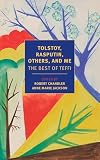
Sometimes when you read a book, the author's personality shines through so strongly that convinced you would hit it off immediately, you wish you could somehow meet. So it was with this collection of writings by Teffi.
Probably such a meeting would be as humiliating as the one the thirteen year old Teffi had with Tolstoy. Recounted in the short story "My First Tolstoy", (1920), Teffi captures perfectly the awkwardness of such a meeting when everything you pictured saying and doing condenses show more into the briefest of encounters. How else could it be when you plan to ask the great author to save Prince Andrei?
While it's easy to relate to the stories from childhood, seeing yourself in the anecdotes, it's a completely different matter with "Rasputin". Written in 1924, Teffi's encounters with Rasputin are still fresh enough in memory to enable her to convey a chilling picture of a sexual predator, a 'sorcerer' as she describes him, a man who has asked particularly to meet her. Reading of his murder, she remembers his prediction:
Much of Teffi's fame in Russia was as a satirist. Satire usually has a short shelf life. However, reminiscences such as "New Life", recalling the politics of the Petersburg newspaper where she worked for awhile, are just as relevant to any office setting today, and still inspire a chuckle.
Teffi left Russian in 1919, just after writing "The Gadarene Swine", a devastating critique of the Whites. She didn't fully realize at the time that she would never return. Perhaps saddest of all are her reflections written in exile, such as "Ilya Repin", a sketch of a celebrated Russian artist living in Finland. His early portrait of her had disappeared, probably to the US. She wrote in 1951, a year before she died
Probably such a meeting would be as humiliating as the one the thirteen year old Teffi had with Tolstoy. Recounted in the short story "My First Tolstoy", (1920), Teffi captures perfectly the awkwardness of such a meeting when everything you pictured saying and doing condenses show more into the briefest of encounters. How else could it be when you plan to ask the great author to save Prince Andrei?
While it's easy to relate to the stories from childhood, seeing yourself in the anecdotes, it's a completely different matter with "Rasputin". Written in 1924, Teffi's encounters with Rasputin are still fresh enough in memory to enable her to convey a chilling picture of a sexual predator, a 'sorcerer' as she describes him, a man who has asked particularly to meet her. Reading of his murder, she remembers his prediction:
...there's one thing they don't know: if they kill Rasputin, it will be the end of Russia.She did.
Remember me then! Remember me!
Much of Teffi's fame in Russia was as a satirist. Satire usually has a short shelf life. However, reminiscences such as "New Life", recalling the politics of the Petersburg newspaper where she worked for awhile, are just as relevant to any office setting today, and still inspire a chuckle.
Teffi left Russian in 1919, just after writing "The Gadarene Swine", a devastating critique of the Whites. She didn't fully realize at the time that she would never return. Perhaps saddest of all are her reflections written in exile, such as "Ilya Repin", a sketch of a celebrated Russian artist living in Finland. His early portrait of her had disappeared, probably to the US. She wrote in 1951, a year before she died
I've never been able to hold on to anything. Neither portraits, nor poems dedicated to me, nor paintings I've been given, nor letters from interesting people. Nothing at all.show less
There is a little more preserved in my memory, but even this is gradually, or even rather quickly, losing its meaning, fading, slipping away from me, wilting and dying.
It's sad to wander about the graveyard of my tired memory, where all hurts have been forgiven, where every sin has been atoned for, every riddle unriddled and twilight quietly cloaks the crosses, now no longer upright, of graves I once wept over.
Teffi was a famous and much-loved a writer in pre-revolutionary Russia. Lenin was a fan, though she was no fan of his, and so was the Czar. She wrote short, humorous pieces for left-wing magazines. Teffi had supported the first revolution, but not the subsequent Bolshevic revolution that overthrew the provisional government. This memoir describes her flight from Russia, ahead of the Bolshevic army. Initially she left for what she thought was a temporary sojourn in Odessa, where there was show more plenty of food, unlike Moscow and St Petersburg, comfortable accommodation, and the opportunity to perform readings of her work. She believed that the Bolsheviks would not endure, and had no idea that she was leaving Russia for ever.
Teffi writes lightly of tragedy. She observes dishonesty and betrayal with sardonic humour, and of barbarity with humanity, even compassion. Her lightness of touch is a counterpoint to the disasters she describes: people she last saw in a drawing room in St Petersburg executed for treason; gay and frivolous young men on their way fight and die for a doomed cause; the barbarity of the White colonel whose wife and children were tortured in front of him. Interspersed with the tragic episodes are the frivolous stories of actors and plays, new journals popping up overnight, women fitting in a last hair appointment before they flee.
The translation, by a string of people that includes Robert Chandler, flows well without jarring, and, as far as I can judge, does a good job of imparting Teffi's humour. show less
Teffi writes lightly of tragedy. She observes dishonesty and betrayal with sardonic humour, and of barbarity with humanity, even compassion. Her lightness of touch is a counterpoint to the disasters she describes: people she last saw in a drawing room in St Petersburg executed for treason; gay and frivolous young men on their way fight and die for a doomed cause; the barbarity of the White colonel whose wife and children were tortured in front of him. Interspersed with the tragic episodes are the frivolous stories of actors and plays, new journals popping up overnight, women fitting in a last hair appointment before they flee.
The translation, by a string of people that includes Robert Chandler, flows well without jarring, and, as far as I can judge, does a good job of imparting Teffi's humour. show less
Lists
Awards


You May Also Like


Associated Authors
Statistics
- Works
- 33
- Also by
- 11
- Members
- 779
- Popularity
- #32,679
- Rating
- 4.2
- Reviews
- 22
- ISBNs
- 49
- Languages
- 9