

Mahmood Mamdani
Author of Good Muslim, Bad Muslim: America, the Cold War, and the Roots of Terror
About the Author
Mahmood Mamdani is the Herbert Lehman Professor of Government at Columbia University and executive director of the Makerere Institute of Social Research. His many books include Citizen and Subject (Princeton) and Saviors and Survivors (Crown).
Works by Mahmood Mamdani
Good Muslim, Bad Muslim: America, the Cold War, and the Roots of Terror (2004) 452 copies, 2 reviews
When Victims Become Killers: Colonialism, Nativism, and the Genocide in Rwanda (2001) 257 copies, 2 reviews
Citizen and Subject: Contemporary Africa and the Legacy of Late Colonialism (Princeton Series in Culture/Power/History) (1996) 181 copies, 1 review
Neither Settler nor Native: The Making and Unmaking of Permanent Minorities (2020) 111 copies, 2 reviews
Slow Poison: Idi Amin, Yoweri Museveni, and the Making of the Ugandan State (2025) 25 copies, 1 review
Scholars in the Marketplace: The Dilemmas of Neo-Liberal Reform at Makerere University, 1989-2005 (2007) 15 copies, 1 review
Beyond Rights Talk and Culture Talk: Comparative Essays on the Politics of Rights and Culture (2000) 12 copies
Tagged
Common Knowledge
- Canonical name
- Mamdani, Mahmood
- Birthdate
- 1947-04-23
- Gender
- male
- Education
- University of Pittsburgh
Fletcher School of Law and Diplomacy
Harvard University - Occupations
- academic
author
political commentator - Relationships
- Nair, Mira (wife)
Mamdani, Zohran (son) - Nationality
- Uganda (birth)
- Birthplace
- Bombay, India
- Places of residence
- Uganda, Africa
USA - Associated Place (for map)
- Bombay, India
Members
Reviews

An ambitious, penetrating book that made some bold claims. It introduced me to the centuries of dispossession of Native Americans, the denazification process in Germany, the emergence and resistance to apartheid in South Africa, and the stranglehold of the British colonial scheme on Sudan and South Sudan.
On the Israel section — I mostly agreed with his argument but had some questions about his phrasing and argumentation. For example, Mamdani argues that Palestinians rebelled against the show more exclusionary Jewish nature of immigration — what he'd referred to as the "settler" nature — but then they also opposed any immigration, even during WWII, which is sus.
Mamdani sees the nation-state as a driver of ethnic cleansing, rather than as the protective apparatus that the 1648 Westphalia treaty conceived it as. For example, he brings up the ethnic cleansing of Germans after WWII — half a million dead, millions more expelled — as evidence that the desire to make a homogeneous Europe necessitated atrocities, not unlike the Nakba that a homogeneous Jewish state demanded. But that is an obvious observation.
One central formulation — that the nation-state can never truly be democratic since it presupposes a permanent majority — never really grapples with democratic nation-states like Japan, with naturally permanent majorities. Some of the writer's solutions also seemed slapped on or perhaps shortsighted, like apportioning some fixed representation for Native Americans as a political route to decolonization, even a state of their own — precisely the sort of tribalization that happened in South Sudan? A sort of approximation of a nation state?
Denazification to Mamdani was a failed process because it handled "big" Nazis as individual criminals — he thinks the antifascist forces should have led the internal reckoning, rather than the big powers exacting a "victor's justice". But what would that internal reckoning look like? And why were these processes mutually exclusive? There is some element of counterfactual history here. show less
On the Israel section — I mostly agreed with his argument but had some questions about his phrasing and argumentation. For example, Mamdani argues that Palestinians rebelled against the show more exclusionary Jewish nature of immigration — what he'd referred to as the "settler" nature — but then they also opposed any immigration, even during WWII, which is sus.
Mamdani sees the nation-state as a driver of ethnic cleansing, rather than as the protective apparatus that the 1648 Westphalia treaty conceived it as. For example, he brings up the ethnic cleansing of Germans after WWII — half a million dead, millions more expelled — as evidence that the desire to make a homogeneous Europe necessitated atrocities, not unlike the Nakba that a homogeneous Jewish state demanded. But that is an obvious observation.
One central formulation — that the nation-state can never truly be democratic since it presupposes a permanent majority — never really grapples with democratic nation-states like Japan, with naturally permanent majorities. Some of the writer's solutions also seemed slapped on or perhaps shortsighted, like apportioning some fixed representation for Native Americans as a political route to decolonization, even a state of their own — precisely the sort of tribalization that happened in South Sudan? A sort of approximation of a nation state?
Denazification to Mamdani was a failed process because it handled "big" Nazis as individual criminals — he thinks the antifascist forces should have led the internal reckoning, rather than the big powers exacting a "victor's justice". But what would that internal reckoning look like? And why were these processes mutually exclusive? There is some element of counterfactual history here. show less
Citizen and Subject: Contemporary Africa and the Legacy of Late Colonialism (Princeton Series in Culture/Power/History) by Mahmood Mamdani
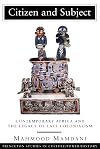
Mahmood Mamdani, professor at Princeton University, specialist of African issues, considered by 'Foreign Policy' and 'Prospect' as being one the 100 most important contemporary intellectuals, attempts here to explain why the process of democratisation failed in most African countries, following their independence.
His thesis? Colonialism wasn't only a racial system whereas Blacks were oppressed by Whites. It was, also, and above all, made possible by very peculiar politics, that led both to show more ethnic divisions (with tragical consequences at times) and strong a divide between the rural world and the urban one. This last division, to him, is in fact the main cause of the failures. How so?
The African scramble had made necessary the implementation of new colonial rules. If the abolition of slavery had transformed the colonies, the limited ruling personnel, compounded by how problematic were communication networks across such vast territories, had made it impossible to rely solely on a White cast to control it all. Decentralisation, then, came as a solution.
Indeed, in those parts where White people had no access or weren't present, they would rely on tribal and local chiefs, created by their own hands (who had nothing traditional about them, then) and who were given considerable powers in order to apply their colonial directives. It was a practical yet deeply cynical approach: corrupting to better conciliate; a dichotomy whereas the State, a mad Janus, took two faces, each defined by the racial identity of who composed it. On the one hand, new customs, completely fabricated by the new chiefs and their White puppeteers, controlling 'subjects' living in rural environments; on the other, in urban areas, the laws of the colonial States being applied only to those who were 'citizens'. And, it's in this institutional evolution that Mahmood Mamdani sees the causes of post-colonial failures when it came to become democratic.
Showing that these divisions (citizens/ subjects, rural world/ urban world) will echo themselves even within nationalist and independentist movements (he delves especially upon the cases of Uganda and South Africa; the first because such movements originated in rural areas, the other because they originated in urban ones) he demonstrates how such movements could only fail managing the disastrous institutional legacy left by colonialism.
The thing was, going from one extreme to the other, democratisation could only be possible through, either a 'detribalisation', involving the replacing of local chiefs (tribal authority) by bureaucrats working solely for the Sate (central authority) and not for their tribes or clans ( something that many refused to do as it would have threaten their own privileges); or, by carrying on with decentralisation as left by previous rulers that is, a maintaining of tribalism and clientelism (and we now know where such tribalism and clientelism have led!).
It's a challenging read, yet that leaves with a new perspective, seductive, that will strike anyone baffled by how deeply the legacy of colonialism had affected Africa, decades after colonialism itself had collapsed. A must-read for anyone interested in African issues. show less
His thesis? Colonialism wasn't only a racial system whereas Blacks were oppressed by Whites. It was, also, and above all, made possible by very peculiar politics, that led both to show more ethnic divisions (with tragical consequences at times) and strong a divide between the rural world and the urban one. This last division, to him, is in fact the main cause of the failures. How so?
The African scramble had made necessary the implementation of new colonial rules. If the abolition of slavery had transformed the colonies, the limited ruling personnel, compounded by how problematic were communication networks across such vast territories, had made it impossible to rely solely on a White cast to control it all. Decentralisation, then, came as a solution.
Indeed, in those parts where White people had no access or weren't present, they would rely on tribal and local chiefs, created by their own hands (who had nothing traditional about them, then) and who were given considerable powers in order to apply their colonial directives. It was a practical yet deeply cynical approach: corrupting to better conciliate; a dichotomy whereas the State, a mad Janus, took two faces, each defined by the racial identity of who composed it. On the one hand, new customs, completely fabricated by the new chiefs and their White puppeteers, controlling 'subjects' living in rural environments; on the other, in urban areas, the laws of the colonial States being applied only to those who were 'citizens'. And, it's in this institutional evolution that Mahmood Mamdani sees the causes of post-colonial failures when it came to become democratic.
Showing that these divisions (citizens/ subjects, rural world/ urban world) will echo themselves even within nationalist and independentist movements (he delves especially upon the cases of Uganda and South Africa; the first because such movements originated in rural areas, the other because they originated in urban ones) he demonstrates how such movements could only fail managing the disastrous institutional legacy left by colonialism.
The thing was, going from one extreme to the other, democratisation could only be possible through, either a 'detribalisation', involving the replacing of local chiefs (tribal authority) by bureaucrats working solely for the Sate (central authority) and not for their tribes or clans ( something that many refused to do as it would have threaten their own privileges); or, by carrying on with decentralisation as left by previous rulers that is, a maintaining of tribalism and clientelism (and we now know where such tribalism and clientelism have led!).
It's a challenging read, yet that leaves with a new perspective, seductive, that will strike anyone baffled by how deeply the legacy of colonialism had affected Africa, decades after colonialism itself had collapsed. A must-read for anyone interested in African issues. show less

The author traces the rise of Islamic terrorism from American training of the mujahadeen in Afghanistan to fighting the Soviets. There, the CIA found it could recruit anti-Soviets by using Muslim religious language to accomplish American political goals.
The CIA's actions were part of a more general trend to conduct the cold war through surrogates after the failure of Viet Nam. Presidents Carter and Reagan attempted to combat various left wing national governments through undermining them show more indirectly rather than through direct confrontation. Nicaragua is a classic example.
Because the president was unable to obtain funding for such subversive activities, the CIA turned to the drug trade to fund its activities in Nicaragua and Afganistan.
The author is perplexed by America's uncritical support of Israel. He refers to the strong Jewish lobby that acts more as a fund raiser than a get-out-the-vote organization. But he still wonders why American news media is willing to criticize any country, including the USA, but not Israel. He sees the phenomenon as a product of the perception (held by both Israelis and Americans) that Israelis are not colonizers or settlers, but people returning to their country after two millenia. That perception is quite rare anywhere else in the world.
The author asserts (not very convincingly) that the Nicaragua-Contra affair could have been as destructive of Reagan's presidency as Watergate was to Nixon's, except that Israeli involvement gave the activities a kind of immunity.
The use of surrogate warriors motivated by religion to accomplish political goals is a common denominator for both CIA subversion and Muslim terrorism. Bin Ladin is a politician, not a theologian.
I think Mamdani, who is Muslim, ignores elements of Islam that make it so easy to recruit Muslims to fight such battles. He seeks to put the blame for the start of terrorism on the CIA, which deserves some blame, but hardly all of it. Nonetheless, the book is often a thought provoking counter to Huntington's "clash of civilizations" thesis. (JAB) show less
The CIA's actions were part of a more general trend to conduct the cold war through surrogates after the failure of Viet Nam. Presidents Carter and Reagan attempted to combat various left wing national governments through undermining them show more indirectly rather than through direct confrontation. Nicaragua is a classic example.
Because the president was unable to obtain funding for such subversive activities, the CIA turned to the drug trade to fund its activities in Nicaragua and Afganistan.
The author is perplexed by America's uncritical support of Israel. He refers to the strong Jewish lobby that acts more as a fund raiser than a get-out-the-vote organization. But he still wonders why American news media is willing to criticize any country, including the USA, but not Israel. He sees the phenomenon as a product of the perception (held by both Israelis and Americans) that Israelis are not colonizers or settlers, but people returning to their country after two millenia. That perception is quite rare anywhere else in the world.
The author asserts (not very convincingly) that the Nicaragua-Contra affair could have been as destructive of Reagan's presidency as Watergate was to Nixon's, except that Israeli involvement gave the activities a kind of immunity.
The use of surrogate warriors motivated by religion to accomplish political goals is a common denominator for both CIA subversion and Muslim terrorism. Bin Ladin is a politician, not a theologian.
I think Mamdani, who is Muslim, ignores elements of Islam that make it so easy to recruit Muslims to fight such battles. He seeks to put the blame for the start of terrorism on the CIA, which deserves some blame, but hardly all of it. Nonetheless, the book is often a thought provoking counter to Huntington's "clash of civilizations" thesis. (JAB) show less

Not an easy read - the book is full of subtle nuances and allusions. Some of the ideas are quite disruptive of the middle-class liberal values we have come to espouse under the influence of Nehruvism (for instance). In common with many other so-called post-modernist or post-liberal writers, this author also seems to be enjoying both worlds - a successful academic career in the enlightened west, while critiquing (or criticising?) the very values that provide them the freedom and tolerance to show more be frank and outspoken. One of his main points is that state violence should not be laid at the doors of individual actors and state servants, but must instead be treated as political crimes. The Nurenberg types of post-upheaval trials does not lead to the rooting out of the cause of the violence and cruelty, as the entire thing is pinned on a few individuals who are punished as scapegoats. Another point he makes is that the "nation" needs to be replaced by a non-partisan, secular state with no moorings in concepts of ethnicity, culture, religion, language etc. He commends the example of South Africa, where they avoided making either party the accused for the past under apartheid, so that both perpetrators and victims could come together as 'adversaries' in a viable political system, rather than as 'enemies' locked in a zero-sum fight. This example is contrasted with the US in respect of its Native American population, and Israel of the native Palestinians. One weakness of his arguments against the 'rule-of-law' approach in dealing with political crimes, is that the consensus in South Africa could well break down if a local demagogue arises and destroys the social contract between different ethnic groups. Indeed the subcontinent could well be taken up as a study of the relative merits of the idealistic, constitutional approach to other, more political, coalitional approaches, as the two successor states have gone about their business in such contrasting modes. show less
Lists
Awards


You May Also Like


Associated Authors
Statistics
- Works
- 19
- Members
- 1,343
- Popularity
- #19,158
- Rating
- 3.9
- Reviews
- 12
- ISBNs
- 79
- Languages
- 5

