
Samuel Hopkins Adams (1871–1958)
Author of The Pony Express
About the Author
Samuel Hopkins Adams was born on January 26, 1871 in Dunkirk, N.Y. He graduated from Hamilton College in 1891. He was a reporter for the New York Sun and McClure's Magazine where his articles focused on the the conditions of public health in the United States. He also wrote a series of eleven show more articles in Collier's Weekly exposing patent medicines and accusing their producers of making false claims and in some cases, damaging the health of their users. These articles were a huge influence on the passage of the first Pure Food and Drugs Act. He not only wrote for magazines, he also wrote fiction and nonfiction. His most popular novel, Revelry was based on the scandals of the Harding administration. His other titles include The Harvey Girls, The Grandfather Stories, and Tenderloin. Adams died Nov. 15, 1958 in Beaufort, South Carolina. (Bowker Author Biography) Samuel Hopkins Adams was born 26 January 1871 in Dunkirk, New York. Adams graduated from Hamilton College in 1891 and was with the New York Sun until 1900. From 1901 to 1905 he was associated in various editorial and advertising capacities with McClure's syndicate and McClure's Magazine, and it was there the he earned a reputation as a muckracker for his articles on the conditions of public health in the United States. Adams also wrote a series of eleven articles for Collier's Weekly, entitled The Great American Fraud in which he exposed patent medicines; these pieces were credited with influencing the passage of the first Pure Food and Drugs Act in 1906. In 1911 the Supreme Court ruled that the prohibition of falsifications referred only to the ingredients of the medicine, meaning that companies could still make false claims about their products. Adams rebuttled this in articles in Collier's Weekly such as Fraud Medicines Own Up (20th January), Tricks of the Trade (17th February, 1912), The Law, the Label, and the Liars (13th April, 1912) and Fraud Above the Law (11th May, 1912), He exposed the misleading advertising that companies were using to sell their products. Adams was an American journalist and author of more than 50 books of fiction, biography, and exposé. He was also known as Warner Fabian, and as a prolific writer, produced both fiction and nonfiction. His best-known novel, Revelry (1926), based on the scandals of the Harding administration, was later followed by Incredible Era (1939), a biography of Harding and his times. Among his other works are The Great American Fraud (1906), The Harvey Girls (1942), Grandfather Stories (1955), and Tenderloin (1959). Samuel Hopkins Adams died 15 November 1958 in Beaufort, South Carolina. (Bowker Author Biography) show less
Image credit: From "How to Live: Rules for Healthful Living Based on Modern Science" (Fisher & Fisk, 1916)
Project Gutenberg
Project Gutenberg
Works by Samuel Hopkins Adams
Little Miss Grouch: A Narrative Based on the Log of Alexander Forsyth Smith's Maiden Transatlantic Voyage (1914) 8 copies, 2 reviews
Landmarks of American History, 10 Vol. Set (Voyages of Christopher Columbus, Landing of the Pilgrims, Paul Revere & (1950) 5 copies, 1 review
Unforbidden Fruit. 4 copies
The World Goes Smash 3 copies
The piper's fee 2 copies
The Men In Her Life 2 copies
Plunder : a novel 2 copies
Maiden effort, 2 copies
Canal Town (abridged) 1 copy
Such as Walk in Darkness 1 copy
The health master, 1 copy
Safe money: The record of one hundred years of mutual savings banking at the Auburn Savings Bank 1 copy
Widow's oats 1 copy
Week-end girl 1 copy
Whispers 1 copy
The Godlike Daniel 1 copy
The Corpse at the Table 1 copy
Associated Works
101 Years' Entertainment: The Great Detective Stories 1841-1941 (1941) — Contributor — 111 copies, 1 review
No, But I Saw the Movie: The Best Short Stories Ever Made Into Film (1960) — Contributor — 80 copies, 3 reviews
Curiosities of medicine;: An assembly of medical diversions, 1552-1962 (1963) — Contributor — 25 copies
Prize stories from Collier's, 5 volumes — Contributor — 1 copy
Omnibook Magazine (Overseas Edition for Armed Forces) July 1945 — Author — 1 copy
Tagged
Common Knowledge
- Other names
- Fabian, Warner
- Birthdate
- 1871-01-26
- Date of death
- 1958-11-15
- Gender
- male
- Education
- Hamilton College
- Occupations
- journalist
novelist
screenplay writer - Organizations
- New York Sun
McClure's
Collier's - Nationality
- USA
- Birthplace
- Dunkirk, New York, USA
- Places of residence
- Dunkirk, New York, USA
Auburn, New York, USA - Place of death
- Beaufort, South Carolina, USA
- Associated Place (for map)
- New York, USA
Members
Reviews

https://fromtheheartofeurope.eu/the-harvey-girls-by-samuel-hopkins-adams/
I found it terribly charming. The three central characters are young women who go out to Arizona from the Midwest and the East to work in one of the Harvey House chain of restaurants in the fictional town of Sandrock. This was a chain where the waitresses were relentlessly chaperoned and had to sign contracts for six months or a year, basically bargaining away their freedom for a steady income and the chance to meet show more lots of potential men in a safe environment.
The tone of the book is affectionately satirical. I think if I had been in a more grumpy mood when I read it, I would have found that annoying, but I wasn’t and I didn’t. The girls have to deal with the standard clichés of prospectors, ranchers, sex workers, the evil judge, an English aristocrat who has somehow got lost, and their own upbringings and expectations; one of them has been brought up in an evangelical cult and is Breaking Free.
'“I wonder what it would be like to be a carnal snare,” she said to herself, and instantly suppressed the frightening and tempting hypothesis.'
It’s a violent book – about a third of the named characters have been killed off by the end, and the threat of coercion lurks ominously in the background. But it’s also a rather cheerful interpretation of the Western legend, by a man but from the women’s point of view. There is a lovely postscript when the survivors get together fifty years later, in the present day (ie the 1940s), making the point to contemporary readers that the Wild West was well within living memory.
Of course the Western genre is thoroughly racist. I think I spotted precisely one black character, and there is a Chinese laundryman in Sandrock (though we are told in the epilogue that his grandchildren have totally assimilated). Native Americans are portrayed only as potential rapists. But it’s also a genre about women’s empowerment, as I have noted before. show less
I found it terribly charming. The three central characters are young women who go out to Arizona from the Midwest and the East to work in one of the Harvey House chain of restaurants in the fictional town of Sandrock. This was a chain where the waitresses were relentlessly chaperoned and had to sign contracts for six months or a year, basically bargaining away their freedom for a steady income and the chance to meet show more lots of potential men in a safe environment.
The tone of the book is affectionately satirical. I think if I had been in a more grumpy mood when I read it, I would have found that annoying, but I wasn’t and I didn’t. The girls have to deal with the standard clichés of prospectors, ranchers, sex workers, the evil judge, an English aristocrat who has somehow got lost, and their own upbringings and expectations; one of them has been brought up in an evangelical cult and is Breaking Free.
'“I wonder what it would be like to be a carnal snare,” she said to herself, and instantly suppressed the frightening and tempting hypothesis.'
It’s a violent book – about a third of the named characters have been killed off by the end, and the threat of coercion lurks ominously in the background. But it’s also a rather cheerful interpretation of the Western legend, by a man but from the women’s point of view. There is a lovely postscript when the survivors get together fifty years later, in the present day (ie the 1940s), making the point to contemporary readers that the Wild West was well within living memory.
Of course the Western genre is thoroughly racist. I think I spotted precisely one black character, and there is a Chinese laundryman in Sandrock (though we are told in the epilogue that his grandchildren have totally assimilated). Native Americans are portrayed only as potential rapists. But it’s also a genre about women’s empowerment, as I have noted before. show less
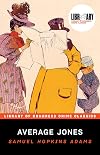
A delightful collection of short stories that have been novelized. A. V. R. E. Jones - "Average" to his friends - is a rather wealthy young man who is doomed to live in New York for five continuous years, so that he might inherit the millions left by a late uncle. Not knowing what to do with himself, a friend suggests that he investigate advertisements in the papers, rooting out the scams and miscreants. Though Average is dubious of the title his friend gives him, the Ad-Visor, he thinks it show more is a fun idea and goes into business as such. The 11 stories that follow are his adventures in the ad business, which take him all over the place in search of murderers, kidnappers, assassins, and dog-haters. The stories are all told quite humorously, and Average himself is a very engaging character.
This is very much a collection of stories of its time. Originally published in 1911, a time when the newspapers were prevalent, and more than half their pages were ads of various kinds (one of the stories mentions 1600 ads in one daily paper). Fans of Sherlock Holmes will understand the usefulness of these pages and pages of ads, as the great detective himself uses them fairly regularly to assist in solving his most baffling cases. Average makes it his business to keep his eyes peeled for interesting adverts that definitely have a story to tell.
I can see a through-line from Average Jones in 1911 and Lester Leith fifty-odd years later. The characters are nothing alike, but their study and use of ads is the same. It's also a genre of story that is truly over, given the dearth of actual printed newspapers these days, and the lack of classified ads even in the ones that do exist. It's a time that has passed, but readers who enjoy clever characters will enjoy this book.
Sadly, there are no other Average Jones stories to be read. Luckily, these can be read over and over again for continued delight and humor! show less
This is very much a collection of stories of its time. Originally published in 1911, a time when the newspapers were prevalent, and more than half their pages were ads of various kinds (one of the stories mentions 1600 ads in one daily paper). Fans of Sherlock Holmes will understand the usefulness of these pages and pages of ads, as the great detective himself uses them fairly regularly to assist in solving his most baffling cases. Average makes it his business to keep his eyes peeled for interesting adverts that definitely have a story to tell.
I can see a through-line from Average Jones in 1911 and Lester Leith fifty-odd years later. The characters are nothing alike, but their study and use of ads is the same. It's also a genre of story that is truly over, given the dearth of actual printed newspapers these days, and the lack of classified ads even in the ones that do exist. It's a time that has passed, but readers who enjoy clever characters will enjoy this book.
Sadly, there are no other Average Jones stories to be read. Luckily, these can be read over and over again for continued delight and humor! show less

A mysterious body is found on the beach at Lonesome Cove, handcuffed to a grid and with a head wound. When suspicion falls on Francis Sedgwick, his friend Chester Kent, a professor who undertakes work investigating for the Department of Justice, takes on the case.
This book dates from 1912 and so falls between Conan Doyle and Agatha Christie. The racial stereotyping of Gansett Jim (a mixed race Native American/African American) is the only sour note. Apart from that, it not only gives us a show more picture of its time but is also a very good mystery with an unexpected solution, which the dedication with its hint of a real-life parallel makes even more intriguing. show less
This book dates from 1912 and so falls between Conan Doyle and Agatha Christie. The racial stereotyping of Gansett Jim (a mixed race Native American/African American) is the only sour note. Apart from that, it not only gives us a show more picture of its time but is also a very good mystery with an unexpected solution, which the dedication with its hint of a real-life parallel makes even more intriguing. show less
Interesting fictionalization of Warren Harding's presidency, on the whole sympathetic to Harding though making clear the vulgarity and corruption of his "gang" A few significant changes --the fictional president's wife is institutionalized with a nervous breakdown, which makes his riomance more excusable than the real Harding's.
Lists
Awards


You May Also Like


Associated Authors
Statistics
- Works
- 62
- Also by
- 25
- Members
- 2,131
- Popularity
- #12,080
- Rating
- 3.7
- Reviews
- 24
- ISBNs
- 206
