
Frederic Manning (1882–1935)
Author of The Middle Parts of Fortune
About the Author
Image credit: National Portrait Gallery
Works by Frederic Manning
The Life of Sir William White 3 copies
Рядові Фортуни 1 copy
Associated Works
Tagged
Common Knowledge
- Other names
- Private 19022
- Birthdate
- 1882-07-22
- Date of death
- 1935-02-22
- Gender
- male
- Education
- self-educated
- Occupations
- poet
novelist
soldier (WWI)
reviewer
biographer - Organizations
- British Army (WWI)
- Short biography
- He was born in Sydney in 1882. He moved to England in 1903 and followed a literary career as a poet and reviewer. He enlisted in the Shropshire Light Infantry in 1915 (Private # 19022). He saw heavy action on the Somme in 1916.
- Nationality
- Australia (birth)
- Birthplace
- Sydney, New South Wales, Australia
- Places of residence
- Edenham, Lincolnshire, England, UK
Bourne, Lincolnshire, England, UK
Surrey, England, UK - Place of death
- Hampstead, London, England, UK
- Map Location
- Australia
Members
Reviews
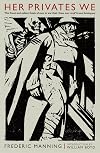
The First World War seems to have been too beastly for literature, or perhaps simply too efficient at killing the people who might have written novels about it. Other than the Poets (or to quote Blackadder, the "endless, bloody, poetry") and All Quiet on the Western Front which my not having read is rapidly becoming a mortal embarrassment, this seems to be the only significant work of literature produced by a combatant about the front line. Frederic Manning certainly wasn't your show more common-or-garden Tommy — he was a litterateur, an Australian, probably gay, and in his late thirties when he enlisted — but Her Privates We is a monument to the men who found themselves, through no fault of their own, entrenched in the Somme. What makes it live and breathe is the ventriloquism — the brilliantly rendered voices of a Britain where regional accents and vocab were yet unmuddied by mass media. I learnt fanti for "crazy", and snobs for a cobbler, and I was glad to see that "cunt-struck" has over a century of pedigree. The swearing is as fluent as can be. Very few writers can render accents convincingly in prose, and Manning is one of them. He was with the Shropshires (or "Westshires" in the novel), where I'm from, and some of the voices here reminded me of the codgers they brought into my primary school in the 80's to tell us first-hand what a terrific disaster the whole thing was for everyone involved.
Most of the story takes place behind — or between — the lines, as the Westshires are shunted from one desolated mining town to another, waiting to be shoved back into the meat-grinder. It's endless marching punctuated by pointless (and sometimes deadly) parading, office politics, raiding of estaminets, and attempts, successful or not, to have a "bon time" on smuggled whisky and vinegarish wine. The POV character, Bourne — a rough analogue of Manning — hangs around with a nondescript soldier called Shem and the 16 year-old Martlow, who's emblematic of Owen's "Doomed Youth", and whom I thought maybe Bourne/Manning was quietly in love with. But it's equally likely that that's the interpretation of a reader who's never been in a remotely similar situation, and for whom sentences like this will never be fully comprehensible:
Most of the story takes place behind — or between — the lines, as the Westshires are shunted from one desolated mining town to another, waiting to be shoved back into the meat-grinder. It's endless marching punctuated by pointless (and sometimes deadly) parading, office politics, raiding of estaminets, and attempts, successful or not, to have a "bon time" on smuggled whisky and vinegarish wine. The POV character, Bourne — a rough analogue of Manning — hangs around with a nondescript soldier called Shem and the 16 year-old Martlow, who's emblematic of Owen's "Doomed Youth", and whom I thought maybe Bourne/Manning was quietly in love with. But it's equally likely that that's the interpretation of a reader who's never been in a remotely similar situation, and for whom sentences like this will never be fully comprehensible:
They laid themselves down, as they were to get a few hours' sleep; and Bourne, dropping off between the two of them, wondered what was the spiritual thing in them which lived and seemed to grow even stronger, in the midst of beastliness.show less
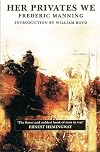
Also known as The Middle Parts of Fortune. If you remember reading All Quiet on the Western Front and thought that was good (which it is), then this is better. An absolute classic of anti-war WW1 fiction, written by a veteran, and it's a shame it's not better known. I had never heard of it until recently. This is the real McCoy right down to the truly dreadful language. When it was first published in 1928 it had to be quickly expurgated to avoid prosecution under obscenity laws. This is the show more unexpurgated version, and it's filthy. But that only makes it more real. show less

One might think that a book about WWI would offer little that a reader today could relate to. Not true. I found much in Her Privates We with which to identify. In his modern intro to the book first published in 1929, William Boyd notes that the unexpurgated version, with its vivid and vulgar language typical to the talk of rank and file soldiers, makes the book curiously contemporary, and he's right. The usual Anglo-saxon crudities used by the British soldiers in the book are the same ones show more still used by soldiers in any army in the world.
Hemingway remarked that Her Privates We was one of the best books he'd ever read about men at war, and that he read it often.
I have to agree with Boyd and Hemingway. There is something so very real, so 'now' about the story Manning tells, about his main character, Bourne, and the other soldiers he befriends and observes throughout the narrative. There was one particular anecdote, one in which Bourne and another soldier had to escort a couple of large stupid Lancashire men to a military prison which reminded me almost immediately of the plot of a popular novel (and film) of the 70s Vietnam era, Darryl Ponicsan's The Last Detail. I wondered idly as I read this section whether Ponicsan had ever read Manning's book.
Another passage which struck me deeply, was a passing comment Bourne made about friendship versus the comradeship the military life often forces upon you.
"I have one or two particular chums, of course; and in some ways, you know, good comradeship takes the place of friendship. It is different; it has its own loyalties and affections; and I am not so sure that it does not rise on occasion to an intensity of feeling which friendship never touches."
And that is exactly what the phrase "old army buddies" is all about. It can't be explained to someone who has never served, but friendships made outside the military rarely rise to that level, to that lasting feeling of "comradeship."
There were many such passages here - truisms and even casual conversations between chums that I understood easily. My own experiences in the US Army in the 60s, then 70s and 80s, were the same. I had my own Bournes, Martlows and Shems, and the end of the story, as heartbreaking as it is, seemed inevitable. That's how real and immediate this book still is. So I understand why Hemingway, Arnold Bennett, T.E. Lawrence and others marked this book for greatness. It is deserving of its status as a classic of war literature. Terrific stuff. I cannot recommend it highly enough. show less
Hemingway remarked that Her Privates We was one of the best books he'd ever read about men at war, and that he read it often.
I have to agree with Boyd and Hemingway. There is something so very real, so 'now' about the story Manning tells, about his main character, Bourne, and the other soldiers he befriends and observes throughout the narrative. There was one particular anecdote, one in which Bourne and another soldier had to escort a couple of large stupid Lancashire men to a military prison which reminded me almost immediately of the plot of a popular novel (and film) of the 70s Vietnam era, Darryl Ponicsan's The Last Detail. I wondered idly as I read this section whether Ponicsan had ever read Manning's book.
Another passage which struck me deeply, was a passing comment Bourne made about friendship versus the comradeship the military life often forces upon you.
"I have one or two particular chums, of course; and in some ways, you know, good comradeship takes the place of friendship. It is different; it has its own loyalties and affections; and I am not so sure that it does not rise on occasion to an intensity of feeling which friendship never touches."
And that is exactly what the phrase "old army buddies" is all about. It can't be explained to someone who has never served, but friendships made outside the military rarely rise to that level, to that lasting feeling of "comradeship."
There were many such passages here - truisms and even casual conversations between chums that I understood easily. My own experiences in the US Army in the 60s, then 70s and 80s, were the same. I had my own Bournes, Martlows and Shems, and the end of the story, as heartbreaking as it is, seemed inevitable. That's how real and immediate this book still is. So I understand why Hemingway, Arnold Bennett, T.E. Lawrence and others marked this book for greatness. It is deserving of its status as a classic of war literature. Terrific stuff. I cannot recommend it highly enough. show less
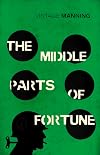
Partly because of contemporary censorship, and partly because so many of the writers of the time were well-educated, middle-class boys, there is sometimes a tendency to imagine everyone from the First World War speaking in cut-glass Eton English. ‘Ready to give the Boche a damn good thrashing, Blodger?’ ‘Lumme, I should hope so old man,’ and so on. I mean you know logically that people still swore and cursed in the 1910s, but it's hard to take it on board instinctively when there's show more so little record of it. And then again, maybe people really were a bit more reserved in those days…?
I have fallen into that trap before; and linguistically speaking, The Middle Parts of Fortune has been a necessary corrective for me. Here, privates in the trenches are more direct:
‘Fuckin' slave drivers, that's what they are!’ said Minton, flinging himself on the ground. ‘What's the cunt want to come down 'ere buggerin' us about for, 'aven't we done enough bloody work in th' week?’
As soon as you read it, you think: ah. Yes. Of course that's how people spoke. I can hear people I know saying that.
Capturing this dialogue is one of Manning's key aims in this novel, and it was also one of the reasons the book got into trouble when it first came out (anonymously) in 1929. A year later it was bowdlerised and re-released as Her Privates We, the title under which it's still published by many modern editors, although it's not clear to me which version of the text is being used by who.
It's a great book anyway, and one that reminded me very much of Henri Barbusse's Le Feu. They have many incidents in common, but they also both depend stylistically on naturalistic slang, and they both spend the bulk of their time examining the interminable boredom that comprised ninety percent of soldiers' lives – the forced marches, billeting in tiny French villages in the rain, linguistic misunderstandings, trench philosophising, drinking binges in two-bit estaminets, the petty politics between different officers. All the time trying not to think about the next ‘show’: it was an existence based around rejecting the immediate future – what Manning describes as ‘their subterranean, furtive, twilight life, the limbo through which, with their obliterated humanity, they moved as so many unhouseled ghosts’.
As perhaps you can tell already, some of the prose is of quite an elevated register, especially compared with the speech. Manning is not averse to throwing in some rare archaisms like venusty to try and ratchet up the emotional effect of some scenes; I'm still not sure how I feel about that. I think the dialogue was more successful than many of the descriptive passages.
He does write very incisively, though, on many aspects of trench life, like its enforced masculinity. The lack of female interaction brings about all kinds of strange psychological symptoms – it instils a ‘sense of privation, which affected more or less consciously all these segregated males, so that they swung between the extremes of a sickly sentimentalism and a rank obscenity’, as demonstrated in several scenes.
I think ultimately Le Feu might be a better book. The Middle Parts of Fortune was very slightly let down for me by the central character, Bourne, who seems to move through a series of scenes that are designed to show off the excellence of his character: he is always the most level-headed, the most intelligent, the most judicious of his companions, and since he's a thinly veiled version of the author, this struck me as slightly off-putting. On the other hand, the portraits of other soldiers are very moving here, and I cared about some of them more than I cared about anyone in Barbusse.
They had nothing; not even their own bodies, which had become mere implements of warfare. They turned from the wreckage and misery of life to an empty heaven, and from an empty heaven to the silence of their own hearts. They had been brought to the last extremity of hope, and yet they put their hands on each other's shoulders and said with a passionate conviction that it would be all right, though they had faith in nothing, but in themselves and in each other.
The book ends with his company going over the top, and by this stage, after so much detailed uncertainty and procrastination, the effect is very powerful. My palms were sweating. Manning handles it perfectly: it feels as though you too, as a reader, have been waiting the whole time, with a sort of sick anxiety that can only be the tiniest shadow of its original, for this final, dreadful rush into hell. show less
I have fallen into that trap before; and linguistically speaking, The Middle Parts of Fortune has been a necessary corrective for me. Here, privates in the trenches are more direct:
‘Fuckin' slave drivers, that's what they are!’ said Minton, flinging himself on the ground. ‘What's the cunt want to come down 'ere buggerin' us about for, 'aven't we done enough bloody work in th' week?’
As soon as you read it, you think: ah. Yes. Of course that's how people spoke. I can hear people I know saying that.
Capturing this dialogue is one of Manning's key aims in this novel, and it was also one of the reasons the book got into trouble when it first came out (anonymously) in 1929. A year later it was bowdlerised and re-released as Her Privates We, the title under which it's still published by many modern editors, although it's not clear to me which version of the text is being used by who.
It's a great book anyway, and one that reminded me very much of Henri Barbusse's Le Feu. They have many incidents in common, but they also both depend stylistically on naturalistic slang, and they both spend the bulk of their time examining the interminable boredom that comprised ninety percent of soldiers' lives – the forced marches, billeting in tiny French villages in the rain, linguistic misunderstandings, trench philosophising, drinking binges in two-bit estaminets, the petty politics between different officers. All the time trying not to think about the next ‘show’: it was an existence based around rejecting the immediate future – what Manning describes as ‘their subterranean, furtive, twilight life, the limbo through which, with their obliterated humanity, they moved as so many unhouseled ghosts’.
As perhaps you can tell already, some of the prose is of quite an elevated register, especially compared with the speech. Manning is not averse to throwing in some rare archaisms like venusty to try and ratchet up the emotional effect of some scenes; I'm still not sure how I feel about that. I think the dialogue was more successful than many of the descriptive passages.
He does write very incisively, though, on many aspects of trench life, like its enforced masculinity. The lack of female interaction brings about all kinds of strange psychological symptoms – it instils a ‘sense of privation, which affected more or less consciously all these segregated males, so that they swung between the extremes of a sickly sentimentalism and a rank obscenity’, as demonstrated in several scenes.
I think ultimately Le Feu might be a better book. The Middle Parts of Fortune was very slightly let down for me by the central character, Bourne, who seems to move through a series of scenes that are designed to show off the excellence of his character: he is always the most level-headed, the most intelligent, the most judicious of his companions, and since he's a thinly veiled version of the author, this struck me as slightly off-putting. On the other hand, the portraits of other soldiers are very moving here, and I cared about some of them more than I cared about anyone in Barbusse.
They had nothing; not even their own bodies, which had become mere implements of warfare. They turned from the wreckage and misery of life to an empty heaven, and from an empty heaven to the silence of their own hearts. They had been brought to the last extremity of hope, and yet they put their hands on each other's shoulders and said with a passionate conviction that it would be all right, though they had faith in nothing, but in themselves and in each other.
The book ends with his company going over the top, and by this stage, after so much detailed uncertainty and procrastination, the effect is very powerful. My palms were sweating. Manning handles it perfectly: it feels as though you too, as a reader, have been waiting the whole time, with a sort of sick anxiety that can only be the tiniest shadow of its original, for this final, dreadful rush into hell. show less
Lists
Awards


You May Also Like


Associated Authors
Statistics
- Works
- 10
- Also by
- 2
- Members
- 901
- Popularity
- #28,453
- Rating
- 3.9
- Reviews
- 17
- ISBNs
- 68
- Languages
- 8
- Favorited
- 2