
Adam Gopnik
Author of Paris to the Moon
About the Author
Adam Gopnik is the author of Paris to the Moon and Through the Children's Gate and is a contributor to The New Yorker. He lives in New York City with his wife and two children. His most recent book is Angels and Ages: A Short Book About Darwin, Lincoln and Modern Life, a comparison about how those show more men changed our nation with their history-making actions. (Bowker Author Biography) show less
Works by Adam Gopnik
Associated Works
The Complete Short Stories of Mark Twain (1957) — Introduction, some editions — 2,916 copies, 15 reviews
Fierce Pajamas: An Anthology of Humor Writing from The New Yorker (2001) — Contributor — 791 copies, 5 reviews
The Annotated Hunting of the Snark (The Annotated Books) (1962) — Introduction, some editions — 686 copies, 8 reviews
Secret Ingredients: The New Yorker Book of Food and Drink (2007) — Contributor — 596 copies, 10 reviews
The Necklace and Other Short Stories {Dover Thrift Editions} (1992) — Introduction, some editions — 593 copies, 6 reviews
An Anthology of Graphic Fiction, Cartoons, and True Stories: v. 2 (2008) — Contributor — 169 copies, 2 reviews
The Necklace and Other Tales {Modern Library Classics} (2003) — Introduction, some editions — 136 copies, 3 reviews
Know the Past, Find the Future: The New York Public Library at 100 (2011) — Contributor — 133 copies, 4 reviews
The Good Book: Writers Reflect on Favorite Bible Passages (2015) — Introduction — 46 copies, 3 reviews
Tagged
Common Knowledge
- Canonical name
- Gopnik, Adam
- Birthdate
- 1956-08-24
- Gender
- male
- Education
- McGill University (BA|1980)
New York University, Institute of Fine Arts (MA) - Occupations
- writer
essayist
commentator
editor - Organizations
- The New Yorker
Alfred A. Knopf
Gentlemen's Quarterly
New York University - Awards and honors
- Chevalier de l'Ordre des Arts et des Lettres (2013)
Légion d'Honneur (Chevalier, 2021)
George Polk Award (1997)
National Magazine Award (1997, 2001, 2021) - Relationships
- Gopnik, Alison (sister)
Gopnik, Myrna (mother)
Gopnik, Irwin (father)
Varnedoe, Kirk (friend) - Nationality
- USA
- Birthplace
- Philadelphia, Pennsylvania, USA
- Places of residence
- Philadelphia, Pennsylvania, USA
Montréal, Québec, Canada
Paris, Ile de France, France
New York, New York, USA - Associated Place (for map)
- USA
Members
Reviews
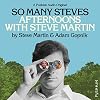
Road trip audiobook!
Adam Gopnik, a friend of Steve Martin, records conversations with the star in which they talk about his wild and crazy career: magician, comedian, actor, writer, and musician. Martin reflects on why he has frequently changed the focus of his artistic output and also discusses his interest in art collecting. It's not a comprehensive biography, but it's a welcome visit with a very talented and humorous man.
I found this as an audiobook, but the chatty back-and-forth feels show more like it was maybe meant to be a podcast.
If you're a fan, I also recommend Steve! (Martin) A Documentary in 2 Pieces, currently streaming on Apple+. show less
Adam Gopnik, a friend of Steve Martin, records conversations with the star in which they talk about his wild and crazy career: magician, comedian, actor, writer, and musician. Martin reflects on why he has frequently changed the focus of his artistic output and also discusses his interest in art collecting. It's not a comprehensive biography, but it's a welcome visit with a very talented and humorous man.
I found this as an audiobook, but the chatty back-and-forth feels show more like it was maybe meant to be a podcast.
If you're a fan, I also recommend Steve! (Martin) A Documentary in 2 Pieces, currently streaming on Apple+. show less
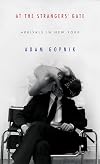
If you can get past wishing you had lived Adam Gopnik’s life back in the ‘80s, then you’ll find this account of his first decade in New York City to be charmingly insightful and wistfully wise. Of course there is more to tell. There always is. Young men don’t just happen to fall in love in Montreal with the most beautiful woman in the world, woo her, and then head to New York City to make a life together. That sounds a bit too much like a Broadway show. Gopnik’s life has that air show more about it. Whether it is his lunch-hour lectures at the MoMA or his copy-editing at GQ or his fast friendships with men like Richard Avedon, it’s all just too much. Or just enough.
By this point in his career, Gopnik’s writing style is largely set. So if you’ve read any of his earlier works, you’ll have a sense of what to expect here. There are smatterings of art history, a touch of style both culinary and cloth, the worked image reworked and tooled until it gets him some kind of product, though not always the one he is aiming at, the rueful glance in the mirror, and the boyish — I was going to write “old-fashioned” — asides and interruptions that both undercut and push forward a leading image. Here, I especially like the chapter on his first, sort of, job at GQ and the next on his remarkable friendship with Richard Avedon. Sometimes he overreaches, as in the lengthy chapter on SoHo in which he attempts to tie together real estate, the art market, art criticism, and uxoriousness. However even here there is much to learn. Perhaps another decade will provide Gopnik sufficient distance to both see all of the contradictions clearly and be able to communicate same.
The writing throughout is well-crafted. And at times surprisingly good. You’ll find this a reliable read even if all you come away with is the desire to have lived Adam Gopnik’s life back in the ‘80s. show less
By this point in his career, Gopnik’s writing style is largely set. So if you’ve read any of his earlier works, you’ll have a sense of what to expect here. There are smatterings of art history, a touch of style both culinary and cloth, the worked image reworked and tooled until it gets him some kind of product, though not always the one he is aiming at, the rueful glance in the mirror, and the boyish — I was going to write “old-fashioned” — asides and interruptions that both undercut and push forward a leading image. Here, I especially like the chapter on his first, sort of, job at GQ and the next on his remarkable friendship with Richard Avedon. Sometimes he overreaches, as in the lengthy chapter on SoHo in which he attempts to tie together real estate, the art market, art criticism, and uxoriousness. However even here there is much to learn. Perhaps another decade will provide Gopnik sufficient distance to both see all of the contradictions clearly and be able to communicate same.
The writing throughout is well-crafted. And at times surprisingly good. You’ll find this a reliable read even if all you come away with is the desire to have lived Adam Gopnik’s life back in the ‘80s. show less

A little Runyon retrospective, in which Gopnik has some fun aping the author's characteristic idiom, but more important, shows a powerful understanding of what makes that idiom so pungent: "The usual things is to insist that Runyon had an amazing 'ear' for natural idiom, but, as Cy Feuer points out, Runyon's dialogue is essentially unplayable, to far removed from any human idiom to be credible in drama. [...] As far as one can tell, Jewish crooks of the period really did speak a surprisingly show more elaborate and cautious diction. They didn't speak like Runyon characters, but they tried to speak high for the same reason that they polished their shoes and tipped their hats and dressed in suits: fancy was classy. This tendency still shows in Sinatra's recorded speech, which, when made for public consumption, is extremely 'high', a Hoboken boy's idea of a class act. [...] One wonders, watching 'Speed-the-Plow', whether studio heads ever really talked like this, until one grasps that Mamet's aim is to capture not their voices but their souls, the inner monologue of stilted present-tense self-justification, the slightly formal tone we all use inside when arguing in our own defense. Runyon's essential discovery was that the right way to get the soul of street-speakers was not to dress their language down but to dress it up. As much as American slang breaks toward the interrupted, partial, and incomplete, it also bends toward the fancy, overformal, and elaborate. Mamet gets this best, but Runyon heard it first." Consider the implications of this for Brian Michael Bendis; for David Foster Wallace. I consider that on some level, when you dress that street-speaker up, fastforward him seventy years into the body of his distant cousin, the educated Canadian workingclassman, and send that kid off to grad school--some part of Runyon's innovation, Gopnik's astute observation, has gone into my own strange idiom.
(New Yorker.) show less
(New Yorker.) show less
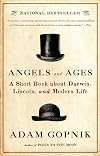
This is a great read, especially on Lincoln. Gopnik understands what Lincoln's view of life was, and how important the law and Shakespeare was to his rhetoric. This is a splendid read for me who has visited the Soldiers Home in Washington,where Lincoln spent the summer months, and Springfield Illinois, where the parks service has a great tour of the man's house and outbuildings. As far as Darwin is concerned, I knew nothing of him or his works, and now will read some, influenced by Gopnik. show more The author seems to argue that the individual religious experience can control life, while science goes its merry way. He does not like fundamentalists, nor do I, and he argues persuasively that they are crazy. show less
Lists
Awards


You May Also Like


Associated Authors
Statistics
- Works
- 46
- Also by
- 43
- Members
- 6,619
- Popularity
- #3,701
- Rating
- 3.8
- Reviews
- 105
- ISBNs
- 138
- Languages
- 5
- Favorited
- 11
