
Pico Iyer
Author of Video Night in Kathmandu and Other Reports from the Not-So-Far East
About the Author
Pico Iyer was born in Oxford, England to Indian parents, who immigrated to California in 1957. He received a B.A. and M.A. from Oxford University and a second masters degree from Harvard University. From 1982 to 1985, he was a writer for Time magazine. Following a leave of absence to visit Asia, show more Iyer wrote Video Nights in Katmandu: And Other Reports from the Not-So-Far East. In 1986 he returned to Time as a contributor. He also contributes regularly to Conde Nast Traveler magazine. Pico Iyer has written several other travel books including The Lady and the Monk: Four Seasons in Kyoto; Falling Off the Map: Some Lonely Places in the World; and Tropical Classical: Essays from Several Directions. (Bowker Author Biography) show less
Image credit: Derek Shapton
Series
Works by Pico Iyer
100 Journeys for the Spirit: Sacred, Inspiring, Mysterious, Enlightening (2010) — Foreword — 67 copies
TED Books Box Set: The Completist (The Terrorist's Son; The Art of Stillness; The Mathematics of Love; The Future of Architecture in 100 Buildings; Follow Your Gut; Beyond… (2015) — Contributor — 5 copies
Same Sun Same Moon 3 copies
Donum, Vol 1 — Author — 1 copy
TED Books Box Set: The Creative Mind (The Art of Stillness; The Future of Architecture; Judge This) (2015) — Contributor — 1 copy
A Place I've Never Been 1 copy
Open Road 1 copy
Maximum India 1 copy
Associated Works
My Bookstore: Writers Celebrate Their Favorite Places to Browse, Read, and Shop (2012) — Contributor — 622 copies, 16 reviews
Lost Classics: Writers on Books Loved and Lost, Overlooked, Under-read, Unavailable, Stolen, Extinct, or Otherwise Out of Commission (2000) — Contributor — 319 copies, 6 reviews
The Condé Nast Traveler Book of Unforgettable Journeys: Great Writers on Great Places (2007) — Contributor — 280 copies, 5 reviews
Burn This Book: PEN Writers Speak Out on the Power of the Word (2009) — Contributor — 217 copies, 3 reviews
Eat, Memory: Great Writers at the Table: A Collection of Essays from the New York Times (2008) — Contributor — 179 copies, 6 reviews
An American Album: One Hundred and Fifty Years of Harper's Magazine (2000) — Contributor — 145 copies, 1 review
An Innocent Abroad: Life-Changing Trips from 35 Great Writers (2014) — Contributor — 87 copies, 4 reviews
The Good Book: Writers Reflect on Favorite Bible Passages (2015) — Contributor — 44 copies, 3 reviews
Journeys Home: Inspiring Stories, Plus Tips and Strategies to Find Your Family History (2015) — Contributor — 39 copies, 1 review
A Lifetime of Wisdom: Essential Writings By and About the Dalai Lama (2002) — Contributor — 27 copies
Digital Geishas and Talking Frogs: The Best 21st Century Short Stories from Japan (2011) — Foreword — 21 copies
Tagged
Common Knowledge
- Canonical name
- Iyer, Pico
- Legal name
- Iyer, Siddharth Pico Raghavan
- Birthdate
- 1957-02-11
- Gender
- male
- Education
- Eton College
Magdalen College, Oxford (BA|MA|1982)
Harvard University (MA|1980) - Occupations
- travel writer
teacher (writing ∙ literature)
journalist (Time Magazine ∙ National Geographic)
author
essayist
novelist (show all 7)
screenwriter - Organizations
- Time
- Relationships
- Iyer, Raghavan N. (father)
- Short biography
- Married to Hiroko, the "Lady" in his second book, and her two children.
- Nationality
- UK
- Birthplace
- Oxford, Oxfordshire, England, UK
- Places of residence
- Oxford, Oxfordshire, England, UK
Cambridge, Massachusetts, USA
Santa Barbara, California, USA
Nara, Japan - Associated Place (for map)
- UK
Members
Reviews

It had seemed, at the time, a good idea, this holiday in Pyongyang.
Falling Off the Map: Some Lonely Places of the World is a series of essays about the parts of the world isolated by politics, geography or culture. Pico Iyer spends time in the places you'd expect, like North Korea, Cuba, Bhutan and Iceland, but also in Argentina and Australia. Iyer comes across as a more thoughtful, less humorous Jon Ronson, able to insert himself into interesting situations, offbeat locations, and to get show more people to speak openly with him, without becoming the focus of his tales. Even the one in which police officers had a great deal of difficulty determining whether "Pico" or "Iyer" was his first name revolves around life in a Cuban village.
Back in the Gran Hotel, the receptionist greeted me in Hindi, a cockroach was waiting to welcome me in my bedroom, and a sudden thunderstorm turned the hotel corridors into rivers, a few dead leaves floating by my door. In the beautiful dining room, where La Madama had once held masked balls and taught le tout Asuncion to polka, four men in ponchos were putting on a show of Paraguayan culture, featuring songs from Mexico, songs from Cuba, and songs from Peru.
Iyer spends time in each of the places featured, returning to some years after his first visits. He falls into the daily rhythms of the places he's staying in, becoming familiar with Saturday markets or the movies being shown at the local cinema. The book itself is a bit dated, having been written twenty years ago but, for me at least, it has lost little of its appeal, the countries that he wrote about remain as exotic and unknown as they were when he wrote the essays. show less
Falling Off the Map: Some Lonely Places of the World is a series of essays about the parts of the world isolated by politics, geography or culture. Pico Iyer spends time in the places you'd expect, like North Korea, Cuba, Bhutan and Iceland, but also in Argentina and Australia. Iyer comes across as a more thoughtful, less humorous Jon Ronson, able to insert himself into interesting situations, offbeat locations, and to get show more people to speak openly with him, without becoming the focus of his tales. Even the one in which police officers had a great deal of difficulty determining whether "Pico" or "Iyer" was his first name revolves around life in a Cuban village.
Back in the Gran Hotel, the receptionist greeted me in Hindi, a cockroach was waiting to welcome me in my bedroom, and a sudden thunderstorm turned the hotel corridors into rivers, a few dead leaves floating by my door. In the beautiful dining room, where La Madama had once held masked balls and taught le tout Asuncion to polka, four men in ponchos were putting on a show of Paraguayan culture, featuring songs from Mexico, songs from Cuba, and songs from Peru.
Iyer spends time in each of the places featured, returning to some years after his first visits. He falls into the daily rhythms of the places he's staying in, becoming familiar with Saturday markets or the movies being shown at the local cinema. The book itself is a bit dated, having been written twenty years ago but, for me at least, it has lost little of its appeal, the countries that he wrote about remain as exotic and unknown as they were when he wrote the essays. show less

Pico Iyer's wife is Japanese, and they've lived in Japan (in Nara) for much of the last thirty years, so he's probably better-qualified than most foreigners to be writing about the country, but he's clearly not entirely joking when he tells us that we should read "Beginner's Guide" as referring to the inexperience of the author, not the reader. Japan is not an easy place to pin down, apparently, especially not if you didn't grow up in a Japanese family and your command of the language is show more less than perfect.
Iyer therefore largely avoids subjective statements of opinion (a very Japanese approach, as he points out) and leans quite heavily on things other people — Japanese and foreign — have said about Japan. Or, occasionally, things people have said about other places that can also be read onto Japan. He arranges them cleverly to expose the many paradoxes in what "we" think we know about the Japanese, and in what the Japanese think they know about themselves, until we find ourselves nudged gently towards the conclusion that, in fact, the Japanese are just like everyone else. Only more so. There are plenty of other places in the world where people eagerly embrace new technologies whilst finding great significance in archaic traditions, or where a a strong desire for outward conformity and avoidance of any kind of individualistic display in public creates masks for people who are wildly eccentric and creative in their inner lives (England was just coming out of that mode when I was growing up, for example). But the Japanese have somehow refined all these things a degree or two beyond the rest of the world.
An enjoyable, thought-provoking book, which will probably become an essential — if useless in practice — reference for anyone visiting Japan for the first time. show less
Iyer therefore largely avoids subjective statements of opinion (a very Japanese approach, as he points out) and leans quite heavily on things other people — Japanese and foreign — have said about Japan. Or, occasionally, things people have said about other places that can also be read onto Japan. He arranges them cleverly to expose the many paradoxes in what "we" think we know about the Japanese, and in what the Japanese think they know about themselves, until we find ourselves nudged gently towards the conclusion that, in fact, the Japanese are just like everyone else. Only more so. There are plenty of other places in the world where people eagerly embrace new technologies whilst finding great significance in archaic traditions, or where a a strong desire for outward conformity and avoidance of any kind of individualistic display in public creates masks for people who are wildly eccentric and creative in their inner lives (England was just coming out of that mode when I was growing up, for example). But the Japanese have somehow refined all these things a degree or two beyond the rest of the world.
An enjoyable, thought-provoking book, which will probably become an essential — if useless in practice — reference for anyone visiting Japan for the first time. show less
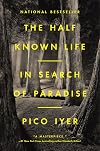
This relatively short book has something to surprise on nearly every page. It's one of those unusual books that starts out, as so many travel books do, as merely interesting, and turns into something much deeper by the end. You could call it a collection of essays on a theme, and certainly there's no indication that the places Iyer visited were visited recently or in the order presented, although you could read the book thinking that. What we have here, in part, is a work by a man who has show more spent decades traveling and is no longer content to simply report on wonderful and unusual destinations. Instead, he's looking deeper, finding new connections between the people and cultures he's encountering and humanity at large, and especially, the connections between humanity at large and he himself. Although he never says so outright, it's clear that he's feeling the approaching shadow of mortality and is no longer content to merely marvel at the surface of things, or to find patterns only a few levels deep. Hence the subtitle of the book, "In Search of Paradise." Not only are we individuals fated to fade away, but so are our cultures. What really, beneath all the bright diversity of people and places, undergirds this vast web called humanity?
Not that this book is at all difficult to read, or that it can't be experienced as travelogue. But late in the book, when Iyer happens to mention that he has spent much time with the Dalai Lama, traveling in his company on several occasions, I wasn't as surprised as I might have been.
Nevertheless I do recommend the book to those who are not looking for something deep; that's how I discovered it. I read the opening pages about Iyer getting off the plane in Tehran and liked his voice and didn't expect anything other than a fresh perspective on overlooked or misrepresented places. The full list of places visited and discussed, in addition to Iran, are North Korea; Kashmir; Broome, in Western Australia; Jerusalem; Ladakh, on the border of India and Tibet; Sri Lanka; Gokurabashi, Japan, an ancient cemetery near Osaka; and Varanasi. Although that last section is only 24 pages long, it let me imagine the place so vividly that my "memory" of it is as strong as my memory of places I've actually visited!
Highly recommended, whether you consider yourself a spiritual person or not. show less
Not that this book is at all difficult to read, or that it can't be experienced as travelogue. But late in the book, when Iyer happens to mention that he has spent much time with the Dalai Lama, traveling in his company on several occasions, I wasn't as surprised as I might have been.
Nevertheless I do recommend the book to those who are not looking for something deep; that's how I discovered it. I read the opening pages about Iyer getting off the plane in Tehran and liked his voice and didn't expect anything other than a fresh perspective on overlooked or misrepresented places. The full list of places visited and discussed, in addition to Iran, are North Korea; Kashmir; Broome, in Western Australia; Jerusalem; Ladakh, on the border of India and Tibet; Sri Lanka; Gokurabashi, Japan, an ancient cemetery near Osaka; and Varanasi. Although that last section is only 24 pages long, it let me imagine the place so vividly that my "memory" of it is as strong as my memory of places I've actually visited!
Highly recommended, whether you consider yourself a spiritual person or not. show less

When Pico Iyer decided to go to Kyoto and live in a monastery, he did so to learn about Zen Buddhism from the inside, to get to know Kyoto, one of the loveliest old cities in the world, and to find out something about Japanese culture today -- not the world of businessmen and production lines, but the traditional world of changing seasons and the silence of temples, of the images woven through literature, of the lunar Japan that still lives on behind the rising sun of geopolitical power.All show more this he did. And then he met Sachiko.Vivacious, attractive, thoroughly educated, speaking English enthusiastically if eccentrically, the wife of a Japanese "salaryman" who seldom left the office before 10 P.M., Sachiko was as conversant with tea ceremony and classical Japanese literature as with rock music, Goethe, and Vivaldi. With the lightness of touch that made Video Night in Kathmandu so captivating, Pico Iyer fashions from their relationship a marvelously ironic yet heartfelt book that is at once a portrait of cross-cultural infatuation -- and misunderstanding -- and a delightfully fresh way of seeing both the old Japan and the very new. show less
Lists
Awards


You May Also Like


Associated Authors
Statistics
- Works
- 35
- Also by
- 39
- Members
- 5,319
- Popularity
- #4,678
- Rating
- 4.0
- Reviews
- 102
- ISBNs
- 160
- Languages
- 7
- Favorited
- 15