
Joe Haldeman
Author of The Forever War
About the Author
Joe Haldeman has uniquely blended a strong interest in astronomy and with his love for writing to publish numerous novels, anthologies and short stories over three decades. He holds a B.S. in astronomy from the University of Maryland (1967), and an M.F.A. in English from the Iowa Writers Workshop show more (1975). An adjunct professor at Massachusetts Institute of Technology, Haldeman has also taught at Michigan State, Larion West Seattle, SUNY Buffalo, Princeton, University of North Dakota, Kent State and the University of North Florida Haldeman's works include War Year (1972), The Forever War (1975), Worlds (1981), Worlds Apart (1983), Tools of the Trade (1987), and The Hemingway Hoax (1990). He has also co-authored and edited numerous works of science fiction. Born in Oklahoma on June 9, 1943, Haldeman grew up in Puerto Rico, New Orleans, Washington D.C., and Alaska. He was drafted into the military in 1967, fighting in the Central Highlands of Vietnam as a combat engineer with the 4th Division (1/22nd Airmobile Battalion), for which he received the Purple Heart, among other medals. (Bowker Author Biography) show less
Series
Works by Joe Haldeman
INTRODUCTION TO THE BEST OF JO 9 copies
Örök háború 4 copies
Seven and the Stars (published in Rod Serling's The Twilight Zone Magazine, May 1981) (1981) 4 copies
The Gift [poem] 2 copies
The Big Bang Theory Explained 2 copies
Expedition With Recipes 2 copies
Time Piece 2 copies
DX [poem] 1 copy
Verso le stelle 1 copy
Guerra eterna, ultimo atto 1 copy
℗L'℗astronave immortale 1 copy
The Novel as Joy Ride 1 copy
我は四肢の和を超えて 1 copy
From Guardian 1 copy
The moon and Marcek 1 copy
Visions of the Future 1 copy
The only war we've got 1 copy
Four In One 1 copy
Sueǫs infinitos 1 copy
Living Hell (short story) 1 copy
Desfase 1 copy
Mardus: Juubeliväljaanne 1 copy
Worlds. Worlds apart 1 copy
Camouflage 1 1 copy
To Fit the Crime 1 copy
Camouflage [Excerpt] 1 copy
Nam Days 1 copy
Camouflage 3 1 copy
Camouflage 2 1 copy
Associated Works
The Year's Best Science Fiction: Twenty-Third Annual Collection (2006) — Contributor — 567 copies, 5 reviews
The Year's Best Science Fiction: Tenth Annual Collection (1993) — Contributor — 476 copies, 5 reviews
The Year's Best Science Fiction: Eleventh Annual Collection (1994) — Contributor — 468 copies, 2 reviews
The Year's Best Science Fiction: Thirteenth Annual Collection (1996) — Contributor — 454 copies, 4 reviews
The Best of the Best: 20 Years of the Year's Best Science Fiction (2005) — Contributor — 436 copies, 20 reviews
The Year's Best Science Fiction: Eighth Annual Collection (1991) — Contributor — 416 copies, 6 reviews
The Norton Book of Science Fiction: North American Science Fiction, 1960-1990 (1993) — Contributor — 344 copies, 6 reviews
The Year's Best Fantasy and Horror: First Annual Collection (1986) — Contributor — 333 copies, 6 reviews
The Year's Best Science Fiction: Twenty-Eighth Annual Collection (2011) — Contributor — 329 copies, 3 reviews
The Year's Best Science Fiction: Third Annual Collection (1986) — Contributor — 250 copies, 1 review
The Best of the Best, Volume 2: 20 Years of the Best Short Science Fiction Novels (2007) — Contributor — 235 copies, 10 reviews
The Year's Best Fantasy and Horror: Sixth Annual Collection (1993) — Contributor — 219 copies, 1 review
The Year's Best Fantasy and Horror: Third Annual Collection (1988) — Contributor — 193 copies, 2 reviews
2041: Twelve Short Stories About the Future by Top Science Fiction Writers (1991) — Contributor — 183 copies, 4 reviews
The Year's Best Science Fiction: First Annual Collection (1984) — Contributor — 148 copies, 1 review
Dogs of War: Ten Classic Stories of Men and Machines in War (2002) — Contributor — 116 copies, 1 review
Gateways: A Feast of Great New Science Fiction Honoring Grand Master Frederik Pohl (2010) — Contributor — 111 copies, 2 reviews
More Wandering Stars: Outstanding Stories of Jewish Fantasy and Science Fiction (1981) — Contributor — 105 copies
The James Tiptree Award Anthology 2: Stories for Men, Women, and the Rest of Us (2006) — Contributor — 101 copies, 3 reviews
Impact Parameter: And Other Quantum Realities (1984) — Foreword, some editions — 98 copies, 4 reviews
Nebula Awards 30: SFWA's Choices For The Best Science Fiction And Fantasy Of The Year (Nebula Awards Showcase) (1996) — Contributor — 89 copies, 2 reviews
Nebula Awards 27: SFWA's Choices for the Best Science Fiction and Fantasy of the Year (1993) — Contributor — 61 copies, 1 review
Nebula Awards 29: SFWA's Choices For The Best Science Fiction And Fantasy Of The Year (Nebula Awards Showcase) (1995) — Contributor — 57 copies
Before They Were Giants: First Works from Science Fiction Greats (2010) — Contributor — 54 copies, 2 reviews
Thieves' World® Volume One: Thieves' World, Tales from the Vulgar Unicorn, and Shadows of Sanctuary (2020) — Contributor — 52 copies, 4 reviews
Nebula Awards 26: SFWA's Choices for the Best Science Fiction and Fantasy of the Year (1992) — Contributor — 52 copies, 1 review
Nebula Awards 21: Sfwa's Choices for the Best Science Fiction and Fantasy, 1985 (Nebula Awards Showcase) (1986) — Contributor — 44 copies, 2 reviews
Light Years and Dark: Science Fiction and Fantasy of and for Our Time (1984) — Contributor — 38 copies
Nebula Awards 20: SFWA's Choices for the Best Science Fiction and Fantasy 1984 (1985) — Contributor — 28 copies
Analog Science Fiction/Science Fact: Vol. XCIV, No. 5 (January 1975) (1975) — Contributor — 27 copies
Sex in the System: Stories of Erotic Futures, Technological Stimulation, and the Sensual Life of Machines (2006) — Contributor — 27 copies, 1 review
Analog Science Fiction/Science Fact: Vol. XCIV, No. 3 (November 1974) (1974) — Contributor — 26 copies
Analog Science Fiction/Science Fact: Vol. XCIV, No. 2 (October 1974) (1974) — Contributor — 26 copies
Analog Science Fiction/Science Fact: Vol. XCV, No. 10 (October 1975) (1975) — Contributor — 26 copies, 2 reviews
Analog Science Fiction/Science Fact: Vol. XCIV, No. 1 (September 1974) (1974) — Contributor — 24 copies
Analog Science Fiction/Science Fact: Vol. XCII, No. 3 (November 1973) (1973) — Contributor — 24 copies
Analog Science Fiction/Science Fact: Vol. XCII, No. 6 (February 1974) (1974) — Contributor — 24 copies
Analog Science Fiction/Science Fact: Vol. LXXXIX, No. 4 (June 1972) (1972) — Contributor — 22 copies
The Best from Fantasy and Science Fiction: A 45th Anniversary Anthology (1994) — Contributor — 21 copies
The Magazine of Fantasy and Science Fiction May/June 2013, Vol. 124, Nos. 5 & 6 (2013) — Contributor — 21 copies, 4 reviews
The Magazine of Fantasy and Science Fiction October/November 2009, Vol. 117, Nos. 3 & 4 (60th Anniversary Issue) (2009) — Author, some editions — 19 copies, 3 reviews
Isaac Asimov's Science Fiction Magazine: Vol. 10, No. 12 [December 1986] (1986) — Contributor — 14 copies
Isaac Asimov's Science Fiction Magazine: Vol. 14, No. 7 [July 1990] (1990) — Contributor — 14 copies
Isaac Asimov's Science Fiction Magazine: Vol. 14, No. 13 [December 1990] (1990) — Contributor — 12 copies
Isaac Asimov's Science Fiction Magazine: Vol. 15, No. 11 [October 1991] (1991) — Contributor — 8 copies
In the Shadow of the Wall: An Anthology of Vietnam Stories That Might Have Been (2002) — Contributor — 6 copies
I Premi Hugo 1976-1983 — Contributor — 4 copies
Starshipsofa Stories Vol 3 — Contributor — 4 copies
Millemondi Inverno 1996 — Contributor — 2 copies
Tagged
Common Knowledge
- Legal name
- Haldeman, Joe William
- Other names
- Graham, Robert
- Birthdate
- 1943-06-09
- Gender
- male
- Education
- University of Maryland (BS) (Physics and Astronomy ) (1967)
University of Iowa (Iowa Writers' Workshop ∙ MFA ∙ Creative Writing ∙ 1975)
University of Maryland (computer science) (did not graduate) - Occupations
- author
combat engineer, US Army
adjunct professor - Organizations
- Authors Guild
Writers Guild of America
Science Fiction and Fantasy Writers of America (SFWA ∙ Past President)
National Space Society (Board of Advisors)
Space Studies Institute
United States Army (show all 7)
Massachusetts Institute of Technology (adjunct professor) - Awards and honors
- Purple Heart (1969)
Jack Williamson Lectureship (1992, 2000, 2003, 2013)
E.E. Smith Memorial Award for Imaginative Fiction (1996)
Damon Knight Memorial Grand Master Award (2010)
SF Hall Of Fame (2012) - Agent
- Ralph M. Vicinanza, Ltd.
- Relationships
- Haldeman, Jack C. (brother)
- Nationality
- USA
- Birthplace
- Oklahoma City, Oklahoma, USA
- Places of residence
- Gainesville, Florida, USA
Cambridge, Massachusetts, USA
Anchorage, Alaska, USA
Bethesda, Maryland, USA - Map Location
- Oklahoma, USA
Members
Discussions
Or, the continuing adventures of Captain Video in Good Show Sir! — bad science fiction and fantasy covers (August 2024)
The Forever War? Ugh. in Science Fiction Fans (August 2016)
The Forever War by Joe Haldeman in Book talk (March 2013)
Joe Haldeman's Old twentieth in Science Fiction Fans (December 2010)
Reviews
The Forever War: The science fiction classic and thought-provoking critique of war (S.F. MASTERWORKS) by Joe Haldeman
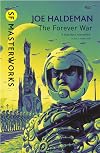
A very odd duck in the military sci fi genre. Despite the title the war takes a passenger seat to a story that's more about humanity changing over thousands of years, and the protagonist experiencing that through time dilation effects as he goes in and out of battles. The war episodes are strangely "realistic", in as much as they're not heroic, the preparation and waiting is longer than any action and one episode basically starts with an immediate failure. People die in droves to enemies show more that remain largely unseen. The author is channeling a lot of his Vietnam War experience into this future war and it shows, especially in the ultimate conclusion.
The other, larger part of the story has some strong wafts of the 60s and 70s era; with episodes of "free love" giving way to paranoia about overpopulation (at a then staggering 9 billion) and resource wars, which in turn gives way for new (government mandated) formulations of sexuality and relationships. Sometimes weirdly prescient about technologies like a universal digital payment system no bigger than a wallet. Sometimes drastically overestimating problems soon to come. The predictions about future social changes don't have time to stick around and be over-analyzed because the protagonist has soon jumped decades or a century ahead, to a whole new world; giving him some of that Future Shock the author references.
There's some parallels (apparently intentional) to Starship Troopers here, as well as some ideas cribbed from Dune. It all works to the book's benefit. show less
The other, larger part of the story has some strong wafts of the 60s and 70s era; with episodes of "free love" giving way to paranoia about overpopulation (at a then staggering 9 billion) and resource wars, which in turn gives way for new (government mandated) formulations of sexuality and relationships. Sometimes weirdly prescient about technologies like a universal digital payment system no bigger than a wallet. Sometimes drastically overestimating problems soon to come. The predictions about future social changes don't have time to stick around and be over-analyzed because the protagonist has soon jumped decades or a century ahead, to a whole new world; giving him some of that Future Shock the author references.
There's some parallels (apparently intentional) to Starship Troopers here, as well as some ideas cribbed from Dune. It all works to the book's benefit. show less

Okay, K asked me to elaborate on why I hate this book, so. Here we go.
There was apparently a point in the distant, fortunately-gone past where all you needed to write science fiction was a good idea. Not a plot. Not characters. Not writing that was remotely competent or dialogue that sounded like human beings might say it or any sort of ability to extrapolate human society or even any understanding of what humans are like. You just had to have a good idea and you could write a classic! The show more Forever War is that classic.
Here is the good idea at the core of this festering waste of words: war is hell, and relativistic war is extremely prolonged hell. Are you amazed? Are you awestruck? Are you stunned with Haldeman's brilliance yet? Well, you better be, my friends, as that is literally ALL HE HAS for you in this book.
The rest of it? Oh my LORD. The hero is -- well, if he had more depth or dimension, I would probably hate him, but as it is, he's just a cardboard cutout of a neckbeard's MMPORG persona. There's a girl. She is technically also a soldier, but obviously she is really just there as window dressing/the object for Our Amazing Hero to moon over. There are future societies, each more ridiculous than the last (my favorite bit of ridiculousness: in the future, tobacco is illegal because it's a waste of farmland, which, fine, but marijuana is distributed free by many governments, because -- I guess it does not require growing?) There's a plot that is barely coherent and a war no one, including the author, gives a single shit about.
And now I must issue a trigger warning; I will spoiler cut this for my friends who need to avoid descriptions of rape.The women in this book are supposed to be equal. They are in the army, they fight on the line, they are Modern Women. But they are ALSO expected to be camp followers. When they arrive at a station inhabited mostly by men, they are required, by law and custom, to have sex with anyone who wants them. Yup! A group of heavily-armed women who are nonetheless subject to culturally enforced rape. And that may be the fantasy of every lonely, pathetic dude incapable of actually interacting with women, but it for sure isn't something I want or accept in my supposedly-equal futures.
So. Just to be sure no one ever feels they have to read this amazingly awful classic, I'm going to spoil absolutely everything of value about this book. Here we go:
War sucks. Don't have one or be in one if you can possibly help it.
The end! And now you never have to read this awful, awful book, you lucky person, you. show less
There was apparently a point in the distant, fortunately-gone past where all you needed to write science fiction was a good idea. Not a plot. Not characters. Not writing that was remotely competent or dialogue that sounded like human beings might say it or any sort of ability to extrapolate human society or even any understanding of what humans are like. You just had to have a good idea and you could write a classic! The show more Forever War is that classic.
Here is the good idea at the core of this festering waste of words: war is hell, and relativistic war is extremely prolonged hell. Are you amazed? Are you awestruck? Are you stunned with Haldeman's brilliance yet? Well, you better be, my friends, as that is literally ALL HE HAS for you in this book.
The rest of it? Oh my LORD. The hero is -- well, if he had more depth or dimension, I would probably hate him, but as it is, he's just a cardboard cutout of a neckbeard's MMPORG persona. There's a girl. She is technically also a soldier, but obviously she is really just there as window dressing/the object for Our Amazing Hero to moon over. There are future societies, each more ridiculous than the last (my favorite bit of ridiculousness: in the future, tobacco is illegal because it's a waste of farmland, which, fine, but marijuana is distributed free by many governments, because -- I guess it does not require growing?) There's a plot that is barely coherent and a war no one, including the author, gives a single shit about.
And now I must issue a trigger warning; I will spoiler cut this for my friends who need to avoid descriptions of rape.
So. Just to be sure no one ever feels they have to read this amazingly awful classic, I'm going to spoil absolutely everything of value about this book. Here we go:
War sucks. Don't have one or be in one if you can possibly help it.
The end! And now you never have to read this awful, awful book, you lucky person, you. show less

4.5/5
While pretty simple in plot and prose style The Forever War is without a doubt the best military SF novel I've read to date. Told through the eyes of conscripted private William Mandala, who is sent through a wormhole across the universe to fight an enemy he knows nothing about, and leaves behind everyone he has ever known thanks to the time dilation effect of getting to the front lines.
It's a very straight forward allegory for the Vietnam war, and all of the horrors that soldiers show more experience during training, battle, and returning to civilian life. It's the detail, subtlety, and care that goes into this exploration that sets it apart from a lot of it's contemporaries in the Military SF sub-genre. The main characters themselves are named after Joe William Haldeman and his wife, Mary Gay. It felt extremely personal to dive so deeply into his experience during the war, and upon his return to the US. The Forever War make it clear just how alienating and isolating it is to sacrifice so much, watch your only friends die during routine training, confront an enemy that you're not even sure is an enemy in the first place, and return to your home shattered by the experience only to find that your culture and society have changed so much that you feel compelled to return to the front line.
The science fiction elements of the story were so interesting and well thought-out. I love the deep exploration of the ramifications of time dilation, creating a dynamic and inconsistent battlefield while also complicating supply lines and military logistics, let alone the psychological consequences. The ending of the novel is super dense with science fiction ideas that made sense within the context of the world, and made for interesting lingering ideas to mull over upon finishing.
I mean, what can I say. There's a reason why this is such a classic in the SF genre. I'm glad to have found that the hype surrounding it did not oversell it. The only thing that I can really fault it for is that simplicity that I mentioned earlier. Had Haldemen been a better craftsman of prose at the time, this could've easily been a 5/5, not that it's far off at it is. Plus that simplicity makes it super approachable for young/newer readers, even if the themes are complex and dark. It's just nice to see some military SF that paints a realistic picture of war. It's amazing that the pulp adventure style to the action, which is sufficiently fun to read, combines so well with his exploration of the themes. show less
While pretty simple in plot and prose style The Forever War is without a doubt the best military SF novel I've read to date. Told through the eyes of conscripted private William Mandala, who is sent through a wormhole across the universe to fight an enemy he knows nothing about, and leaves behind everyone he has ever known thanks to the time dilation effect of getting to the front lines.
It's a very straight forward allegory for the Vietnam war, and all of the horrors that soldiers show more experience during training, battle, and returning to civilian life. It's the detail, subtlety, and care that goes into this exploration that sets it apart from a lot of it's contemporaries in the Military SF sub-genre. The main characters themselves are named after Joe William Haldeman and his wife, Mary Gay. It felt extremely personal to dive so deeply into his experience during the war, and upon his return to the US. The Forever War make it clear just how alienating and isolating it is to sacrifice so much, watch your only friends die during routine training, confront an enemy that you're not even sure is an enemy in the first place, and return to your home shattered by the experience only to find that your culture and society have changed so much that you feel compelled to return to the front line.
The science fiction elements of the story were so interesting and well thought-out. I love the deep exploration of the ramifications of time dilation, creating a dynamic and inconsistent battlefield while also complicating supply lines and military logistics, let alone the psychological consequences. The ending of the novel is super dense with science fiction ideas that made sense within the context of the world, and made for interesting lingering ideas to mull over upon finishing.
I mean, what can I say. There's a reason why this is such a classic in the SF genre. I'm glad to have found that the hype surrounding it did not oversell it. The only thing that I can really fault it for is that simplicity that I mentioned earlier. Had Haldemen been a better craftsman of prose at the time, this could've easily been a 5/5, not that it's far off at it is. Plus that simplicity makes it super approachable for young/newer readers, even if the themes are complex and dark. It's just nice to see some military SF that paints a realistic picture of war. It's amazing that the pulp adventure style to the action, which is sufficiently fun to read, combines so well with his exploration of the themes. show less
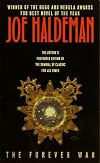
You can say pretty much everything worth saying about powered armor space marines between The Forever War and Starship Troopers. Joe Haldeman's The Forever War covers the same ground of training, combat, recuperation, and command as Heinlein's novel, but from a pacifistic and detached post-Vietnam perspective. William Mandella, our hero, is a reluctant soldier, an "elite draftee" with an IQ over 150 and a physics background sent out to fight an unknown alien enemy, the Taurans, who have been show more hitting human colony ships. FTL involves jumps through collapsars, black holes with orbiting planetoids, so Mandella and his comrades are trained to fight in extreme conditions just above absolute zero, with seas of liquid helium and deadly hydrogen ice sheets. The plan is simple: land on a planetoid, kill any Taurens, construct a bunker and laser installation and hold till relieved.
Of course, the first rule of all military activity is SNAFU, and for their first mission, Mandella is sent to a jungle world at near boiling temperatures. Their landing site is mile underwater (fortunately their dropships are submersible), the local wildlife is telepathic, and after an unprovoked attack kills the platoon's telepathic sensitive and spookily shadows them. The Tauren's don't fight back, but one escapes in a personal spaceship. Despite the lack of resistance, some of the squad is killed by anti-air weapon. Mandella is disgusted by the use of post-hypnotic suggestion to make him fight. A second encounter in space goes poorly for their cruiser and they retreat, with one of my favorite lines in the book "...surely the Captain was not possessed by something so unmilitary as the will to live." This is where one of the central conceits of the book is introduced. Though FTL exists, relativistic maneuvering around collapsars and fighting in the warped spacetime on portal planets dilates time for soldiers. Soldiers, even if they survive, can never really go back to a planet that has experienced decades of time to their subjective year-long tour. Worse, enemy forces can come from your subjective future, with the benefits of extra R&D. Technically, this advantage applies to both sides at random, but that's cold comfort when the enemy shows up with a superweapon you've never seen and have no counter for.
The second chunk of the book was stripped from the original version (I'm reading the 1991 complete edition), and follows Mandella on an Earth that has gone downhill since he left. His mother is 80 years old, a food war killed billions, and the survivors are equally victimized by a powerful one-world government which controls food, power, and jobs, and criminal factions which provide necessary work-arounds to the system and random criminal violence. Mandella and his lover, lost on Earth, re-enlist on promise of a safe training job and are immediately reassigned to combat. Mandella is no hero, but a knack for survival gets him promoted to Major and strike force command. By now, he's separated by centuries from the troops, who are creche raised and all gay, with heterosexuality treated as a curable deviance. Command is no picnic, Mandella is profoundly alone and untrusted by his troops, and separated forever from his lover. He sets up a base on a larger than average portal planet in the Magellanic Cloud, survives one last battle, which features a lone fighter making an attack run at .999c that destroys the enemy cruiser and shatters Mandella's bunker with an earthquake, and returns home to find that the war is over. Humanity has been replaced by Man, a race of clones, which has reached a peace settlement with the Taurans, also a race of clones. The whole war was a lie, the initial attack faked by UN high command who thought a war was just what Earth needed to kick it out of an economic depression. Baseline humans have settled space, and Mandella's lover Marygay, has also survived, using an obsolete cruiser as a relativistic shuttle until he returns.
Some closing thoughts: Haldeman is obviously a talent. He wrote this book in his late 20s (serialized in 1972, novel in 1974) as an MFA thesis at the Iowa Writer's Workshop, which is the major influence on post-war American literary fiction. It's a personal novel as well; Haldeman is a Vietnam veteran with a physics degree, his wife shares a name with Mandella's partner. While Starship Troopers takes war as necessary to glorious, The Forever War sees it as dehumanizing and full of lies. The basic incompetence of commanders, and the numerous ways in which they screw with ordinary soldiers, is a repeated theme. The mutual alienation of soldiers, the society they are "defending", and the reasons for the war, are all directly translated from the Vietnam War. The social side is also fascinating. Mandella's army is a grunt's fantasy, 50-50 coed with willing combat females, legal marijuana after hours, and "Fuck you, sir!" as the mandatory closing refrain. Many changes on Earth are only sketched at, but the shift to mandatory homosexuality as a birth control measure is handled pretty well for a novel written back when being gay was still technically a mental illness ("...you think you're tolerant, sir.") But one of the coolest scifi points, and one which is easy to overlook, is the way The Forever War plays with temporality. While the Vietnam War as a whole seemed to go on forever, individual soldiers were acutely aware of how much time they had left on their 365 day tour, unlike the space marines who are unlikely to ever see the end of their two-year subjective enlistment. The subjectivity of time is another interesting point. In Vietnam, everybody's tours counted down the same, whether you were safe running a PX in Da Nang or an airmobile machinegunner who might see 300 days of combat. Time's the thing. show less
Of course, the first rule of all military activity is SNAFU, and for their first mission, Mandella is sent to a jungle world at near boiling temperatures. Their landing site is mile underwater (fortunately their dropships are submersible), the local wildlife is telepathic, and after an unprovoked attack kills the platoon's telepathic sensitive and spookily shadows them. The Tauren's don't fight back, but one escapes in a personal spaceship. Despite the lack of resistance, some of the squad is killed by anti-air weapon. Mandella is disgusted by the use of post-hypnotic suggestion to make him fight. A second encounter in space goes poorly for their cruiser and they retreat, with one of my favorite lines in the book "...surely the Captain was not possessed by something so unmilitary as the will to live." This is where one of the central conceits of the book is introduced. Though FTL exists, relativistic maneuvering around collapsars and fighting in the warped spacetime on portal planets dilates time for soldiers. Soldiers, even if they survive, can never really go back to a planet that has experienced decades of time to their subjective year-long tour. Worse, enemy forces can come from your subjective future, with the benefits of extra R&D. Technically, this advantage applies to both sides at random, but that's cold comfort when the enemy shows up with a superweapon you've never seen and have no counter for.
The second chunk of the book was stripped from the original version (I'm reading the 1991 complete edition), and follows Mandella on an Earth that has gone downhill since he left. His mother is 80 years old, a food war killed billions, and the survivors are equally victimized by a powerful one-world government which controls food, power, and jobs, and criminal factions which provide necessary work-arounds to the system and random criminal violence. Mandella and his lover, lost on Earth, re-enlist on promise of a safe training job and are immediately reassigned to combat. Mandella is no hero, but a knack for survival gets him promoted to Major and strike force command. By now, he's separated by centuries from the troops, who are creche raised and all gay, with heterosexuality treated as a curable deviance. Command is no picnic, Mandella is profoundly alone and untrusted by his troops, and separated forever from his lover. He sets up a base on a larger than average portal planet in the Magellanic Cloud, survives one last battle, which features a lone fighter making an attack run at .999c that destroys the enemy cruiser and shatters Mandella's bunker with an earthquake, and returns home to find that the war is over. Humanity has been replaced by Man, a race of clones, which has reached a peace settlement with the Taurans, also a race of clones. The whole war was a lie, the initial attack faked by UN high command who thought a war was just what Earth needed to kick it out of an economic depression. Baseline humans have settled space, and Mandella's lover Marygay, has also survived, using an obsolete cruiser as a relativistic shuttle until he returns.
Some closing thoughts: Haldeman is obviously a talent. He wrote this book in his late 20s (serialized in 1972, novel in 1974) as an MFA thesis at the Iowa Writer's Workshop, which is the major influence on post-war American literary fiction. It's a personal novel as well; Haldeman is a Vietnam veteran with a physics degree, his wife shares a name with Mandella's partner. While Starship Troopers takes war as necessary to glorious, The Forever War sees it as dehumanizing and full of lies. The basic incompetence of commanders, and the numerous ways in which they screw with ordinary soldiers, is a repeated theme. The mutual alienation of soldiers, the society they are "defending", and the reasons for the war, are all directly translated from the Vietnam War. The social side is also fascinating. Mandella's army is a grunt's fantasy, 50-50 coed with willing combat females, legal marijuana after hours, and "Fuck you, sir!" as the mandatory closing refrain. Many changes on Earth are only sketched at, but the shift to mandatory homosexuality as a birth control measure is handled pretty well for a novel written back when being gay was still technically a mental illness ("...you think you're tolerant, sir.") But one of the coolest scifi points, and one which is easy to overlook, is the way The Forever War plays with temporality. While the Vietnam War as a whole seemed to go on forever, individual soldiers were acutely aware of how much time they had left on their 365 day tour, unlike the space marines who are unlikely to ever see the end of their two-year subjective enlistment. The subjectivity of time is another interesting point. In Vietnam, everybody's tours counted down the same, whether you were safe running a PX in Da Nang or an airmobile machinegunner who might see 300 days of combat. Time's the thing. show less
Lists
Nebula Award (4)
Futurism Works (1)
War Literature (1)
Unread books (1)
Awards


You May Also Like


Associated Authors
Statistics
- Works
- 191
- Also by
- 192
- Members
- 30,806
- Popularity
- #645
- Rating
- 3.7
- Reviews
- 687
- ISBNs
- 499
- Languages
- 16
- Favorited
- 72


