
Jonathan Meiburg
Author of A Most Remarkable Creature: The Hidden Life and Epic Journey of the World's Smartest Birds of Prey
Works by Jonathan Meiburg
A Most Remarkable Creature: The Hidden Life and Epic Journey of the World's Smartest Birds of Prey (2021) 334 copies, 12 reviews
Tagged
Common Knowledge
- Birthdate
- 1976-03-01
- Gender
- male
- Education
- University of Texas at Austin (MS|Geography)
University of the South in Sewanee, Tennessee (Bachelor’s Degree|English, minor in Religion) - Occupations
- singer-songwriter
- Organizations
- Shearwater (band)
- Agent
- Farley Chase (Chase Literary)
- Nationality
- USA
- Birthplace
- Baltimore, Maryland, USA
- Places of residence
- Texas, USA
- Associated Place (for map)
- USA
Members
Reviews
A most remarkable creature : the hidden life and epic journey of the world's smartest birds of prey by Jonathan Meiburg

I’d never heard of the South American raptors called caracaras before reading this book, but now I’m captivated by them. If you look up author Jonathan Meiburg in Wikipedia, you’ll see that he’s most famous for being the lead singer of the band Shearwater, but this book had its origins in his master’s thesis in geography (“The Biogeography of Striated Caracaras”). It’s far from dry and academic, however. This book is charming and delightful, sometimes slyly playful, like its show more subject. For example, in one passage Meiburg describes being shown a human skull with a wren’s nest built in it and muses: “The thought that a bird could one day build its home in my head was reassuring, a reminder that the natural world will always be heedless of human time, human history, human interest.” Then wryly, in the footnote, says, “This book, if nothing else, is proof that one has already done it.”
At every turn, Meiburg’s artistic background makes itself felt. For example, the footnote to this passage:
is simply a quote from the Wallace Stevens poem “The Idea of Order at Key West,” sans any additional explanatory text whatsoever.
It is also moving and wistful at times, when Meiburg considers the extinction or possible extinction of species or the fate of individual birds.
In addition to the caracaras themselves, Meiburg pays tribute to the devoted naturalists documenting them and other little-known species. He joined many of these naturalists from the Falkland Islands to Tierra del Fuego to a trip along the Rewa River in Guiana in his pursuit of various species of caracaras.
He also taught me a lot about William Henry Hudson, a contemporary of Darwin’s, a naturalist who wrote about the caracaras of his native Argentina and who founded the Royal Society for the Protection of Birds in the U.K., and who I formerly was familiar with only as the author of Green Mansions. (In a footnote, Meiburg wryly notes that “Rima, sadly, ticks many of the boxes for ‘The Manic Pixie Dream Girl.’”)
Since I can’t do the writing justice in my description, I’ll simply offer some more of my favorite quotes:
At every turn, Meiburg’s artistic background makes itself felt. For example, the footnote to this passage:
“A need to organize the world around us seems to be as basic to our species as language or religion—or, as Hudson said, shouting when there’s nothing to shout about.”
is simply a quote from the Wallace Stevens poem “The Idea of Order at Key West,” sans any additional explanatory text whatsoever.
It is also moving and wistful at times, when Meiburg considers the extinction or possible extinction of species or the fate of individual birds.
“Striated caracaras’ small population and range are red flags of impending extinction, and humans have done them few favors in the Falklands, where introduced predators and decades of persecution have taken a toll on their numbers, their prey, and their habitats.”
“The ‘flying monkeys’ that troubled and amused Darwin, it seems, are entering the most precarious moment of their lives. Unlike the Guadalupe caracaras, they’ve survived long enough for us to care about them—but their island homes are poised to shrink even further, and their most important prey could soon move beyond their reach. This may be the way of things on a warming planet, as we’re forced to accept the extinction of species we’ve run off the road; but every time I think about the prison of their tiny range, I can’t help dreaming up ways to break them out. If it’s still possible to save the Johnny rooks, it feels heartless—and unimaginative—not to try.”
“But our world is changing in ways we’ve never seen it change before, and we may need to stretch our ideas of wildlife conservation in ways that seem risky, even reckless, if we want to save animals like the Johnny rooks. Since we’re the ones destroying their homes, it seems only fair to see if we could learn to live together, and when you consider all their lineage has accomplished, from the wasp-eating tropical red-throats to the rock-turning alkamaris of the high desert, it seems unlikely that the challenges of our cities would be beyond them.”
In addition to the caracaras themselves, Meiburg pays tribute to the devoted naturalists documenting them and other little-known species. He joined many of these naturalists from the Falkland Islands to Tierra del Fuego to a trip along the Rewa River in Guiana in his pursuit of various species of caracaras.
He also taught me a lot about William Henry Hudson, a contemporary of Darwin’s, a naturalist who wrote about the caracaras of his native Argentina and who founded the Royal Society for the Protection of Birds in the U.K., and who I formerly was familiar with only as the author of Green Mansions. (In a footnote, Meiburg wryly notes that “Rima, sadly, ticks many of the boxes for ‘The Manic Pixie Dream Girl.’”)
Since I can’t do the writing justice in my description, I’ll simply offer some more of my favorite quotes:
“But if you visit them, they refuse to behave like a species on the verge of extinction. They’ll pluck the cap from your head, tug at the zippers of your backpack, and meet your eye with a forthright, impish gaze—and it’s this earnest, playful quality, not their rarity or remoteness, that caught and held me when I met them twenty-five years ago. Striated caracaras seem disarmingly conscious, and they prod at the turf with their bills and feet and crane their necks to peer at everything with keen but slightly dubious interest, as if they’ve just emerged from the ark and wonder what else the world might have to offer….
“The first ones I saw stared back at me so intensely that I felt slightly abashed, as if I owed them an explanation.”
“[The earth’s] true age was most recently revised in 1953, when radiometric studies of a hunk of extraterrestrial metal called the Canyon Diablo meteorite suggested that our solar system formed about 4.5 billion years ago—a number so large it repels understanding.
“Our response to figures like this is usually to nod in their direction and go about our business.”
“It’s an outfit that makes them [red-throated caracaras] both striking and slightly ridiculous, like weaponized chickens.”
“Connecting the biological journeys of living things with the geological history of the earth is sometimes called historical biogeography or phylogeography, but it’s really just a new kind of history—the one William Henry Hudson dreamed of, with other living creatures in it.”
“Hudson was moved by the thought that he and Polly [a parrot] might have shared a memory of a common home to which neither of them could return, and to him, her curious reaction to his Spanish seemed like proof of not only her intelligence but her ability to access the mysterious and melancholy depths of memory.”
“But the price Hudson paid, like Abel [from Green Mansions], was to live in a state of perpetual longing—and, like Rima, to feel he was alone in the world.”
“This was his [Hudson’s] greatest theme: that only by looking to the nonhuman world, with all the tools of science and art, can we see what we really are—and that we aren’t as alone as we feel.”show less
A Most Remarkable Creature: The Hidden Life and Epic Journey of the World's Smartest Birds of Prey by Jonathan Meiburg

During his voyage on the Beagle, Charles Darwin encountered a bird in the Falklands, a falcon, but oddly crow-like. It was unwary of people, extremely curious, and prone to rather aggressively stealing anything that caught its interest, whether potential food, or not. And the bird's view of what's "potential food" was quite broad. Darwin was puzzled by this crow-like falcon that existed nowhere but in a fairly narrow range of South America, but it was one of many mysteries he noted on his show more voyage, and this wasn't one he returned to.
Jonathan Meiburg did return to the mystery, and gives us a fascinating account of, not just the striated caracara, commonly called the "Johnny Rook" by the people in its territory, but of its near relatives. There are other species of caracara over mostly southern South America, including one that feasts on wasps' nests with seeming impunity.
The striated caracara, or Johnny Rook, itself is a a wily, curious, opportunistic bird who will investigate the food possibilities of literally anything, try to strip boots down into small, edible bits, raid nests of larger birds of prey, scavenge dead animals, attack live sheep. It's because of its willingness to attack and injure, especially go after existing injuries on sheep, that the Falklands government put a bounty on them, and they were almost hunted to extinction before a naturalist got the bounty lifted and a conservation plan implemented. Now, however, the Johnny Rooks do well only on a few islands that aren't suitable for sheep farming.
Meiburg gives us the history and the puzzles of the striated caracara, but also fascinating accounts of other caracara species, and glimpses of caracara species that are barely known, documented to exist but rarely photographed and never really studied. It's a fascinating look at a piece of avian history and evolution most of us will never observe directly, and this are truly fascinating birds.
Recommended.
I bought this audiobook. show less
Jonathan Meiburg did return to the mystery, and gives us a fascinating account of, not just the striated caracara, commonly called the "Johnny Rook" by the people in its territory, but of its near relatives. There are other species of caracara over mostly southern South America, including one that feasts on wasps' nests with seeming impunity.
The striated caracara, or Johnny Rook, itself is a a wily, curious, opportunistic bird who will investigate the food possibilities of literally anything, try to strip boots down into small, edible bits, raid nests of larger birds of prey, scavenge dead animals, attack live sheep. It's because of its willingness to attack and injure, especially go after existing injuries on sheep, that the Falklands government put a bounty on them, and they were almost hunted to extinction before a naturalist got the bounty lifted and a conservation plan implemented. Now, however, the Johnny Rooks do well only on a few islands that aren't suitable for sheep farming.
Meiburg gives us the history and the puzzles of the striated caracara, but also fascinating accounts of other caracara species, and glimpses of caracara species that are barely known, documented to exist but rarely photographed and never really studied. It's a fascinating look at a piece of avian history and evolution most of us will never observe directly, and this are truly fascinating birds.
Recommended.
I bought this audiobook. show less
A most remarkable creature : the hidden life and epic journey of the world's smartest birds of prey by Jonathan Meiburg
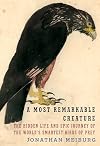
You may have never heard of caracaras, but Meiburg considers them among the most fascinating birds on the planet. Native to South America and often inhabiting often remote environments, these members of the falcon family are surprisingly intelligent, curious, playful and resourceful. In this book Meiburg sets out to introduce caracaras into popular perception, increasing awareness of their history, ecologic roles and the threats they face due to human encroachment and environmental and show more climate degradation. I love a good microhistory and, though it reads slightly on the dry side, this work is chock full of information interesting to natural history enthusiasts or ornithology. I'd love to get the opportunity to observe a caracara! show less
A Most Remarkable Creature: The Hidden Life and Epic Journey of the World’s Smartest Birds of Prey by Jonathan Meiburg
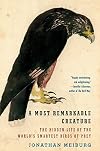
Blending memoir, travelogue, science, and natural history, Jonathan Meiburg introduces readers to the little-known striated caracara, a large, endangered bird of prey found in the Falkland Islands. They are intelligent, curious, mischievous, and social. He traces their history, and the history of birds in general, back to the dinosaurs. He relates their encounters with Charles Darwin and William Henry Hudson. He also takes readers on a journey to various parts of the world to find close show more relatives of these birds.
Meiburg is obviously passionate about his subject, and it shows in his writing. He beautifully describes his sleuthing in the wilderness of South America and the thrill of making discoveries in the natural world. He describes the impact of climate change on birds, and caracaras in particular. If you are interested in ornithology or natural history, this remarkable book is well worth reading. show less
Meiburg is obviously passionate about his subject, and it shows in his writing. He beautifully describes his sleuthing in the wilderness of South America and the thrill of making discoveries in the natural world. He describes the impact of climate change on birds, and caracaras in particular. If you are interested in ornithology or natural history, this remarkable book is well worth reading. show less
Lists
Awards


You May Also Like


Statistics
- Works
- 2
- Members
- 335
- Popularity
- #71,018
- Rating
- 4.1
- Reviews
- 12
- ISBNs
- 8