

Yasmina Khadra
Author of The Swallows of Kabul
About the Author
Disambiguation Notice:
a.k.a. Mohammed Moulessehoul (Moulesschoud)
(fre) a.k.a. Mohammed Moulessehoul (Moulesschoud)
Image credit: Yasmina Khadra en 2019
Series
Works by Yasmina Khadra
L'attentat 2 copies
Tilræðið 1 copy
Cœur d'amande 1 copy
Günün Geceye Borcu 1 copy
I virtuosi (Italian Edition) 1 copy
La parte del muerto (13/20) 1 copy
2006 1 copy
Associated Works
African Rhapsody: Short Stories of the Contemporary African Experience (1994) — Contributor — 23 copies
Tagged
Common Knowledge
- Legal name
- Moulessehoul, Mohammed
- Other names
- ياسمينة خضراء
- Birthdate
- 1955-01-10
- Gender
- male
- Education
- Ecole des cadets de la Révolution d'El Mechouar, Tlemce, Algérie (19 64 | 19 78)
- Occupations
- army officer
novelist - Organizations
- Algerian Army
- Short biography
- Yasmina Khadra, révèle dans un entretien au Monde des Livres que sous cette identité féminine se cache un homme. Dans L'écrivain, paru en 2001, le mystère est entièrement dissipé. Yasmina Khadra s'appelle de son vrai nom Mohamed Moulessehoul, qui a déjà publié sous ce nom nouvelles et romans en Algérie. Officier dans l'armée algérienne, il a participé à la guerre contre le terrorisme. Il a quitté l'institution en 2000, avec le grade de commandant, pour se consacrer à sa vocation: écrire. Il choisit de le faire en français. Morituri le révèle au grand public. Aujourd'hui écrivain internationalement connu, Yasmina Khadra est traduit en 33 langues.
Les indications suivantes nous ont été fournies par Yasmina Khadra. Nous les transcrivons telles quelles.
10 janvier 1955 : naissance à Kenadsa (Sahara algérien) d'un père infirmier et d'une mère nomade.
1956 : mon père rejoint les rangs de l'ALN. Blessé en 1958. Devient officier de l'ALN en 1959
Septembre 1964 : j'avais neuf ans, mon père me confie à une école militaire (Ecole Nationale des Cadets de la Révolution, pour faire de moi un officier
1973 : je termine mon premier recueil de nouvelles "Houria" qui paraîtra onze ans plus tard
Septembre 1975 : je pars à l'Académie Militaire Inter-armes de Cherchell, que je quitte en 1978 avec le grade de sous-lieutenant. Je rejoins les unités de combat sur le front ouest
Septembre 2000 : près trente six ans de vie militaire, je quitte l'Armée pour me consacrer à la littérature (Je pars à la retraite avec le grade de commandant).
En 2001, après un court séjour au Mexique, avec ma femme et mes trois enfants, je viens m'installer en France, à Aix-en-Provence, où je réside encore.
Ces éléments de biographie se retrouvent dans deux des ouvrages de Yasmina Khadra : L'écrivain (où il évoque son séjour à l'Ecole Nationale des Cadets et l'éveil de sa vocation d'écrivain) et L'imposture des mots, davantage consacré à une justification de sa démarche et de son oeuvre, après la révélation de la véritable identité de Yasmina Khadra. - Nationality
- Algeria
- Birthplace
- Kenadsa, Wilaya de Béchar, Sahara, Algeria
- Places of residence
- France
Algeria - Disambiguation notice
- a.k.a. Mohammed Moulessehoul (Moulesschoud)
- Associated Place (for map)
- Sahara, Algeria
Members
Reviews
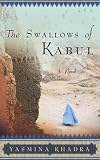
This short novel follows two couples in a Taliban-run Kabul. Mohsen comes from a family of wealthy shopkeepers; his wife, Zunaira, is a beautiful and brilliant teacher. The Taliban has destroyed their business and home, and Zunaira is no longer allowed to work. In contrast, we see Atiq, a jailer who has adopted the Taliban teachings, and his faithful and loving wife, Musarrat, who is dying of a debilitating illness.
Khadra writes with poetic detail about a city which the residents no longer show more recognize as their own. Frightened, confused, unsure, despairing, they struggle to make sense of a culture that is at once familiar and foreign:
“…hundreds of little kids … many barely old enough to walk, and all silently braiding the stout rope they’ll use, someday soon, to lynch their country’s last hope of salvation.”
“We had some privileges that we didn’t know how to defend, and so we forfeited them to the apprentice mullahs….It would be marvelous to stand in front of a shop window, leaning against you, or to sit at a table, just the two of us, chatting away or making fantastic plans. But that’s no longer possible.”
”How could he have believed that lovers’ promenades were still possible in a city that looks like a hospice for the moribund, overrun with repellent fanatics whose eyes stare out of the dark backward and abysm of time? How could he have lost sight of the horrors that punctuate daily life in a nation so contemptible its official language is the whip?”
“You’re happy, but you don’t know it. All your life, you’ve only listened to other people – your teachers and your holy men, your leaders and your demons – and they’ve spoken to you of nothing but wrongs and bitterness and war.”
There are some startlingly brutal images contained in this small volume. This is a tragedy, and things will not end well for all these characters. But I feel that I have gained a little understanding of the situation by reading this novel, and for that I’m grateful. show less
Khadra writes with poetic detail about a city which the residents no longer show more recognize as their own. Frightened, confused, unsure, despairing, they struggle to make sense of a culture that is at once familiar and foreign:
“…hundreds of little kids … many barely old enough to walk, and all silently braiding the stout rope they’ll use, someday soon, to lynch their country’s last hope of salvation.”
“We had some privileges that we didn’t know how to defend, and so we forfeited them to the apprentice mullahs….It would be marvelous to stand in front of a shop window, leaning against you, or to sit at a table, just the two of us, chatting away or making fantastic plans. But that’s no longer possible.”
”How could he have believed that lovers’ promenades were still possible in a city that looks like a hospice for the moribund, overrun with repellent fanatics whose eyes stare out of the dark backward and abysm of time? How could he have lost sight of the horrors that punctuate daily life in a nation so contemptible its official language is the whip?”
“You’re happy, but you don’t know it. All your life, you’ve only listened to other people – your teachers and your holy men, your leaders and your demons – and they’ve spoken to you of nothing but wrongs and bitterness and war.”
There are some startlingly brutal images contained in this small volume. This is a tragedy, and things will not end well for all these characters. But I feel that I have gained a little understanding of the situation by reading this novel, and for that I’m grateful. show less
Dans les ruines brûlantes de la cité millénaire de Kaboul, la mort rôde, un turban noir autour du crâne. Ici, une lapidation de femme, là des exécutions publiques, les Taliban veillent. La joie et le rire sont suspects. Atiq, le courageux moudjahid reconverti en geôlier, traîne sa peine. Le goût de vivre a également abandonné Mohsen, qui rêvait de modernité. Son épouse Zunaira, avocate, plus belle que le ciel, est désormais condamnée à l'obscurité grillagée du tchadri. show more Alors Kaboul, que la folie guette, n'a plus d'autres histoires à offrir que des tragédies. Le printemps des hirondelles semble bien loin encore... show less

Except for his wife's, Atiq hasn't seen a woman's face for many years. He's even learned to live without such sights. For him, woman are only ghosts, voiceless, charmless ghosts that pass practically unnoticed along the streets; flocks of infirm swallows—blue, yellow, often faded, several seasons behind—that make a mournful sound when they come into the proximity of men.
Yasmina Khadra is the pseudonym for Mohammed Moulessehoul, an Algerian army officer who writes about issues of show more fundamentalism and Islam. In [The Swallows of Kabul], he follows two couples in Kabul, Afghanistan over the period of a week or so. Atiq Shaukat is a jailor of woman who have been condemned of arbitrary crimes and sentenced to be executed the next day. His wife, Musarrat, is dying of an unnamed illness. Mohsen Ramat is a former professional, now destitute and unmoored, whose only remaining point of reference is his wife, the beautiful former magistrate, Zunaira. The Taliban overshadows all, dictating their public lives, and insidiously invading their personal relationships and inner selves. A damning condemnation of life under the Taliban made more poignant now that the Taliban is back in control after a period of personal freedom. show less
Yasmina Khadra is the pseudonym for Mohammed Moulessehoul, an Algerian army officer who writes about issues of show more fundamentalism and Islam. In [The Swallows of Kabul], he follows two couples in Kabul, Afghanistan over the period of a week or so. Atiq Shaukat is a jailor of woman who have been condemned of arbitrary crimes and sentenced to be executed the next day. His wife, Musarrat, is dying of an unnamed illness. Mohsen Ramat is a former professional, now destitute and unmoored, whose only remaining point of reference is his wife, the beautiful former magistrate, Zunaira. The Taliban overshadows all, dictating their public lives, and insidiously invading their personal relationships and inner selves. A damning condemnation of life under the Taliban made more poignant now that the Taliban is back in control after a period of personal freedom. show less
https://nwhyte.livejournal.com/2945262.html
It's the story of a German doctor, dismayed by his wife's suicide, who sets off on a long sail journey with a friend; they are kidnapped by pirates and he ends up, after numerous rather horrible adventures, in a refugee camp in Darfur, where eventually he is rescued; but he finds that he cannot find peace in Frankfurt, and returns to Africa.
There are a couple of whopping big problems with it that require some suspension of disbelief. The pirates who show more capture the narrator and his friend are surprisingly eloquent for a bunch of militia. (One of them turns out to be a published poet, but the others are not.) The path from the Gulf of Aden to Darfur is politically implausible and geographically weak - there is no mention of the River Nile, which flows firmly across any conceivable route and is rather hard to miss. While Darfur is not exactly lush, it's not as desertified as portrayed here either. The parts of the book in Frankfurt seem a bit more grounded in local knowledge.
Of course, "Khadra" (in real life Mohammed Moulessehoul, using his wife's name as a pseudonym) is Algerian, and I suspect that some of the scenes of violence and indeed of refugee camps are more closely drawn from experience and knowledge of his home country rather than places further to the east or south. And certainly I've met militia leaders with literary pretensions, and even white Frenchmen who have adopted African-ness as a new identity like the character Bruno. So if you can swallow the implausibilities it's an interesting narrative. show less
It's the story of a German doctor, dismayed by his wife's suicide, who sets off on a long sail journey with a friend; they are kidnapped by pirates and he ends up, after numerous rather horrible adventures, in a refugee camp in Darfur, where eventually he is rescued; but he finds that he cannot find peace in Frankfurt, and returns to Africa.
There are a couple of whopping big problems with it that require some suspension of disbelief. The pirates who show more capture the narrator and his friend are surprisingly eloquent for a bunch of militia. (One of them turns out to be a published poet, but the others are not.) The path from the Gulf of Aden to Darfur is politically implausible and geographically weak - there is no mention of the River Nile, which flows firmly across any conceivable route and is rather hard to miss. While Darfur is not exactly lush, it's not as desertified as portrayed here either. The parts of the book in Frankfurt seem a bit more grounded in local knowledge.
Of course, "Khadra" (in real life Mohammed Moulessehoul, using his wife's name as a pseudonym) is Algerian, and I suspect that some of the scenes of violence and indeed of refugee camps are more closely drawn from experience and knowledge of his home country rather than places further to the east or south. And certainly I've met militia leaders with literary pretensions, and even white Frenchmen who have adopted African-ness as a new identity like the character Bruno. So if you can swallow the implausibilities it's an interesting narrative. show less
Lists
Awards


You May Also Like


Associated Authors
Statistics
- Works
- 52
- Also by
- 4
- Members
- 5,077
- Popularity
- #4,926
- Rating
- 3.6
- Reviews
- 278
- ISBNs
- 392
- Languages
- 23
- Favorited
- 6


