
Robert Owen (1) (1771–1858)
Author of A New View of Society and Other Writings (Penguin Classics)
For other authors named Robert Owen, see the disambiguation page.
Works by Robert Owen
A New View Of Society Or Essays On The Principle Of The Formation Of The Human Character And The Application Of The Prin (2004) 5 copies
Ausgewählte Schriften. Das soziale System, Über ein neues Gesellschaftssystem, Über das Eigentum (Reclam Universal-Bi (1988) 3 copies
Pädagogische Schriften 1 copy
Associated Works
Voices of the Industrial Revolution: Selected Readings from the Liberal Economists and Their Critics (1961) — Contributor — 50 copies
Tagged
Common Knowledge
- Birthdate
- 1771-05-14
- Date of death
- 1858-11-17
- Gender
- male
- Occupations
- Mill Owner
- Relationships
- Owen, Robert Dale (son)
- Nationality
- Wales
UK - Birthplace
- Newtown, Montgomeryshire, Wales, UK
- Place of death
- Newtown, Montgomeryshire, Wales, UK
- Associated Place (for map)
- Newtown, Montgomeryshire, Wales, UK
Members
Reviews
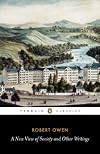
Robert Owen was far more than a socialist theoretician. The typical example of the paternalistic 'manager' he incarnates, also, what the so-called philanthropical capitalism was all about, being the master head of an audacious utopia (New Lanark) which saw the implementation of many reforms, some astonishingly modern, and those repercussions would inspire from anarchists to Engels and Marx.
Tiny Scottish village centred around a textile factory, New Lanark served indeed as a laboratory where show more Robert Owen, having full power over a disempowered working class community, will test and apply his theories -from new production methods in his factories to dictating the living condition of his employees themselves. Productivity would be closely supervised and monitored, but breaktime would be extended. Children would not be forced to work, but, on the contrary, send to school where a liberal curriculum was taught (and, even, equipped with playgrounds!). Nurseries were specifically created for babies those parents were at work in his factories. Hygiene, even into people's households, was strictly controlled. Open public spaces were created... Owen implemented so many policies, in fact, that it's difficult to isolate any in particular when it comes to how audacious and radically new such model was!
A man of the Enlightenment, he in fact believed that people were shaped by their environment. At the time of the Industrial Revolution and the emergence of a growing working class, worrying then the social establishment for the potential troubles this could mean for their privileges, his view was nevertheless nothing but simple: in order to avoid such working classes to revolt, then one should avoid them to be pushed towards the 'vices' of the time (criminality, alcoholism, prostitution, violence...) which may lead to threatening social instability. New Lanark, then, surely was an admirable model for keeping people away from dreadful living conditions such as the slums so prevalent at the times, but it was, also, a powerful mean of control, to keep the lower classes strictly compliant while making quite substantial profits.
Was Owen really a philanthropist? Or was he merely cynical? Being fully in charge of people having otherwise not much of a choice (him paying their wages) such community was better than other settings for sure, yet it also smack of a totalitarian environment. Reading this I couldn't help but think about the Soviet model and how life might have been behind the Iron Curtain. Dreadful? Yes, and yet...
And yet, for a man emerging with the Industrial Revolution (he died in 1858) the modernity of his reforms, his spirit courageously libertarian, the incredible fervour with which he defended his ideas (especially his fight against the politicians of the time for the betterment of children's conditions and of the poor in general) cannot but leave inspired somehow. Even nowadays, in fact, some of his powerful arguments haven't lost any of their relevance, and, yes, even in Britain!
There's a lot to condemn in Robert Owen. 'The road to hell is paved with good intent', as they say, and his imposing of his personal view of how people should live to help make a better profit for him and his social class, views imposed with concerned people having no choice in the matter, may have been 'enlightened' at the time; but we ought to know better. Having said that, he was surely armed with good intent regardless; and one has to admit that, in our contemporary society more GDP friendly than family friendly, we ought to take heed and learn from some of his most astonishing reforms. Robert Owen, after all, couldn't have been perfect -and he was a man of his time. He might have believed 'scientific management' would solve all of our problems, but we're not tiny robots. Sorting out the wheat from the chaff, this remains a great political manifesto. show less
Tiny Scottish village centred around a textile factory, New Lanark served indeed as a laboratory where show more Robert Owen, having full power over a disempowered working class community, will test and apply his theories -from new production methods in his factories to dictating the living condition of his employees themselves. Productivity would be closely supervised and monitored, but breaktime would be extended. Children would not be forced to work, but, on the contrary, send to school where a liberal curriculum was taught (and, even, equipped with playgrounds!). Nurseries were specifically created for babies those parents were at work in his factories. Hygiene, even into people's households, was strictly controlled. Open public spaces were created... Owen implemented so many policies, in fact, that it's difficult to isolate any in particular when it comes to how audacious and radically new such model was!
A man of the Enlightenment, he in fact believed that people were shaped by their environment. At the time of the Industrial Revolution and the emergence of a growing working class, worrying then the social establishment for the potential troubles this could mean for their privileges, his view was nevertheless nothing but simple: in order to avoid such working classes to revolt, then one should avoid them to be pushed towards the 'vices' of the time (criminality, alcoholism, prostitution, violence...) which may lead to threatening social instability. New Lanark, then, surely was an admirable model for keeping people away from dreadful living conditions such as the slums so prevalent at the times, but it was, also, a powerful mean of control, to keep the lower classes strictly compliant while making quite substantial profits.
Was Owen really a philanthropist? Or was he merely cynical? Being fully in charge of people having otherwise not much of a choice (him paying their wages) such community was better than other settings for sure, yet it also smack of a totalitarian environment. Reading this I couldn't help but think about the Soviet model and how life might have been behind the Iron Curtain. Dreadful? Yes, and yet...
And yet, for a man emerging with the Industrial Revolution (he died in 1858) the modernity of his reforms, his spirit courageously libertarian, the incredible fervour with which he defended his ideas (especially his fight against the politicians of the time for the betterment of children's conditions and of the poor in general) cannot but leave inspired somehow. Even nowadays, in fact, some of his powerful arguments haven't lost any of their relevance, and, yes, even in Britain!
There's a lot to condemn in Robert Owen. 'The road to hell is paved with good intent', as they say, and his imposing of his personal view of how people should live to help make a better profit for him and his social class, views imposed with concerned people having no choice in the matter, may have been 'enlightened' at the time; but we ought to know better. Having said that, he was surely armed with good intent regardless; and one has to admit that, in our contemporary society more GDP friendly than family friendly, we ought to take heed and learn from some of his most astonishing reforms. Robert Owen, after all, couldn't have been perfect -and he was a man of his time. He might have believed 'scientific management' would solve all of our problems, but we're not tiny robots. Sorting out the wheat from the chaff, this remains a great political manifesto. show less

This book is nothing less than astonishing! Robert Owen - not just because he wrote down these ideas over 200 years ago (in 1813) - was a genius, whose ideas would solve even today many of the world's problems, peacefully. And remember that he proved it (you can read about it in Wikipedia) a generation (some 60 or 70 years) BEFORE Marx and Engels!
Lists
You May Also Like


Associated Authors
Statistics
- Works
- 15
- Also by
- 4
- Members
- 241
- Popularity
- #94,247
- Rating
- 3.4
- Reviews
- 2
- ISBNs
- 106
- Languages
- 9
- Favorited
- 2
