
Peter Weiss (1) (1916–1982)
Author of The Persecution and Assassination of Jean-Paul Marat as Performed by the Inmates of the Asylum of Charenton Under the Direction of the Marquis de Sade
For other authors named Peter Weiss, see the disambiguation page.
About the Author
In December 1965 Peter Weiss's Marat/Sade (1964), in a presentation by Britain's Royal Shakespeare Company, stormed the Broadway stage, captivating audience and critic alike. The assumption that the play about the murder of Marat by Charlotte Corday might have been one of the many dramatic pieces show more written by Sade---and enacted by his fellow inmates for "therapeutic" reasons during the Marquis's confinement at Charenton---provided Weiss (who maintained that "every word I put down is political") with his framework for the "confrontation of the revolutionary Marat as the apostle of social improvement and the cynical individualist, the Marquis de Sade" (N.Y. Times). The Investigation (1965), which Weiss considered his best play, was first presented in 20 theaters in East and West Germany; Ingmar Bergman (see Vol. 3) was its Swedish director. It was staged in New York in 1966. Taken almost entirely from the actual proceedings of the 1965 Frankfurt War Crimes Tribunal on Auschwitz, The Investigation is a "harrowing but insistently commanding experience" (Walter Kerr, N.Y. Times). The audience, in effect, reenacts the role of the original courtroom spectators in this shattering, true account of man's depravity. Weiss received the Buchner Prize in 1982. (Bowker Author Biography) show less
Image credit: Photograph by Dietbert Keßler (1982)
Series
Works by Peter Weiss
The Persecution and Assassination of Jean-Paul Marat as Performed by the Inmates of the Asylum of Charenton Under the Direction of the Marquis de Sade (1964) — Author — 1,385 copies, 15 reviews
Marat/Sade, The Investigation, The Shadow of the Body of the Coachman: Peter Weiss (German Library) (1998) 49 copies, 1 review
Suhrkamp BasisBibliothek : Peter Weiss : Die Verfolgung und Ermordung Jean Paul Marats (2004) — Text — 15 copies
Diagnos 6 copies
Notizbücher 3 copies
Tre atti unici 3 copies
Nacht mit Gästen 3 copies
Fluchtpunkt : Roman 1 copy
Nacht mit Gästen zwei Stücke 1 copy
Weiss Peter 1 copy
Prosa und Marat 1 copy
Song Of The Lusitanian Bogey 1 copy
Der Prozeß 1 copy
Gesang vom Lusitanischen Popanz: Mit Materialien (Edition Suhrkamp ; 700) (German Edition) (1974) 1 copy, 1 review
Jean Paul Marat... 1 copy
Associated Works
Two, three ... many Vietnams;: A radical reader on the wars in Southeast Asia and the conflicts at home (1971) — Contributor — 16 copies
Napalm — Author — 6 copies
Als de dagen van het jaar verhalen uit de Westduitse werkelijkheid 1970-heden (1985) — Author — 3 copies
Tagged
Common Knowledge
- Canonical name
- Weiss, Peter
- Legal name
- Weiss, Peter Ulrich
- Other names
- Sinclair (pseudonym)
- Birthdate
- 1916-11-08
- Date of death
- 1982-05-10
- Gender
- male
- Education
- Prague Art Academy
Polytechnic School of Photography - Occupations
- playwright
painter
graphic artist
filmmaker
novelist - Awards and honors
- Georg Büchner Preis (1982)
Swedish Theatre Critics Prize (1982)
De Nios Prize (1982)
Bremen Literature Prize (1982)
Cologne Literature Prize (1981)
Thomas Dehler Prize (1978) (show all 11)
Carl Albert Anderson Prize (1967)
Tony Award for Best Play (Marat/Sade, 1966)
Heinrich Mann Prize (1966)
Lessing Prize (1965)
Charles Veillon Award (1963) - Relationships
- Jungk, Robert (friend)
- Short biography
- Peter Weiss was born in Nowawes, near Berlin, Germany. His parents were Franziska Frieda and Eugen "Jenö" Weiss, a Hungarian Jew who converted to Christianity, and he had four siblings. After World War I and the break-up of the Austro-Hungarian Empire, his father became a Czech citizen and Peter acquired his father's nationality. He began training as a painter as a teenager. In 1935, after persecution by the Nazi regime, the family moved to the UK. Weiss studied photography at the Polytechnic Regent Street (now the University of Westminster) in London. In 1936, the family moved to Czechoslovakia, where Weiss attended the Prague Art Academy. After Nazi Germany's invasion in 1938, the family moved to Sweden, while Weiss was in Switzerland visiting Hermann Hesse. He rejoined his family the following year in Stockholm, where he lived for the rest of his life. He painted and made experimental films influenced by the Surrealists. Later he became a prolific novelist, playwright, and nonfiction writer, originally in Swedish, but by 1950 in German. He gained international acclaim for his 1963 play Marat/Sade, the Broadway production of which won the 1966 Tony Award for Best Play, and its 1967 film adaptation. In the 1960s, Weiss became increasingly left-wing politically. In 1968, he joined the Swedish Left Communist Party (VPK). He opposed U.S. involvement in the Vietnam war, and visited North Vietnam, later publishing a book about his trip. He wrote three autobiographical novels: Der Schatten des Körpers des Kutschers (The Shadow of the Body of the Coachman, 1960), Abschied von den Eltern (The Leave-taking, 1961), and Fluchtpunkt (Exile, 1962). His monumental three-part novel The Aesthetics of Resistance appeared in 1975–1981. Weiss received numerous prestigious awards, including the highest German literary award, the Georg Büchner Prize in 1982.
- Cause of death
- heart attack
- Nationality
- Czechoslovakia
Sweden (naturalized 1946) - Birthplace
- Nowawes, Germany
- Places of residence
- Chislehurst, Kent, England, UK
Prague, Czechoslovakia
Stockholm, Sweden
Paris, France
London, England, UK - Place of death
- Stockholm, Sweden
- Map Location
- Sweden
Members
Reviews

This edition starts with a wonderful introduction/essay by Peter Brook, the English theatre and film director. Not only does he analyze the play and its reception but tackles the topic of what makes theatre good, in general.
The play itself is one of Sade's swan songs from imprisonment at Charenton, the final imprisonment and the place of his death. In it, the imaginary meeting between the Marquis and Marat is a departure point for Sade, who had said, "It is not my mode of thought that has show more caused my misfortunes, but the mode of thought of others", to feel resentment over his own condition:
"Give up Marat
You said yourself nothing can be achieved by
scribbling
Long ago I abandoned my masterpiece a roll of paper
in my dungeon years ago
It vanished when the Bastille fell
it vanished as everything written
everything thought and planned
will disappear."
and echo the French soul's buyer's remorse over buying revolution heavily seasoned with violence:
"We're all so clogged with dead ideas
passed from generation to generation
that even the best of us don't know the way out
We invented the Revolution
but we don't know how to run it
Look everyone wants to keep something from the past
a souvenir of the old regime
This man decides to keep a painting
This one keeps his mistress
He [pointing] keeps his garden
He [pointing] keeps his estate
He keeps his country house
He keeps his factories
This man couldn't part with his shipyards
This one kept his army
and that one keeps his king"
Marat and Sade both saw the need for revolutionary change and in answering the call, they were killed by the demons they themselves helped to summon:
"...you came one day to the Revolution because you saw the most important vision
That our circumstances must be changed fundamentally
and without these changes everything we try to do must fail" show less
The play itself is one of Sade's swan songs from imprisonment at Charenton, the final imprisonment and the place of his death. In it, the imaginary meeting between the Marquis and Marat is a departure point for Sade, who had said, "It is not my mode of thought that has show more caused my misfortunes, but the mode of thought of others", to feel resentment over his own condition:
"Give up Marat
You said yourself nothing can be achieved by
scribbling
Long ago I abandoned my masterpiece a roll of paper
in my dungeon years ago
It vanished when the Bastille fell
it vanished as everything written
everything thought and planned
will disappear."
and echo the French soul's buyer's remorse over buying revolution heavily seasoned with violence:
"We're all so clogged with dead ideas
passed from generation to generation
that even the best of us don't know the way out
We invented the Revolution
but we don't know how to run it
Look everyone wants to keep something from the past
a souvenir of the old regime
This man decides to keep a painting
This one keeps his mistress
He [pointing] keeps his garden
He [pointing] keeps his estate
He keeps his country house
He keeps his factories
This man couldn't part with his shipyards
This one kept his army
and that one keeps his king"
Marat and Sade both saw the need for revolutionary change and in answering the call, they were killed by the demons they themselves helped to summon:
"...you came one day to the Revolution because you saw the most important vision
That our circumstances must be changed fundamentally
and without these changes everything we try to do must fail" show less
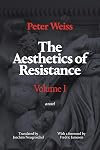
Good god what can't Peter Weiss do?
Aesthetics of Resistance is a three volume work, but unfortunately for the Angloworld only Volume One has been translated into English. This is a travesty for political, socio-historical, ethical and aesthetic/cultural reasons. What he offers is not only an "historical novel" centered around the aesthetic education of 3 working class students coming of age in the tumultuous and politically volatile onset of WWII, it also provides a granular view of the show more populist clash between Communism, Socialism and Fascism, both political and psychological. It may as well serve as a syllabus for a master class on the History of Underdog Art, with incisive aesthetic criticism/commentary of the same.
My dudes, it bowled me over. While this volume provides more content than I could chew over in a lifetime, I am seriously considering shooting Joachim Neugroschel a personal email requesting galleys of Volumes 2 and 3.
I am convinced that now, more than ever, we need a nuanced understanding of the rise of Fascism that pays especial attention to its greatest victims and most (un)likely allies--the un and underemployed laborers, i.e. the poor and disenfranchised. Peter Weiss has an enormous amount to tell us about where we are and, I suspect, where we might be if the lessons of aesthetic resistance are learned. show less
Aesthetics of Resistance is a three volume work, but unfortunately for the Angloworld only Volume One has been translated into English. This is a travesty for political, socio-historical, ethical and aesthetic/cultural reasons. What he offers is not only an "historical novel" centered around the aesthetic education of 3 working class students coming of age in the tumultuous and politically volatile onset of WWII, it also provides a granular view of the show more populist clash between Communism, Socialism and Fascism, both political and psychological. It may as well serve as a syllabus for a master class on the History of Underdog Art, with incisive aesthetic criticism/commentary of the same.
My dudes, it bowled me over. While this volume provides more content than I could chew over in a lifetime, I am seriously considering shooting Joachim Neugroschel a personal email requesting galleys of Volumes 2 and 3.
I am convinced that now, more than ever, we need a nuanced understanding of the rise of Fascism that pays especial attention to its greatest victims and most (un)likely allies--the un and underemployed laborers, i.e. the poor and disenfranchised. Peter Weiss has an enormous amount to tell us about where we are and, I suspect, where we might be if the lessons of aesthetic resistance are learned. show less
The Persecution and Assassination of Jean-Paul Marat As Performed by the Inmates of the Asylum of Charenton Under the Direction of the Marquis De sade by Peter Weiss

“We're all free and equal to die like dogs”
Every death even the cruelest death
drowns in the total indifference of Nature
Nature herself would watch unmoved
if we destroyed the entire human race
I hate Nature
this passionless spectator this unbreakable iceberg-face
that can bear everything
this goads us to greater and greater acts
Once and for all
the idea of glorious victories
won by the glorious army
must be wiped out
Neither side is glorious
On either side they're just frightened men messing show more their pants
and they all want the same thing
Not to lie under the earth
but to walk upon it
without crutches. show less
The Persecution and Assassination of Jean-Paul Marat As Performed by the Inmates of the Asylum of Charenton Under the Direction of The Marquis de Sade (or Marat Sade) by Peter Weiss
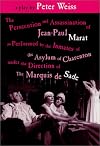
I saw this play years ago, and I still remember it as one of the most powerful plays I've ever encountered on the stage. In all truth, I wasn't sure how well it would hold up in a simple reading, but the themes and language are as powerful and hardhitting as I remember. Of course, the visuals came back to me as I read Weiss's work, so I can't be sure how well the work translates to a reader unfamiliar with the staged production. I can say that, as a creative play on history that interacts show more with true personalities and philosophies and histories taken directly from the past, this play is unsurpassable, and worth every effort to produce. I've heard there's a phenomenal dvd production of the play, and I plan on looking it up before fully committing to teaching this text--but, in the meantime, if you're a reader of plays or looking for works to produce, you should read this. It may be based in history, but its power and ideas are as relevant now as they were upon Weiss's writing. Absolutely recommended. show less
Lists
Awards


You May Also Like


Associated Authors
Statistics
- Works
- 90
- Also by
- 7
- Members
- 3,111
- Popularity
- #8,216
- Rating
- 4.0
- Reviews
- 34
- ISBNs
- 227
- Languages
- 16
- Favorited
- 4