
Anthony Smith (1) (1926–2014)
Author of The Body
For other authors named Anthony Smith, see the disambiguation page.
About the Author
Anthony Smith flew with the RAF, trained as a zoologist, worked in Africa and South America, and is an author with many books to his credit
Works by Anthony Smith
Machine Gun: The Story of the Men and the Weapon That Changed the Face of War (2002) 36 copies, 2 reviews
The Lost Lady of the Amazon: The Story of Isabela Godin and Her Epic Journey (2003) 27 copies, 1 review
Sea Never Dry 4 copies
The Body: 2 (Pelican) 1 copy
Tagged
Common Knowledge
- Legal name
- Smith, Anthony
- Birthdate
- 1926-03-30
- Date of death
- 2014-07-07
- Gender
- male
- Education
- University of Oxford
- Occupations
- explorer
broadcaster
balloonist
author - Short biography
- Anthony Smith (born March 30, 1926) is, among other things, an explorer, author and former Tomorrow’s World television presenter. He is perhaps best known for his bestselling work The Body (originally published in 1968 and later renamed The Human Body), which has sold over 800,000 copies worldwide and tied in with a BBC television series, known in America by the name Intimate Universe: The Human Body. The series aired in 1998 and was presented by Professor Robert Winston.
Smith read zoology at Balliol College, Oxford and wrote as a science correspondent for the Daily Telegraph. He also worked extensively in both television and radio, writing for several
natural history programmes.
Smith’s first expedition was to Persia, exploring the Qanat underground irrigation tunnels. This expedition was documented in the book Blind White Fish in Persia; a species of fish which he discovered is named after him
He was the first Briton to cross the Alps in a balloon. He led an expedition (with Douglas Botting) to fly a balloon from Zanzibar to East Africa, and then across the Ngorongoro crater (Documented in Throw out two Hands).
In 2003 he wrote The Lost Lady of the Amazon: The Story of Isabela Godin and Her Epic Journey about Jean Godin des Odonais.
Smith now resides in London, UK. - Nationality
- England
UK - Birthplace
- Buckinghamshire, England, UK
- Places of residence
- London, England, UK
- Place of death
- Oxford, Oxfordshire, England, UK
- Associated Place (for map)
- England, UK
Members
Reviews
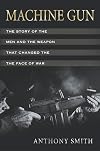
Sort of a biographical history of machine gun development, with some comments on deployment. Very little in the way of technical information; in fact, author Anthony Smith (described as an “author of many books and television host” on the jacket blurb) often shows he has little or no conception of how machine guns actually work.
Still, it’s a little different than most firearms books, which will often go into excruciating detail on such things as labeling of safeties and whether or not show more a particular variant had a knurled trigger. The biographies start out with Samuel Colt, who never designed a machine gun himself but whose Hartford, Connecticut, factory made Gatlings and provided gunsmith training to Hiram Maxim and John Browning (among others). Then follows Richard Gatling; Gatling had numerous patents but his only successful inventions were a wheat planting drill and the Gatling Gun, which apparently had similar mechanisms. Hiram Maxim is presented as a prolific inventor but serious egotist, and as more or less “the” machine gun inventor. Isaac Newton Lewis, Benjamin Hotchkiss, John Browning, Thorsten Nordenfelt, and miscellaneous others get passing mention. I learned a couple of interesting things; I never realized that the U.S. Army’s Benét-Mercié and the French Hotchkiss were the same weapon, with the French naming it after the American inventor while the U.S. used the French manufacturing firm (as it happened, Lawrence Benét was an American too, so it works out).
A lot of the book – perhaps a third – discusses the First World War, with the usual comments about the British Army being “lions led by donkeys”. There really isn’t any other way to describe it, I suppose. Smith supplies some statistics on gun acquisition here – the Royal Army had about 200 machine guns on strength in 1914, and 120000 in 1918. There’s even a little conspiracy theory, The 1925 monument to the Machine Gun Corps, a statue of “The Boy David”, was quickly removed and not erected again until 1963; perhaps the inscription from I Samuel xvii 7 noting that “Saul had slain his thousands, and David his ten thousands” was considered in bad taste. Similarly, the operational records of the Machine Gun Corps were destroyed in a fire in 1922 (which, according to Smith, only affected the Machine Gun Corps documents stored at the site). Two Royal Army officers who offered to write histories of the Machine Gun Corps were posted to Burma and the Northwest Frontier. Several veterans felt that all this was a deliberate attempt to blot out the memory of the Machine Gun Corps. Perhaps; I can see why you might want to be less than enthusiastic about recalling Ypres and the Somme, but that was the other side’s machine guns.
There’s a not quite relevant chapter on aviation technology, which seems to be there just to point out that Spitfires and Hurricanes used machine guns. The book closes with an excellent bibliography.
As mentioned, Smith is on shaky ground when he tries any sort of technical discussion. An egregious example is the claim that British and German machine gunners would remove bullets from the belts so they could “play tunes”, the favorite being “MEET me DOWN in PICCaDILLy” to which the Germans would reply “YES withOUT my DRAWERS ON”. I imagine everybody can see the problem with this story. (As it happens, it’s traceable back to Robert Graves, who presumably was having a little joke with the non-military readers of Goodbye to All That). Further along, Smith describes a gas-operated weapon as using “gas to cause the bolt to recoil” which I suppose is technically correct but not the way anybody familiar with firearms would describe it, and finally implies that all the barrels in a Gatling Gun fired at once.
If you’re interested in this sort of thing, a better choice might be John Ellis’ The Social History of the Machine Gun, which has fewer bibliographic details but much more cogent analysis of why most armies resisted adoption of machine guns, and how the machine gun was viewed in popular culture (There are probably more Gatling Guns in Western movies than were ever actually used in the American west, for example). show less
Still, it’s a little different than most firearms books, which will often go into excruciating detail on such things as labeling of safeties and whether or not show more a particular variant had a knurled trigger. The biographies start out with Samuel Colt, who never designed a machine gun himself but whose Hartford, Connecticut, factory made Gatlings and provided gunsmith training to Hiram Maxim and John Browning (among others). Then follows Richard Gatling; Gatling had numerous patents but his only successful inventions were a wheat planting drill and the Gatling Gun, which apparently had similar mechanisms. Hiram Maxim is presented as a prolific inventor but serious egotist, and as more or less “the” machine gun inventor. Isaac Newton Lewis, Benjamin Hotchkiss, John Browning, Thorsten Nordenfelt, and miscellaneous others get passing mention. I learned a couple of interesting things; I never realized that the U.S. Army’s Benét-Mercié and the French Hotchkiss were the same weapon, with the French naming it after the American inventor while the U.S. used the French manufacturing firm (as it happened, Lawrence Benét was an American too, so it works out).
A lot of the book – perhaps a third – discusses the First World War, with the usual comments about the British Army being “lions led by donkeys”. There really isn’t any other way to describe it, I suppose. Smith supplies some statistics on gun acquisition here – the Royal Army had about 200 machine guns on strength in 1914, and 120000 in 1918. There’s even a little conspiracy theory, The 1925 monument to the Machine Gun Corps, a statue of “The Boy David”, was quickly removed and not erected again until 1963; perhaps the inscription from I Samuel xvii 7 noting that “Saul had slain his thousands, and David his ten thousands” was considered in bad taste. Similarly, the operational records of the Machine Gun Corps were destroyed in a fire in 1922 (which, according to Smith, only affected the Machine Gun Corps documents stored at the site). Two Royal Army officers who offered to write histories of the Machine Gun Corps were posted to Burma and the Northwest Frontier. Several veterans felt that all this was a deliberate attempt to blot out the memory of the Machine Gun Corps. Perhaps; I can see why you might want to be less than enthusiastic about recalling Ypres and the Somme, but that was the other side’s machine guns.
There’s a not quite relevant chapter on aviation technology, which seems to be there just to point out that Spitfires and Hurricanes used machine guns. The book closes with an excellent bibliography.
As mentioned, Smith is on shaky ground when he tries any sort of technical discussion. An egregious example is the claim that British and German machine gunners would remove bullets from the belts so they could “play tunes”, the favorite being “MEET me DOWN in PICCaDILLy” to which the Germans would reply “YES withOUT my DRAWERS ON”. I imagine everybody can see the problem with this story. (As it happens, it’s traceable back to Robert Graves, who presumably was having a little joke with the non-military readers of Goodbye to All That). Further along, Smith describes a gas-operated weapon as using “gas to cause the bolt to recoil” which I suppose is technically correct but not the way anybody familiar with firearms would describe it, and finally implies that all the barrels in a Gatling Gun fired at once.
If you’re interested in this sort of thing, a better choice might be John Ellis’ The Social History of the Machine Gun, which has fewer bibliographic details but much more cogent analysis of why most armies resisted adoption of machine guns, and how the machine gun was viewed in popular culture (There are probably more Gatling Guns in Western movies than were ever actually used in the American west, for example). show less
For me, this book was a tedious read, and only partially informative. Although it is nominally in chronological order, the flash backs and peeks into the future are distracting and confusing, making it more of a 'post modern' story than a history. Much of the content is only peripherally relevant to the topic.

Retells the amazing journey of Tapscott and Widdicombe over 2,500 miles in an open boat after the sinking of the s.s. Anglo-Saxon by the raider Widder. The last third of the book describes the recovery of the boat in the 1990s and its eventual transfer to the Imperial War Museum from the Mystic Seaport Museum.

pbs show. great photos. well-written story of the rift. perhaps he would change the last chapter about natural resources.
Lists
You May Also Like


Statistics
- Works
- 30
- Members
- 593
- Popularity
- #42,348
- Rating
- 3.3
- Reviews
- 8
- ISBNs
- 131
- Languages
- 10