
Lucy Sante
Author of Low Life: Lures and Snares of Old New York
About the Author
Disambiguation Notice:
Name is pronounced SAHNT (one syllable).
Image credit: Headshot of Lucy Sante, posted on her Instagram account (@luxante) on September 21, 2021.
Works by Lucy Sante
Nineteen Reservoirs: On Their Creation and the Promise of Water for New York City (2022) 46 copies, 2 reviews
Subjective Realities: The Refco Collection of Contemporary Photography (2004) — Photographer — 30 copies
Take Me to the Water: Immersion Baptism in Vintage Music and Photography 1890-1950 (2009) 18 copies, 1 review
A Luta Continua: The Sylvio Perlstein Collection: Art and Photography from Dada to Now (2019) 9 copies
Collection in context : selected contemporary photographs of hands from the collection of Henry Mendelssohn Buhl (1996) 4 copies
Instead of a Book 1 copy
Associated Works
The Count of Monte Cristo (abridged) (1846) — Introduction, some editions — 1,795 copies, 13 reviews
The Count of Monte Cristo (abridged ∙ Barnes & Noble Classics) (2004) — Introduction — 1,406 copies, 11 reviews
The Big Con: The Story of the Confidence Man (1999) — Introduction; Introduction, some editions — 512 copies, 4 reviews
Looking In: Robert Frank's The Americans: Expanded Edition (2009) — Contributor — 186 copies, 2 reviews
Paris Vagabond (New York Review Classics) (2016) — Introduction, some editions — 126 copies, 2 reviews
Unknown Masterpieces: Writers Rediscover Literature's Hidden Classics (New York Review Books Classics) (2003) — Contributor — 113 copies, 2 reviews
These United States: Original Essays by Leading American Writers on Their State within the Union by John Leonard (1995) — Contributor — 102 copies, 1 review
Significant Objects: 100 Extraordinary Stories about Ordinary Things (2012) — Contributor — 64 copies, 1 review
American photography, 1890-1965, from the Museum of Modern Art, New York (1995) — Contributor — 59 copies
Crimes of New York: Stories of Crooks, Killers, and Corruption from the World's Toughest City (Adrenaline Classics) (2003) — Contributor — 22 copies, 2 reviews
Beatrice the Sixteenth: Being the Personal Narrative of Mary Hatherley, M.B., Explorer and Geographer (1909) — Introduction, some editions — 12 copies, 4 reviews
Tagged
Common Knowledge
- Canonical name
- Sante, Lucy
- Other names
- Sante, Luc
- Birthdate
- 1954-05-25
- Gender
- female
- Education
- Columbia University
Regis High School, New York, New York - Occupations
- writer
critic - Organizations
- Bard College
- Awards and honors
- Guggenheim Fellowship (1992)
Grammy Award (album notes ∙ 1998)
Whiting Writers' Award (1989)
Award in Literature, American Academy of Arts and Letters (1997) - Relationships
- Pierson, Melissa Holbrook (former wife)
- Short biography
- Lucy Sante is a Belgium-born American writer, critic, and artist. She is a frequent contributor to The New York Review of Books. Her books include Low Life: Lures and Snares of Old New York (1991). She was publicly named Luc Sante until 2021, when she announced her transition.
- Nationality
- Belgium (birth)
USA (residence) - Birthplace
- Verviers, Belgium
- Places of residence
- New York, New York, USA
- Disambiguation notice
- Name is pronounced SAHNT (one syllable).
- Associated Place (for map)
- New York, New York, USA
Members
Reviews
Rating: 5* of five
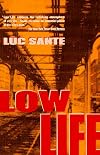
The Publisher Says: Luc Sante's Low Life is a portrait of America's greatest city, the riotous and anarchic breeding ground of modernity. This is not the familiar saga of mansions, avenues, and robber barons, but the messy, turbulent, often murderous story of the city's slums; the teeming streets—scene of innumerable cons and crimes whose cramped and overcrowded housing is still a prominent feature of the cityscape.
Low Life voyages through Manhattan from four different show more directions. Part One examines the actual topography of Manhattan from 1840 to 1919; Part Two, the era's opportunities for vice and entertainment—theaters and saloons, opium and cocaine dens, gambling and prostitution; Part Three investigates the forces of law and order which did and didn't work to contain the illegalities; Part Four counterposes the city's tides of revolt and idealism against the city as it actually was.
Low Life provides an arresting and entertaining view of what New York was actually like in its salad days. But it's more than simpy a book about New York. It's one of the most provocative books about urban life ever written—an evocation of the mythology of the quintessential modern metropolis, which has much to say not only about New York's past but about the present and future of all cities.
I HAVE OWNED THIS BOOK FOR DECADES.
My Review: Yeah, this is a re-read; this is also a five-star Pearl-Rule read. It's here because Author Sante is now Lucy, not Luc. I wanted to re-read it with Lucy's transition in my mind, as a test of my hypothesis that the transition was not some giant, wrenching shift in the author's identity.
Job done.
Halfway through Part Three, the law'n'order bit that I always get boiling mad reading, I figured out that Lucy, as a person new to my conscious awareness, changed nothing in my idea of Author Sante as a prose stylist or a storyteller. I immersed myself into Author Sante's deep dive into my beloved home city without any slightest thought of how the story would be different had it been written by Lucy, not Luc...they're both Author Sante, albeit I'm sure age has wrought its usual changes on the idea factory within. That would be true no matter whose writing one is looking at.
Why transphobes think transitioning ruins anything at all says bad things about them, and only them.
FSG asks $12.99 for a Kindle version. This is a must-read for all Manhattanphiles, anyone interested in the evolution of cities, and any aspiring hipsters. show less
The Publisher Says: Luc Sante's Low Life is a portrait of America's greatest city, the riotous and anarchic breeding ground of modernity. This is not the familiar saga of mansions, avenues, and robber barons, but the messy, turbulent, often murderous story of the city's slums; the teeming streets—scene of innumerable cons and crimes whose cramped and overcrowded housing is still a prominent feature of the cityscape.
Low Life voyages through Manhattan from four different show more directions. Part One examines the actual topography of Manhattan from 1840 to 1919; Part Two, the era's opportunities for vice and entertainment—theaters and saloons, opium and cocaine dens, gambling and prostitution; Part Three investigates the forces of law and order which did and didn't work to contain the illegalities; Part Four counterposes the city's tides of revolt and idealism against the city as it actually was.
Low Life provides an arresting and entertaining view of what New York was actually like in its salad days. But it's more than simpy a book about New York. It's one of the most provocative books about urban life ever written—an evocation of the mythology of the quintessential modern metropolis, which has much to say not only about New York's past but about the present and future of all cities.
I HAVE OWNED THIS BOOK FOR DECADES.
My Review: Yeah, this is a re-read; this is also a five-star Pearl-Rule read. It's here because Author Sante is now Lucy, not Luc. I wanted to re-read it with Lucy's transition in my mind, as a test of my hypothesis that the transition was not some giant, wrenching shift in the author's identity.
Job done.
Halfway through Part Three, the law'n'order bit that I always get boiling mad reading, I figured out that Lucy, as a person new to my conscious awareness, changed nothing in my idea of Author Sante as a prose stylist or a storyteller. I immersed myself into Author Sante's deep dive into my beloved home city without any slightest thought of how the story would be different had it been written by Lucy, not Luc...they're both Author Sante, albeit I'm sure age has wrought its usual changes on the idea factory within. That would be true no matter whose writing one is looking at.
Why transphobes think transitioning ruins anything at all says bad things about them, and only them.
FSG asks $12.99 for a Kindle version. This is a must-read for all Manhattanphiles, anyone interested in the evolution of cities, and any aspiring hipsters. show less
"New York, like other cities, is filled with people who have no idea where their water comes from and are only occasionally made aware that it is a precious and very finite resource..."
Having grown up within sight of the Delaware River, I knew where some of New York City's water came from long before I ever visited there. I have a child's recollection of overhearing conversations about the condemnation and drowning of villages up river from us. Cannonsville, Rock Rift, Rock Royal, show more Downsville--those were all real places where people I knew had been forced to relocate because of the construction of dams, reservoirs and associated systems to provide water to "the city". New York’s Board of Water Supply had an office not far outside the small town where my parents both worked and where I went to school from sixth grade through high school; some local people even worked for the Board. And the river itself, well it’s in my DNA. I’ve waded in it, swum in it, eaten critters hooked or pronged from it, crossed it untold times on multiple bridges, floated in it, boated on it, involuntarily swallowed some of it; I can smell its elemental warm wet essence in nostalgic moments when I remember skipping stones over its shallows with my grandmother. By the time the East and West Branches of the Delaware merged at Hancock and flowed together through my tiny home hamlet on the Pennsylvania side, NYC had siphoned off its share through a system of reservoirs and aqueducts that really does stagger the imagination.
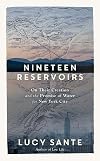
The process by which upstate mountain valley watersheds were tapped between 1907 and 1967, with over a million acres of land taken through eminent domain, in order to provide the metropolis with an abundant reliable supply of good water is the subject of [Nineteen Reservoirs], and it’s fascinating. Sante’s research is detailed, but it does not smother her prose, and she has been a resident of both the city and the affected countryside, so she "gets it" from both perspectives. The result is a highly readable narrative, enhanced with excellent photography, much of it done specifically for this volume by the equally talented Tim Davis. It’s local history for me, but it treats of big issues—who does have the right to control waterways that travel hundreds of miles through all sorts of territory, providing sustenance along the way; when do the needs of the many outweigh the needs of the few (how many is "many", how few are "few"); does a city owe its citizens unlimited access to as much free water as they all care to use or waste? (NYC did not start a program of individually metering all residential and business properties until 1990, and in the following 16 years, despite a population increase, overall water usage dropped significantly.) It’s a short book, with lots of photos, but it’s packed with interesting and thought provoking information.
A big shout-out to John Ogozalek, a now-retired (I think) high school teacher from my general neck of the woods, whose review of this book was featured on the editorial page of The Hancock Herald to which I still faithfully subscribe nearly 55 years after graduating from my high school near the wedding of the waters, in the Catskill hills. I’m not sure the book would have come to my attention if I had not seen that review, even though Sante's [Low Life] has been on my shelf for decades. But you can obtain it anywhere you like to buy your books. If you live anywhere along the Hudson, Delaware, or Croton Rivers, or in the Metropolitan New York/New Jersey area dependent on their waters, your library ought to have it. Make noise if they don't. show less
Having grown up within sight of the Delaware River, I knew where some of New York City's water came from long before I ever visited there. I have a child's recollection of overhearing conversations about the condemnation and drowning of villages up river from us. Cannonsville, Rock Rift, Rock Royal, show more Downsville--those were all real places where people I knew had been forced to relocate because of the construction of dams, reservoirs and associated systems to provide water to "the city". New York’s Board of Water Supply had an office not far outside the small town where my parents both worked and where I went to school from sixth grade through high school; some local people even worked for the Board. And the river itself, well it’s in my DNA. I’ve waded in it, swum in it, eaten critters hooked or pronged from it, crossed it untold times on multiple bridges, floated in it, boated on it, involuntarily swallowed some of it; I can smell its elemental warm wet essence in nostalgic moments when I remember skipping stones over its shallows with my grandmother. By the time the East and West Branches of the Delaware merged at Hancock and flowed together through my tiny home hamlet on the Pennsylvania side, NYC had siphoned off its share through a system of reservoirs and aqueducts that really does stagger the imagination.
The process by which upstate mountain valley watersheds were tapped between 1907 and 1967, with over a million acres of land taken through eminent domain, in order to provide the metropolis with an abundant reliable supply of good water is the subject of [Nineteen Reservoirs], and it’s fascinating. Sante’s research is detailed, but it does not smother her prose, and she has been a resident of both the city and the affected countryside, so she "gets it" from both perspectives. The result is a highly readable narrative, enhanced with excellent photography, much of it done specifically for this volume by the equally talented Tim Davis. It’s local history for me, but it treats of big issues—who does have the right to control waterways that travel hundreds of miles through all sorts of territory, providing sustenance along the way; when do the needs of the many outweigh the needs of the few (how many is "many", how few are "few"); does a city owe its citizens unlimited access to as much free water as they all care to use or waste? (NYC did not start a program of individually metering all residential and business properties until 1990, and in the following 16 years, despite a population increase, overall water usage dropped significantly.) It’s a short book, with lots of photos, but it’s packed with interesting and thought provoking information.
A big shout-out to John Ogozalek, a now-retired (I think) high school teacher from my general neck of the woods, whose review of this book was featured on the editorial page of The Hancock Herald to which I still faithfully subscribe nearly 55 years after graduating from my high school near the wedding of the waters, in the Catskill hills. I’m not sure the book would have come to my attention if I had not seen that review, even though Sante's [Low Life] has been on my shelf for decades. But you can obtain it anywhere you like to buy your books. If you live anywhere along the Hudson, Delaware, or Croton Rivers, or in the Metropolitan New York/New Jersey area dependent on their waters, your library ought to have it. Make noise if they don't. show less
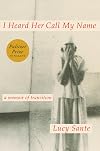
[book:I Heard Her Call My Name: A Memoir of Transition|154486930]I Heard Her Call My Name is a fascinating description of the process of transitioning at an "advanced" age. What's it like when a vague discomfort with yourself and a penchant toward distance suddenly are transformed into knowledge about your gender? How do you change the way you've presented yourself to the world after 60 years?
Lucy Sante is exactly the right person to be writing this book. She's thoughtful and articulate. show more She's brave enough to share moments of difficulty and confusion, as well as moments of clarity and empowerment. Regardless of the identity of the reader, I Heard Her Call My Name offers an opportunity to reflect on how we come to know ourselves and how assumptions about "normal" can make that self-knowledge more difficult.
I received a free electronic review copy of this title from the publisher via NetGalley: the opinions are my own. show less
Lucy Sante is exactly the right person to be writing this book. She's thoughtful and articulate. show more She's brave enough to share moments of difficulty and confusion, as well as moments of clarity and empowerment. Regardless of the identity of the reader, I Heard Her Call My Name offers an opportunity to reflect on how we come to know ourselves and how assumptions about "normal" can make that self-knowledge more difficult.
I received a free electronic review copy of this title from the publisher via NetGalley: the opinions are my own. show less
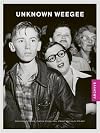
The viewing public's image of Weegee is of the prototypical New York tabloid news photographer: tough, garrulous and on the scene, ready to cover two murders in one night. But the inventive Jewish immigrant Arthur Fellig (1899-1968), who assumed the self-mocking nickname Weegee, was also one of the most original and creative photographers of the twentieth century. His work for The New York Times, the Herald Tribune, World-Telegram, Daily News, Post, Journal-American and Sun, his images of show more the masses at Coney Island, the confrontation of wealth and poverty at opening night at the opera, and the aftermath of brutal crime scenes are, by now, classics. But beyond the iconic images that have been so widely circulated, what do we know of Weegee the photographer--his history, his methods, his meaning? Drawing on ICP's unique archive of nearly 20,000 prints by this celebrated master, Unknown Weegee presents 120 photographs that have never been made available to the public. They reveal a politically astute and witty social critic and attest to the seriousness and self-consciousness of his photographic endeavors. With essays by Luc Sante and ICP curator Cynthia Young. show less
Lists
Awards


You May Also Like


Associated Authors
Statistics
- Works
- 32
- Also by
- 43
- Members
- 2,404
- Popularity
- #10,668
- Rating
- 3.9
- Reviews
- 46
- ISBNs
- 76
- Languages
- 5
- Favorited
- 9
