
U.R. Anantha Murthy (1932–2014)
Author of Samskara: A Rite for a Dead Man
About the Author
Works by U.R. Anantha Murthy
සංස්කාර 1 copy
Associated Works
Tagged
Common Knowledge
- Legal name
- Ananthamurthy, Udupi Rajagopalacharya
- Birthdate
- 1932-21-12
- Date of death
- 2014-08-22
- Gender
- male
- Education
- University of Mysore, India
University Of Birmingham, England, UK - Occupations
- vice chancellor
- Awards and honors
- Man Booker International Prize Finalist (2013)
- Nationality
- India
- Birthplace
- Melige, Tirthahalli taluk, Shimoga District, Kingdom of Mysore
- Places of residence
- Bangalore, India
- Place of death
- Bangalore, India
- Associated Place (for map)
- Bangalore, India
Members
Reviews
Answers are delayed until the question is no longer relevant.
Knowing next to nothing about the Hindu culture, I can hardly add anything to this novel's deeper meaning. I can only reflect on it personally via this English translation.
In a very brief summary, this is a 1965 novel about a village religious leader, Praneshacharya, who is presented with a dilemma related to the rites and cremation of one of the members of the village. The dead man, although also a brahmin, has deliberately mocked show more brahminism and is considered polluted as well as polluting. No one wants to touch him but no one except a brahmin can do the rites. The whole village must wait upon Praneshacharya to find a solution.
Meanwhile, the man's corpse is rotting and the village isn't allowed to eat or pray until he has been cremated. Praneshacharya has a crisis of indecision. After searching the scriptures to no avail, he decides to go to a temple where he asks and waits for an answer from the temple's god. He receives none. In the subsequent state of dejection and fatigue, he succumbs to an act of religiously immoral passion. Because of his hitherto faithfulness and his role as an example to others, this aberration causes him psychic pain and he falls into deep self-reflection.
As a non-Hindu reader, I found the novel and its premise fascinating. The writing was superb, the plot was intriguing, the characters well defined and the drama highly thought-provoking. I'm certain that to Hindus it would be incredibly more complicated. But even from my cultural distance, it was stimulating and rewarding.
Praneshacharya is an empathetic character. He is honest in his faith and has lived his life with a clear moral compass going back to his early teens. He is now almost 40, an age common for an identity crisis. However, the same faithfulness can't be said of the other village brahmins, including the reprobate dead man. While alive he had been Praneshacharya's opposite, his nemesis who now, in death, continues to antagonize and challenge Praneshacharya's understanding of what is holy and righteous. This is his long-needed trial, the kind that can either destroy or enrich one's spiritual understanding. It will foundationally change his personal and religious perspective about himself and his place as a member of humanity.
It was an immersive read. I loved that about it. I may not have understood all the many nuances and other political facts (perhaps includes effects of Colonialism) that a fellow native of author Ananthamurthy's would, but I am convinced the novel can be understood at a universal level of the State, Society, and Religion versus personal morality. I'm reminded of Sophocles' play Antigone in that way.
From my admittedly narrow perspective, the novel's hero was the despised low caste consort of the dead man, who like the hero in Antigone also outside the power structure, is a woman. Her credo was so much simpler--and one could argue is the premise of every religion: how should we best live? To love and care for others. And to honor this life of pain and joy.
A fine, thought-provoking read. show less
Knowing next to nothing about the Hindu culture, I can hardly add anything to this novel's deeper meaning. I can only reflect on it personally via this English translation.
In a very brief summary, this is a 1965 novel about a village religious leader, Praneshacharya, who is presented with a dilemma related to the rites and cremation of one of the members of the village. The dead man, although also a brahmin, has deliberately mocked show more brahminism and is considered polluted as well as polluting. No one wants to touch him but no one except a brahmin can do the rites. The whole village must wait upon Praneshacharya to find a solution.
Meanwhile, the man's corpse is rotting and the village isn't allowed to eat or pray until he has been cremated. Praneshacharya has a crisis of indecision. After searching the scriptures to no avail, he decides to go to a temple where he asks and waits for an answer from the temple's god. He receives none. In the subsequent state of dejection and fatigue, he succumbs to an act of religiously immoral passion. Because of his hitherto faithfulness and his role as an example to others, this aberration causes him psychic pain and he falls into deep self-reflection.
As a non-Hindu reader, I found the novel and its premise fascinating. The writing was superb, the plot was intriguing, the characters well defined and the drama highly thought-provoking. I'm certain that to Hindus it would be incredibly more complicated. But even from my cultural distance, it was stimulating and rewarding.
Praneshacharya is an empathetic character. He is honest in his faith and has lived his life with a clear moral compass going back to his early teens. He is now almost 40, an age common for an identity crisis. However, the same faithfulness can't be said of the other village brahmins, including the reprobate dead man. While alive he had been Praneshacharya's opposite, his nemesis who now, in death, continues to antagonize and challenge Praneshacharya's understanding of what is holy and righteous. This is his long-needed trial, the kind that can either destroy or enrich one's spiritual understanding. It will foundationally change his personal and religious perspective about himself and his place as a member of humanity.
It was an immersive read. I loved that about it. I may not have understood all the many nuances and other political facts (perhaps includes effects of Colonialism) that a fellow native of author Ananthamurthy's would, but I am convinced the novel can be understood at a universal level of the State, Society, and Religion versus personal morality. I'm reminded of Sophocles' play Antigone in that way.
From my admittedly narrow perspective, the novel's hero was the despised low caste consort of the dead man, who like the hero in Antigone also outside the power structure, is a woman. Her credo was so much simpler--and one could argue is the premise of every religion: how should we best live? To love and care for others. And to honor this life of pain and joy.
A fine, thought-provoking read. show less
A very difficult book for me. Not because of the writing, which is mostly clear and unambiguous, but because of the treatment. On the surface, it’s the journey (both literal and figurative) of an acharya (a Brahmin scholar/teacher) in a small village where an apostate Brahmin dies. The title is a Sanskrit word with multiple meanings and nuances; indeed, the epigraph is a transcription from an old dictionary defining the word that means everything from “rite of passage” to “moment of show more recognition”…and much more. Should the dead man be buried and accorded all the rights (and rites) of a Brahmin, notwithstanding his clear rejection of all that being a Brahmin entailed? The issue deeply divides the other Brahmins in the village but it demands an answer as the dead body lies unburied and begins to rot.
As the acharya whom the village turns to wrestles with the “correct” answer according to the religious and philosophical texts, more and more people are falling sick and dying: a plague has struck the area. On one hand, the issue is clear: do we, as a community, elevate form (rite and ritual) over substance (humanity)? On the other, our protagonist has his own personal issues. How good must one be? While the larger issues are clear, the story is so deeply embedded in expositions of classic texts (like the Veda) and Vedanta philosophy are to be very hard to follow at some points. It is, by all accounts, a world classic; the notes were generally helpful although I found it very difficult to follow some parts as Anantha Murthy has a weakness for introducing (and then dropping) obscure and arcane (to me, anyway) fine points of Brahmin obligations. show less
As the acharya whom the village turns to wrestles with the “correct” answer according to the religious and philosophical texts, more and more people are falling sick and dying: a plague has struck the area. On one hand, the issue is clear: do we, as a community, elevate form (rite and ritual) over substance (humanity)? On the other, our protagonist has his own personal issues. How good must one be? While the larger issues are clear, the story is so deeply embedded in expositions of classic texts (like the Veda) and Vedanta philosophy are to be very hard to follow at some points. It is, by all accounts, a world classic; the notes were generally helpful although I found it very difficult to follow some parts as Anantha Murthy has a weakness for introducing (and then dropping) obscure and arcane (to me, anyway) fine points of Brahmin obligations. show less
Samskara: A Rite for a Dead Man, Second Edition (Oxford India Perennials Series) by U. R. Anantha Murthy
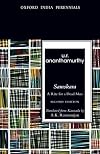
The blurb tells me that Samskara, a Rite for a Dead Man is a classic of modern Indian literature but I bought it when the author U.R. Ananthamurthy (1932-2014) was a finalist for the 2013 Man Booker International Prize. In this edition the novella is only 118 pages long, but it offers plenty to think about and I’m not surprised that it enjoyed critical acclaim as well as popularity when it was first published in India in 1965.
The Translator’s Note tells us that Samskara is a religious show more novella about a decaying Brahmin colony in a Karnataka village, an allegory rich in realistic detail. That doesn’t sound immediately appealing, but the story absorbed me almost immediately. A dilemma arises when a man has died and the Brahmin religious rites must be performed – but he has no son and none of the Brahmins want to sully themselves by doing it for him because he was a bad man who had flaunted his sinfulness for a long time. And while the community deliberates over this, it is forbidden for any of the adults to eat, and what’s worse, the body is putrefying and making the whole village smell.
Naranappa’s sins are drinking alcohol, taking an ‘unclean’ woman as his lover, and breaking numerous taboos such as throwing a sacred stone into the temple pool. There’s no doubt that he’s been provocative, and he’s been a very bad influence on the next generation too. However, Naranappa remains a Brahmin despite all this because unless he is excommunicated he remains a Brahmin all his life – and Praneshacharya, (the spiritual leader of the community) never took that step because Naranappa had threatened to convert to Islam if he did. Under the new secular laws of the Congress, Naranappa cannot be evicted from his house, so the presence of a Muslim among them would mean that they would all have to leave their nice houses and comfortable way of life in order to stay ‘pure’.
When I discussed this conundrum with The Spouse who is a student of philosophy, he thought that the solution was simple. The risks to public health outweigh religious scruples: cremate the body and be done with it. (And that, in fact is eventually what happens, though the Brahmins don’t know it and go on agonising about it.) But it’s not as simple as that for people of faith. The problem for them, at heart, is the Brahmin fear of ‘polluting’ themselves because that would interfere with whatever karma they’ve accumulated towards their next reincarnation. (Karma is the universal causal law by which good or bad actions determine the future modes of an individual’s existence). Praneshacharya has spent his whole life in self-sacrifice in preparation for his next rebirth, and failing to live in accordance with his dharma puts that at risk. (Dharma means law, duty, code of conduct, righteousness, and rules.) (To put it crudely, he could plummet from being a highly respected sanyasi to being reborn as an Untouchable, or worse, some kind of despised insect…)
However, Samskara is not a simple religious parable. Praneshacharya is not the noble holy man that he seems to be.
To read the rest of my review please visit https://anzlitlovers.com/2018/04/19/samskara-a-rite-for-a-dead-man-by-u-r-ananth... show less
The Translator’s Note tells us that Samskara is a religious show more novella about a decaying Brahmin colony in a Karnataka village, an allegory rich in realistic detail. That doesn’t sound immediately appealing, but the story absorbed me almost immediately. A dilemma arises when a man has died and the Brahmin religious rites must be performed – but he has no son and none of the Brahmins want to sully themselves by doing it for him because he was a bad man who had flaunted his sinfulness for a long time. And while the community deliberates over this, it is forbidden for any of the adults to eat, and what’s worse, the body is putrefying and making the whole village smell.
Naranappa’s sins are drinking alcohol, taking an ‘unclean’ woman as his lover, and breaking numerous taboos such as throwing a sacred stone into the temple pool. There’s no doubt that he’s been provocative, and he’s been a very bad influence on the next generation too. However, Naranappa remains a Brahmin despite all this because unless he is excommunicated he remains a Brahmin all his life – and Praneshacharya, (the spiritual leader of the community) never took that step because Naranappa had threatened to convert to Islam if he did. Under the new secular laws of the Congress, Naranappa cannot be evicted from his house, so the presence of a Muslim among them would mean that they would all have to leave their nice houses and comfortable way of life in order to stay ‘pure’.
When I discussed this conundrum with The Spouse who is a student of philosophy, he thought that the solution was simple. The risks to public health outweigh religious scruples: cremate the body and be done with it. (And that, in fact is eventually what happens, though the Brahmins don’t know it and go on agonising about it.) But it’s not as simple as that for people of faith. The problem for them, at heart, is the Brahmin fear of ‘polluting’ themselves because that would interfere with whatever karma they’ve accumulated towards their next reincarnation. (Karma is the universal causal law by which good or bad actions determine the future modes of an individual’s existence). Praneshacharya has spent his whole life in self-sacrifice in preparation for his next rebirth, and failing to live in accordance with his dharma puts that at risk. (Dharma means law, duty, code of conduct, righteousness, and rules.) (To put it crudely, he could plummet from being a highly respected sanyasi to being reborn as an Untouchable, or worse, some kind of despised insect…)
However, Samskara is not a simple religious parable. Praneshacharya is not the noble holy man that he seems to be.
To read the rest of my review please visit https://anzlitlovers.com/2018/04/19/samskara-a-rite-for-a-dead-man-by-u-r-ananth... show less
I picked this book up because it's required reading for a course I'm taking, but I was pleasantly surprised at how good it is. It's a great story about old vs new, religious vs secular, and rediscovering one's self.
Awards


You May Also Like


Associated Authors
Statistics
- Works
- 14
- Also by
- 1
- Members
- 456
- Popularity
- #53,830
- Rating
- 3.8
- Reviews
- 4
- ISBNs
- 27
- Languages
- 3
