

Anne Somerset
Author of Elizabeth I
About the Author
Anne Somerset was born in England in 1955 and studied history at King's College London
Works by Anne Somerset
The Affair of the Poisons: Murder, Infanticide, and Satanism at the Court of Louis XIV (2004) — Author — 392 copies, 7 reviews
Associated Works
What Might Have Been : Leading Historians on Twelve 'What Ifs' of History (2004) — Contributor — 197 copies, 6 reviews
Tagged
Common Knowledge
- Canonical name
- Somerset, Anne
- Legal name
- Carr, Anne Mary
- Birthdate
- 1955-01-21
- Gender
- female
- Education
- King's College, London (BA|1976)
- Occupations
- historian
biographer - Relationships
- Fielding, Daphne (grandmother)
Somerset, David Robert (father)
Thynne, Caroline Jane (mother)
Carr, Matthew (husband) - Short biography
- Anne Somerset read History at King's College, London and published her first book in 1980. She's the daughter of a famous English aristocratic family: her father is David Somerset, 11th Duke of Beaufort, whose home is Badminton House. Her late husband Matthew Carr (1953-2011) was the artist, not the author.
- Nationality
- UK
- Birthplace
- England, UK
- Places of residence
- London, England, UK
- Associated Place (for map)
- England, UK
Members
Reviews
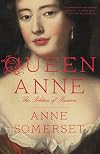
For all the history I try to read, my encounters with Queen Anne have been relatively rare - she's generally an afterthought, noted as the last Stuart monarch before the start of the Hanoverian dynasty, a character in someone else's story (such as a novel about Sarah Churchill I read a few years ago), or she comes up as a possible lesbian due to her relationships with female favorites. Overlooked seems to be the word to describe her, even during her own reign. Repeatedly, the author of this show more biography describes how the courtiers and advisors around Anne appeared to not think she had her own ideas, could come to her own conclusions, or make her own decision, despite evidence to the contrary. I had a lot of sympathy for Anne by the end of this biography, considering the politics she navigated, the personal tragedies she endured, and fracturing of so many of her personal relationships after she became queen. show less
Queen Victoria and Her Prime Ministers: Her Life, the Imperial Ideal, and the Politics and Turmoil That Shaped Her Extraordinary Reign by Anne Somerset
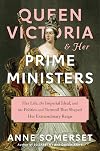
A vivid portrait of Queen Victoria as politician emerges from this deep study of her relationship with her prime ministers. Beginning with the teenaged queen who developed an emotional reliance on Lord Melbourne, to the young mother influenced and supported by Prince Albert, to the widow who removed herself from ceremonial events while staying involved with political affairs, the queen endeavored to maintain the empire’s status in a time of worldwide, emerging democratization.
Queen show more Victoria pushed the limits of her authority in influencing Parliament. She had strong feelings about her prime ministers based on personality and politics. “The Queen alone is enough to kill any man,” Gladstone bemoaned; he was quite hated by the Queen for his support of Home Rule for Ireland. Disraeli’s honeyed tongue played on her vanity, and he allowed her to think she had the sway she sought.
She ruled in a century of turmoil, with European emperors and kings vying for power and land, a populace demanding a say in government, and international wars and conflicts. It was like one big family feud, with Victoria’s children married to royalty across the continent. The Queen was unwilling to give up lands, status, or influence. In retrospect, some of her decisions were ill advised, like the Boer War.
And yet, the queen shed tears over the suffering of the civilians and soldiers at war, and believed in the emerging middle class. She was broad minded in accepting Muslims. She was called shrewd and knowledgeable.
The prime ministers each emerge from the page, vivid and fully drawn. Quotes from Victoria’s letters and of the ministers give insight into the relationships.
This impressive, detailed history can be overwhelming, but for the serious student it is a revelation.
Thanks to the publisher for a free book. show less
Queen show more Victoria pushed the limits of her authority in influencing Parliament. She had strong feelings about her prime ministers based on personality and politics. “The Queen alone is enough to kill any man,” Gladstone bemoaned; he was quite hated by the Queen for his support of Home Rule for Ireland. Disraeli’s honeyed tongue played on her vanity, and he allowed her to think she had the sway she sought.
She ruled in a century of turmoil, with European emperors and kings vying for power and land, a populace demanding a say in government, and international wars and conflicts. It was like one big family feud, with Victoria’s children married to royalty across the continent. The Queen was unwilling to give up lands, status, or influence. In retrospect, some of her decisions were ill advised, like the Boer War.
And yet, the queen shed tears over the suffering of the civilians and soldiers at war, and believed in the emerging middle class. She was broad minded in accepting Muslims. She was called shrewd and knowledgeable.
The prime ministers each emerge from the page, vivid and fully drawn. Quotes from Victoria’s letters and of the ministers give insight into the relationships.
This impressive, detailed history can be overwhelming, but for the serious student it is a revelation.
Thanks to the publisher for a free book. show less

What makes a good biography? For me, there are three main things for which I look in such a book. They are; firstly, a confident tone that leads me to believe that I am reading someone with greater knowledge than myself about the subject. This needs to be backed up by the second requirement, a plentiful series of quotations and notes referring to historical sources to back up the assertions of the author. The final attribute may seem less important but, if the whole is not served up in an show more entertaining manner, then a book of seven hundred plus pages may easily become tedious. Thankfully, Anne Somerset passes all these tests with consummate ease in this excellent biography of Queen Elizabeth I.
I have an interest, but no great knowledge, in the history of England at the time of Elizabeth's reign. My picture of the lady was coloured by the famous speech given to the troops sent to deal with the Armada ("I may have the body of a weak and feeble woman....."). This lead to a view that Elizabeth was a historical Margaret Thatcher; a domineering, decisive woman. Nothing could be further from the truth. Elizabeth seems to have preferred to leave well alone and only take action when forced so to do by events. She also had far more to do with England's Protestant state religion than Henry VIII. Whilst Henry may have amended our religious standing, one gets the feeling that this was largely in a fit of pique, and that it was Elizabeth's careful stewardship of the Church of England that sealed our conversion.
I was intrigued to learn that the Court, at this time, was so heavily dependant upon a complex system of flattery - and almost flirting between the officials and the Queen. My ignorance also extended to a lack of awareness as to how far the Queen depended upon private enterprise. Stories of her sending the Navy to deal with Spain's Navy only to have the commercial leaders divert the ships to the West Indies in an unsuccessful attempt to plunder Spanish treasure ships is both amusing and scarily premonitional of today's politics where money talks louder than the people.
This book is so good, that I will happily add Anne Somerset's name to Peter Ackroyd's as my two favourite historical biographers. I have not read any other works by this lady, but I hold that as a fault which I must speedily rectify. show less
I have an interest, but no great knowledge, in the history of England at the time of Elizabeth's reign. My picture of the lady was coloured by the famous speech given to the troops sent to deal with the Armada ("I may have the body of a weak and feeble woman....."). This lead to a view that Elizabeth was a historical Margaret Thatcher; a domineering, decisive woman. Nothing could be further from the truth. Elizabeth seems to have preferred to leave well alone and only take action when forced so to do by events. She also had far more to do with England's Protestant state religion than Henry VIII. Whilst Henry may have amended our religious standing, one gets the feeling that this was largely in a fit of pique, and that it was Elizabeth's careful stewardship of the Church of England that sealed our conversion.
I was intrigued to learn that the Court, at this time, was so heavily dependant upon a complex system of flattery - and almost flirting between the officials and the Queen. My ignorance also extended to a lack of awareness as to how far the Queen depended upon private enterprise. Stories of her sending the Navy to deal with Spain's Navy only to have the commercial leaders divert the ships to the West Indies in an unsuccessful attempt to plunder Spanish treasure ships is both amusing and scarily premonitional of today's politics where money talks louder than the people.
This book is so good, that I will happily add Anne Somerset's name to Peter Ackroyd's as my two favourite historical biographers. I have not read any other works by this lady, but I hold that as a fault which I must speedily rectify. show less

I have the annoying habit of tending to think of history – especially English history – as just like today except with funny clothes. Every book I read provides contrary evidence, and Unnatural Murder is no exception.
Elizabeth was notoriously parsimonious and prudish; when her successor James I took the throne, he reversed both these trends. James spent Elizabeth’s carefully hoarded treasury recklessly, handing out subsidies and pensions to his favorites. Although married and several show more times a father, James “played on both teams”; he made it clear that his Gentlemen of the Bedchamber were expected to do more than fluff the pillows and turn down the sheets. Not to be outdone, the women of James’ court replaced the ornate but conservative dress of Elizabeth’s time with equally ornate wardrobes that look like they were designed by Frederick’s of Holyrood. Court ladies that married or, worse, became pregnant while not married were banished by Elizabeth; James had no such compunctions and his courtiers threw themselves into affairs with enthusiasm.
James was especially difficult for his “companions”, since he had some sort of minor jaw or tongue deformity that made him drool constantly, and he was not shy about public kissing with his favorites. Nevertheless, courtiers quickly realized what the path to power was and Robert Carr led the pack, quickly becoming Viscount Rochester and then the Earl of Somerset because of his talents. He parlayed his position into wealth; anybody who wanted to speak to the King had to go through him first and he only allowed access to James after a substantial bribe. Carr/Rochester/Somerset only had three problems: everybody else at court hated him; he had the intelligence of a bucket of doorknobs; and fell in love with Frances, the Countess of Essex. He didn’t really care about problem one; he solved problem two by using a couple of mentors, the Earl of Northampton and Sir Thomas Overbury; and he worked on number three by dallying with the lady as much as he could and working to get her marriage to Robert Devereux, Earl of Essex, ended. (This is the son of the Earl of Essex that got himself beheaded for treason, thereby earning a movie portrayal by Errol Flynn and a Donizetti opera).
At the time, the only way for a wife to initiate an annulment was for both parties to swear before a religious court that the husband was impotent and the marriage unconsummated. This put the husband in a difficult position, since if after the annulment he was ever able to consummate a relationship with another women he was guilty of perjury and had to take his first wife back. Devereux/Essex was having none of that; although he and his wife hated each other, he also hated Somerset like everybody else and he certainly wasn’t going to swear to impotence for him (even though he admitted he had never consummated with Frances). He went so far as to invite a number of friends to his bedchamber to demonstrate that he wasn’t impotent.
Somerset worked around the problem by appealing to James’ interest in witchcraft (James wrote a book about it). James was persuaded that a man could be made permanently impotent with one woman by sorcery but remain capable with others. The Countess was examined by a team of midwives and found, to the utter astonishment of everyone at court, to be a virgin. (One presumes the midwives became suddenly wealthy). The King made it clear to the divines that they should annul the marriage, and, with some grumbling and on a close vote, they did.
Sir Thomas Overbury was sort of a second-string Renaissance Man. He wrote tolerable poetry, had a haphazard knowledge of a couple of languages, and was acknowledged to be fairly astute on foreign affairs. As Somerset’s éminence grise he was also making money hand over fist, since people had to bribe him to see Somerset then bribe Somerset to see the King. Unfortunately for him, he had two fatal flaws; he was a misogynist and was completely tactless. He began bragging about his power, and managed to be rude to the two most powerful women at court, Queen Anne (to whom he refused to take off his hat); and Frances, now his patron’s wife and Countess of Somerset, who he publicly called “base” and unchaste. Somerset tried to get him out of trouble by asking the King to appoint him an ambassador, giving him his choice of Russia, the Spanish Netherlands, or Spain (and thus getting him away from court and out of trouble). Overbury did the incredible and refused. It’s not good to disrespect the King, and James immediately had him committed to the Tower (this was technically illegal, but who was going to argue)?
Overbury wrote (smuggled out, since he wasn’t supposed to communicate with anybody) arrogant letters to Somerset, demanding release. Somerset wrote back suggesting Overbury feign illness, thereby appealing to royal compassion, and kept his mentor supplied with tarts, jellies, medicines, and various other treats, aided by a complaisant jailer and a cooperative Lieutenant of the Tower. Since Overbury was something of a hypochondriac anyway, he set about “feigning” illness with enthusiasm; under the care of the best doctor of the day, he was repeatedly treated to emetics, enemas and bleeding. He was bled so often that his doctor decided to make “issues” – permanent wounds to facilitate bleeding – one in the arm, held open by a gold pin, and one in the back, held open by forcing “five to seven” dried peas into the wound and then covering it with a proprietary balsam. (I attach the recipe for the balsam here, in case anyone wants to try it):
“Take three of the greater sort of serpents or snakes cut into pieces (their skins being first stripped off);
Twelve bats;
Two very fat sucking puppies;
One pound of earthworms washed in white wine;
Common oil;
Malago sack;
Marjoram and bay leaves.
Boil together, then stir in two pounds of hog’s lard;
When the wine is evaporated, press out the fat and mix with;
The marrow of a stag;
An ox’s legs;
Liquid amber;
Butter;
And nutmegs.
Apply to the backbone regularly, and give dog nettle enemas every morning.”
Skeptics will note that unlike the chemicals forced on us by modern medicine, this formula is all natural (except possibly the sack). If you decide to test it, let me know how it works.
Alas, despite the best medical science of the day had to offer, Sir Thomas feigned illness so successfully that he died. The coroner noted he had some sort of gangrenous hole in his back, and the corpse smelled so bad that he was shoveled under the floor at St. Peter Ad Vincula the same day.
So now Somerset was on top of the world. He was the King’s favorite, he was fabulously wealthy, and was married to the woman who was acknowledged as the most beautiful in England, and the annoying Sir Thomas Overbury had obligingly departed (as had his other “mentor”, the Earl of Northampton). Then, in few years, it all fell apart.
The first thing that went wrong was the King found another “favorite”. This was George Villiers, a handsome and elegant scion of minor nobility who was quickly promoted to Gentleman of the Bedchamber over Somerset’s vehement objections. Villiers eventually became Duke of Buckingham and was one of the few notables of James’ court to retain power when Charles I came to the throne. (Although presumably not with the same duties; Charles did not share his father’s predilections). If you’ve read The Three Musketeers and/or seen one of the movies, this is the Duke of Buckingham who (according to Dumas) became the lover of Anne of Austria, Queen of France, and eventually got whacked by Cardinal Richelieu and Milady.
The next thing was people began to ask questions about the death of Sir Thomas Overbury. Overbury’s jailer, Richard Weston; the Lieutenant of the Tower, Sir Gervase Elwes; and a lady in waiting to the Countess of Essex, Anne Turner, were arrested and “questioned”; all eventually admitted that the tarts, jellies and medicines delivered to Overybury during his imprisonment contained various interesting substances: aqua fortis, (nitric acid – one wonders exactly how you make nitric acid tarts or jellies), “great spiders”, ground glass, “white arsenic” (arsenic trioxide) and “sublimate of mercury” (mercury (II) chloride); and that Sir Thomas had expired shortly after receiving a “sublimate of mercury” enema administered by an “unknown apothecary”. And all the accused pointed to the Countess of Somerset as the instigator.
I learned quite a bit about the law of the time at this point. The accused were not informed of the case against them in advance, they were not allowed counsel, they could not summon witnesses (they could have witnesses, but they could not compel them to appear), were not allowed to take notes during the prosecution’s presentation, and had to remain standing without food, water, or bathroom breaks during the entire trial (which could last for 10-12 hours). Not surprisingly, all three were found guilty and hanged.
Then it was the Somerset’s turn. They were not allowed to communicate with each other nor were they told what their accomplices had said. Frances showed notable wifely affection by pleading guilty and taking the blame for everything; the Earl, in turn, blamed everything on her. After making a miserable defense, (bookmakers had given odds he would be acquitted), the Earl was found guilty. However, the fix was in; after some confinement in the Tower (with crowds showing up every day just in case the Somersets were publicly hanged or beheaded) both received a royal pardon. The public was outraged, but the Somerset’s power was broken; they retired to one of their estates. They became estranged; Frances died of ovarian cancer in 1632 (attended by the same doctor who had treated Overbury) and Robert in 1645.
Author Anne Somerset (I wonder if she’s related?) does a good job of making a 400-year-old murder case interesting. (She speculates that, ironically, Overbury may not have been murdered at all but actually died of his medical treatment). The background information is most impressive; I was fascinated by the descriptions of court life under James I, the accounts of medical practice, and the operation of English law. The book is not a particularly easy read, with a sometimes convoluted style; and although she acknowledges receiving advice from physicians and toxicologists in her introduction, she does not do a very good job of describing the poisons involved, always referring to them by their contemporary names and not relating them very well to modern toxicological knowledge. However, it was definitely a good addition to my knowledge of early Stuart history. show less
Elizabeth was notoriously parsimonious and prudish; when her successor James I took the throne, he reversed both these trends. James spent Elizabeth’s carefully hoarded treasury recklessly, handing out subsidies and pensions to his favorites. Although married and several show more times a father, James “played on both teams”; he made it clear that his Gentlemen of the Bedchamber were expected to do more than fluff the pillows and turn down the sheets. Not to be outdone, the women of James’ court replaced the ornate but conservative dress of Elizabeth’s time with equally ornate wardrobes that look like they were designed by Frederick’s of Holyrood. Court ladies that married or, worse, became pregnant while not married were banished by Elizabeth; James had no such compunctions and his courtiers threw themselves into affairs with enthusiasm.
James was especially difficult for his “companions”, since he had some sort of minor jaw or tongue deformity that made him drool constantly, and he was not shy about public kissing with his favorites. Nevertheless, courtiers quickly realized what the path to power was and Robert Carr led the pack, quickly becoming Viscount Rochester and then the Earl of Somerset because of his talents. He parlayed his position into wealth; anybody who wanted to speak to the King had to go through him first and he only allowed access to James after a substantial bribe. Carr/Rochester/Somerset only had three problems: everybody else at court hated him; he had the intelligence of a bucket of doorknobs; and fell in love with Frances, the Countess of Essex. He didn’t really care about problem one; he solved problem two by using a couple of mentors, the Earl of Northampton and Sir Thomas Overbury; and he worked on number three by dallying with the lady as much as he could and working to get her marriage to Robert Devereux, Earl of Essex, ended. (This is the son of the Earl of Essex that got himself beheaded for treason, thereby earning a movie portrayal by Errol Flynn and a Donizetti opera).
At the time, the only way for a wife to initiate an annulment was for both parties to swear before a religious court that the husband was impotent and the marriage unconsummated. This put the husband in a difficult position, since if after the annulment he was ever able to consummate a relationship with another women he was guilty of perjury and had to take his first wife back. Devereux/Essex was having none of that; although he and his wife hated each other, he also hated Somerset like everybody else and he certainly wasn’t going to swear to impotence for him (even though he admitted he had never consummated with Frances). He went so far as to invite a number of friends to his bedchamber to demonstrate that he wasn’t impotent.
Somerset worked around the problem by appealing to James’ interest in witchcraft (James wrote a book about it). James was persuaded that a man could be made permanently impotent with one woman by sorcery but remain capable with others. The Countess was examined by a team of midwives and found, to the utter astonishment of everyone at court, to be a virgin. (One presumes the midwives became suddenly wealthy). The King made it clear to the divines that they should annul the marriage, and, with some grumbling and on a close vote, they did.
Sir Thomas Overbury was sort of a second-string Renaissance Man. He wrote tolerable poetry, had a haphazard knowledge of a couple of languages, and was acknowledged to be fairly astute on foreign affairs. As Somerset’s éminence grise he was also making money hand over fist, since people had to bribe him to see Somerset then bribe Somerset to see the King. Unfortunately for him, he had two fatal flaws; he was a misogynist and was completely tactless. He began bragging about his power, and managed to be rude to the two most powerful women at court, Queen Anne (to whom he refused to take off his hat); and Frances, now his patron’s wife and Countess of Somerset, who he publicly called “base” and unchaste. Somerset tried to get him out of trouble by asking the King to appoint him an ambassador, giving him his choice of Russia, the Spanish Netherlands, or Spain (and thus getting him away from court and out of trouble). Overbury did the incredible and refused. It’s not good to disrespect the King, and James immediately had him committed to the Tower (this was technically illegal, but who was going to argue)?
Overbury wrote (smuggled out, since he wasn’t supposed to communicate with anybody) arrogant letters to Somerset, demanding release. Somerset wrote back suggesting Overbury feign illness, thereby appealing to royal compassion, and kept his mentor supplied with tarts, jellies, medicines, and various other treats, aided by a complaisant jailer and a cooperative Lieutenant of the Tower. Since Overbury was something of a hypochondriac anyway, he set about “feigning” illness with enthusiasm; under the care of the best doctor of the day, he was repeatedly treated to emetics, enemas and bleeding. He was bled so often that his doctor decided to make “issues” – permanent wounds to facilitate bleeding – one in the arm, held open by a gold pin, and one in the back, held open by forcing “five to seven” dried peas into the wound and then covering it with a proprietary balsam. (I attach the recipe for the balsam here, in case anyone wants to try it):
“Take three of the greater sort of serpents or snakes cut into pieces (their skins being first stripped off);
Twelve bats;
Two very fat sucking puppies;
One pound of earthworms washed in white wine;
Common oil;
Malago sack;
Marjoram and bay leaves.
Boil together, then stir in two pounds of hog’s lard;
When the wine is evaporated, press out the fat and mix with;
The marrow of a stag;
An ox’s legs;
Liquid amber;
Butter;
And nutmegs.
Apply to the backbone regularly, and give dog nettle enemas every morning.”
Skeptics will note that unlike the chemicals forced on us by modern medicine, this formula is all natural (except possibly the sack). If you decide to test it, let me know how it works.
Alas, despite the best medical science of the day had to offer, Sir Thomas feigned illness so successfully that he died. The coroner noted he had some sort of gangrenous hole in his back, and the corpse smelled so bad that he was shoveled under the floor at St. Peter Ad Vincula the same day.
So now Somerset was on top of the world. He was the King’s favorite, he was fabulously wealthy, and was married to the woman who was acknowledged as the most beautiful in England, and the annoying Sir Thomas Overbury had obligingly departed (as had his other “mentor”, the Earl of Northampton). Then, in few years, it all fell apart.
The first thing that went wrong was the King found another “favorite”. This was George Villiers, a handsome and elegant scion of minor nobility who was quickly promoted to Gentleman of the Bedchamber over Somerset’s vehement objections. Villiers eventually became Duke of Buckingham and was one of the few notables of James’ court to retain power when Charles I came to the throne. (Although presumably not with the same duties; Charles did not share his father’s predilections). If you’ve read The Three Musketeers and/or seen one of the movies, this is the Duke of Buckingham who (according to Dumas) became the lover of Anne of Austria, Queen of France, and eventually got whacked by Cardinal Richelieu and Milady.
The next thing was people began to ask questions about the death of Sir Thomas Overbury. Overbury’s jailer, Richard Weston; the Lieutenant of the Tower, Sir Gervase Elwes; and a lady in waiting to the Countess of Essex, Anne Turner, were arrested and “questioned”; all eventually admitted that the tarts, jellies and medicines delivered to Overybury during his imprisonment contained various interesting substances: aqua fortis, (nitric acid – one wonders exactly how you make nitric acid tarts or jellies), “great spiders”, ground glass, “white arsenic” (arsenic trioxide) and “sublimate of mercury” (mercury (II) chloride); and that Sir Thomas had expired shortly after receiving a “sublimate of mercury” enema administered by an “unknown apothecary”. And all the accused pointed to the Countess of Somerset as the instigator.
I learned quite a bit about the law of the time at this point. The accused were not informed of the case against them in advance, they were not allowed counsel, they could not summon witnesses (they could have witnesses, but they could not compel them to appear), were not allowed to take notes during the prosecution’s presentation, and had to remain standing without food, water, or bathroom breaks during the entire trial (which could last for 10-12 hours). Not surprisingly, all three were found guilty and hanged.
Then it was the Somerset’s turn. They were not allowed to communicate with each other nor were they told what their accomplices had said. Frances showed notable wifely affection by pleading guilty and taking the blame for everything; the Earl, in turn, blamed everything on her. After making a miserable defense, (bookmakers had given odds he would be acquitted), the Earl was found guilty. However, the fix was in; after some confinement in the Tower (with crowds showing up every day just in case the Somersets were publicly hanged or beheaded) both received a royal pardon. The public was outraged, but the Somerset’s power was broken; they retired to one of their estates. They became estranged; Frances died of ovarian cancer in 1632 (attended by the same doctor who had treated Overbury) and Robert in 1645.
Author Anne Somerset (I wonder if she’s related?) does a good job of making a 400-year-old murder case interesting. (She speculates that, ironically, Overbury may not have been murdered at all but actually died of his medical treatment). The background information is most impressive; I was fascinated by the descriptions of court life under James I, the accounts of medical practice, and the operation of English law. The book is not a particularly easy read, with a sometimes convoluted style; and although she acknowledges receiving advice from physicians and toxicologists in her introduction, she does not do a very good job of describing the poisons involved, always referring to them by their contemporary names and not relating them very well to modern toxicological knowledge. However, it was definitely a good addition to my knowledge of early Stuart history. show less
Lists
Awards


You May Also Like


Associated Authors
Statistics
- Works
- 7
- Also by
- 1
- Members
- 2,105
- Popularity
- #12,228
- Rating
- 3.6
- Reviews
- 33
- ISBNs
- 38
- Languages
- 1
