
Dimitri Verhulst
Author of The Misfortunates
About the Author
Works by Dimitri Verhulst
Op. 26: 7-12 Twaalf Liederen In Muzijk Gebragt Voor Eene Zangstem Met Piano-Forte. Op. 26 Heft 2 copies
Werf en wrak 1 copy
Deze gin 1 copy
Waarom Wettelen? 1 copy
Associated Works
Sport : de 141 beste Nederlandse en Vlaamse sportverhalen van 1945 tot nu (2007) — Contributor — 6 copies
Tagged
Common Knowledge
- Canonical name
- Verhulst, Dimitri
- Birthdate
- 1972-10-02
- Gender
- male
- Occupations
- author
- Awards and honors
- Gouden Uil Publieksprijs 2007
- Nationality
- Belgium
- Birthplace
- Aalst, Belgium
- Places of residence
- Nieuwerkerken, Aalst, Belgium
Huccorgne, Wanze, Belgium - Associated Place (for map)
- Aalst, Belgium
Members
Reviews

In 1889, James Ensor painted Christ entering Brussels in the midst of a massive, chaotic procession of ordinary Belgians of his own time. In this short satirical novel, Verhulst picks up this idea and transfers it to the early 21st century: Christ has apparently announced that he will be arriving in the capital on the 21st of July, and Belgium is suddenly in a ferment of confused preparation, as six (count ‘em!) parliaments try to decide whose competence this falls under and which language show more should be used, whilst bishops and nuns panic and ordinary people decide to be nice to their neighbours or confess to long-forgotten crimes. An engaging satire, with lots of surreal Belgian flourishes, and the usual slightly bleak view of the world. show less

Sixty-something composer Pierre is heading down the autoroute to Avignon with the severely-handicapped teenager Sonny, whom he's abducted from the care-home where he lives. His quixotic mission seems to be to mark Sonny's 16th birthday by taking him to the top of a hill in Provence to tell him the story of his origins, tied up with the location and with the unhappy love-story of Pierre and Sonny's mother.
There's no real evidence that Sonny is in any way able to understand or respond to what show more he's being told, so the novella is very much a reflective monologue by Pierre, switching from time to time between first and third person. He takes apart the history of his own dysfunctional private life whilst idolising that of Sonny's mother, and we start to see how the love and empathy that he failed to express properly in earlier relationships is now all being projected, clumsily, onto the surrogate infant Sonny.
An uncomfortable story in lots of ways, but you could call it a kind of Belgian/Provençal Of mice and men, perhaps... show less
There's no real evidence that Sonny is in any way able to understand or respond to what show more he's being told, so the novella is very much a reflective monologue by Pierre, switching from time to time between first and third person. He takes apart the history of his own dysfunctional private life whilst idolising that of Sonny's mother, and we start to see how the love and empathy that he failed to express properly in earlier relationships is now all being projected, clumsily, onto the surrogate infant Sonny.
An uncomfortable story in lots of ways, but you could call it a kind of Belgian/Provençal Of mice and men, perhaps... show less

I bought this so long ago that can’t remember why I wanted it… but I think I read it through a different prism to those who interpreted it as a poignant story about an old woman’s grief. This is a book that will resonate differently, depending on the age of the reader.
think this novella is more of a cautionary tale, and I think that the author’s flippant and discursive tone is intended to alert the read to more than the story’s diverting context.
Madame Verona and her husband show more deliberately chose an isolated hideaway for a home. In widowhood, Madame Verona has stayed in this secluded place until one day, when she is 82 and has used up the supply of chopped firewood her husband had left for her, she goes down the hill, knowing that she lacks the strength to climb back up the hill. That’s it. We know what’s going to happen. It’s a choice to die on her own terms. Someone will find her eventually, frozen to death.
Before long #SpoilerAlert we learn that her husband’s thoughtful act of provisioning with the wood takes place after Monsieur Potter is diagnosed with cancer. He chops up 20 years’ worth of wood and then hangs himself. This is framed by some readers as a thoughtful act too, deciding to spare Madame Verona the burden of looking after him. But that is not actually what the text says. He visits Dr Lunette (this isolated village has to make do with a vet) and makes up his mind very quickly. It seems to me that he wants to spare himself. That’s not unreasonable, but let’s not romanticise it:
Surely the reader who imagines the next step i.e. his wife — alone —finding his body swinging from the tree, and then having to deal with it (remember, their house is remote, a long way from the village) would conclude that this was not an act of love designed to spare her anything. Even if there is a poem in chapter V that tells her not to wait for his time to come. Even if he did chop down a forest of wood to keep her warm afterwards. These are not decisions made jointly by a loving couple. This is him, making decisions for her.
To read the rest of my review please visit https://anzlitlovers.com/2026/06/24/madame-verona-comes-down-the-hill-2009-by-di... show less
think this novella is more of a cautionary tale, and I think that the author’s flippant and discursive tone is intended to alert the read to more than the story’s diverting context.
Madame Verona and her husband show more deliberately chose an isolated hideaway for a home. In widowhood, Madame Verona has stayed in this secluded place until one day, when she is 82 and has used up the supply of chopped firewood her husband had left for her, she goes down the hill, knowing that she lacks the strength to climb back up the hill. That’s it. We know what’s going to happen. It’s a choice to die on her own terms. Someone will find her eventually, frozen to death.
Before long #SpoilerAlert we learn that her husband’s thoughtful act of provisioning with the wood takes place after Monsieur Potter is diagnosed with cancer. He chops up 20 years’ worth of wood and then hangs himself. This is framed by some readers as a thoughtful act too, deciding to spare Madame Verona the burden of looking after him. But that is not actually what the text says. He visits Dr Lunette (this isolated village has to make do with a vet) and makes up his mind very quickly. It seems to me that he wants to spare himself. That’s not unreasonable, but let’s not romanticise it:
The only thing Monsieur Potter had really considered while sitting between the skeletons in her waiting room was his hypochondriac tendency. But the pain that had floated between kidney and lung for weeks on end and whose location he, to Dr Lunette’s immense displeasure, was unable to specify to the exact millimetre was, in combination with his nocturnal coughing fits and the threads of blood he found in his saliva every morning, difficult to brush off as a symbol. And since he was, after all, a smoker, she gave her diagnosis without any trace of pity — only yourself to blame — and he accepted it immediately. He had no desire to wait for the immaculate white of a hospital room where he would rot away until the ECG plateaued and a beeping machine called the hospital corpse washers to attention and got them sopping their sponges. (p.44)
Surely the reader who imagines the next step i.e. his wife — alone —finding his body swinging from the tree, and then having to deal with it (remember, their house is remote, a long way from the village) would conclude that this was not an act of love designed to spare her anything. Even if there is a poem in chapter V that tells her not to wait for his time to come. Even if he did chop down a forest of wood to keep her warm afterwards. These are not decisions made jointly by a loving couple. This is him, making decisions for her.
To read the rest of my review please visit https://anzlitlovers.com/2026/06/24/madame-verona-comes-down-the-hill-2009-by-di... show less
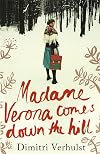
If the love of your life were to die while you were still young, how would you choose to live the remainder of your life?
Madame Verona, as she is known to the villagers, is not a native of the hamlet at the foot of the mountain. She and her husband have bought a remote house and surrounding woods because "'this is a house you could die in and it's a house you could be unhappy in. We'd be mad not to take it'". Deeply in love, the couple didn't realize how soon their off-hand remark would show more come to be.
When the abandoned were still lovers, they had sworn that they didn't want to live without each other, they had given each other power of attorney over the meaning of their existence and the disappearance of one would have cried out for the disappearance of the other. With the elderly that is often a natural process: if one drops dead, the other hurries to the grave without any extra effort on their part. But young adults are not yet capable of dying like swans; their hearts are able to bear grief...
For Madame Verona, who always has a stray dog at her heals, it is the dog's needs that keep her moving forward, step by step, "and so, before she knew it, Madame Verona had been drawn into living on for her allotted span."
The majority of the story is told from the perspective of members of the village. Vignettes of life in the little community are wonderfully pastoral and funny, and their interactions with and opinions of Madame Verona are simple and askew. The story moves between the villagers' perspective and Madame Verona's memories and present thoughts to create a pastiche that is charming but not cloying. Without melodrama, the author writes of love and grief and life in a way that encompasses the noble and the mundane.
Being from a small town myself, I couldn't help but chuckle at the oddities and tall tales of the villagers, and I loved the simple and sonorous language of the book. Often, I would read passages aloud and savor the sounds and images. In less than 150 pages, I was entertained and touched by the lives and loves of the characters. Warm and gentle, this novel was a wonderful holiday read. show less
Madame Verona, as she is known to the villagers, is not a native of the hamlet at the foot of the mountain. She and her husband have bought a remote house and surrounding woods because "'this is a house you could die in and it's a house you could be unhappy in. We'd be mad not to take it'". Deeply in love, the couple didn't realize how soon their off-hand remark would show more come to be.
When the abandoned were still lovers, they had sworn that they didn't want to live without each other, they had given each other power of attorney over the meaning of their existence and the disappearance of one would have cried out for the disappearance of the other. With the elderly that is often a natural process: if one drops dead, the other hurries to the grave without any extra effort on their part. But young adults are not yet capable of dying like swans; their hearts are able to bear grief...
For Madame Verona, who always has a stray dog at her heals, it is the dog's needs that keep her moving forward, step by step, "and so, before she knew it, Madame Verona had been drawn into living on for her allotted span."
The majority of the story is told from the perspective of members of the village. Vignettes of life in the little community are wonderfully pastoral and funny, and their interactions with and opinions of Madame Verona are simple and askew. The story moves between the villagers' perspective and Madame Verona's memories and present thoughts to create a pastiche that is charming but not cloying. Without melodrama, the author writes of love and grief and life in a way that encompasses the noble and the mundane.
Being from a small town myself, I couldn't help but chuckle at the oddities and tall tales of the villagers, and I loved the simple and sonorous language of the book. Often, I would read passages aloud and savor the sounds and images. In less than 150 pages, I was entertained and touched by the lives and loves of the characters. Warm and gentle, this novel was a wonderful holiday read. show less
Lists
Awards


You May Also Like


Associated Authors
Statistics
- Works
- 39
- Also by
- 2
- Members
- 3,888
- Popularity
- #6,515
- Rating
- 3.5
- Reviews
- 139
- ISBNs
- 153
- Languages
- 16
- Favorited
- 18

