
Dana Gioia
Author of Literature: An Introduction to Fiction, Poetry, and Drama
About the Author
Dana Gioia is a poet and critic. He has published five collections of poetry, most recently 99 Poems: New Selected, which won the Poets' Prize. His child collection, Interrogations at Noon, was awarded the American Book Award. Gioia's first critical collection, Can Poetry Matter?, was a finalist show more for the National Book Critics Circle Award. Gioia has served as the Chairman of the National Endowment for the Arts and California State Poet Laureate. show less
Image credit: Dana Gioia (photo by Star Black) By Dana Gioia by Star Black - Dana Gioia, Public Domain, https://commons.wikimedia.org/w/index.php?curid=51913850
Works by Dana Gioia
Backpack Literature: An Introduction to Fiction, Poetry, Drama, and Writing (4th Edition) (2005) — Editor — 96 copies
100 Great Poets of the English Language (Penguin Academics Series) (Penguin Academics) (2004) 46 copies
The Longman Dictionary of Literary Terms -The Essential Literary Terms: The Jargon for the Informed Reader (for Sourcebooks, Inc.) (2005) 16 copies
Longman Anthology of Short Fiction, Compact Edition, The: Stories and Authors in Context (2002) 12 copies
Literature: An Introduction to Fiction, Poetry, Drama, and Writing, Compact Edition (6th Edition) (2009) — Editor — 7 copies
Barrier of a Common Language: An American Looks at Contemporary British Poetry (Poets on Poetry) (2003) 6 copies
Words / Palabras 3 copies
Planting A Sequoia 3 copies
Homage to Soren Kierkegaard 2 copies
The Ballad of Jesus Ortiz 2 copies
For the Birth of Christ 1 copy
On Being a California Poet 1 copy
Teaching Shakespeare 1 copy
National Endowment for the Arts Reader's Guide: Zora Neale Hurston's Their Eyes Were Watching God 1 copy
Praise to the Rituals 1 copy
Film noir 1 copy
The litany 1 copy
The Apple Orchard 1 copy
Two epitaphs 1 copy
My Handsome Cousin 1 copy
Associated Works
Poetry Speaks Expanded: Hear Poets Read Their Own Work from Tennyson to Plath (2007) — Advisory Editor; Contributor — 158 copies, 2 reviews
Ogden Nash: The Life and Work of America's Laureate of Light Verse (2005) — Foreword — 41 copies, 1 review
St. Peter's B-list: Contemporary Poems Inspired by the Saints (2014) — Contributor — 33 copies, 1 review
Seneca: The Tragedies (Complete Roman Drama in Translation) (1995) — Translator, some editions — 17 copies
This Man's Army: A War in Fifty-odd Sonnets (The Joseph M. Bruccoli Great War) (2008) — Introduction, some editions — 9 copies
Tagged
Common Knowledge
- Canonical name
- Gioia, Dana
- Legal name
- Gioia, Michael Dana
- Birthdate
- 1950-12-24
- Gender
- male
- Education
- Stanford University (BA|1973|MBA|1977)
Harvard University (MA|1975 - Comparative Literature) - Occupations
- poet
literary critic
editor
essayist
translator
librettist (show all 8)
professor
music critic - Organizations
- National Endowment for the Arts (chairman)
University of Southern California (professor)
General Foods Corporation (manager of new business development ∙ marketing manager ∙ vice-president)
Sequoia Magazine (editor)
Inquiry Magazine (editor)
Poetry Society of America (vice president) (show all 8)
San Francisco magazine (classical music critic)
College of Fellows of the Dominican School of Philosophy and Theology (2008) - Awards and honors
- Presidential Citizens Medal (2008)
Laetare Medal (2010)
John Ciardi Award for Lifetime Achievement in Poetry (2005)
Aiken Taylor Award (2014)
Frederick Bock Award (1986)
California State Poet Laureate (2015) (show all 9)
Walt Whitman Champion of Literacy Award (2017)
Denise Levertov Award (2016)
American Book Award (2002) - Relationships
- Gioia, Ted (brother)
- Nationality
- USA
- Birthplace
- Hawthorne, California, USA
- Places of residence
- Santa Rosa, California, USA
Hastings-on-Hudson, New York, USA
Los Angeles, California, USA - Associated Place (for map)
- California, USA
Members
Reviews
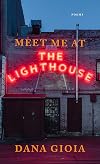
Summary: A collection of poems reflecting memories of people from several generations as well as the places of Gioia’s life.
I’ve suggested to others wanting to begin reading poetry to find an anthology and notice whose poetry you like and explore those poets further. Here, I am following my own advice, having encountered and liked Dana Gioia’s poetry in an anthology. And in this case, it was good advice. There was so much I connected with in these poems.
Many of these are about show more memories, typified in the opening and title poem, “Meet Me at the Lighthouse.” He recalls an old nightclub, on a foggy pier, speaks to an anonymous friend who has died, urging him to meet him there for one night of listening to some of the greats in jazz–Gerry Mulligan, Cannonball Adderly, Hampton Hawes, Stan Getz, Chet Baker, and Art Pepper. Who of us hasn’t remembered places like this and ghosts of our past and wished for ‘one more time?”
In “Three Drunk Poets” he recalls the crazy things we do in our youth. In this case, he recalls a night where, with two other poet friends in a small town, they challenged each other to keep walking until they ran out of remembered poems. They ran out of city lights before they did poems, with a coyote joining the recitation. At that, they turned around.
“Tinsel, Frankincense, and Fir” evokes memories of the Christmas season. Like many of us, his decorations are old and carry memories of Christmases past–and the ghosts of family.
Gioia evokes other ghosts. One is of an uncle, Theodore Ortiz, who joined the U.S. Merchant Marine, serving until his early death. Another is of the life and death of his great grandfather, Jesus Ortiz, and of the two boys who followed him as cowboys.
He writes several poems about Los Angeles. “Psalm and Lament for Los Angeles” paraphrases Psalm 137, setting it in the demolished places of his childhood. He asks, “What was there to sing in a strange and empty land?” His lament recalls the feelings of revisiting my home town of Youngstown and missing so many of the places of my youth–my house, my school, my church, the department store where both my father and I worked.
He also recalls the hot summer nights and the passions of the flesh so near the surface while another poem recalls the missed chances of romance.
In the final poem, “The Underworld,” Gioia joins the ranks of poets who chronicle a descent into hell. He alludes to Virgil, Dante, Senecas, Christopher Marlowe, Yeats, and T.S. Eliot. He concludes with “Disappointments” what was not there. He captures the nothingness that the Bible calls the “outer darkness.”
I found that there was a lot I could connect with in Gioia. Perhaps what I like as a relative neophyte at reading poetry is the accessibility of what he writes. Familiar verse structures and rhyme schemes. A story line. Perhaps as well in this collection, his remembering provokes my own. He recalls what is both sweet and sad in life and reminds us of how often these come together.
Now to find more of his work! show less
I’ve suggested to others wanting to begin reading poetry to find an anthology and notice whose poetry you like and explore those poets further. Here, I am following my own advice, having encountered and liked Dana Gioia’s poetry in an anthology. And in this case, it was good advice. There was so much I connected with in these poems.
Many of these are about show more memories, typified in the opening and title poem, “Meet Me at the Lighthouse.” He recalls an old nightclub, on a foggy pier, speaks to an anonymous friend who has died, urging him to meet him there for one night of listening to some of the greats in jazz–Gerry Mulligan, Cannonball Adderly, Hampton Hawes, Stan Getz, Chet Baker, and Art Pepper. Who of us hasn’t remembered places like this and ghosts of our past and wished for ‘one more time?”
In “Three Drunk Poets” he recalls the crazy things we do in our youth. In this case, he recalls a night where, with two other poet friends in a small town, they challenged each other to keep walking until they ran out of remembered poems. They ran out of city lights before they did poems, with a coyote joining the recitation. At that, they turned around.
“Tinsel, Frankincense, and Fir” evokes memories of the Christmas season. Like many of us, his decorations are old and carry memories of Christmases past–and the ghosts of family.
Gioia evokes other ghosts. One is of an uncle, Theodore Ortiz, who joined the U.S. Merchant Marine, serving until his early death. Another is of the life and death of his great grandfather, Jesus Ortiz, and of the two boys who followed him as cowboys.
He writes several poems about Los Angeles. “Psalm and Lament for Los Angeles” paraphrases Psalm 137, setting it in the demolished places of his childhood. He asks, “What was there to sing in a strange and empty land?” His lament recalls the feelings of revisiting my home town of Youngstown and missing so many of the places of my youth–my house, my school, my church, the department store where both my father and I worked.
He also recalls the hot summer nights and the passions of the flesh so near the surface while another poem recalls the missed chances of romance.
In the final poem, “The Underworld,” Gioia joins the ranks of poets who chronicle a descent into hell. He alludes to Virgil, Dante, Senecas, Christopher Marlowe, Yeats, and T.S. Eliot. He concludes with “Disappointments” what was not there. He captures the nothingness that the Bible calls the “outer darkness.”
I found that there was a lot I could connect with in Gioia. Perhaps what I like as a relative neophyte at reading poetry is the accessibility of what he writes. Familiar verse structures and rhyme schemes. A story line. Perhaps as well in this collection, his remembering provokes my own. He recalls what is both sweet and sad in life and reminds us of how often these come together.
Now to find more of his work! show less
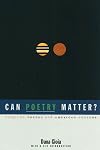
I just finished Can Poetry Matter? Essays on Poetry and American Culture (1992/2002) by Dana Gioia.
Anybody who reads contemporary poetry or even is thinking about reading contemporary poetry should read the title essay, conveniently available at this link [PDF].
Gioia starkly outlines an artistic field that has decayed. There are more schools, magazines, grants, and awards than ever for working on poetry in the USA, but American poets mainly write elliptical, egotistical lyric poems, and show more honest appraisals of poetry are almost impossible to come by.
Gioia lays out a solemn decree to write good poetry criticism, and makes good on it in the fourteen pieces that follow. He gives elegant readings of poems, particularly when it comes to favorites like Robinson Jeffers, Weldon Kees, Howard Moss, and Donald Justice. These are all really important discoveries for me. Donald Justice, for example, generates poems out of previous poetry, including nursery rhymes as in "Counting the Mad:"
This one was put in a jacket,
This one was sent home,
This one was given bread and meat
But would eat none,
And this one cried No No No No
All day long.
This one looked at the window
As though it were a wall,
This one saw things that were not there,
This one things that were,
And this one cried No No No No
All day long.
This one though himself a bird,
This one a dog,
And this one thought himself a man,
An ordinary man,
And cried and cried No No No No
All day long.
The explanation for this poem is quite basic, but it's still fun to hear Gioia say it: "The harmless market-day adventures of five childlike pigs become a nightmarish tour of an insane asylum."
Equally fun are the withering, but balanced, critiques of James Dickey's collection Puella, Margaret Atwood, and especially Robert Bly:
Bly's weaknesses as a translator underscore his central failings as a poet. He is simplistic, monotonous, insensitive to sound, enslaved by literary diction, and pompously sentimental. Morever, these are not accidental faults. They are consequences of his poetic method and they are exacerbated by his didactic impulse.
In other short pieces on the long poem, new formalism, business and poetry, Gioia strays too much from reading poems, revealing a tendency to repeat himself. Even still, Gioia's essays are as clear as SAT reading samples, each with an easy to grasp thesis.
I want to write like this, making clear, reasonable claims about the directions of art, with incisive readings of poems guiding my way. show less
Anybody who reads contemporary poetry or even is thinking about reading contemporary poetry should read the title essay, conveniently available at this link [PDF].
Gioia starkly outlines an artistic field that has decayed. There are more schools, magazines, grants, and awards than ever for working on poetry in the USA, but American poets mainly write elliptical, egotistical lyric poems, and show more honest appraisals of poetry are almost impossible to come by.
Gioia lays out a solemn decree to write good poetry criticism, and makes good on it in the fourteen pieces that follow. He gives elegant readings of poems, particularly when it comes to favorites like Robinson Jeffers, Weldon Kees, Howard Moss, and Donald Justice. These are all really important discoveries for me. Donald Justice, for example, generates poems out of previous poetry, including nursery rhymes as in "Counting the Mad:"
This one was put in a jacket,
This one was sent home,
This one was given bread and meat
But would eat none,
And this one cried No No No No
All day long.
This one looked at the window
As though it were a wall,
This one saw things that were not there,
This one things that were,
And this one cried No No No No
All day long.
This one though himself a bird,
This one a dog,
And this one thought himself a man,
An ordinary man,
And cried and cried No No No No
All day long.
The explanation for this poem is quite basic, but it's still fun to hear Gioia say it: "The harmless market-day adventures of five childlike pigs become a nightmarish tour of an insane asylum."
Equally fun are the withering, but balanced, critiques of James Dickey's collection Puella, Margaret Atwood, and especially Robert Bly:
Bly's weaknesses as a translator underscore his central failings as a poet. He is simplistic, monotonous, insensitive to sound, enslaved by literary diction, and pompously sentimental. Morever, these are not accidental faults. They are consequences of his poetic method and they are exacerbated by his didactic impulse.
In other short pieces on the long poem, new formalism, business and poetry, Gioia strays too much from reading poems, revealing a tendency to repeat himself. Even still, Gioia's essays are as clear as SAT reading samples, each with an easy to grasp thesis.
I want to write like this, making clear, reasonable claims about the directions of art, with incisive readings of poems guiding my way. show less

This is a good anthology of some of the better known short stories by some of the better known short story writers. I'd say that most students of literature have read at least two or three of these short stories at some point in their education, and they have most likely heard of the rest of the stories or else are familiar with the authors. If not, this book is a good way to gain that familiarity, since these short stories are often assumed to be a common background for people discussing show more literature.
One of the features of this book, compared to other anthologies I own or have read, is the diversity of the authors featured. There are many different ethnicities and time periods included, though there is a bias towards American writers. Presumably, the bias is because the publisher is an American company and the anthology is most likely intended for American students.
I'm not really interested in writing short stories myself or in the process of writing, but I did find the "perspectives" (short essays by the authors about writing) and the section about critical approaches to short stories to be quite interesting.
I picked this book up by chance, because it was left behind in the theatre of the museum where I work, but I am quite happy that I did. Some of the stories, such as "The Yellow Wallpaper" or "The Metamorphosis", I'd never read, but had been aware of for a very long time. I'd been intending to get around to reading them eventually but never felt like reading online versions and they weren't included in the few anthologies I had picked up. Others like Camus's "The Guest", Joyce's "The Dead", or Hemingway's "A Clean, Well-Lighted Place" were stories I had read a decade ago in high school and remembered enjoying, but had never had a version on my shelves, even though I recall them often.
Hopefully the owner of the book doesn't come to claim it in the next ten days so that I can take it home to keep instead of just reading it during slow periods at my desk. show less
One of the features of this book, compared to other anthologies I own or have read, is the diversity of the authors featured. There are many different ethnicities and time periods included, though there is a bias towards American writers. Presumably, the bias is because the publisher is an American company and the anthology is most likely intended for American students.
I'm not really interested in writing short stories myself or in the process of writing, but I did find the "perspectives" (short essays by the authors about writing) and the section about critical approaches to short stories to be quite interesting.
I picked this book up by chance, because it was left behind in the theatre of the museum where I work, but I am quite happy that I did. Some of the stories, such as "The Yellow Wallpaper" or "The Metamorphosis", I'd never read, but had been aware of for a very long time. I'd been intending to get around to reading them eventually but never felt like reading online versions and they weren't included in the few anthologies I had picked up. Others like Camus's "The Guest", Joyce's "The Dead", or Hemingway's "A Clean, Well-Lighted Place" were stories I had read a decade ago in high school and remembered enjoying, but had never had a version on my shelves, even though I recall them often.
Hopefully the owner of the book doesn't come to claim it in the next ten days so that I can take it home to keep instead of just reading it during slow periods at my desk. show less

Some really nice stuff, I thought it trailed off at the end--the "stories" section struck me as just that, unremarkable stories cut up into lines of poetry. I didn't think the last two sections, "songs" and "love" were as strong as the rest of the book either, though the final poem was the best in the book. Not a lot of poets write rhymed poetry, which makes the book as a whole special.
Lists
Awards


You May Also Like


Associated Authors
Statistics
- Works
- 69
- Also by
- 20
- Members
- 3,815
- Popularity
- #6,644
- Rating
- 3.9
- Reviews
- 29
- ISBNs
- 178
- Languages
- 1
- Favorited
- 4