
Zoé Oldenbourg (1916–2002)
Author of The Crusades
About the Author
Series
Works by Zoé Oldenbourg
SAINT-BERNARD - Le Mémorial des Siècles, établi par Gerard Walter. XIIème Siècle les Hommes. (1970) 3 copies
L'épopée des Cathédrales. 2 copies
Ridderne fra Champagne : og reisen til det forjettede land : roman (1956) — Author — 2 copies, 1 review
l'assedio a montsegur 1 copy
Nagy Katalin 1 copy
Les brulés, tome 1 1 copy
L'épopée des cathédrales 1 copy
Les brulés, tome 2 1 copy
La Pierre Angulaire II 1 copy
La Pierre Angulaire I 1 copy
L'Évêque et la vieille dame: ou La Belle-mère de Peytavi Borsier: pièce en dix tableaux et un prologue (1983) 1 copy
Kamień węgielny 1 copy
Associated Works
Tagged
Common Knowledge
- Canonical name
- Oldenbourg, Zoé
- Legal name
- Oldenburg, Zoya Sergeevna (birth)
- Other names
- Oldenbourg-Idalie, Zoé
- Birthdate
- 1916-03-31
- Date of death
- 2002-11-08
- Gender
- female
- Education
- Lycée Molière, Paris
Sorbonne, Paris, France
Académie Ranson, Paris - Occupations
- historical novelist
historian
biographer
writer - Awards and honors
- Prix Femina (1953)
Grand prix du roman de la Ville de Paris (1980)
Légion d'Honneur (Chevalier)
Ordre des Arts et des Lettres (Officier) - Short biography
- Zoé Oldenbourg was born into a family of prominent Russian scholars and scientists. Her early childhood was marked by the upheavals of the Bolshevik Revolution and the first years of Communism. Her family managed to emigrate in 1925 to Paris, where Zoé obtained her baccalauréat diploma from the Lycée Molière. She went on to attend the Sorbonne and then studied painting at the Académie Ranson. During World War II, she supported herself by making hand-painted scarves. Although her original intention was to become an artist, Zoé was encouraged to write by her father, a journalist, and she published her first novel, Argiles et cendres (translated as The World Is Not Enough), in 1946. She wrote her first works in Russian and later almost exclusively in French. In 1948, she married Heinric Idalovici and the couple had two children. Zoé Oldenbourg was highly acclaimed for her scholarship and her deep emotional feeling for the Middle Ages that made her books so lively and readable. Her books were bestsellers and several won prestigious prizes. She also wrote an autobiography, Visages d'un autoportrait (Faces of a Self-Portrait) in 1977.
- Nationality
- France
Russia (birth) - Birthplace
- Petrograd, Russian Empire (today, Saint Petersburg, Russia)
- Places of residence
- Paris, France
England, UK - Place of death
- Boulogne-Billancourt, France
- Burial location
- Cimetière de l'Ouest, Boulogne-Billancourt, Hauts-de-Seine, France
- Associated Place (for map)
- France
Members
Reviews

Friendly reminder that the Catholic Church was and is an absolute abomination of an organization:
“Before the Albigensian Crusade and the inquisition, bishops and abbots still raised their voices in protest against the burning of heretics, and preached compassion towards such strayed brethren. In the thirteen century, however, St Thomas Aquinas justified such autos-da-fé in terms that are ill-suited to any Christian. Excesses that could previously be attributed to ignorance or the brutal show more mores of the period were now given the stamp of approval, consecrated ex cathedra theologica by one of the greatest philosophers of Christianity. This fact is too serious to be minimized. From the thirteenth century onwards we no longer find saint or doctor in the Catholic Church bold enough to assert (as for instance St Hildegarde had done in the twelfth century) that a man who errs in religious matters is still one of God’s creatures, and that to deprive him of his life is a crime. The Church which so resolutely forgot this very simple truth no longer deserved the title of ‘Catholic’; in this sense we may claim that heresy had dealt the Church a blow from which it never recovered.
The victory was bought at too great a price. Even if the Roman Church, by taking the strong line against heresy that she did, spared Western Christendom grave troubles which might have brought the whole social and cultural structure crashing down in ruins—and this is by no means certain—she only did so at the cost of a moral capitulation the consequences of which she is still suffering today.” show less
“Before the Albigensian Crusade and the inquisition, bishops and abbots still raised their voices in protest against the burning of heretics, and preached compassion towards such strayed brethren. In the thirteen century, however, St Thomas Aquinas justified such autos-da-fé in terms that are ill-suited to any Christian. Excesses that could previously be attributed to ignorance or the brutal show more mores of the period were now given the stamp of approval, consecrated ex cathedra theologica by one of the greatest philosophers of Christianity. This fact is too serious to be minimized. From the thirteenth century onwards we no longer find saint or doctor in the Catholic Church bold enough to assert (as for instance St Hildegarde had done in the twelfth century) that a man who errs in religious matters is still one of God’s creatures, and that to deprive him of his life is a crime. The Church which so resolutely forgot this very simple truth no longer deserved the title of ‘Catholic’; in this sense we may claim that heresy had dealt the Church a blow from which it never recovered.
The victory was bought at too great a price. Even if the Roman Church, by taking the strong line against heresy that she did, spared Western Christendom grave troubles which might have brought the whole social and cultural structure crashing down in ruins—and this is by no means certain—she only did so at the cost of a moral capitulation the consequences of which she is still suffering today.” show less

I remember reading Oldenbourg's "The Crusades" for a tenth grade history presentation (late 1990s) and was quickly drawn into the socio-political portrait created by the author, the first history book to have ever interested me so thoroughly. Having forgotten the author's name (and with the plethora of other works with similar titles) I was unable to relocate it for years despite scouring the internet. It was only through LibraryThing that I was able to find it again by recognizing the show more original book cover design from the 1966 edition. Here, Oldenbourg is a very accessible writer. Some of the events described, such as the Children's Crusade, might be out of date in the face of more recent research. But on the whole, this account of the crusades manages to weave together various figures, their personal backgrounds and motivations, and how they fit into the overall history of the period. To this day I can vividly recall the imagery the author invoked when describing Emperor Alexius looking out upon the host of the western european forces arriving at Constantinople and realizing by their numbers that his request for aid against the border incursions of the Seljuk Turks had been used as a pretext to advance through his territory and to conquer Jerusalem. This is one of the most engaging historical texts I have read. show less

Heirs to the Kingdom by Zoe Oldenbourg is a pretty fascinating read, a tale of a young French couple who get caught up in the First Crusade after hearing a charismatic sermon by Peter the Hermit. At the point I am at, they have taken the Cross and are bout to embark on their long trip to Jerusalem. From what I know of the People's Crusade it's all going to end rather badly. Some might consider this a dry read, but Oldenbourg writes with such a strange, dream-like intensity that you can't show more help but get caught up. I don't know much about the genre "magical realism" but I think that's the kind of duck I'm plucking here. There is little attention paid to linear storytelling, the present and flashbacks blend together but the narrative never becomes tedious. I must say that I'm learning quite a lot about Medieval life, particularly about the ins and outs of French weavers; there are many interesting tidbits about the garment-making industry and urban feudalism in general (such as the putting-out system of economics), what it's like to be of the poor merchant class in Tenth Century Europe. show less
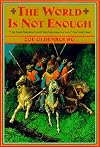
The World is Not Enough is set in France in the late 12th century. Opening with the marriage of Alis and Ansiau, the reader is immediately thrust into the lives of these characters and the time they lived in, right up through old age. The focus of the novel is on the Crusades, which Ansiau participates in, leaving Alis at home to manage the household and become a person in her own right.
The strength of the novel lies in the amount of detail with which the author provides the reader, but I show more thought that at times the detail bogged down the pace and progress of the story, making the book at least 100 pages longer than it really needed to be. We also get told a lot of things rather than have them shown to us, which made the novel much less interesting to read. The prose is also stilted, which may have more to do with the translation of the book (originally published in French) rather than the author’s actual style. In the end I found that I didn’t really like many of the characters or care about what happened to them, so I stopped reading at around 200 pages. I don't know how the author did it, but she even managed to make the Crusades seem uninteresting--and medieval history was my specialty in college. show less
The strength of the novel lies in the amount of detail with which the author provides the reader, but I show more thought that at times the detail bogged down the pace and progress of the story, making the book at least 100 pages longer than it really needed to be. We also get told a lot of things rather than have them shown to us, which made the novel much less interesting to read. The prose is also stilted, which may have more to do with the translation of the book (originally published in French) rather than the author’s actual style. In the end I found that I didn’t really like many of the characters or care about what happened to them, so I stopped reading at around 200 pages. I don't know how the author did it, but she even managed to make the Crusades seem uninteresting--and medieval history was my specialty in college. show less
Lists
Awards


You May Also Like


Associated Authors
Statistics
- Works
- 40
- Also by
- 2
- Members
- 2,029
- Popularity
- #12,665
- Rating
- 3.8
- Reviews
- 29
- ISBNs
- 106
- Languages
- 5
- Favorited
- 4