
Lois Tilton
Author of Betrayal
About the Author
Image credit: Lois Tilton
Works by Lois Tilton
The Dragonbone Flute 3 copies
Dragon's Teeth 2 copies
The Other Woman 2 copies
Lone Werewolf 1 copy
Expendable 1 copy
Pericles the Tyrant 1 copy
The Matter Of The Ahhiyans 1 copy
My Dear Madame Mina 1 copy
The Clearing 1 copy
The Enclave 1 copy
Avatar 1 copy
Associated Works
The Year's Best Science Fiction: Ninth Annual Collection (1992) — Contributor — 457 copies, 4 reviews
Bruce Coville's Book of Spine Tinglers: Tales to Make You Shiver (1996) — Author — 137 copies, 1 review
Graven Images: Fifteen Tales of Dark Magic and Ancient Myth (2000) — Contributor — 57 copies, 1 review
Women of Darkness II: More Original Horror and Dark Fantasy by Contemporary Women Writers (Tor Horror) (1990) — Contributor — 27 copies
Tagged
Common Knowledge
- Legal name
- Tilton, Lois Ann
- Birthdate
- 1946
- Gender
- female
- Occupations
- writer
- Organizations
- Science Fiction and Fantasy Writers of America
- Nationality
- USA
- Places of residence
- Glen Ellyn, Illinois, USA
- Associated Place (for map)
- Illinois, USA
Members
Reviews

I loved this book so much that I read it twice within three weeks of getting it. The story is about a Chicago vampire who wakes out of his daytime nap to discover that the entire world has gone up in a nuclear holocaust. The story then follows him as he comes across small pockets of surviving humanity that he comes to realize he must not destroy if he himself is to survive.
Tilton makes sure to paint him in as unflattering light as possible, no sparkly vampire for her. He's a cold-blooded show more killer who has munched on a human for dinner every night of his long existence, which by my calculation added up to him killing almost 60,000 people in his long vampiry life. That being said, by the time the book was through, I not only felt sympathy and pity for him, I actually really liked his character.
His trek through the American midwest during the nuclear winter that follows the bombs dropping causes him to interact with humans in a way that he's never had to before, and it changes him, but Tilton never soft sells his dark side, and the fact that he will never be free of his vampire nature. This book, and her other vampire book, Darkness on the Ice, are the two vampire books that made me truly feel the "otherness" of vampires. A really, really good book. show less
Tilton makes sure to paint him in as unflattering light as possible, no sparkly vampire for her. He's a cold-blooded show more killer who has munched on a human for dinner every night of his long existence, which by my calculation added up to him killing almost 60,000 people in his long vampiry life. That being said, by the time the book was through, I not only felt sympathy and pity for him, I actually really liked his character.
His trek through the American midwest during the nuclear winter that follows the bombs dropping causes him to interact with humans in a way that he's never had to before, and it changes him, but Tilton never soft sells his dark side, and the fact that he will never be free of his vampire nature. This book, and her other vampire book, Darkness on the Ice, are the two vampire books that made me truly feel the "otherness" of vampires. A really, really good book. show less
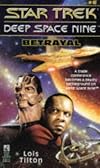
Your typical DS9 Star Trek Novel. Lots of Cardiassians and lots of Bajorans with the Federation and Starfleet in the middle getting it from both sides.
The story starts out simple enough, a bomb blows up on the station right before all these other races are set to appear so that they can negotiate trade agreements with the Bajorans. Then a Cardassian ship comes steaming into the picture, on it a representative of the party that's taken over the Cardassian government from whatever party Gul show more Dukat was in. (And they've done it pretty bloodily too). Then there's more bombs and all sorts of strife and anger.
That's one of the things that really sticks out about this book for me, it's really, really an angry novel. I don't mean in a yelling way, there tends to be a lot of yelling in DS9 novels since it was a darker series, but Tilton really gets across the rage that the Bajorans and Cardassians have for the other race and for those of their own race that they think are traitors. I don't think that I've read a book that gets the rage across quite so well. show less
The story starts out simple enough, a bomb blows up on the station right before all these other races are set to appear so that they can negotiate trade agreements with the Bajorans. Then a Cardassian ship comes steaming into the picture, on it a representative of the party that's taken over the Cardassian government from whatever party Gul show more Dukat was in. (And they've done it pretty bloodily too). Then there's more bombs and all sorts of strife and anger.
That's one of the things that really sticks out about this book for me, it's really, really an angry novel. I don't mean in a yelling way, there tends to be a lot of yelling in DS9 novels since it was a darker series, but Tilton really gets across the rage that the Bajorans and Cardassians have for the other race and for those of their own race that they think are traitors. I don't think that I've read a book that gets the rage across quite so well. show less
Seriously, what is it about Deep Space Nine novels and Odo going off to catch a murderer. We are at the sixth Deep Space Nine book and so far each and every one of them has a murderer loose in the station and Odo out to catch him. Fortunately this is not the case in the television series: in fact I am up to episode 12 of the first season, and yes there have been murderers, but not every episode, and not with Odo investigating every one (in fact the one episode about a murderer has Odo show more excluded on the grounds that they believe that he is the culprit).
Anyway, I do find the show interesting to watch, particularly since they bring the Ferengi to the forefront and we learn more about their culture and society. In a way we question whether such a society can exist, let alone reach the stars, particularly since it is all about wheeling and dealing and getting ahead of the pack. One wonders how such a race could survive and succeed, as well as bringing about order to enable the construction of a starship. The only thing I can think of is that the Ferengi know about capital and also know about labour. I suspect (and it is not evident in the series) that the Ferengi are probably a slave owing society that also has a feudal structure about it as well.
I guess Star Trek does not really go too deep into somantics here. Okay, I have written a lot about the unrealism of the Federation, and in a way it does not stop there. For instance in one of the movies, First Contact, we have the Federation developing the warpdrive and thus bringing the Vulcans to Earth to see if they are ready to join the Federation. It is suggested that planets are only allowed to have FTL (faster than light) travel if they are mature enough to traverse space. However that turns out not to be the case, especially when we consider the traditional bad races such as the Klingons and the Romulans, or even some of the newer races such as the Cardassians and the Ferengi.
One of the interesting things that I have noticed watching the series recently is the uncanny prescience with regards to computer technology. As I sit here playing with my smartphone (I don't own a tablet, and do not see the need to own one) I notice that this series, and even the earlier series, uses computers that are uncannily similar. They all have their little pads with touch screens, and all of the computers on the station use touch screens as well. These days we still have keyboards and mice, but with the development of the smartphone that is changing. However, the thing that catches me is that we usually develop the big first and the miniaturise it. However the opposite has happened with smartphones, because the tablet came out later, and we still don't have touch screens for out PCs (well, we do now, but not when this was written). show less
Anyway, I do find the show interesting to watch, particularly since they bring the Ferengi to the forefront and we learn more about their culture and society. In a way we question whether such a society can exist, let alone reach the stars, particularly since it is all about wheeling and dealing and getting ahead of the pack. One wonders how such a race could survive and succeed, as well as bringing about order to enable the construction of a starship. The only thing I can think of is that the Ferengi know about capital and also know about labour. I suspect (and it is not evident in the series) that the Ferengi are probably a slave owing society that also has a feudal structure about it as well.
I guess Star Trek does not really go too deep into somantics here. Okay, I have written a lot about the unrealism of the Federation, and in a way it does not stop there. For instance in one of the movies, First Contact, we have the Federation developing the warpdrive and thus bringing the Vulcans to Earth to see if they are ready to join the Federation. It is suggested that planets are only allowed to have FTL (faster than light) travel if they are mature enough to traverse space. However that turns out not to be the case, especially when we consider the traditional bad races such as the Klingons and the Romulans, or even some of the newer races such as the Cardassians and the Ferengi.
One of the interesting things that I have noticed watching the series recently is the uncanny prescience with regards to computer technology. As I sit here playing with my smartphone (I don't own a tablet, and do not see the need to own one) I notice that this series, and even the earlier series, uses computers that are uncannily similar. They all have their little pads with touch screens, and all of the computers on the station use touch screens as well. These days we still have keyboards and mice, but with the development of the smartphone that is changing. However, the thing that catches me is that we usually develop the big first and the miniaturise it. However the opposite has happened with smartphones, because the tablet came out later, and we still don't have touch screens for out PCs (well, we do now, but not when this was written). show less

An allegory about graduate school. Fun in a grim way.
Lists
Awards


You May Also Like


Associated Authors
Statistics
- Works
- 25
- Also by
- 39
- Members
- 933
- Popularity
- #27,526
- Rating
- 3.5
- Reviews
- 8
- ISBNs
- 19
- Languages
- 2
- Favorited
- 3
