
Dan Barker
Author of Godless: How an Evangelical Preacher Became One of America's Leading Atheists
About the Author
Dan Barker is co-president of the Freedom From Religion Foundation and co-host of Freethought Radio.
Image credit: Photo of Dan Barker, by Brent Nicastro - http://brentnicastrophotography.com/
Works by Dan Barker
Godless: How an Evangelical Preacher Became One of America's Leading Atheists (2008) 590 copies, 10 reviews
Free Will Explained: How Science and Philosophy Converge to Create a Beautiful Illusion (2018) 24 copies, 2 reviews
Associated Works
Parenting Beyond Belief: On Raising Ethical, Caring Kids Without Religion (2007) — Contributor — 345 copies, 11 reviews
The Founding Myth: Why Christian Nationalism Is Un-American (2019) — Preface, some editions — 314 copies, 6 reviews
Stubborn Light: The Best Of The Sun, Volume III - A collection of writings from the second decade of the Sun (2000) — Contributor — 39 copies
Perfidious Proverbs and Other Poems: A Satirical Look at the Bible (Gateway Bookshelf) (2011) — Foreword — 20 copies
Tagged
Common Knowledge
- Other names
- Barker, Daniel E.
- Birthdate
- 1949-06-25
- Gender
- male
- Education
- Azusa Pacific University (Religion)
- Occupations
- preacher (1965-1984)
evangelist (1965-1984)
musician
composer - Organizations
- Freedom From Religion Foundation (co-president)
Lenape Tribe
Freethought Radio - Relationships
- Gaylor, Annie Laurie (spouse)
- Nationality
- Lenape Nation
USA - Birthplace
- Santa Monica, California, USA
- Places of residence
- Madison, Wisconsin, USA
- Associated Place (for map)
- USA
Members
Reviews
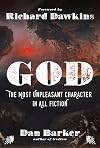
Although most books like Dan Barker’s God: The Most Unpleasant Character in All Fiction are almost exclusively read by skeptics, agnostics, and atheists, it most certainly should be read by believers. An interesting forward by Richard Dawkins connects this book with Dawkins’ best seller, The God Delusion, and Barker begins his introduction with a quote from Chapter Two of God Delusion>/i>, “The God of the old Testament is arguably the most unpleasant character in all fiction: jealous show more and proud of it; a petty, unjust, unforgiving control freak; a vindictive, bloodthirsty ethnic cleanser; a misogynistic, homophobic, racist, infanticidal, genocidal, filicidal, pestilential, megalomaniacal, sadomasochistic, capricious malevolent bully” (1).
Strident yes, but Barker then breaks down each of these charges with extensive quotes from the Bible. Every rational, literate, and open-minded person – regardless of beliefs – should exam this collection and think about what they truly know as completely separate from what one believes. Belief should be a personal and private set of vies of life, death, and everything we experience in between. Knowledge is entirely another matter. If you can read this and come away with your belief system intact, fine. If you reject all of Barker and Dawson, also fine, but perhaps you might learn one lesson and that I take from Matthew 6:5-6, “And when thou prayest, thou shalt not be as the hypocrites are: for they love to pray standing in the synagogues and in the corners of the streets, that they may be seen of men. Verily, I say unto you, They have their reward (5). “But thou, when thou prayest, enter into thy closet, and when thou hast shut thy door, pray to thy Father which is in secret: and thy Father which seeth in secret shall reward they openly” (6). Amen.
--Jim, 5/10/16 show less
Strident yes, but Barker then breaks down each of these charges with extensive quotes from the Bible. Every rational, literate, and open-minded person – regardless of beliefs – should exam this collection and think about what they truly know as completely separate from what one believes. Belief should be a personal and private set of vies of life, death, and everything we experience in between. Knowledge is entirely another matter. If you can read this and come away with your belief system intact, fine. If you reject all of Barker and Dawson, also fine, but perhaps you might learn one lesson and that I take from Matthew 6:5-6, “And when thou prayest, thou shalt not be as the hypocrites are: for they love to pray standing in the synagogues and in the corners of the streets, that they may be seen of men. Verily, I say unto you, They have their reward (5). “But thou, when thou prayest, enter into thy closet, and when thou hast shut thy door, pray to thy Father which is in secret: and thy Father which seeth in secret shall reward they openly” (6). Amen.
--Jim, 5/10/16 show less
This short book is a great reminder that morality is less complex, and more dependent on our cooperative instincts and on reason, than most people suppose. It’s also a reminder that reason is not a thing, but rather a function of the brain, and to be a fully aware and functioning moral agent requires the use of reason and the freedom to choose.
The book also shows how morality cannot come from religion, as very few people follow every teaching within the Bible or claim to be biblical show more literalists. The decision as to which parts of the Bible are moral and which are not (stoning homosexuals to death comes to mind as a teaching that is most definitely not moral) obviously cannot come from within the Bible but rather comes from modern moral sensibility applied via reason.
The better way to think about moral problems is in terms of the harm principle, which directs our actions towards the avoidance of unnecessary suffering. In fact, the parts of the Bible we reject almost always violate the harm principle while the ones we accept always abide by the harm principle.
Barker does a great job of elaborating on these points, showing how our three moral minds operate (instinct, reason, and law), and explaining how religion gets in the way of moral progress. show less
The book also shows how morality cannot come from religion, as very few people follow every teaching within the Bible or claim to be biblical show more literalists. The decision as to which parts of the Bible are moral and which are not (stoning homosexuals to death comes to mind as a teaching that is most definitely not moral) obviously cannot come from within the Bible but rather comes from modern moral sensibility applied via reason.
The better way to think about moral problems is in terms of the harm principle, which directs our actions towards the avoidance of unnecessary suffering. In fact, the parts of the Bible we reject almost always violate the harm principle while the ones we accept always abide by the harm principle.
Barker does a great job of elaborating on these points, showing how our three moral minds operate (instinct, reason, and law), and explaining how religion gets in the way of moral progress. show less
Dan Barker's semi-autobiographical critique of religion came into my life years ago at the same time I began asking the hard questions about the nature of existence, the universe and everything. To say that Losing Faith in Faith influenced me would be an understatement—more accurately, it fueled the flame that steered me away from dogmatic belief once and for all.
Barker's writing is clever, replete with humor and a pure joy to read for anyone wrestling with the illogicality of belief. He show more can no longer take religion seriously so you see that he's just laughing at the absurdity of it all.
In the mid-2000's Losing Faith was updated for a newly-energized freethought market, and the result was 2008's Godless. The new edition is worth checking out since it goes into further detail on most of the subjects first printed here, but I still prefer this version. show less
Barker's writing is clever, replete with humor and a pure joy to read for anyone wrestling with the illogicality of belief. He show more can no longer take religion seriously so you see that he's just laughing at the absurdity of it all.
In the mid-2000's Losing Faith was updated for a newly-energized freethought market, and the result was 2008's Godless. The new edition is worth checking out since it goes into further detail on most of the subjects first printed here, but I still prefer this version. show less
It's hard to imagine a more fervent believer than Dan Barker, a born-again Evangelical preacher and missionary from the age of 17. You might expect he'd be the least likely to lose his faith, but lose it he did -- from coming out as an atheist on Oprah in 1984 to becoming co-president of the Freedom from Religion Foundation. The initial autobiographical portion of the book eventually gives way to both philosophical arguments (e.g., how a being cannot be simultaneously both infinitely show more merciful and infinitely just), appeals to logic, and detailed descriptions of biblical inaccuracies and contradictions that refute the idea that it is the word of an omniscient, divine being.
I listen occasionally to the FFRF's weekly podcasts, but I'm not a particular fan of Barker as a host. I find his smug personality and flat humor rather off-putting and, while he's admittedly a gifted musician, I find most of his compositions almost unbearably corny. If it weren't for the show's fascinating guest interviews I wouldn't be listening at all. That said, Barker is much more likable and convincing on paper, and I wholeheartedly recommend this book. I enjoyed the philosophical reasoning, and I was also particularly fond of the chapter titled 'Dear Theologian,' a monologue of existential questioning directed from God to his human creation. show less
I listen occasionally to the FFRF's weekly podcasts, but I'm not a particular fan of Barker as a host. I find his smug personality and flat humor rather off-putting and, while he's admittedly a gifted musician, I find most of his compositions almost unbearably corny. If it weren't for the show's fascinating guest interviews I wouldn't be listening at all. That said, Barker is much more likable and convincing on paper, and I wholeheartedly recommend this book. I enjoyed the philosophical reasoning, and I was also particularly fond of the chapter titled 'Dear Theologian,' a monologue of existential questioning directed from God to his human creation. show less
Lists
You May Also Like


Associated Authors
Statistics
- Works
- 22
- Also by
- 6
- Members
- 1,281
- Popularity
- #20,020
- Rating
- 3.9
- Reviews
- 33
- ISBNs
- 40
- Languages
- 4

