

Darrell Huff (1913–2001)
Author of How to lie with statistics
About the Author
Works by Darrell Huff
Associated Works
Tagged
Common Knowledge
- Canonical name
- Huff, Darrell
- Birthdate
- 1913-07-15
- Date of death
- 2001-06-27
- Gender
- male
- Education
- University of Iowa (BA|1938|MA|1939)
- Occupations
- editor
writer - Organizations
- Central Coast CoHousing
Better Homes and Gardens
Liberty Magazine - Nationality
- USA
- Birthplace
- Gowrie, Iowa, USA
- Places of residence
- Gowrie, Iowa, USA (birthplace)
Carmel, California, USA - Place of death
- Carmel, California, USA
- Associated Place (for map)
- California, USA
Members
Reviews
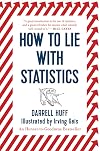
Huff's short book/ long pamphlet is tandard reading before you pass the Writing Requirement at my undergrad school (Marlboro College). Unlike Strunk & White's _Elements of Style_, it is not brilliantly written. However, it amusingly and very clearly illustrates Twain's (?) quote:
There are three kinds of lies: lies, damned lies, and statistics.
You'll never be swayed by numbers in an article again without checking out their stats methodology.
There are three kinds of lies: lies, damned lies, and statistics.
You'll never be swayed by numbers in an article again without checking out their stats methodology.
What catches you first is its title. What keeps you in it are the examples, humor, and illustrations. Yes, it is somewhat dated, but certainly not outdated and is still relevant -- possibly more than ever with the lifetimes-worth of content on the web. Reading this book will help you sniff out the bad stuff so you can focus on the information that counts.
The main theme is fairly simple: don't take a number at face value -- there's chicanery afoot. Yes, people want to win arguments and make show more gains. It turns out numbers help with this. Even if there isn't an element of chicanery (the word's used a lot in the book), clumsiness or carelessness can still lead to false conclusions, and each chapter describes a mischievous tactic for twisting a number to come to those conclusions.
There aren't too many pages and the lessons are invaluable. Take a few hours to read this and keep the lessons in your frontal lobe when you meet numbers supporting conclusions. show less
The main theme is fairly simple: don't take a number at face value -- there's chicanery afoot. Yes, people want to win arguments and make show more gains. It turns out numbers help with this. Even if there isn't an element of chicanery (the word's used a lot in the book), clumsiness or carelessness can still lead to false conclusions, and each chapter describes a mischievous tactic for twisting a number to come to those conclusions.
There aren't too many pages and the lessons are invaluable. Take a few hours to read this and keep the lessons in your frontal lobe when you meet numbers supporting conclusions. show less

For a book to remain in print for fifty years it must be good. This one was originally published in 1954 and, as far as I can tell, has been in print ever since. A book less than 150 pages long, generously seeded with amusing cartoons is not what you would expect to find on a graduate school reading list but that is exactly where I learned about this one. Darrell Huff and illustrator Irving Geis produced a little marvel with their book “How to Lie with Statistics”. As Huff points out show more early in the book a cat-burglar who writes a how-to memoir in prison does not do it for other cat-buglers. They already know how to burgle. The intended audience is people who do not want to be burgled, or, in the case of this book, lied to.
Huff is careful to spread the blame for lying statistics widely, overeager researchers, poor information gathering by statisticians, advertising people willing to apply lipstick of any color to their pig, journalists looking for a marketable story. The fact that most of these lies are “true” is not ignored. For me the most memorable story he uses to make this clear is the restauranteur who explains his rabbit-burger is 50% rabbit, he mixes it in a 1 to 1 ratio with horse-meat. One rabbit to one horse.
After nine chapters of explaining how easy it is for statistics, charts, graphs, and percentages to lie the last chapter makes a serious attempt to explaining how we can avoid being lied to by asking a few simple questions like, who says so, how does he know, what’s missing, and does it make sense. As Huff points out it is important to be able to detect these lies, not just because of misleading advertisements but because we have elections every few years.
As an amateur historian who is just a few years younger than this book I have to admit I enjoyed the window into the past that the many cartoons offered. Yes, we really dressed and smoked like that. The books age was a little disconcerting when Huff dissected an article about the income of the “average” Yale graduate. Going to Yale hardly seemed worth the $25,000 income it offered until I ran it through an inflation calculator, then it made sense. This book is one of the most informative and fun books I have read in a long, long time. It was informative not because I know nothing about statistics, I do, it was informative because nether of the classes I have taken on statistics covered how easy it is to miss-use or misunderstand exactly what it is the numbers say. If you do not like being lied to, consider reading this book. show less
Huff is careful to spread the blame for lying statistics widely, overeager researchers, poor information gathering by statisticians, advertising people willing to apply lipstick of any color to their pig, journalists looking for a marketable story. The fact that most of these lies are “true” is not ignored. For me the most memorable story he uses to make this clear is the restauranteur who explains his rabbit-burger is 50% rabbit, he mixes it in a 1 to 1 ratio with horse-meat. One rabbit to one horse.
After nine chapters of explaining how easy it is for statistics, charts, graphs, and percentages to lie the last chapter makes a serious attempt to explaining how we can avoid being lied to by asking a few simple questions like, who says so, how does he know, what’s missing, and does it make sense. As Huff points out it is important to be able to detect these lies, not just because of misleading advertisements but because we have elections every few years.
As an amateur historian who is just a few years younger than this book I have to admit I enjoyed the window into the past that the many cartoons offered. Yes, we really dressed and smoked like that. The books age was a little disconcerting when Huff dissected an article about the income of the “average” Yale graduate. Going to Yale hardly seemed worth the $25,000 income it offered until I ran it through an inflation calculator, then it made sense. This book is one of the most informative and fun books I have read in a long, long time. It was informative not because I know nothing about statistics, I do, it was informative because nether of the classes I have taken on statistics covered how easy it is to miss-use or misunderstand exactly what it is the numbers say. If you do not like being lied to, consider reading this book. show less
Don't believe anything!
This fast little read does an amazing job uncovering the methods of presenting misleading statistics. This book was first published in 1954, but it reads as fresh as ever. People with axes to grind have been employing the same subversive tactics since statistics have been popularized. Furthermore, this book is often funny, hilarious even, particularly with the illustrations. The "claim to fame" statistic on the cover is an almost certainly deliberate illustration of show more ironic contempt for misleading statistics. After all, just because "Twighlight" was a bigger seller than "Anna Karenina" doesn't make it better. show less
This fast little read does an amazing job uncovering the methods of presenting misleading statistics. This book was first published in 1954, but it reads as fresh as ever. People with axes to grind have been employing the same subversive tactics since statistics have been popularized. Furthermore, this book is often funny, hilarious even, particularly with the illustrations. The "claim to fame" statistic on the cover is an almost certainly deliberate illustration of show more ironic contempt for misleading statistics. After all, just because "Twighlight" was a bigger seller than "Anna Karenina" doesn't make it better. show less
Lists
Awards


You May Also Like


Associated Authors
Statistics
- Works
- 14
- Also by
- 1
- Members
- 3,441
- Popularity
- #7,388
- Rating
- 3.9
- Reviews
- 63
- ISBNs
- 36
- Languages
- 10
- Favorited
- 1