
J. G. Farrell (1935–1979)
Author of The Siege of Krishnapur
About the Author
Series
Works by J. G. Farrell
A man from elsewhere 1 copy
Tagged
Common Knowledge
- Legal name
- Farrell, James Gordon
- Birthdate
- 1935-01-25
- Date of death
- 1979-08-11
- Gender
- male
- Education
- University of Oxford (Brasenose College|BA|1960)
Rossall School, Fleetwood, Lancashire, England, UK - Occupations
- teacher
novelist - Relationships
- Farrell, William (father)
- Cause of death
- drowning
- Nationality
- UK
- Birthplace
- Liverpool, Lancashire, England, UK
- Places of residence
- Kilcrohane, County Cork, Ireland
London, England, UK
Dublin, Ireland - Place of death
- Bantry Bay, County Cork, Ireland
- Burial location
- Cemetery of St. James' Church of Ireland, Durrus, County Cork, Ireland
- Map Location
- England, UK
Members
Discussions
December 2022: J. G. Farrell in Monthly Author Reads (May 2023)
Group Read, December 2019: The Singapore Grip in 1001 Books to read before you die (December 2019)
Group Read, September 2015: Troubles in 1001 Books to read before you die (September 2015)
Troubles by J.G. Farrell: A Memorial Group Read in Honor of JanetinLondon in 75 Books Challenge for 2012 (April 2012)
Reviews

When I was 16 or 17 we read Catch-22 in English class and because I was a 16 or 17 year-old boy — and because it's brilliant — I loved it. My enthusiasm must have been palpable because my teacher gave me a copy of J.G. Farrell's The Siege of Krishnapur, set in a fictional colonial outpost during the Indian Rebellion (or "Mutiny" as she would have said) of 1857, and suggested I do a compare-and-contrast on the two novels. I probably wrote about how a rich vein of black-comic absurdity show more runs through both of them, and how they're both about people going mad in confined spaces — an army base in one, a colonial cantonment in the other — in the midst of death and indecency. I probably didn't make much of Siege's discussion of the nature of civilisation and the relative worth of faith and reason, words and deeds, and definitely not of its unflinching post-mortem of the (British) colonial project. (Incidentally I think Catch-22 can also be read through a colonial lens). I don't remember being quite as smitten with Siege as with Catch back then, perhaps because it forwent the cartoon anarchy and balls-to-the-wall yank attitude of the latter in favour of a more phlegmatic, British kind of humour. But I did enjoy it, and doing so made me feel grown-up in a way a book hadn't before.
Since then I've read each of Farrell's so-called "Empire trilogy" — of which Siege is the second and shortest — twice, and I'm convinced that his misadventurous death at 44 (slipped on rocks while angling) deprived English lit. of an unknown but non-zero number of masterpieces. I love his controlled raconteurism, his way of telling a story as if he were sitting by you telling you his story without any intermediate bookish artifice. This isn't to say that his prose is ordinary or plain, just that it's always a medium, never the message itself. It takes courage, I think, to write this kind of prose, but it brings a detachment to the narrative that's essential for its overarching irony, verging on mordancy, to be effective. Irony is Farrell's principal mode; he delights in all kinds of irony, especially unsubtle ones. Troubles and The Singapore Grip both evolve into siege-type situations, too, but it's here that all the glorious gradual disintegrations of dignity — disease, distress, dirt, famine — that go with being besieged are displayed to their fullest.
The broader canvases of Troubles and The Singapore Grip allow for more character development, but even in the course of the relatively punchy Siege we see one character lose his faith in reason (or at least in progress, civilisation, "ideas" as the Collector dismisses it all in the story's coda) while another, the fresh-off-the-boat Fleury, is perversely transformed by the barbarous crucible of the siege from a moon-faced dreamer into an emblem of Victorian (Christian) rationality who tinkers fondly with an experimental 15-barrelled pistol. This is one of the ironies of Empire, and especially of its chief architects the Victorians, that interests Farrell — how its tenet of divine providence, of the White man's dominion over God's creation, was antithetical to the original Garden of Eden setup. Faith trumps reason when the senior of the camp's two doctors, vehement in his erroneous espousal of an airborne vector for cholera, wins most of the population to his side in his debate with the logical, softer-spoken, Scottish, and correct Dr McNab through a combination of his seniority, Englishness, and vehemence. But reason (or at any rate civilisation and "ideas") trumps faith when an electro-metal head of Shakespeare, detached from a statue and shot from a cannon, takes out a swath of besiegers:
"...it had scythed its way through a whole astonished platoon of sepoys advancing in single file through the jungle. The Collector suspected that the Bard's success in this respect might have a great deal to do with the ballistic advantages stemming from its baldness."
Keats's lavishly-coiffured noggin fares less well, and Voltaire's only succeeds in jamming the gun. show less
Since then I've read each of Farrell's so-called "Empire trilogy" — of which Siege is the second and shortest — twice, and I'm convinced that his misadventurous death at 44 (slipped on rocks while angling) deprived English lit. of an unknown but non-zero number of masterpieces. I love his controlled raconteurism, his way of telling a story as if he were sitting by you telling you his story without any intermediate bookish artifice. This isn't to say that his prose is ordinary or plain, just that it's always a medium, never the message itself. It takes courage, I think, to write this kind of prose, but it brings a detachment to the narrative that's essential for its overarching irony, verging on mordancy, to be effective. Irony is Farrell's principal mode; he delights in all kinds of irony, especially unsubtle ones. Troubles and The Singapore Grip both evolve into siege-type situations, too, but it's here that all the glorious gradual disintegrations of dignity — disease, distress, dirt, famine — that go with being besieged are displayed to their fullest.
The broader canvases of Troubles and The Singapore Grip allow for more character development, but even in the course of the relatively punchy Siege we see one character lose his faith in reason (or at least in progress, civilisation, "ideas" as the Collector dismisses it all in the story's coda) while another, the fresh-off-the-boat Fleury, is perversely transformed by the barbarous crucible of the siege from a moon-faced dreamer into an emblem of Victorian (Christian) rationality who tinkers fondly with an experimental 15-barrelled pistol. This is one of the ironies of Empire, and especially of its chief architects the Victorians, that interests Farrell — how its tenet of divine providence, of the White man's dominion over God's creation, was antithetical to the original Garden of Eden setup. Faith trumps reason when the senior of the camp's two doctors, vehement in his erroneous espousal of an airborne vector for cholera, wins most of the population to his side in his debate with the logical, softer-spoken, Scottish, and correct Dr McNab through a combination of his seniority, Englishness, and vehemence. But reason (or at any rate civilisation and "ideas") trumps faith when an electro-metal head of Shakespeare, detached from a statue and shot from a cannon, takes out a swath of besiegers:
"...it had scythed its way through a whole astonished platoon of sepoys advancing in single file through the jungle. The Collector suspected that the Bard's success in this respect might have a great deal to do with the ballistic advantages stemming from its baldness."
Keats's lavishly-coiffured noggin fares less well, and Voltaire's only succeeds in jamming the gun. show less

Drawing upon the history of the Indian Mutiny in 1857, J.G. Farrell once again turns his razor sharp wit upon the British justification of their colonial policy. In [The Siege of Krishnapur] which he loosely based on the sieges of Lucknow and Cawnpore, he gives us a dramatically vivid account of a well mixed group of unique characters as they are trapped in the Company residency for a number of months holding the mutineers at bay.
While these people are plunged into danger and despair, we show more also are treated to their inner thoughts and justification for being in India and, from missionary zeal to actually believing that the British were improving the life of native Indians through medicine and science, we also see how effortlessly these same people hold themselves above the native population, fully confident in their superiority.
Beautifully written with his trademark ironic warmth, this is the middle book of his Empire Trilogy. J.G. Farrell is indeed an author of great skill as he delivers a suspenseful story, yet still manages to convey the political and human consequences of the British Colonial rule. The story is interesting and gut-wrenching while the political background is fascinating, I highly recommend this book. show less
While these people are plunged into danger and despair, we show more also are treated to their inner thoughts and justification for being in India and, from missionary zeal to actually believing that the British were improving the life of native Indians through medicine and science, we also see how effortlessly these same people hold themselves above the native population, fully confident in their superiority.
Beautifully written with his trademark ironic warmth, this is the middle book of his Empire Trilogy. J.G. Farrell is indeed an author of great skill as he delivers a suspenseful story, yet still manages to convey the political and human consequences of the British Colonial rule. The story is interesting and gut-wrenching while the political background is fascinating, I highly recommend this book. show less

I need to preface this review by stating that the conclusion of The Siege of Krishnapur is one of most powerful bits of writing I’ve ever read. I found it oddly moving and deeply affecting. Part Four of this novel forced me to go back and reconsider all of my opinions about the rest of the book. It was almost enough to cause me to write a very different review than what follows.
Of course, the relevant word in that sentence is “almost”...
I had some real trouble getting into this book. show more It didn’t manage to fully engage me until I was several pages into Part Two – and that's just because I like a good war story. Getting through Part One was a chore. At least Parts Two & Three read quickly.
I think I may be the only person who likes Farrell’s novel Troubles better than this one.
Which is strange when you consider how incredibly well written The Siege of Krishnapur is! I completely understand why it won the Booker. It’s a wonderfully accomplished work! In fact, I would go so far as to say that it’s better written than Troubles. Or, maybe more accurately, the contrast between the two novels illustrates what a talented writer Farrell really is. The style, tone, and atmosphere of each is so different! It always impresses me when a writer can command such various authorial voices to great effect.
I think the best way to explain my problem with Siege is to cite one of the reviews from the dust jacket on the copy I read:
“A suggestion made by T. S. Eliot, about the possibility of constructing a work of art on two levels with very different kinds of appeal, has been brilliantly used in The Siege of Krishnapur.” – Julian Symons, The Sunday Times
This novel is absolutely masterful on one level – it’s a brilliant critique of Victorian attitudes and culture during the autumn years of the British Empire. It’s subtle, incisive, unmerciful, and historically apt – just the way I like my satire!
Where it fails for me is on the other level, the level of story. I never cared about any of the characters. I understand that their function is to embody the worldview and culture being criticized – but there’s a fine line between using characters as negative examples and making them largely unsympathetic. Exemplars of the Culture they may be – but they still have to be people living in the world. They still need to function as characters in the story.
I liked Miriam – she seems like the kind of woman who will shortly get the Suffrage Movement underway – but so little of the story is told from her point of view. I suppose the Collector is the most sympathetic character, as he’s the only one who comes to question his previously held imperialistic view of India, as well as his faith in Science and Progress, to any great extent – but he’s still an overbearing, misogynistic, Victorian patriarch. I found the characters in this novel pathetic. I spent the entire book wanting to slap them.
Which is a good thing, insofar as it's a testament to the ultimate effectiveness of Farrell’s cultural criticism – but it didn’t make for an enjoyable reading experience. Victorian attitudes and the culture of British Imperialism have always offended me on a deeply personal level. I don't like spending this much time immersed in them, even if it is in the service of satire. show less
Of course, the relevant word in that sentence is “almost”...
I had some real trouble getting into this book. show more It didn’t manage to fully engage me until I was several pages into Part Two – and that's just because I like a good war story. Getting through Part One was a chore. At least Parts Two & Three read quickly.
I think I may be the only person who likes Farrell’s novel Troubles better than this one.
Which is strange when you consider how incredibly well written The Siege of Krishnapur is! I completely understand why it won the Booker. It’s a wonderfully accomplished work! In fact, I would go so far as to say that it’s better written than Troubles. Or, maybe more accurately, the contrast between the two novels illustrates what a talented writer Farrell really is. The style, tone, and atmosphere of each is so different! It always impresses me when a writer can command such various authorial voices to great effect.
I think the best way to explain my problem with Siege is to cite one of the reviews from the dust jacket on the copy I read:
“A suggestion made by T. S. Eliot, about the possibility of constructing a work of art on two levels with very different kinds of appeal, has been brilliantly used in The Siege of Krishnapur.” – Julian Symons, The Sunday Times
This novel is absolutely masterful on one level – it’s a brilliant critique of Victorian attitudes and culture during the autumn years of the British Empire. It’s subtle, incisive, unmerciful, and historically apt – just the way I like my satire!
Where it fails for me is on the other level, the level of story. I never cared about any of the characters. I understand that their function is to embody the worldview and culture being criticized – but there’s a fine line between using characters as negative examples and making them largely unsympathetic. Exemplars of the Culture they may be – but they still have to be people living in the world. They still need to function as characters in the story.
I liked Miriam – she seems like the kind of woman who will shortly get the Suffrage Movement underway – but so little of the story is told from her point of view. I suppose the Collector is the most sympathetic character, as he’s the only one who comes to question his previously held imperialistic view of India, as well as his faith in Science and Progress, to any great extent – but he’s still an overbearing, misogynistic, Victorian patriarch. I found the characters in this novel pathetic. I spent the entire book wanting to slap them.
Which is a good thing, insofar as it's a testament to the ultimate effectiveness of Farrell’s cultural criticism – but it didn’t make for an enjoyable reading experience. Victorian attitudes and the culture of British Imperialism have always offended me on a deeply personal level. I don't like spending this much time immersed in them, even if it is in the service of satire. show less
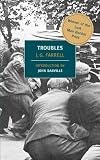
J.G. Farrell
Farrell (1935-1979) was born in Liverpool, of Irish descent. He died at 44, swept out to sea while fishing from the shore in Ireland. Farrell wrote eight novels (two published posthumously), but he is best known for the Empire Trilogy: Troubles (1970), The Siege of Krishnapur (1973), and The Singapore Grip (1978). The overarching theme of the Trilogy, which is clearly on display in Troubles, is the human and political consequences and costs of British colonial rule.
Troubles
The show more time is 1919-1921, a period of escalating anti-British and sectarian violence that slowly engulfs the protagonists. The place is the small town of Kilnalough, Ireland. The setting is the visit by Major Brendan Archer, British, to the increasingly decrepit Majestic Hotel owned by Edward Spencer, stalwart Unionist, and father of Angela whom Brendan met, and kissed, while on leave three years earlier, and with whom he had since maintained a lengthy correspondence while in the trenches and afterwards, as he recovered from shell-shock, and with whom, he might or might not, be betrothed. And so proceeds one of the saddest stories I have read, but one pulsing with wonderful descriptions of people, places, emotions, and real humour all within a historical moment of change fraught with violence and uncertainty. The tone, as John Banville describes it in his preface, is: "...one of vague, helpless desperation, while the wit is dry to the point of snapping."
The writing is a pleasure: "Thereafter the meal became lugubrious and interminable, even to the Major who thought that in hospital he had explored the very depths of boredom....The food was entirely tasteless except for a dish of very salty steamed bacon and cabbage that gave off a vague, wispy odour of humanity." And this description of the first time Brendan and Angela met: "He now only retained a dim recollection of that time, dazed as he was by the incessant, titanic thunder of artillery that cushioned it thickly, before and after. They had been somewhat hysterical--Angela perhaps feeling amid all the patriotism that she too should have something personal to lose, the Major that he should have at least one reason for surviving."
While Farrell has nothing good to portray about the British colonial experience, he is no less acerbic about the Irish whom he describes as surrendering to, "the country's vast and narcotic inertia", characterized by the stultifying hand of the church, the rigid sectarian and class divisions of society, the poverty of people on the edge of starvation while their British landlords live warm and well, the lack of education and opportunities, and above all, the enervating tribalism. Early in the novel, when the Major is told that he too will become critical of Catholics, he says, "I hope not to be so bigoted. Surely there's no need to abandon one's reason simply because one is in Ireland." The riposte is, "In Ireland you must choose your tribe. Reason has nothing to do with it."
The novel has a contemporary feel in reminding us that while techniques change, terrorism itself is not a new phenomenon: "The Major only glanced at the newspaper these days, tired of trying to comprehend a situation which defined comprehension, a war without battles or trenches....Every now and then, however, he would become aware with a feeling of shock that, for all its lack of pattern, the situation was different, and always a little worse." Farrell reminds us that Ireland was not alone in the turmoil of the time. There are frequent insertions of news articles of the day detailing clashes in Italy, Russia, Poland, India, Middle East, South Africa, all struggling with nationalist pressures and revolutions.
The nationalist and sectarian violence swells and laps at the walls of the Majestic Hotel. The reaction of the British, however dressed in high-sounding phrases, is extremely violent, thus feeding the spiral of hate and more violence that seems to offer no solution. If one stays in Ireland, there is neither escape nor neutral ground.
There is a second, major protagonist in the novel: the Majestic Hotel itself, a 300-room monster on the seaside, that in its heyday was a preferred holiday destination as the epitome of class and comfort, with numberless public rooms, outside amenities, a huge ballroom, and expansive dining room, all maintained by a small army of staff. Now it is home for a number of elderly ladies who have nowhere else to go, strangers such as the Major who come, by accident, for their own reasons or no reason at all, and occasional visitors who return for memories and are disappointed: "they would taste the bittersweet knowledge that nothing is invulnerable to growth, change and decay, not even one's most fiercely guarded memories."
The hotel is huge and it looms over the novel as well; it is the perfect metaphor for the glory of a rich lifestyle for those in power, but now, like the brittle and waning British colonialism, it is a site of decline and decrepitude; Farrell's descriptions of the irremediable decay of the hotel and its reversion to a state of nature are brilliant.
Thinking it through, there is not a single happy person in this novel. The closest one is perhaps the elderly, irascible town doctor who looks upon everyone and everything with a stoical eye, regularly intoning that all is change, everything must pass. But this does not make for an uninteresting novel; far from it: the characters are true to the vagaries of life that continue even in the midst of turmoil; they are varied and well-drawn as they play out individual hopes and fears, generational struggles, love, lust and relationships in a very unsettled and unsettling time.
It is years since I read The Siege of Krishnapur and The Singapore Grip. I enjoyed both and having now added Troubles, I have no hesitation in recommending the trilogy for fine writing and fine stories in pointed historical fiction with strong political and social edges. show less
Farrell (1935-1979) was born in Liverpool, of Irish descent. He died at 44, swept out to sea while fishing from the shore in Ireland. Farrell wrote eight novels (two published posthumously), but he is best known for the Empire Trilogy: Troubles (1970), The Siege of Krishnapur (1973), and The Singapore Grip (1978). The overarching theme of the Trilogy, which is clearly on display in Troubles, is the human and political consequences and costs of British colonial rule.
Troubles
The show more time is 1919-1921, a period of escalating anti-British and sectarian violence that slowly engulfs the protagonists. The place is the small town of Kilnalough, Ireland. The setting is the visit by Major Brendan Archer, British, to the increasingly decrepit Majestic Hotel owned by Edward Spencer, stalwart Unionist, and father of Angela whom Brendan met, and kissed, while on leave three years earlier, and with whom he had since maintained a lengthy correspondence while in the trenches and afterwards, as he recovered from shell-shock, and with whom, he might or might not, be betrothed. And so proceeds one of the saddest stories I have read, but one pulsing with wonderful descriptions of people, places, emotions, and real humour all within a historical moment of change fraught with violence and uncertainty. The tone, as John Banville describes it in his preface, is: "...one of vague, helpless desperation, while the wit is dry to the point of snapping."
The writing is a pleasure: "Thereafter the meal became lugubrious and interminable, even to the Major who thought that in hospital he had explored the very depths of boredom....The food was entirely tasteless except for a dish of very salty steamed bacon and cabbage that gave off a vague, wispy odour of humanity." And this description of the first time Brendan and Angela met: "He now only retained a dim recollection of that time, dazed as he was by the incessant, titanic thunder of artillery that cushioned it thickly, before and after. They had been somewhat hysterical--Angela perhaps feeling amid all the patriotism that she too should have something personal to lose, the Major that he should have at least one reason for surviving."
While Farrell has nothing good to portray about the British colonial experience, he is no less acerbic about the Irish whom he describes as surrendering to, "the country's vast and narcotic inertia", characterized by the stultifying hand of the church, the rigid sectarian and class divisions of society, the poverty of people on the edge of starvation while their British landlords live warm and well, the lack of education and opportunities, and above all, the enervating tribalism. Early in the novel, when the Major is told that he too will become critical of Catholics, he says, "I hope not to be so bigoted. Surely there's no need to abandon one's reason simply because one is in Ireland." The riposte is, "In Ireland you must choose your tribe. Reason has nothing to do with it."
The novel has a contemporary feel in reminding us that while techniques change, terrorism itself is not a new phenomenon: "The Major only glanced at the newspaper these days, tired of trying to comprehend a situation which defined comprehension, a war without battles or trenches....Every now and then, however, he would become aware with a feeling of shock that, for all its lack of pattern, the situation was different, and always a little worse." Farrell reminds us that Ireland was not alone in the turmoil of the time. There are frequent insertions of news articles of the day detailing clashes in Italy, Russia, Poland, India, Middle East, South Africa, all struggling with nationalist pressures and revolutions.
The nationalist and sectarian violence swells and laps at the walls of the Majestic Hotel. The reaction of the British, however dressed in high-sounding phrases, is extremely violent, thus feeding the spiral of hate and more violence that seems to offer no solution. If one stays in Ireland, there is neither escape nor neutral ground.
There is a second, major protagonist in the novel: the Majestic Hotel itself, a 300-room monster on the seaside, that in its heyday was a preferred holiday destination as the epitome of class and comfort, with numberless public rooms, outside amenities, a huge ballroom, and expansive dining room, all maintained by a small army of staff. Now it is home for a number of elderly ladies who have nowhere else to go, strangers such as the Major who come, by accident, for their own reasons or no reason at all, and occasional visitors who return for memories and are disappointed: "they would taste the bittersweet knowledge that nothing is invulnerable to growth, change and decay, not even one's most fiercely guarded memories."
The hotel is huge and it looms over the novel as well; it is the perfect metaphor for the glory of a rich lifestyle for those in power, but now, like the brittle and waning British colonialism, it is a site of decline and decrepitude; Farrell's descriptions of the irremediable decay of the hotel and its reversion to a state of nature are brilliant.
Thinking it through, there is not a single happy person in this novel. The closest one is perhaps the elderly, irascible town doctor who looks upon everyone and everything with a stoical eye, regularly intoning that all is change, everything must pass. But this does not make for an uninteresting novel; far from it: the characters are true to the vagaries of life that continue even in the midst of turmoil; they are varied and well-drawn as they play out individual hopes and fears, generational struggles, love, lust and relationships in a very unsettled and unsettling time.
It is years since I read The Siege of Krishnapur and The Singapore Grip. I enjoyed both and having now added Troubles, I have no hesitation in recommending the trilogy for fine writing and fine stories in pointed historical fiction with strong political and social edges. show less
Lists
My TBR (3)
All Things India (1)
1970 Club (1)
Franklit (1)
Schwob Nederland (1)
Awards


You May Also Like


Associated Authors
Statistics
- Works
- 9
- Members
- 5,297
- Popularity
- #4,701
- Rating
- 4.0
- Reviews
- 160
- ISBNs
- 97
- Languages
- 7
- Favorited
- 23